Karuna Yoga Vidya Peetham Bangalore

karuna yoga vidya peetham logo

Blog

-
Blog

Yoga Mudrasana(Psychic Union Pose or Yoga Gesture)

This is known as the yoga gesture or psychic union pose. Start in padmasana, which is a seated pose with your arms intertwined and locked behind your back. Keep your eyes closed and relax, concentrating on the mooladhara chakra. Inhale and observe the breath rise from mooladhara to the ajna chakra. Hold the breath as you concentrate on the ajna chakra. Exhale and then fold forward from the hips. Bring your forehead to touch the floor as you expel all the air from your lungs. Feel as the breath moves from the ajna to the mooladhara chakra as you stay here for a few seconds concentrating on the mooladhara chakra. Now inhale and rise back up as you are aware of the breath moving from mooladhara to ajna chakra. Exhale and move your attention down to the mooladhara chakra. Try to do this entire exercise for three to ten rounds. Precaution: who suffering from sciatica, high blood pressure, pelvic inflammatory disease or any other serious abdominal ailment should avoid this practice. Benefits: Massages the abdominal organs and stretches the back.  Preparatory practice for meditation.  It relieves anger and tension, inducing tranquillity. It develops awareness and control of psychic energy and is used to awaken manipura chakra.

Read More »

Ardha Matsyendrasana (Half Lord of the Fishes Pose or Half Spinal Twist Pose)

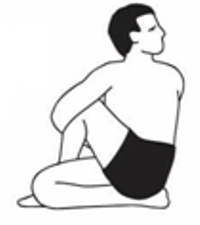
This is the half spinal twist. First sit on the floor with the legs stretched out in front of you. Bend the left knee, place it on the ground and sit in the left foot so the heel is under the left buttock. Then bend the right knee and lift the right leg and keep it by the outer side of the left thigh. The outer right ankle touches the outer left thigh. Keep the right shin perpendicular to the floor.  Turn ninety degrees to the right until the left armpit touches the outer side of the right thigh. The armpit should then come over the right knee. Bend the left elbow and place the left wrist behind the waist. Exhale and move the trunk until there is no space between the left armpit and the right knee. Turn the neck to look over the left (or right) shoulder. Breathe and hold the pose for about thirty seconds. Come out of the pose and repeat it on the other side. Precaution: Pregnant women should avoid this practice. People suffering from peptic ulcer, hernia or hyperthyroidism should only practice this pose under the guidance of a competent teacher. People with sciatica or slipped disc should not practice it. Benefits: It tones the nerves of the spine, makes the back muscles supple, relieves lumbago and muscular spasms, and reduces the tendency of adjoining vertebrae to develop inflammatory problems and calcium deposits. the secretions of the adrenal gland, liver and pancreas, and is beneficial for the kidneys.

Read More »

Baddha Konasana(Bound Angle Pose or Cobbler Pose)

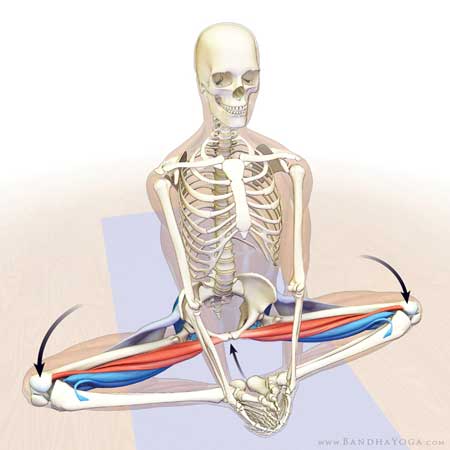
This is the bounded angle pose. First sit on the floor with the legs stretched out in front of you. Bend your knees. Bring the feet closer to the trunk of the body. Join the heels and soles of the feet and grasp the feet and bring them towards the perineum. Widen the thighs and make sure that the knees are touching the ground. Make sure your spine is erect. Interlock the hands around your feet and bend forward from the lower back on an exhale. Try and touch your forehead to the floor and then, if possible, touch the chin and then the mouth to the floor. Stay here breathing easily for about thirty seconds. Then relax back up. PRECAUTION: Knee, hip, or groin injury. BENEFITS: It relieves sciatic pain and prevents hernia. If practiced regularly, it relieves pain and heaviness in the testicles. The pose is a blessing to women. Irregular menstrual periods and helps the ovaries to function properly. It is found that pregnant women who sit daily in this pose for a few minutes will have much less pain during delivery and will be free from varicose veins.

Read More »

Upavistha Konasana(Wide Angle Seated Forward Bend Pose)

This is the wide angled seated forward bend pose. First sit on the floor with the legs stretched out in front of you. Now widen the distance between the legs as much as you can. Reach forward and grasp the toes with the respective thumb and first two fingers of your hand. Keep the spine erect as you breathe easily. Then exhale as you bend forwards and try to touch your forehead to the ground. If possible try and place the chin on the floor. Then release back up gently. PRECAUTION: Back pain or knee injury. BENEFITS: Stretches the hamstrings and helps the blood to circulate properly in the pelvic region and keeps it healthy. It prevents the development of hernia of which it can cure mild cases and relieves sciatic pains. Since the asana controls and regularizes the menstrual flow and also stimulates the ovaries, it is a boon to women.

Read More »

Ardha Navasana(Half Boat Pose)

This is the half boat pose. First sit on the floor with the legs stretched out in front of you. Link your fingers behind the back of your head. Exhale and recline the trunk while you raise both legs off the floor. Here you are resting only on the buttocks, keeping the knees straight and the legs at an angle of roughly thirty five degrees. Hold this pose as you breathe easily for thirty seconds. Then slowly release back down to the ground. PRECAUTION: Pregnancy or injury. BENEFITS: Ardha Navasana works on the liver, gall bladder and spleen. In the beginning, the back is too weak to bear the strain of the pose bring life and vigour to the back.

Read More »

Marichyasana(Half Spinal Twist Pose or Sage Marichi Pose)

This is a seated position and is named after the sage Mariachi. First sit on the floor with the legs stretched out in front of you. Bend your left knee and place the left foot flat on the floor and the calf should touch the back of the thigh. Exhale and turn the spine ninety degree to the left and bring the right arm so it is over the left thigh. The right shoulder should be beyond the left knee, stretched out forwards. The left arm is behind the back. Turn the spine more to the left and stay here for thirty seconds breathing easily. You can try to clasp the hands behind the back if possible. Then come out of the pose and repeat it on the other side. PRECAUTION: Pregnancy and who have undergone abdominal surgery should not do. BENEFITS: By the regular practice of this asana, splitting backaches, lumbago and pains in the hips disappear rapidly. The liver and the spleen are contracted and so are toned and cease to be sluggish. The muscles of the neck gain power. Sprains in the shoulder and displacement of the shoulder joints are relieved and the shoulder movements become free. The intestines also benefit from this asana. It also helps to reduce the size of the abdomen.

Read More »

Gomukhasana(Cow Face Pose)

This is the cow faced pose and is a seated pose. First sit on the floor with the legs stretched out in front of you. Bend your left knee and sit on the left foot and then bend the right leg and bring it to rest on top of the left. The heels should be touching and the seat should be raised. Raise the left arm over your head and bend it at the elbow and place it behind the nape of the neck. Lower your right arm, bend it at the elbow and place it between your shoulder blades. Try and clasp both your hands together. Hold the position for about thirty seconds as you breathe comfortably with your neck erect and looking ahead. Unclasp the hands, change the top leg to make it the bottom leg and then repeat the pose on the other side, reversing the hands. PRECAUTION: Hip replacements Shoulder injury. BENEFITS: Cures cramp in the legs and makes the leg muscles elastic. The chest is well expanded and the back becomes erect. . It relieves backache, sciatica, rheumatism and general stiffness in the shoulders and neck, and improves posture by increasing energy, awareness, and generally opening the chest area.

Read More »

Paschimottansana(Seated Forward Bend Pose)

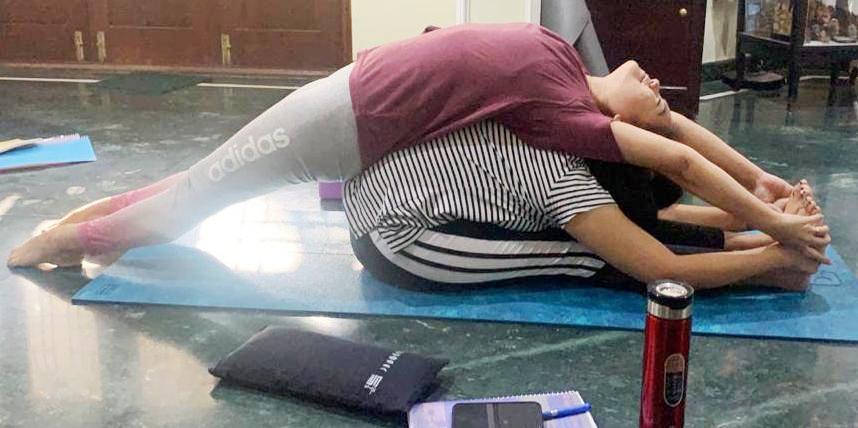
Sit on the floor and stretch your legs out in front of you and keep the palms on the floor, near the hips. Breathe easily then on an exhale stretch out the hands and extend until you are grasping the toes. The right big toe is in between the right thumb and first two fingers and the same with the opposite hand. Extend the spine and bend down from the pelvic region, extending the arms from the shoulders. Pull the trunk forward and try and touch the forehead to the knees. Stay here for thirty seconds, trying to bring your elbows to rest on the floor. Breathe easily and make you’re your knees are not rising up off the floor. You should eventually be able to rest the chin on the shins beyond the knees. Inhale and rise back up. PRECAUTION:  Back injury, slipped disc, sciatica or hernia should not practice. BENEFITS: • Can relieve some symptoms of menstrual discomfort and menopause. • May alleviate headache, anxiety, and fatigue. • Can help relieve high blood pressure, infertility, insomnia, and sinusitis. Tones and massages the entire abdominal and pelvic region, including the liver, pancreas, spleen, uro-genital system, kidneys and adrenal glands.

Read More »

Parivrtta Janu Sirsasana(Revolved Head to Knee Pose)

This is the revolved head to knee pose. Sit on the floor and stretch your legs out in front of you. Bend the left leg and place the left heel as close to the right inner thigh as possible. Try and keep the right knee firmly touching the ground, it should not rise off. Now twist your trunk to the left and stretch the right arm to the stretched out right leg and grasp the right foot. Then with the left hand stretched over the head, try and grasp the outer side of the right foot. Try and bend the right arm and rest the elbow on the floor as you try and bring the back of the head (face towards the ceiling) towards the knee. Release the foot and then rise back up. Repeat the pose on the other side.

Read More »

Janu Sirsasana(Head to Knee Forward Bend Pose)

This is a pose in which you will attempt to touch your head to the knee. Sit on the floor and stretch your legs out in front of you. Bend the left leg and place the left heel as close to the right inner thigh as possible. Try and keep the right knee firmly touching the ground, it should not rise off. Make sure your legs are at an obtuse angle. Extend your arms forwards towards the right foot and hold it with both hands. Then, bending from the lower back, try and rest your forehead, then the nose and then the lips above the right knee. Stay here for about thirty seconds, breathing easily. Then come out of this pose and repeat it on the other side. precaution: Acute knee or back pain or Intestinal discomfort. benefits: • Stretches and strengthens the spine. • Stretches the hamstrings and groin. • Relieves symptoms of high blood pressure, insomnia, and sinusitis. This asana tones the liver and the spleen and thereby aids digestion. It also tones and activates the kidneys. Persons suffering from enlargement of the prostate gland will benefit by staying longer in this pose.

Read More »

Padmasana(Lotus Pose)

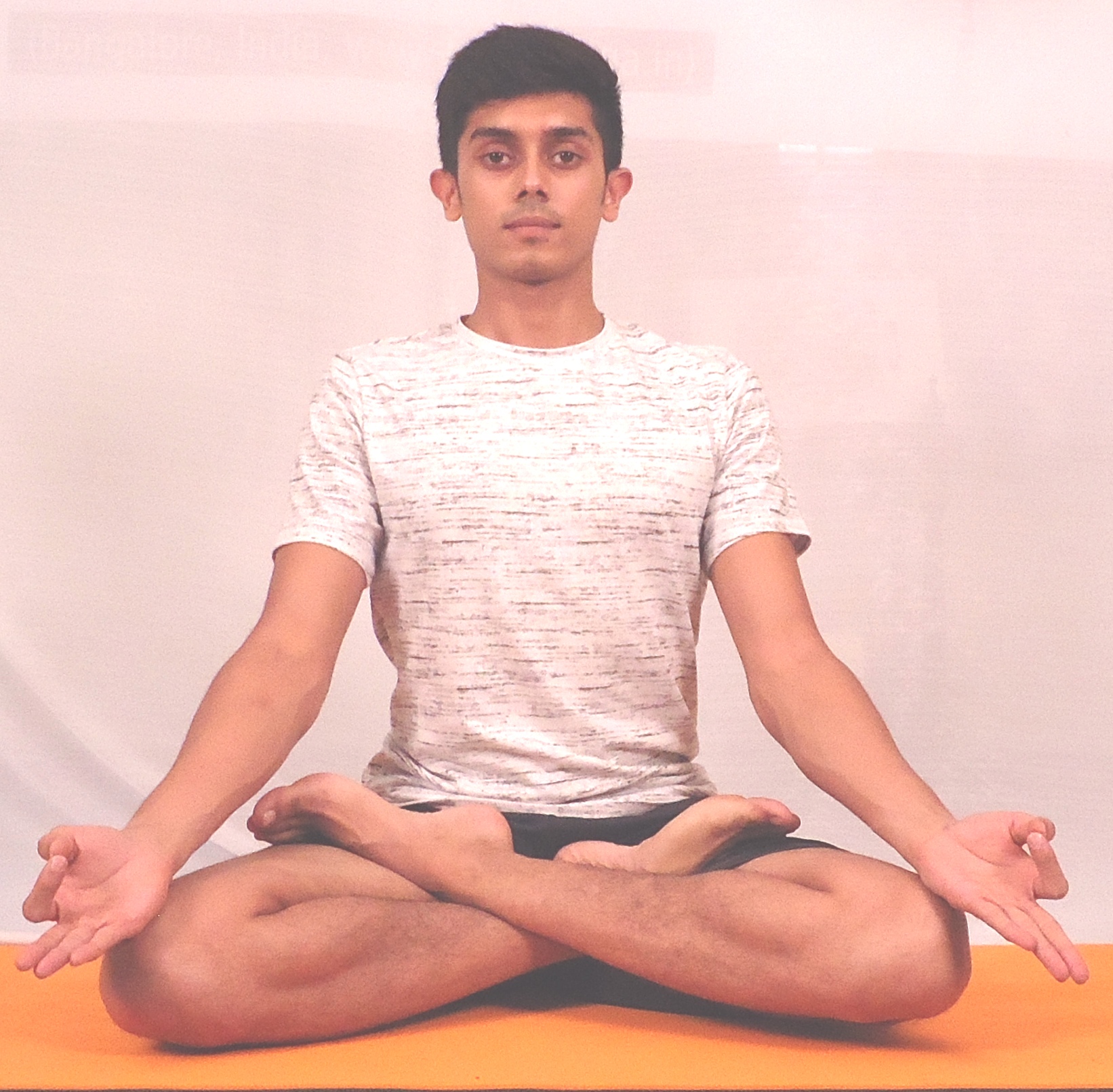
This is the lotus pose. Sit on the floor with your legs stretched out straight in front of you. Bend the right leg and take the right foot, placing it at the root of the left thigh. The right heel should be close to the navel. Place the left leg over the right so that again, the left heel is near the navel. Make sure the soles of your feet are facing the sky. Keep the spine and neck erect and firm. You can place the hands on the respective knees or stretch them in gyana or chin mudra. precaution: Acute knee injury. benefits: • Relieves stiffness in the hips, knees, and ankles. The breath becomes slow, muscular tension is decreased and blood pressure is reduced. The normally large blood flow to the legs is redirected to the abdominal region.

Read More »

Siddhasana(Accomplished or Perfect Pose)

This is the adept’s pose and is also known as the psychic pose. Sit on the floor with your legs stretched out in front of you. Bend the right leg and bring the sole of the foot so that it is resting against the inner left thigh with the heel pressed to the groin. Bend the left leg and fit the toes in between the right calf and thigh. Now pull the toes of the right foot so that the they fit between the left calf and thigh. The left heel may be against the pubis here. Rest your knees on the floor and make yourself as comfortable as possible. Keep your spine and head straight and breath easily. Benefits: Makes reproductive organs stronger, awaken, and makes to move energy upward instead of going downward vainly. It is one of the best among all. This posture is recommended for  Meditation and  breathing practices.

Read More »

Swastikasana(Auspicious Pose)

This is the auspicious pose. Sit on the floor with the legs stretched straight out in front of the body. Bend the left knee and place the sole of the left foot against the inner right thigh. The heel should not touch the perineum. Bend the right knee and place the right foot in the space between the left thigh and calf. The heel should not touch the pubic area. Grasp the left foot and pull them up into the space between the right thigh and calf. Make yourself as comfortable as possible with your knees firmly on the floor. Straighten the spine and keep your palms on your knees or in gyana or chin mudra.

Read More »

Dandasana(Staff Pose)

This is the seated staff pose. You can sit on the floor with your legs stretched straight out in front of you and make sure not to bend the knees. Place your palms near the hips on the floor. Your fingers should be pointing to the feet. Make the arms straight and keep your back straight and erect. Sit like this as you breathe comfortably and easily.

Read More »

Sukhasana(Easy Pose)

This is the easy pose. Sit with the legs stretched out in front of you. Then bend one leg and place the foot under the opposite thigh and do the same with the other leg. Place your hands on your kneed or you can press the fingers into chin or gyana mudra. Keep your head and neck straight and relaxed and your spine should be erect but not stiff. Relax your whole body and breathe easily. precaution: no precaution. benefits: It can be utilized without ill effect by persons who are unable to sit in the more difficult meditation postures. It facilitates mental and physical balance without causing strain or pain.

Read More »

Supta Virasana(Reclining Hero Pose)

This is a reclined hero pose. You start in the hero pose or virasana with your knees together and your feet apart. Rest your buttocks on the floor and then recline the trunk backwards until your elbows are on the floor. Rest the crown of your head on the floor and then slowly lower the back of the head down and then finally rest your back on the floor. You can stretch your arms out over your head on the floor and breathe comfortably, staying here as long as you can. Rise up again by placing your elbows by your trunk and coming up again as you exhale. PRECAUTION: Neck problems, sciatica, slipped disc, sacral ailments or knee complaints. BENEFITS: This asana stretches the abdominal organs and the pelvic region. People whose legs ache will get relief from holding this pose for 10 to 15 minutes and it is recommended to athletes and all who have to walk or stand about for long hours.

Read More »

Ustrasana(Camel Pose)

This is the camel pose. For this come into a kneeling position on your mat. Then rise up so that your thighs, torso and head are in a straight line. Stretch your arms out straight in front of you, then slowly move your right hand behind your back as you bend your spine backwards as you reach your right hand for your right ankle. Then reach your left hand down and grasp your left ankle. Throw your head back if possible, contract the buttocks and stretch the dorsal and coccyx regions. Remain here with steady and comfortable breathing for about thirty seconds. Then release your hands and bring them to rest on your hips. Then sit in a relaxed position on the floor. PRECAUTION:Severe Back or neck concerns. High blood pressure. BENEFITS: Spine is stretched back and is toned. This pose can be tried conveniently by the elderly and even by persons with spinal Injury. This asana is beneficial for the digestive and reproductive systems. It stretches the stomach and intestines, alleviating constipation. The backward bend loosens up the vertebrae and stimulates the spinal nerves, relieving backache, rounded back and drooping shoulders.

Read More »

Virasana(Hero Pose)

This is the hero pose and is another kneeling pose. Kneel on the floor in diamond pose. Then, keeping the knees together, spread the feet apart a few inches. Try and rest your buttock on the floor or on the mat. Your feet should be to the side of your thighs with your toes pointing backwards and touching the floor. Your wrists rest on your knees, palms facing towards the sky. Keep your thumb and forefinger of each hand joined. Stay here for as long as possible, breathing easily. PRECAUTION: Serious knee or back concerns. BENEFITS: Cures rheumatic pains in the knees and gout, and is also good for flat feet. Due to the stretching of the ankles and the feet, proper arches will be formed. This, however, takes a long time and requires daily practice of the pose for a few minutes for several months. done immediately after food and will relieve heaviness in the stomach.

Read More »

Vyaghrasana(Tiger Pose)

This is the tiger pose. To come into this pose, you must start in cat pose, on your hands and knees with a comfortable distance between your knees. Arching the back down, take your right leg out and stretch it up and backwards, then bend it.  If possible, bring your toes towards the back of your head. Hold your breath for a couple of seconds. Then arch the back upwards and bend the head, bringing your nose to your knee. Repeat the movements a few times and then rest the leg back on the mat in cat pose. Now repeat this on the other side.

Read More »

Marjaryasana(Cat-Cow Pose)

This is the cat pose. It begins in the kneeling diamond pose. From here come to cat pose, in which you must get on your hands and knees, with a comfortable distance between your knees, and your palms flat on the mat, directly under your shoulder. Your hands and knees should be in line and your arms and thighs are perpendicular to the ground. As you inhale, raise your head to look up and make your back concave in a cow stretch. Exhale and lower the head so that it is between the arms and then round the back into cat stretch.

Read More »

Mandukasana(Frog Pose) or Bhadrasana (Gracious Pose)

This is the frog pose, another kneeling posture. You must start in diamond pose. From here, open and separate the knees as far as you can go while the toes remain in contact with the floor or mat. Separate your feet so that you can rest your buttocks on the floor or mat, between your feet. If you can, separate the knees further. Here, you can concentrate on the tip of your nose or nasikagra dristi. Breathe easily and try to remain here for as long as possible. Slowly increase the length of time you can stay in this pose to increase your flexibility. PRECAUTION: Knee issues. BENEFITS: Stimulating influence on mooladhara chakra. It is an excellent meditation pose. The benefits are basically the same as for vajrasana.

Read More »

Balasana – Child’s Pose or Shashankasana – Moon / Hare Pose

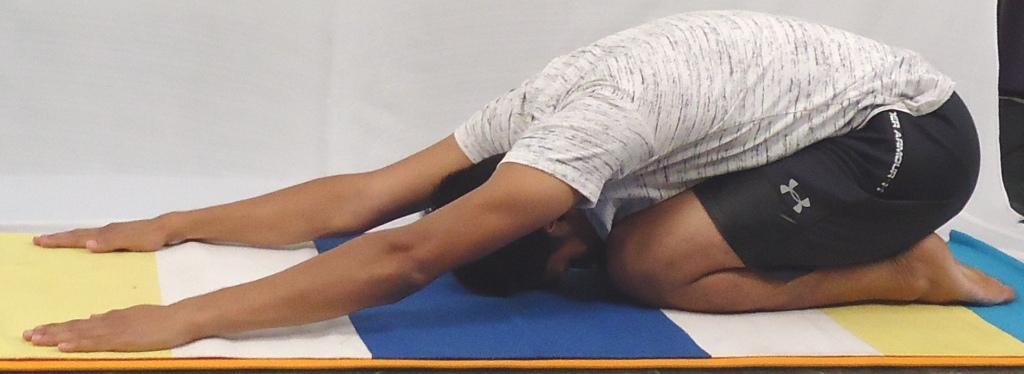
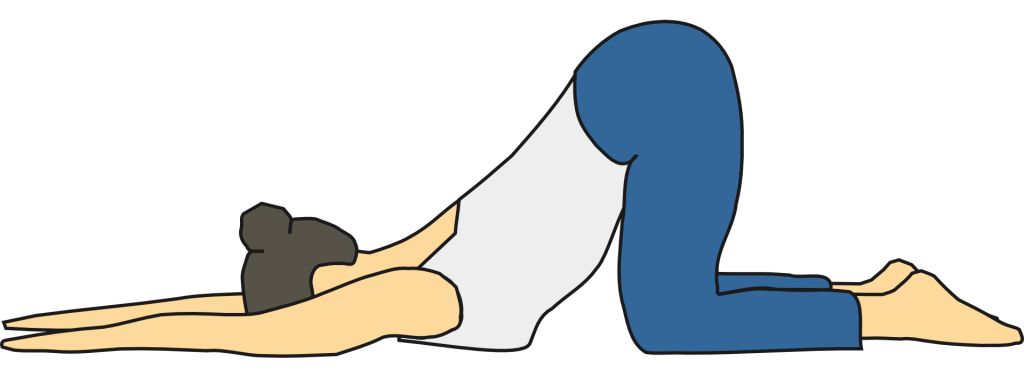
This is the child’s pose. You must start in the diamond pose or kneeling posture, with your palms face down on your thighs. Relax and keep your spine and head straight as you breathe comfortably. Exhale and bend down from the hips so that your head and arms are in line with the trunk. Rest your forehead on the mat with your arms resting outstretched in front of you, also resting on the mat. Take a few breaths here and clear your mind. Then inhale and raise your arms, trunk and head back up and return to diamond pose. PRECAUTION: Knee pain. BENEFITS: Stretches and strengthens the back muscles and separates the individual vertebrae from each other, releasing pressure on the discs. Often nerve connections emanating from the spinal cord are squeezed by these discs. It also regulates the functioning of the adrenal glands. It tones the pelvic muscles and the sciatic nerves. Relieve Constipation

Read More »

Ardha Baddha Padmottanasana( Half Bound Lotus Standing Forward Bend Pose)

This is the standing half bound lotus pose. From Tadasana inhale as you bring your right knee to the chest. Then, place the right foot on top of the left inner thigh. Place your left hand behind your back and exhale. Then lean down from your lower back so that your right hand is on the ground by your right foot. Make your back as concave as possible and take a few breaths. Exhale and bring your forehead or chin to your left knee. Place your left palm on the floor by the left foot. Come out of the pose and repeat the pose on the other side.

Read More »

Urdhva Parasarita Eka Padasana(Standing Split Pose)

This is a standing split. Here it is about stretching your quad and hamstring and not about how high you can extend your leg. You must begin in the standing forward bend. Inhale as you elongate your spine and press your hands into the ground. Breathe easily and on an inhale lift your right leg so that it is parallel to the floor and then rotate the inner thigh upwards, pressing into the ball of the foot. Lift the right leg higher and straighten the leg on the ground by pulling in the knee caps. Come back to the forward fold and then repeat the pose on the other side.

Read More »

Baddha Parivrtta Parsvakonasana(Bound Revolved Side Angle Pose)

This is revolved bounded side angle pose. Start in Tadasana and with a deep inhalation step your feet four or four and a half feet apart. Raise your arms sideways with your arms in line with your shoulders and your palms facing down. Lower into a lunge position with your right leg forward and at a 90 degree angle to the ground and the left leg extended backwards and straight at the knee. Twist your torso across the right thigh. Wrap your left arm over the thigh and reach under your body. Circle your right arm around the back and reach for your left hand. Clasp your hands and breathe easily as you hold the pose for about 30 seconds. Then return to Tadasana and do the pose on the opposite side.

Read More »

Parivrtta Ardha Chandrasana(Revolved Half Moon Pose)

This is the revolved half moon pose. Here, you begin in Tadasana. From Tadasana you perform the revolved triangle pose to the right side of your body. Your right foot is facing forward. Place your left hand down on the floor and revolve so that your left side is facing the floor and your right side is facing the sky, your right hand extended straight upwards at a ninety degree angle to the floor. Left your left leg so that it is extended straight outwards, parallel to the floor. Make sure your head is relaxed and you are looking up at your right hand. Breathe comfortably through the posture. Stay here for approximately thirty seconds, then slide the left leg onto the floor and return to revolved triangle posture. Then turn and repeat this on the other side.

Read More »

Ardha Chakrasana(Half Wheel Pose)

This is the half moon pose. Here, you begin in Tadasana. From Tadasana you perform the Trikonasana or the triangle pose to the right side of your body. Place your right palm about a foot away from the right foot by bending the right knee. Simultaneously, bring the left forward about a foot or half a foot forward. Exhale and straighten the right hand and right foot by planting them firmly into the floor and pressing. Now lift the left leg so it is parallel to the floor and extend it outwards. Make sure your torso is rotated to the left, your left hand on your hip and your head neutral. Stay here for approximately thirty seconds, then slide the left leg onto the floor and return to triangle posture. Then turn and repeat this on the other side.

Read More »

Padangusthasana(Big Toe Pose)

In this pose, you hold the big toe in a forward fold. Stand in Tadasana with your feet at a distance of one foot between them. Keep your legs straight, inhale deeply then exhale and fold forward from the lower back. Extend your hands and grasp your big toes between the thumb and first two fingers of your respective hands. Keep your head up as you stretch the diaphragm towards the chest and make your back concave. Stay in this position for a few breaths. Then slowly  exhale and to go deeper into the pose, bring your head between your knees. Keep pulling the toes at this stage. Your feet should remain firmly planted on the floor. Remain here for a few breaths, for about 30 seconds. Then inhale and slowly return to Tadasana.

Read More »

Utthita Vayu Muktasana(Standing Wind Relieving Pose)

The standing wind relieving pose or Uthitta Vayu Muktasana begins at Tadasana or the mountain pose. Stand straight, with the heels and toes of both feet pressed together. Keep your arms by your side, weight distributed evenly across your feet from your heels to your toes. Raise your right leg, bend it at the knee and hug it into your chest, clasping your arms around the leg. Stay here with your breath as a steady, comfortable and easy pace, for approximately 30 seconds. If you want a deeper stretch, you can try and touch your nose to your knee. Then, slowly raise your head from your knee and lower your leg back to the ground. Repeat this on the other side. You can eventually increase the length of time you hold the pose.

Read More »

Ardhakati Chakrasana(Half Waist Wheel Pose)

The half wheel pose or Ardhakati Chakrasana begins at Tadasana or the mountain pose. Stand straight, with the heels and toes of both feet pressed together. Keep your arms by your side, weight distributed evenly across your feet from your heels to your toes. Inhaling in, raise your right hand vertically over the head while your left hand is at your side. Stretch the right hand out as far as you can. Next, slowly bend to the left side from your waist. Make sure to maintain a normal and comfortable rate of breathing. Maintain this posture for a few breaths, for about 30 seconds. Then slowly, straighten back up and lower your right hand down slowly by your side. Repeat this on the other side. You can eventually increase the length of time you hold the pose. Benefits: Reduces fat in waist region, stimulates sides of the body. Give lateral bending to the spine, improves function of liver.

Read More »

Isometric and Isotonic (pose) Yoga Asana

Isometric – no movement, muscles stay the same length. Example, staying in plank position, not moving. Isotonic: i.e. eccentric and concentric Eccentric muscle moves to lengthen, resisting gravity i.e. forward fold into Uttanasana. Concentric, muscle moves to shorten, moving against gravity. Example, moving from chaturanga dandasana to plank position.  

Read More »

Pancha Kosha (Five Level of Human Existence)

In the Taittriya upanishad, the five layers of the body are expounded upon. Going beyond these, one can reach the atman. These five layers are the pancha kosas. These are: Annamaya kosha or physical body. Pranamaya kosha or the energy body. This consists of a further five levels or the pancha bhootas, i.e earth, fire, wind, water and space. Manamaya kosha or the mental sheath. Here there is perception, memory and ego. Here also lie emotions which can cause one to be swayed from what is right. Vigyanamaya kosha, which is the wisdom layer. This contains knowledge and the conscience. A person who doesn’t have Buddhi or the discriminating faculty, which is found in this sheath, is no better than an animal. Anandmaya kosha or the bliss sheath. Ananda is what everything in the universe has been created from. By doing various tapas, man can journey toward and attain oneness with the ultimate.

Read More »

 Yoga as a Science of 4 States of Human Consciousness

  The Mandukya Upanishad deals with the four states of consciousness. Waking, 2. dreaming, 3. Deep sleep and 4. Turiya or samadhi state. It also states that everything in the universe is OM and that the past, present and future are contained in OM. The three components or syllables comprise the three states of Brahman. After meditation on OM one is taken to the silence which is Atman or Brahman.

Read More »

Aerobic and Anaerobic Yoga Pose

Aerobic activity This takes place with oxygen where carbohydrate and oxygen are used as fuel for the first two minutes after which fat is burned. These are lower intensity activities. More fat for energy is used and leads to a better ability to burn fat. Blood vessels increase and become bigger to accommodate the oxygen being used. It changes the composition of muscle fibres which contract slower and at a lower intensity. Aerobic activity increase these type one muscles which increases endurance and performance. Aerobic activity increases mitochondria which improved the aerobic capacity of muscles. Anaerobic activity This happens without oxygen, fuel comes from muscle storage and is short, highly intense and burns fat directly. Example is weightlifting. More fast twitch muscle fibres are produced for strength. It increases lactic acid tolerance for endurance. It increases glycolysis, ATP, CP and creatine. It increases growth hormone and testosterone.

Read More »

Muscle Fiber Types: Fast Twitch Muscle Fiber and Slow Twitch Muscle Fiber

  Slow Twitch Muscles that are associated with aerobic work are called slow twitch. These are the muscles working when we do the simpler yoga poses. Small force is produced over a sustained period. It is suited for endurance activities such as running marathons. Fast Twitch These fibres are associated with anaerobic activity. They are used when we perform high intensity activity which is sustained for shorter periods such as sprinting. The lactic acid build up from these activities means they cannot be sustained for a long time.  1) Fast oxidative glycolytic fibres These are more resistant to fatigue that fast glycolytic fibres. 2) Fast glycolytic fibres These fibres generate the largest amount of force and have the greatest anaerobic capacity.

Read More »
[gravityform id="2" title=false]
Call Back Form