
1. Word Meaning and Etymology
“Urdhva Cakrasana” is a Sanskrit term composed of two words:
- Urdhva = upward, lifted, elevated
- Cakra = wheel, circular shape
- Asana = posture or seat

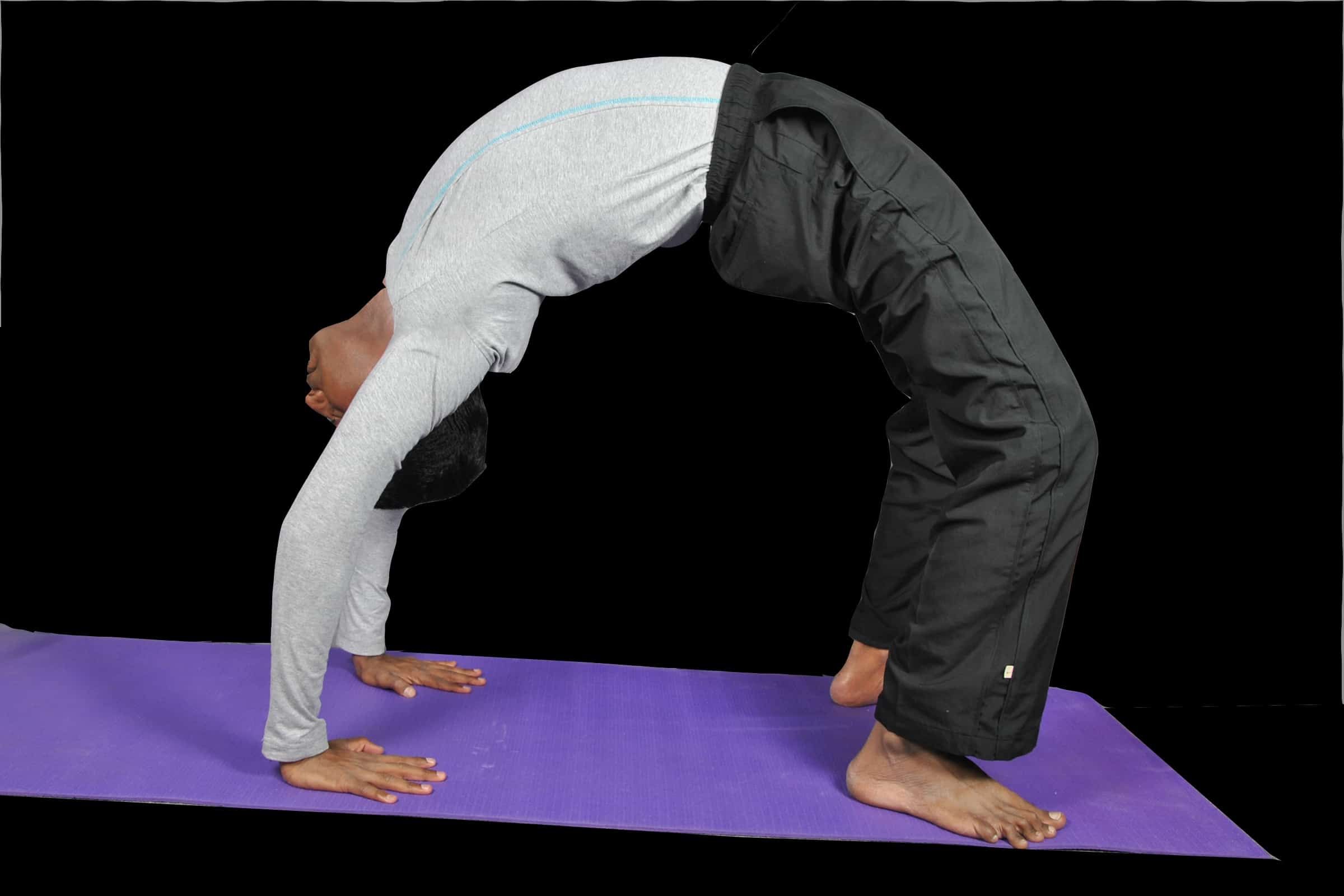
Thus, Urdhva Cakrasana means “Upward Wheel Pose.”
The name describes the posture’s overall shape: the spine curves into a deep wheel-like arc, with the chest, pelvis, and thighs lifted upward. It is also commonly known as Chakrasana, Urdhva Dhanurasana (Upward Bow), or Full Wheel Pose.
The yoga scriptures often refer to “cakra” as energy centers, and symbolically, Urdhva Cakrasana is believed to open the anahata (heart), visuddhi (throat), and manipura (navel) chakras, stimulating vitality and emotional expansion.
2. Definition
Urdhva Cakrasana is a deep backbend and chest opener performed from a supine position by lifting the body into an arch supported by both hands and feet. It requires strong activation of the:
- spinal extensors
- gluteal and hamstring muscles
- shoulder external rotators
- wrist stabilizers
- hip flexors and quadriceps
It is considered an advanced pose requiring flexibility, strength, proprioception, and structural awareness. The posture enhances thoracic expansion, lumbar extension, hip extension, and open-chain shoulder flexion.
3. Method of Practice – Step-by-Step Technique
Step 1: Preparation
- Lie on your back in Supta Tadasana.
- Bend both knees and bring the heels close to the sitting bones.
- Place feet hip-width apart and parallel.
- Bend elbows and place palms beside the ears, fingers pointing toward shoulders.
- Spread the fingers wide and root the fingertips.
Step 2: Setting Foundation
- Press the feet firmly down.
- Draw shoulder blades down the back.
- Engage core muscles lightly to support lumbar region.
- Avoid flaring ribs too early—keep a neutral ribcage before lifting.
Step 3: First Lift – Rise onto the Crown
- Press both feet and hands into the floor.
- Lift the pelvis upward.
- Once pelvis is lifted, gently press into the arms and come to the crown of the head (not resting weight fully).
- Adjust elbows to be shoulder-width apart.
Step 4: Full Lift – Straighten the Arms
- Press palms and feet down simultaneously.
- Lengthen through the arms and straighten elbows.
- Lift the chest upward and forward toward the wall behind you.
- Push thighs toward the wall in front of you.
- Let the spine extend evenly—from sacrum to cervical spine.
Step 5: Holding the Pose
- Breathe deeply and evenly—expand ribs on inhalation.
- Keep feet parallel and knees pointing forward.
- Lift sternum toward the ceiling.
- Stay relaxed in the facial muscles and throat.
Step 6: Coming Down
- Bend elbows slowly and lower crown gently.
- Release the spine vertebra by vertebra.
- Let pelvis rest last.
- Hug knees to chest to decompress spine.
4. Alignment Cues
Feet and Legs
- Feet should remain parallel; avoid turnout.
- Knees must not splay outward.
- Press evenly through all four corners of each foot.
- Lengthen thigh bones forward.
Pelvis and Hips
- Engage gluteus maximus moderately—avoid over-squeezing.
- Lengthen tailbone toward knees while lifting pubic bone upward.
- Keep hip joints aligned and symmetrical.
Spine
- Distribute the backbend along thoracic spine, not just lumbar.
- Visualize lifting the sternum upward like a flower opening.
- Avoid compressing lumbar vertebrae.
Shoulders and Arms
- Elbows parallel, no outward flaring.
- Rotate inner upper arms forward and down (external rotation).
- Press firmly through palms and fingertips.
- Broaden collarbones.
Head and Neck
- Allow natural arc—avoid collapsing.
- Keep neck long; do not turn head sideways.
- Lift chest away from throat.
Breath
- Inhale to expand ribs laterally and anteriorly.
- Exhale to soften the diaphragm, maintaining extension.
5. Benefits of Urdhva Cakrasana
Physical Benefits
- Strengthens the entire posterior chain—glutes, hamstrings, spinal extensors.
- Improves thoracic mobility and heart-lung capacity.
- Deeply stretches hip flexors, particularly psoas and rectus femoris.
- Strengthens arms, wrists, and shoulders.
- Enhances flexibility of vertebral column.
- Stimulates abdominal organs—improving digestion.
- Opens intercostal muscles—improving breathing efficiency.
- Increases blood circulation and energizes the whole body.
- Develops balance and neuromuscular coordination.
Therapeutic Benefits
- Counteracts poor posture and sedentary lifestyle.
- Helps reduce mild depression and fatigue.
- Stimulates endocrine glands: adrenal, thyroid, pituitary.
- Supports chest expansion for asthma patients (under guidance).
- Releases emotional tension held in the chest and abdomen.
Energetic Benefits
- Activates Manipura, Anahata, Vishuddha chakras.
- Expands pranic flow through the Sushumna.
- Promotes feelings of openness and fearlessness.
6. Contraindications
Absolute Contraindications
- Wrist fractures, carpal tunnel syndrome (acute).
- Recent spine surgery or herniation.
- Severe low back pain.
- Advanced hip or knee osteoarthritis.
- Uncontrolled hypertension.
- Severe shoulder injuries.
Relative Contraindications
- Pregnancy (second–third trimester).
- Migraine or vertigo.
- Weak wrists or elbows.
- Cervical instability.
- Epilepsy.
Precautions
- Warm-up is essential.
- Avoid overextending lumbar region.
- Never turn head sideways in the pose.
- Practice under supervision if new to backbending.
7. Counterposes
- Supta Baddha Konasana – chest softening
- Apanasana / Pawanmuktasana – neutralizes lumbar spine
- Paschimottanasana – stretches backline
- Balasana (Child’s Pose) – decompresses spine
- Ardha Matsyendrasana – mild twisting release
Counterposes help neutralize deep spinal extension.
8. Preparatory Practices
To prepare the body, practice:
Backbending Prep
- Bhujangasana
- Urdhva Mukha Svanasana
- Salabhasana
- Dhanurasana
Shoulder-Opening Prep
- Gomukhasana arms
- Puppy Pose (Uttana Shishosana)
- Wall shoulder stretches
Hip Flexor Opening
- Anjaneyasana
- Supta Virasana
Spinal Mobility
- Marjaryasana–Bitilasana
- Thoracic extension work with a bolster
Strength Prep
- Plank, forearm plank
- Bridge pose (Setu Bandha Sarvangasana)
- Dolphin pose for shoulder stability
9. Modifications and Variations
For Beginners
- Practice with yoga blocks under hands.
- Practice bridge pose instead of full wheel.
- Use a partner assisting lift.
- Elevate heels on blocks.
- Use a strap around elbows to prevent flaring.
Intermediate Variations
- Straighten legs fully into Viparita Dandasana prep.
- Lift onto toes for deeper thoracic lift.
- Practice one-legged Urdhva Cakrasana.
Advanced Variations
- Dropbacks from standing.
- Full Viparita Dandasana.
- Walk hands closer to feet to deepen backbend.
10. Muscles Involved
Primary Muscles Working (Agonists)
- Spinal extensors (erector spinae, multifidus)
- Gluteus maximus
- Hamstrings (especially biceps femoris for hip extension)
- Quadriceps
- Shoulder flexors & stabilizers (deltoids, serratus anterior)
- Triceps brachii
- Forearm and wrist stabilizers
Primary Muscles Stretching (Antagonists)
- Psoas major & iliacus
- Rectus femoris
- Intercostals
- Rectus abdominis
- Latissimus dorsi
- Pectoralis major & minor
- Deep cervical flexors
Synergists
- Gluteus medius/minimus
- Transversus abdominis
- Obliques (stabilizing role)
- Rotator cuff muscles
11. Kinesiology of Urdhva Cakrasana
Joint Actions
Spine
- Extension at lumbar, thoracic, and cervical regions
- Increase in vertebral spacing anteriorly
- Disc compression posteriorly
Shoulders
- Flexion
- External rotation
- Scapular upward rotation and retraction
Elbows
- Extension
Wrists
- Hyperextension with weight-bearing
Hips
- Extension
- Slight external rotation
Knees
- Flexion (fixed position)
Ankles
- Neutral to slight dorsiflexion
Planes of Movement
- Primary action in sagittal plane.
- Shoulder and hip rotation involves transverse plane.
- Minor lateral stability corrections in frontal plane.
12. Kinematics of the Pose
Kinematics describes movement without considering forces.
Movement Sequence
- Initial Lift – pelvis rises from floor (hip extension).
- Transition to Crown – spine lengthens; shoulder flexion begins.
- Full Wheel – arms straighten, spine forms an arc.
- End Range – thoracic and lumbar segments reach extension peak.
Key Points
- Movement is closed-chain for upper and lower limbs.
- Spine moves in open chain kinetic pattern.
- Coordination between shoulder flexion and spinal extension is essential.
- Breath enables rib mechanics for thoracic extension.
13. Biomechanism
Biomechanism explains the forces and structural dynamics.
Force Distribution
- Arms and feet form four stable pillars.
- Weight is divided approximately:
- 60% legs
- 40% arms
Mechanical Actions
- Spinal extensors generate concentric contraction to lift trunk.
- Hip flexors undergo eccentric stretching.
- Shoulder girdle sustains compression and tensile loads.
- Palmar fascia supports wrist extension loads.
- Thoracic spine acts as the bridge keystone where the arc begins.
Common Stress Points
- Lumbar vertebrae—if glutes are inactive
- Wrists—if hands incorrectly placed
- Shoulders—if internal rotation occurs
- Neck—if chin collapses
Solutions
- Strengthen posterior chain.
- Improve shoulder flexion range.
- Use props to reduce angle load.
14. Functional Anatomy & Physiology
Spine
- Extension increases space for anterior discs.
- Strengthens posterior longitudinal ligaments.
- Activates deep stabilizers (multifidus).
- Encourages thoracic mobility for better breathing.
Thoracic Cage
- Rib expansion enhances lung capacity.
- Diaphragm lifts, allowing deeper inhalation post-release.
Shoulder Complex
- Glenohumeral joint in flexion + external rotation reduces impingement.
- Serratus anterior stabilizes scapulae.
Pelvis & Hips
- Hip extension stretches psoas, reducing anterior pelvic tilt long-term.
- Glute activation stabilizes sacroiliac joints.
Cardiovascular & Endocrine Response
- Increased heart rate due to energetic demand.
- Stimulates adrenal glands.
- Opens thoracic region enhancing venous return.
Neuromuscular Integration
- Requires proprioception and coordination.
- Demands simultaneous activation of stabilizer muscles.
15. How to Correct and Adjust While Teaching
Verbal Cues
- “Keep feet parallel—don’t let them turn out.”
- “Lift your sternum upward and forward.”
- “Draw elbows in.”
- “Press into fingertips to lighten wrist pressure.”
- “Engage glutes but don’t over-squeeze.”
- “Lengthen the lower back; open the chest.”
Hands-On Adjustments (Only with Consent)
1. For Feet Alignment
- Stand near the student’s feet.
- Gently rotate feet to parallel.
- Press down on heels to stabilize.
2. For Shoulder Alignment
- From behind the student, gently roll outer shoulders inward.
- Encourage external rotation.
3. For Chest Lift
- Place hands behind student’s upper back and gently lift upward.
- Avoid pushing the ribcage forcefully.
4. For Arm Straightening
- Support elbows, helping them extend.
- Ensure that shoulder stability is maintained.
Common Mistakes & Corrections
Knees splaying outward
✔ Place a block between thighs.
Weight dumped into lumbar spine
✔ Engage core + lift sternum.
Collapsed shoulders
✔ Use blocks under hands.
Wrist pain
✔ Turn fingers slightly outward; elevate heels of hands.
Head turned during pose
✔ Emphasize immobility of neck.
Safety Guidelines for Teachers
- Always warm up students.
- Avoid forcing deeper backbends.
- Encourage resting in counterposes after practice.
- Support emotional release sensitively—Urdhva Cakrasana often opens emotional blockages.
Conclusion
Urdhva Cakrasana is one of the most transformative backbends in yoga. It represents expansion, strength, courage, and emotional openness. Through mindful practice, correct biomechanical understanding, and conscious breathing, this posture strengthens the entire body, promotes spinal health, opens the heart, and enhances energy levels. For teachers, awareness of anatomical structures, alignment principles, kinesiology, and proper adjustment techniques is essential to guide students safely into this powerful pose.
QUESTION AND ANSWER
SECTION 1 — GENERAL KNOWLEDGE & FOUNDATIONS
1. The Sanskrit meaning of “Urdhva Cakrasana” is:
A. Upward wheel pose
B. Bowed spinal posture
C. Upward dog posture
D. Circular backbend posture
Answer: A
2. Urdhva Cakrasana belongs to which category of asanas?
A. Forward bends
B. Backbends
C. Twisting asanas
D. Balancing asanas
Answer: B
3. What is the main energetic action in Urdhva Cakrasana?
A. Flexion of the spine
B. Extension of the spine
C. Rotation of the spine
D. Lateral flexion
Answer: B
4. Which chakra is primarily stimulated in this posture?
A. Muladhara
B. Manipura
C. Vishuddha
D. Anahata
Answer: D
(Heart-opening backbend)
SECTION 2 — ANATOMY & MUSCLES
5. The prime mover (agonist) in spinal extension during Urdhva Cakrasana is:
A. Rectus abdominis
B. Erector spinae
C. Iliopsoas
D. Sternocleidomastoid
Answer: B
6. Which muscle group works as the major hip extensors?
A. Quadriceps
B. Hamstrings
C. Gluteus maximus
D. Adductors
Answer: C
7. Which shoulder movement allows lifting into the pose?
A. Shoulder internal rotation
B. Shoulder flexion
C. Shoulder extension + external rotation
D. Horizontal adduction
Answer: C
8. Which of the following muscles are strongly stretched?
A. Gastrocnemius and soleus
B. Neck flexors
C. Pectoralis major/minor
D. Wrist flexors
Answer: C
9. Which joint is MOST loaded during the pose?
A. Knee joint
B. Wrist joint
C. Shoulder joint
D. Elbow joint
Answer: B
10. Overuse of lumbar extensors without thoracic mobility leads to:
A. Proper alignment
B. Hyperkyphosis
C. Lumbar compression
D. Frozen shoulder
Answer: C
SECTION 3 — KINESIOLOGY & BIOMECHANICS
11. What is the safest spinal action when initiating the backbend?
A. Start in lumbar spine
B. Start in thoracic spine
C. Start in cervical spine
D. Start in sacrum
Answer: B
12. To prevent wrist strain, the hands should be:
A. Fingers pointing inward
B. Fingers pointing backward
C. Fingers pointing toward shoulders
D. Fingers spread, pointing toward feet
Answer: D
13. Grounding the feet properly prevents:
A. Hip external rotation
B. Knee splaying outward
C. Spine elongation
D. Shoulder stability
Answer: B
14. Which movement helps create space in the lumbar region?
A. Press knees inward
B. Lengthen tailbone toward knees
C. Tighten upper trapezius
D. Lock elbows
Answer: B
15. The load distribution in an ideal Urdhva Cakrasana is:
A. 80% hands, 20% feet
B. 20% hands, 80% feet
C. 50% hands, 50% feet
D. 10% hands, 90% feet
Answer: C
SECTION 4 — METHOD OF PRACTICE
16. Before lifting into the pose, the student should:
A. Hold breath
B. Warm up with forward bends
C. Warm up with backbends, chest openers, shoulder mobility
D. Start with Sirsasana
Answer: C
17. A key preparatory pose for Urdhva Cakrasana is:
A. Uttanasana
B. Setu Bandhasana
C. Paschimottanasana
D. Ardha Matsyendrasana
Answer: B
18. While lifting up, which cue is correct?
A. Tuck the tailbone strongly
B. Push the floor away with arms
C. Drop the head completely
D. Let knees widen apart
Answer: B
19. Ideal breathing pattern during the lift is:
A. Inhale to rise
B. Exhale to rise
C. Hold the breath
D. Fast shallow breaths
Answer: A
20. Head position in full pose should be:
A. Neutral, looking down
B. Hyperextended aggressively
C. Chin touching the chest
D. Chin tucked in tightly
Answer: A
SECTION 5 — ALIGNMENT CUES
21. To protect the lumbar spine, the teacher should cue:
A. More lift from chest
B. More compression at lower back
C. Relax glutes completely
D. Lock elbows
Answer: A
22. To avoid shoulder impingement:
A. Externally rotate upper arms
B. Internally rotate upper arms
C. Bend elbows slightly inward
D. Let chest drop
Answer: A
23. Proper knee alignment means:
A. Knees touch each other
B. Knees hip-width, pointing forward
C. Knees widely apart
D. Knees turned inward
Answer: B
24. Which cue stabilizes wrists?
A. Lift the palms
B. Ground through the inner hands
C. Rotate hands outward
D. Lift fingers
Answer: B
25. Hyperextension in elbows is corrected by:
A. Rolling eye of elbow forward
B. Micro-bending elbows
C. Placing elbows on blocks
D. Hugging elbows outward
Answer: B
SECTION 6 — BENEFITS
26. Which physiological benefit is scientifically accurate?
A. Stimulates adrenal glands
B. Reduces oxygen intake
C. Weakens quadriceps
D. Decreases spinal mobility
Answer: A
27. Urdhva Cakrasana helps correct:
A. Kyphotic posture
B. Lordosis
C. Flat back posture
D. Scoliosis
Answer: A
28. Which body system benefits most from this pose?
A. Digestive
B. Circulatory
C. Nervous system
D. Endocrine
Answer: C
SECTION 7 — CONTRAINDICATIONS & CAUTIONS
29. The pose is contraindicated for:
A. Migraine
B. Recent spine surgery
C. Cold feet
D. Low stamina
Answer: B
30. Which condition requires modification or avoidance?
A. Frozen shoulder
B. Sinus infection
C. Menstrual cycle
D. Overactive thyroid
Answer: A
31. Students with weak glutes may experience:
A. Overextension at cervical spine
B. Sagging lower back
C. Shoulder dissociation
D. Locked knees
Answer: B
32. Which injury risk increases when knees splay apart?
A. SI joint strain
B. Wrist hyperflexion
C. Necks strain
D. Foot sprain
Answer: A
SECTION 8 — COUNTERPOSES & SEQUENCING
33. Best counterpose is:
A. Ustrasana
B. Balasana
C. Bhujangasana
D. Dhanurasana
Answer: B
34. After Urdhva Cakrasana, which gentle pose restores spine neutrality?
A. Supta Virasana
B. Ardha Uttanasana
C. Apanasana
D. Sarvangasana
Answer: C
SECTION 9 — TEACHING & ADJUSTMENTS
35. A safe verbal cue for beginners is:
A. Push knees outward
B. Lift chest toward the wall behind you
C. Drop your head all the way
D. Straighten elbows forcefully
Answer: B
36. A hands-on adjustment for shoulder opening:
A. Press shoulders toward ears
B. Internally rotate arms
C. Gently widen upper arms and lift chest
D. Push elbows down
Answer: C
37. A teacher must NEVER press on which area?
A. Thoracic spine
B. Lumbar spine
C. Upper arms
D. Feet
Answer: B
38. To help a weak student, teacher may use:
A. Belt around knees
B. Blocks under hands
C. Wall support
D. All of the above
Answer: D
39. For students with wrist pain:
A. Force palms flat
B. Use fists or wedges
C. Bend elbows
D. Avoid leg activation
Answer: B
40. For hypermobile students, best cue is:
A. Push into flexibility
B. Contract glutes and hamstrings
C. Drop chest lower
D. Let ribs flare
Answer: B