
1. Word Meaning
The Sanskrit expression Ubhaya Padangusthasana breaks down into:
- Ubhaya – both / dual / two
- Pada – foot
- Angustha – big toe
- Asana – posture
Thus, Ubhaya Padangusthasana means “the posture where one holds both big toes.”
It is a balancing forward-fold posture combining spinal flexion, core engagement, and hamstring stretch.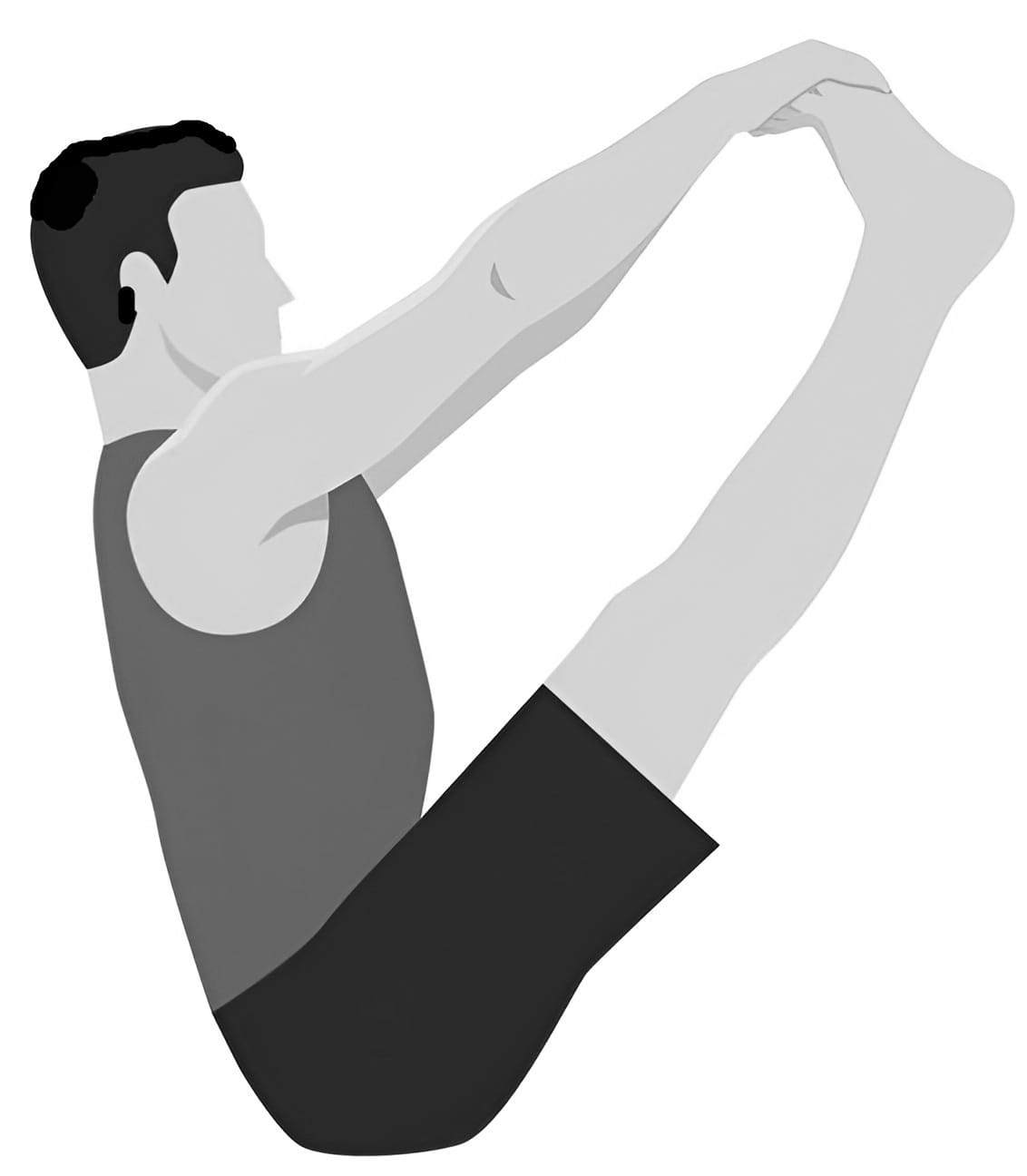
2. Definition
Ubhaya Padangusthasana is a classical seated balance pose in which the practitioner rocks forward from a reclined position to balance on the sitting bones while holding both big toes with the fingers, extending the legs upward. It demands synchronous control of the core, hip flexors, pelvis, and spine to maintain equilibrium without collapsing the lumbar or rounding excessively.
The posture appears in Ashtanga Yoga Primary Series as a transitional and integrative pose between hamstring stretches and core-strengthening postures.
3. Method of Practice – Step-by-Step
Preparatory Setup
Sit in Dandasana with legs straight, spine long, and pelvis neutral.
Step 1 – Entering the Pose
- Exhale and gently recline back until your pelvis rolls posteriorly.
- Lift both legs together using your hip flexors.
- Bend the knees slightly and slide your hands to grab your big toes using yogic toe lock (index and middle fingers + thumb).
Step 2 – Drawing the Legs In
- Bring the knees toward the chest while maintaining a long spine.
- Activate the core to prevent collapsing.
Step 3 – Transition to Balance
- Start to rock forward, lifting the torso upright.
- Balance on the sitting bones, not the sacrum.
Step 4 – Straightening the Legs
- Slowly extend both legs upward while keeping:
- chest lifted,
- collarbones broad,
- shoulders away from the ears.
Step 5 – Finding Stability
- Engage the pelvic floor and deep abdominal muscles.
- Keep gaze (drishti) at the toes or straight ahead.
Step 6 – Holding the Pose
- Maintain smooth, even breathing for 5–10 breaths.
- Feel equal weight on both sitting bones.
Step 7 – Exiting
- Exhale, bend the knees, release the toes.
- Lower feet gently back to the mat.
4. Alignment Cues
Feet & Legs
- Keep toes active and feet flexed.
- Kneecaps face upward; avoid internal rotation.
- Lift from the inner thighs rather than gripping hip flexors.
Pelvis
- Find a neutral or slightly anterior tilt.
- Avoid falling onto the sacrum (posterior tilt).
Core & Spine
- Draw navel slightly in to stabilize.
- Keep spine tall, avoiding collapse in lower back.
- Lift the sternum upward.
Shoulders & Arms
- Shoulders move down and back.
- Elbows softly extended but not locked.
Breath & Drishti
- Maintain smooth inhales and exhales.
- Gaze gently toward the big toes or horizon.
5. Benefits
Physical Benefits
- Strengthens core musculature (transverse abdominis, obliques).
- Improves balance and proprioception.
- Stretches hamstrings, calves, and lower back.
- Strengthens hip flexors and deep stabilizers.
- Enhances pelvic floor control.
- Improves spinal mobility and alignment.
- Strengthens the erector spinae for upright posture.
- Enhances flexibility in posterior chain.
Physiological Benefits
- Stimulates abdominal organs – aiding digestion and elimination.
- Improves respiratory efficiency through upright thoracic extension.
- Enhances neuromuscular coordination.
- Promotes sympathetic–parasympathetic balance.
Psychological Benefits
- Develops focus and concentration.
- Enhances body awareness.
- Reduces mental restlessness through breath-mind synchronization.
6. Contraindications
- Severe lower back pain or herniated disc.
- Acute sciatica.
- Hamstring tears or high hamstring tendinopathy.
- Hip joint injury or labral tear.
- Post-abdominal surgery.
- Vertigo or balance disorders.
- Pregnancy (2nd and 3rd trimester).
Use Caution
- Tight hamstrings.
- Weak core.
- Knee issues.
- Limited hip flexion.
7. Counterposes
- Baddha Konasana
- Janu Sirsasana
- Supta Baddha Konasana
- Paschimottanasana (gentle version)
- Apanasana (knees-to-chest)
These relax the hip flexors and hamstrings after the intense stretch.
8. Preparatory Practices
Warm-Up
- Cat–Cow
- Seated forward folds
- Hip circles
- Light abdominal activation
Preparatory Asanas
- Dandasana
- Paschimottanasana
- Supta Padangusthasana
- Navasana
- Uttanasana
- Ardha Navasana
- Baddha Konasana
These prepare the hamstrings, hip flexors, and core.
9. Modifications
For Hamstring Tightness
- Keep knees bent.
- Use a strap looped around feet.
For Balance Challenges
- Practice with back against a wall.
- Place a bolster under sitting bones.
For Weak Core
- Practice only the reclined version, holding toes while lying down.
For Limited Hip Flexion
- Hold ankles instead of toes.
10. Muscles Involved
Primary Muscles
- Iliopsoas
- Rectus femoris
- Quadriceps
- Erector spinae
- Transverse abdominis
- Obliques
Secondary Muscles
- Hamstrings
- Calves (gastrocnemius, soleus)
- Gluteus medius
- Pelvic floor muscles
- Serratus anterior (indirect stabilizer)
- Rhomboids (maintain shoulder retraction)
11. Kinesiology of Ubhaya Padangusthasana
Joint Actions
Hip Joint
- Flexion (primary)
- Slight external rotation
- Hamstring lengthening (eccentric stretch)
Knee Joint
- Extension (active quadriceps contraction)
Pelvis
- Neutral to slight anterior tilt
- Stabilized by core activation
Spine
- Axial extension and moderate flexion
- Lumbar stabilization
Shoulder & Arm
- Elbow extension
- Shoulder flexion (light)
- Finger flexion (toe lock)
12. Kinematics
Movement Phases
1. Initiation Phase (Reclining to Lift)
- Hip flexion increases.
- Core engages to counter leg weight.
- Center of mass shifts forward.
2. Balancing Phase
- Small continuous adjustments through:
- pelvic micro-tilts,
- core contraction,
- shoulder-scapula stabilizing.
3. Extension Phase
- Legs straighten both via:
- concentric quadriceps activation,
- eccentric hamstring lengthening.
4. Stabilization Phase
- Maintaining upright position with:
- spinal erectors,
- deep core muscles,
- pelvic floor.
13. Biomechanism
Force Dynamics
- Weight of lifted legs creates a forward torque.
- Core provides counter-torque to keep spine upright.
- Gripping toes creates a closed kinetic chain, improving stability.
Base of Support
- Very small: sit bones only.
- Requires continual micro-adjustments.
Muscle Co-Activation
- Hip flexors + Rectus abdominis = main force pairing.
- Erector spinae stabilizes thoracic and lumbar spine.
- Quadriceps maintain knee extension.
Balance Strategy
- Combination of ankle, hip, and core strategies.
- Primary strategy: core stabilization.
14. Functional Anatomy & Physiology
Spinal Segment Function
- Thoracic extension opens the chest for breathing.
- Lumbar spine stabilizes against gravity using:
- multifidus,
- transverse abdominis,
- pelvic floor co-activation.
Nervous System Activation
- Requires intense proprioceptive feedback.
- Strengthens neuromuscular mapping between core and lower limbs.
Respiratory Function
- Deep diaphragmatic breathing enhances:
- oxygenation,
- parasympathetic activation,
- overall stability.
Circulatory Response
- Increases blood flow to:
- abdominal organs,
- pelvic organs,
- lower limbs.
15. How to Correct and Adjust While Teaching
General Teaching Principles
- Encourage length over height—spine stays long, legs can stay bent.
- Stabilize pelvis before attempting full extension.
- Avoid forcing the fold.
Verbal Cues
For Core Activation
- “Lift from the sternum.”
- “Draw the navel gently in.”
- “Balance on the center of your sitting bones.”
For Legs & Feet
- “Reach through your heels.”
- “Extend legs from the base of the thighs.”
For Shoulders & Arms
- “Relax your shoulders away from your ears.”
- “Broaden your collarbones.”
Hands-On Adjustments (Only with consent)
1. Pelvic Adjustment
- Place hands lightly on hips.
- Gently guide pelvis into neutral/anterior tilt.
2. Spinal Lengthening
- One hand at upper back, guiding upward.
- Other hand stabilizing lower ribs.
3. Hamstring Support
- Support the back of thighs while student extends legs.
Common Mistakes & Corrections
1. Collapsing the Spine
- Cue: “Lift the chest higher.”
- Modify: Bend knees slightly.
2. Rounding Lower Back
- Cue: “Tilt pelvis slightly forward.”
- Add folded blanket to elevate hips.
3. Overworking Hip Flexors
- Cue: “Use your breath to lift, not just your legs.”
4. Losing Balance
- Teach against a wall or on a bolster.
Conclusion
Ubhaya Padangusthasana is a dynamic and integrative yoga posture that merges core strength, hamstring flexibility, spinal extension, and fine neurological control. Its challenge lies not just in lifting the legs but in balancing effortlessly on the sitting bones with a sense of lightness and breath-centered stability. With proper preparation, mindful cues, and appropriate modifications, this posture becomes a gateway to enhanced balance, improved flexibility, stronger core stability, and heightened inner awareness.
QUESTION AND ANSWER
1. The word “Ubhaya” in Ubhaya Padangusthasana means:
A. Upward
B. Both
C. Feet
D. Arms
Answer: B
2. Ubhaya Padangusthasana primarily belongs to which category of asanas?
A. Backbends
B. Balance + Forward fold
C. Inversions
D. Twists
Answer: B
3. The main base of support in Ubhaya Padangusthasana is:
A. Sacrum
B. Heels
C. Sitting bones
D. Lower back
Answer: C
4. Which movement is the primary action at the hip joint in this pose?
A. Extension
B. Flexion
C. Abduction
D. Circumduction
Answer: B
5. The yogic grip used in this posture is:
A. Chin mudra
B. Vishnu mudra
C. Toe lock (Padangustha grip)
D. Jnana mudra
Answer: C
6. Which muscle is MOST responsible for raising both legs into the posture?
A. Gluteus maximus
B. Iliopsoas
C. Hamstrings
D. Quadratus lumborum
Answer: B
7. What is an essential alignment cue for the spine in Ubhaya Padangusthasana?
A. Deep rounding of lower back
B. Spine relaxed
C. Spine tall and lifted
D. Shoulders hunched
Answer: C
8. Students with which condition should AVOID this pose?
A. Weak ankles
B. Back pain due to disc herniation
C. Wrist pain
D. Migraine
Answer: B
9. The breathing pattern advised in this asana is:
A. Rapid breathing
B. Shallow chest breathing
C. Hold breath
D. Smooth diaphragmatic breathing
Answer: D
10. The primary muscle group stretched is:
A. Quadriceps
B. Hamstrings
C. Glutes
D. Deltoids
Answer: B
11. The posture demands strong activation of which deep core muscle?
A. Deltoids
B. Transverse abdominis
C. Piriformis
D. Biceps brachii
Answer: B
12. A common mistake in this pose is:
A. Excessive knee flexion
B. Falling onto the sacrum
C. Keeping spine tall
D. Using toe lock
Answer: B
13. Which modification helps students with tight hamstrings?
A. Use a strap around feet
B. Fold forward deeply
C. Lift legs higher
D. Hold breath
Answer: A
14. The final drishti (gaze) is generally directed at:
A. Ceiling
B. Hands
C. Big toes
D. Navel
Answer: C
15. Ubhaya Padangusthasana appears in which traditional sequence?
A. Iyengar Pranayama Sequence
B. Ashtanga Primary Series
C. Gheranda Advanced Series
D. Yin Yoga Sequence
Answer: B
16. Which is NOT a preparatory pose?
A. Navasana
B. Dandasana
C. Uttanasana
D. Chakrasana
Answer: D
17. What should a teacher correct first in a struggling student?
A. Foot angle
B. Pelvic alignment
C. Eye position
D. Finger grip
Answer: B
18. Which joint performs extension during the leg straightening phase?
A. Hip
B. Knee
C. Ankle
D. Wrist
Answer: B
19. This posture strongly improves:
A. Shoulder mobility
B. Core stability
C. Neck flexibility
D. Chest compression
Answer: B
20. A good counterpose after this asana is:
A. Matsyasana
B. Apanasana
C. Handstand
D. Ustrasana
Answer: B
21. Which biomechanical action prevents falling backward?
A. Hip adduction
B. Core counter-torque
C. Foot inversion
D. Knee rotation
Answer: B
22. Which structure stabilizes the pelvis most during balancing?
A. Rectus femoris
B. Gluteus maximus
C. Pelvic floor muscles
D. Triceps
Answer: C
23. Over-activation of which muscles can create discomfort?
A. Hip flexors
B. Gluteus minimus
C. Rhomboids
D. Tibialis anterior
Answer: A
24. The safest way to enter the pose is:
A. Kick legs upward
B. Sudden pull using hands
C. Controlled lift using core
D. Bend backward first
Answer: C
25. Which version is used for beginners?
A. Full leg extension
B. Knees bent holding ankles
C. Holding toes with straight legs
D. Balancing on sacrum
Answer: B
26. What is the ideal pelvic tilt in this pose?
A. Posterior tilt
B. Lateral tilt
C. Neutral to anterior tilt
D. Extreme anterior tilt
Answer: C
27. Which movement of the spine predominates?
A. Hyperextension
B. Neutral + axial extension
C. Side bending
D. Spinal rotation
Answer: B
28. Which breath cue helps students maintain balance?
A. Exhale fully and hold
B. Short rapid breaths
C. Slow steady exhales
D. Only inhale
Answer: C
29. The toe lock mainly engages which muscles in the arms?
A. Finger flexors
B. Triceps
C. Deltoids
D. Wrist extensors
Answer: A
30. Which condition warrants wall support?
A. Hypermobile hamstrings
B. Poor balance
C. Shoulder stiffness
D. Migraine
Answer: B
31. What is the role of quadriceps in this pose?
A. Attempt to flex hip
B. Assist knee extension
C. Relax completely
D. Rotate pelvis
Answer: B
32. Which fascial line is most stretched?
A. Spiral line
B. Superficial back line
C. Deep lateral line
D. Arm line
Answer: B
33. Holding the pose too long may stress which structure?
A. Wrist
B. Sacroiliac joint
C. Shoulder joint
D. Ankle
Answer: B
34. The MOST essential cue for students losing balance is:
A. Lift the chin
B. Press sitting bones down
C. Lock elbows
D. Squeeze toes harder
Answer: B
35. Which muscle group lengthens eccentrically during the rise into balance?
A. Pectorals
B. Hamstrings
C. Biceps
D. Gastrocnemius
Answer: B
36. A prop used for beginners is:
A. Bolster under hips
B. Sandbag on legs
C. Wall strap
D. Head block
Answer: A
37. Primary spinal stabilizer engaged is:
A. Trapezius
B. Multifidus
C. Gastrocnemius
D. Biceps
Answer: B
38. Which teaching correction helps keep shoulders aligned?
A. Lift shoulders up
B. Pull shoulders behind hips
C. Draw shoulders down and back
D. Rotate shoulders inward
Answer: C
39. Which mental benefit is strongly connected to this pose?
A. Hyperarousal
B. Anxiety increase
C. Sense of stability and focus
D. Mental dullness
Answer: C
40. What is the safest cue to exit the pose?
A. Release toes suddenly
B. Swing legs outward
C. Lower legs slowly with breath
D. Drop back to mat
Answer: C