
1. Introduction
Trianga Mukhaikapada Paschimottanasana is a unique seated forward-bending posture from classical Hatha Yoga and the Ashtanga Yoga Primary Series. It blends the qualities of unilateral hip flexion, knee flexion, forward folding, spinal elongation, breath-awareness, and pelvic stabilization. This asana is both therapeutic and strengthening when performed correctly, as it works on the hamstrings, quadriceps, gluteal muscles, spinal extensors, and deep abdominal tissues.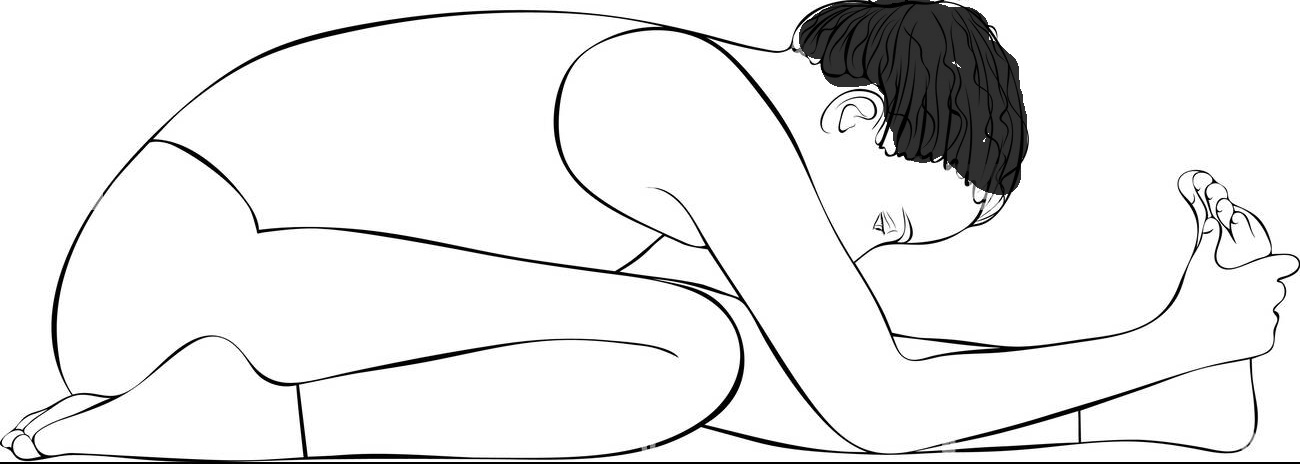
While it appears simple at first glance, the posture demands mindful technique and an understanding of biomechanics, especially regarding knee alignment, hip safety, and the correct direction of pelvic movement. Because one leg is folded back in a half-virasana-like position, the asana influences the quadriceps and hip flexors differently on each side, making it an important asymmetrical forward-fold.
2. Word Meaning
Trianga Mukhaikapada Paschimottanasana is a compound Sanskrit term composed of:
- Tri-anga = Three limbs or three parts
- Mukha = Face/front
- Eka-pada = One leg
- Paschima = West/back side of the body
- Uttana = Intense stretch
- Asana = Pose
Thus, the full name translates roughly as:
“Three-limbed forward fold pose stretching the back side of the body with one leg folded.”
It refers to the three-limbed arrangement: one leg extended, one leg folded back, and the torso folding forward.
3. Definition
Trianga Mukhaikapada Paschimottanasana is a seated asymmetrical forward-leaning posture where:
- One leg remains extended forward in Dandasana.
- The other leg folds back beside the hip (half-Virasana position).
- The practitioner bends forward over the extended leg, elongating the entire posterior chain.
It is a pose of deep hamstring stretch, hip stabilisation, pelvic tilt training, lengthening of spinal fascia, and expansion of breath into the back body.
4. Method of Practice — Step-by-Step
Step 1: Begin in Dandasana
Sit with both legs extended in front. Keep the spine tall and palms by the hips.
Step 2: Fold one leg back
- Bend the right leg.
- Place the right foot next to the right hip, toes pointing back.
- Ensure the knee is comfortably folded without strain.
Step 3: Adjust pelvis and sit bones
- Root the left sitting bone down.
- If the right hip lifts excessively, sit on a folded blanket or block.
Step 4: Square the torso
Rotate the torso slightly toward the extended leg so both sides of the waist are even.
Step 5: Inhale and lengthen the spine
Raise the arms overhead, creating axial elongation.
Step 6: Exhale and fold forward
- Hinge from the hips.
- Catch the left foot with hands (or use a strap).
- Maintain length in the front body.
Step 7: Deepen the posture
Allow the abdomen, ribs, and chest to descend toward the thigh.
Step 8: Maintain the pose
Hold for 8–12 breaths, relaxing into the forward fold.
Step 9: Release
Come back up slowly, switch legs, and repeat.
5. Alignment Cues
Lower Body
- Knee Safety: The folded leg’s knee must point straight ahead; avoid lateral rotation.
- Ankle Alignment: Keep the foot of folded leg relaxed, toes backward.
- Extended Leg:
Level kneecap upward
Engage quadriceps
Flex the ankle to protect hamstrings
Pelvis
- Drop the extended-leg sit bone firmly.
- Avoid collapsing into the bent-leg side.
- Initiate the fold from the hip hinge, not lumbar flexion.
Spine
- Keep the spine long and neutral.
- Allow the chest to move forward before head drops.
Shoulders & Arms
- Draw shoulders away from ears.
- Use a strap if rounding excessively.
Breath
- Inhale to lengthen
- Exhale to deepen without force
6. Benefits
Physical Benefits
- Deep stretch to hamstrings and calves of the extended leg
- Stretch and release of quadriceps and hip flexors of the folded leg
- Improves pelvic mobility
- Enhances spinal flexibility
- Strengthens abdominal muscles during forward fold
- Corrects muscle imbalances between left & right sides
- Improves knee joint mobility when done properly
- Massages abdominal organs improving digestion
Therapeutic Benefits
- Helpful for sciatica (with proper modification)
- Relieves menstrual discomfort
- Calms the nervous system
- Improves respiratory efficiency by facilitating back-body breathing
7. Contraindications
Avoid or modify if you have:
- Knee injury (meniscus, ligament tear)
- Ankle stiffness preventing half-Virasana
- Severe tight quadriceps
- Lower back herniation (unless supervised)
- Hip joint inflammation
- Sciatica flare-ups
Pregnancy:
Avoid deep forward folds in later trimesters.
8. Counterposes
After Trianga Mukhaikapada Paschimottanasana, practice:
- Dandasana
- Vajrasana
- Supta Virasana (gentle version)
- Setu Bandhasana (bridge pose)
- Ardha Matsyendrasana (gentle twist)
9. Preparatory Practices
Hip & Leg Preparation
- Virasana
- Ardha Virasana
- Supta Padangusthasana
- Janu Sirsasana
- Baddha Konasana
Hamstring Preparation
- Uttanasana
- Paschimottanasana
- Dynamic leg lifts
Back & Spine Preparation
- Cat–Cow
- Ardha Uttanasana
- Seated spinal lengthening
10. Modifications
1. Sit on a Block
If the pelvis tilts backward or the knee lifts, elevate the hips.
2. Strap Around the Extended Foot
To avoid rounding of the spine.
3. Support Under the Knee of Folded Leg
Place a folded blanket under the knee to remove pressure.
4. Keep Hands on Shin or Floor
Instead of holding the foot, keep the spine long.
5. Wall Assistance
Sit with back lightly touching a wall to train axial extension.
11. Muscles Involved
Primary Muscles Stretched
- Hamstrings (biceps femoris, semitendinosus, semimembranosus)
- Gastrocnemius
- Soleus
- Erector spinae
- Latissimus dorsi
- Gluteus maximus
Muscles Stretched in the Folded Leg
- Quadriceps (vastus group, rectus femoris)
- Tibialis anterior
- Psoas (mild stretch depending on pelvic angle)
Primary Muscles Engaged
- Quadriceps of extended leg
- Hip flexors
- Abdominals
- Spinal extensors
Stabilizing Muscles
- Gluteus medius & minimus
- Pelvic floor muscles
- Internal/external obliques
12. Kinesiology
Movement Analysis
- Hip Flexion: On extended leg side
- Hip Extension / Knee Flexion: On folded leg
- Spinal Flexion: Forward bending
- Ankle Dorsiflexion: Extended leg
- Shoulder Flexion: Initial lift of arms
Joint Actions
- Extended Leg: Hip flexion + knee extension
- Folded Leg: Hip extension + knee deep flexion
- Spine: Lengthens → then flexes
Muscle Contraction Types
- Isometric: Spinal extensors, quadriceps
- Eccentric: Hamstrings during forward hinge
- Concentric: Abdominals to deepen the fold
13. Kinematics
1. Sagittal Plane Dominance
Main movement occurs in forward and backward direction.
2. Asymmetrical Loading
Each side of the pelvis undergoes different forces.
3. Hip Hinge Mechanics
The correct hinge initiates from:
- Ischial tuberosities sliding back
- Neutral lumbar curve maintained
4. Controlled Descent
The torso moves through:
- Lengthened spine
- Eccentric stretch of posterior chain
14. Biomechanism
Pelvic Mechanics
The pelvis rotates anteriorly over the head of the femur in extended leg.
Knee Biomechanics
The folded leg experiences:
- Compressive forces
- Stretch through quadriceps
- Crucial importance of neutral knee tracking
Fascial Influences
The pose stretches:
- Superficial back fascial line
- Deep frontal core fascia
- Lateral fascial connections (due to asymmetry)
Load Distribution
- More weight shifts toward the side of the folded leg.
- Balanced muscular engagement maintains neutrality.
Spinal Biomechanics
- Pressure shifts slightly to thoracolumbar fascia
- Safe only if the fold initiates from the pelvis
15. Functional Anatomy & Physiology
Nervous System
- Activates the parasympathetic system
- Reduces sympathetic overstimulation
Musculoskeletal System
- Improves length-tension relationships of hamstrings
- Enhances hip mobility without overloading joints
Respiratory System
- Promotes diaphragmatic back-body expansion
- Increases breath capacity in the posterior lungs
Digestive System
Forward fold compresses abdominal organs which:
- Stimulates peristalsis
- Enhances detoxification
- Relieves bloating
16. How to Correct and Adjust While Teaching
1. Correcting Pelvic Tilt
- Use hands to gently draw the student’s lower ribs forward
- Cue: “Lift the spine before folding”
2. Supporting the Folded Leg
- Place a block under the sit bone or knee
- Cue: “No pain in the knee—adjust height”
3. Ensuring Knee Alignment
- Make sure knee points forward
- Avoid outward (valgus) or inward (varus) drift
4. Addressing Spinal Rounding
- Instruct student to sit up tall
- Use strap to prevent collapsing chest
5. Assisting the Forward Fold
- Stand behind the student
- Hold the waist or hips
- Guide the hinge from pelvis, not lumbar spine
6. Deepening the Pose
- Once the student is aligned, gently press down on the back
- Only with consent and without forcing
7. Breath Cueing
- “Inhale to lengthen”
- “Exhale to soften into the posture”
8. Safety Cues
- “Stop if you feel knee pain”
- “Keep pelvis squared”
- “Maintain neutral spine initially”
Conclusion
Trianga Mukhaikapada Paschimottanasana is a profound, multifaceted asana that integrates asymmetrical leg positioning with forward folding mechanics, encouraging both flexibility and stability. It enhances hamstring length, quadriceps release, hip mobility, pelvic alignment, spinal elongation, and parasympathetic nervous system activation. Practiced thoughtfully, it becomes a deeply meditative forward bend with powerful effects on the musculoskeletal, respiratory, and digestive systems.
Through proper alignment, modifications, careful adjustments, and breath awareness, practitioners can safely experience the transformative benefits of this classical yoga posture.
QUESTION AND ANSWER
1. The term “Trianga” in Trianga Mukhaikapada Paschimottanasana refers to:
A. Three angles
B. Three limbs or parts
C. Three breaths
D. Three stretches
Answer: B
2. The folded leg in this pose resembles which classical posture?
A. Padmasana
B. Virasana / Half-Virasana
C. Baddha Konasana
D. Vajrasana
Answer: B
3. The main movement of the torso in Trianga Mukhaikapada Paschimottanasana is:
A. Spinal extension
B. Lateral flexion
C. Forward flexion
D. Spinal rotation
Answer: C
4. Which side experiences hip flexion in this posture?
A. The folded-leg side
B. The extended-leg side
C. Both sides equally
D. Neither side
Answer: B
5. Which muscle group is primarily lengthened in the extended leg?
A. Quadriceps
B. Hamstrings
C. Adductors
D. Gluteals
Answer: B
6. Which joint action occurs in the folded leg?
A. Knee extension
B. Knee flexion
C. Knee abduction
D. Knee rotation
Answer: B
7. Which of the following is a key alignment cue?
A. Keep the pelvis tilted backward
B. Round the spine deeply
C. Root the extended-leg sit bone
D. Point the extended foot outward
Answer: C
8. A major contraindication for this asana is:
A. Shoulder impingement
B. Knee injury
C. Headache
D. Common cold
Answer: B
9. What is the ideal direction of the torso when folding?
A. Toward the folded leg
B. Toward the extended leg
C. Straight down the center
D. Away from both legs
Answer: B
10. Trianga Mukhaikapada Paschimottanasana primarily stretches which fascial line?
A. Lateral line
B. Spiral line
C. Superficial back line
D. Deep front line
Answer: C
11. A suitable preparatory pose for this asana is:
A. Chakrasana
B. Tadasana
C. Janu Sirsasana
D. Ustrasana
Answer: C
12. Which of the following helps protect the lower back in this pose?
A. Flex the spine early
B. Initiate movement from the hips
C. Keep shoulders elevated
D. Collapse the chest
Answer: B
13. What is a safe modification for knee discomfort?
A. Add weight to the bent knee
B. Elevate the hips on a block
C. Forcefully push hip down
D. Point toes sideways
Answer: B
14. Which muscle must engage to stabilize the extended leg?
A. Rectus femoris
B. Quadriceps
C. TFL
D. Soleus
Answer: B
15. Which respiratory effect is associated with this posture?
A. Shallow chest breathing
B. Breath retention
C. Back-body breath expansion
D. Forced exhalation
Answer: C
16. The folded leg’s quadriceps experience:
A. Contraction
B. Deep stretch
C. No activation
D. Compression
Answer: B
17. A teacher adjustment should focus on:
A. Forcing the student deeper
B. Broadening the shoulders and lengthening spine
C. Compressing the abdomen
D. Rotating the pelvis backward
Answer: B
18. Which is NOT a benefit of this asana?
A. Improved digestion
B. Release of posterior chain tension
C. Strengthening of the triceps
D. Nervous system relaxation
Answer: C
19. Which structure is most at risk in improper bent-leg alignment?
A. Deltoid muscle
B. Meniscus of the knee
C. Achilles tendon
D. Radius bone
Answer: B
20. Which biomechanical action initiates safe forward bending here?
A. Pelvic anterior tilt
B. Pelvic posterior tilt
C. Thoracic rounding
D. Neck flexion
Answer: A
21. Which kinematic plane primarily governs this movement?
A. Frontal plane
B. Transverse plane
C. Sagittal plane
D. Horizontal plane
Answer: C
22. Which counterpose is most suitable?
A. Setu Bandhasana
B. Chakrasana
C. Shirshasana
D. Bakasana
Answer: A
23. A sign that a student needs support is:
A. Calm breathing
B. Even pelvic alignment
C. Knee lifting off ground painfully
D. Neutral spine
Answer: C
24. The extended foot should ideally be:
A. In plantar flexion
B. Relaxed outward
C. Dorsiflexed
D. Pointed toward the bent leg
Answer: C
25. In teaching adjustments, a key safety instruction is:
A. “Push harder to increase stretch.”
B. “If you feel pain in knee, come out immediately.”
C. “Ignore discomfort and hold longer.”
D. “Round the back to go deeper.”
Answer: B