
1. Word Meaning
The term Supta Konasana is derived from Sanskrit:
- Supta – “supine,” “reclining,” or “lying down.”
- Kona – “angle.”
- Asana – “posture.”
Thus, Supta Konasana translates to “Reclined Angle Pose.”
It is a deep forward fold performed in the supine position where the legs stretch wide apart overhead, forming an extended angle.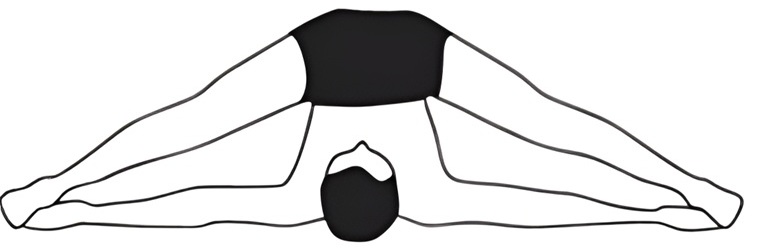
2. Definition
Supta Konasana is an intermediate-to-advanced flexibility posture practiced in Hatha Yoga, Ashtanga Yoga (specifically in the Primary and Intermediate series), and therapeutic yoga traditions. The posture involves lying on the back, lifting the legs overhead, spreading them wide apart, and folding from the hips while maintaining spinal integrity.
It combines elements of
- forward bending,
- hamstring and adductor stretching,
- core activation,
- pelvic stability, and
- inversion mechanics (when combined with halasana-like entry).
Overall, it is a deep restorative and introspective pose, promoting calmness, enhanced circulation to the pelvic region, and proprioceptive awareness.
3. Method of Practice – Step-by-Step Procedure
Traditional Method (from lying supine)
- Starting Position
Lie down in Shavasana with legs extended and arms relaxed. - Activate the Core
On inhalation, engage the lower abdominal muscles and press the lower back gently toward the mat. - Lift the Legs
Raise both legs to 90° using slow controlled movement. - Move Into Halasana-like Entry
Press palms into the ground and lift hips slightly, allowing the legs to move overhead. - Spread the Legs
Gently widen the legs apart as far as comfortable, aiming for a V-shape (ideally 120–180° depending on flexibility). - Hold the Big Toes or Feet
Reach the hands to hold the big toes (yoga toe lock – padangustha grip) or ankles.
If not accessible, hold behind the thighs. - Deepening the Stretch
Use exhalation to maintain the elongation in hamstrings and inner thighs.
Keep the neck and shoulders relaxed. - Maintain Neutral Breathing
Hold the pose for 5–10 slow breaths or 30–60 seconds. - Release Safely
Bring the legs together overhead, slowly lower the spine vertebra by vertebra, and return to Shavasana.
4. Alignment Cues
Leg Alignment
- Keep legs straight and active; avoid collapsing the knees inward.
- Toes point slightly forward or slightly flexed depending on comfort.
- Spread legs evenly to avoid twisting the pelvis.
Spinal Alignment
- Maintain length in the lumbar spine.
- Avoid collapsing the chest into the sternum.
- Ensure shoulders stay broad and grounded.
Hip Alignment
- Hips should stay level; avoid one side lifting more than the other.
- Move from hip joints, not from knees.
Arm & Shoulder Mechanics
- Avoid pulling toes aggressively; grip lightly.
- Shoulders stay relaxed and away from the ears.
Breathing Cues
- Inhale to lengthen spine.
- Exhale to soften into the stretch, keeping the diaphragm relaxed.
5. Benefits
A. Physical Benefits
- Stretches hamstrings, adductors, and calves deeply.
- Improves spinal flexibility and releases lower back tension.
- Stimulates abdominal organs, aiding digestion.
- Enhances pelvic floor mobility and blood flow.
- Improves circulatory and lymphatic drainage due to inverted nature.
- Stretches groin and hip joints, improving functional mobility.
- Reduces sciatic nerve tightness when done with proper alignment.
B. Therapeutic Benefits
- Beneficial for constipation, mild menstrual cramps, and pelvic congestion.
- Helps reduce anxiety and mental fatigue.
- Calms the nervous system and supports parasympathetic activation.
C. Energetic Benefits (According to Yoga Philosophy)
- Stimulates Muladhara, Svadhisthana, and Manipura chakras.
- Enhances grounding and emotional release.
D. Functional Benefits
- Improves range of motion in hips and legs.
- Enhances postural awareness and proprioception.
- Builds a balance of flexibility and strength in lower body kinetic chains.
6. Contraindications
Avoid or modify if the student has:
- Cervical spondylosis or neck injuries
- Severe sciatica
- Hernia or abdominal surgery
- High blood pressure
- Glaucoma (due to inversion-like pressure)
- Severe lower back pain
- Menstruation (varies per tradition; Ashtanga discourages inversions)
Pregnant women must avoid the pose.
7. Counterposes
After Supta Konasana, perform:
- Pavanmuktasana – to neutralize lower back
- Setu Bandhasana – to release hamstrings
- Gentle spinal twist – to rebalance pelvis
- Shavasana – for final rest
8. Preparatory Practices
Warm-ups
- Supine leg raises
- Halasana preparation
- Baddha Konasana
- Upavistha Konasana (wide-angle seated pose)
- Supta Padangusthasana (hamstring opener)
- Adductor stretches
- Core strengthening like Navasana
9. Modifications
- Use a strap to hold feet if flexibility is limited.
- Support the hips with a folded blanket for comfort.
- Bend knees slightly to reduce hamstring strain.
- Hands behind thighs instead of toes for beginners.
- Wall support: Feet can rest on the wall in a V-shape.
10. Muscles Involved (Primary and Secondary)
Primary Muscles Stretched
- Hamstrings (Biceps femoris, Semitendinosus, Semimembranosus)
- Adductors (Magnus, Longus, Brevis)
- Gracilis
- Obturator muscles
- Gastrocnemius (mild)
Primary Muscles Engaged
- Core muscles (Rectus abdominis, Transverse abdominis, Obliques)
- Hip flexors (Iliopsoas)
- Quadriceps (for knee extension)
- Erector spinae (stabilizing)
Secondary Muscles Activated
- Pelvic floor muscles
- Rhomboids (if reaching toes)
- Latissimus dorsi (light engagement)
11. Kinesiology
Joint Actions
- Hip flexion – legs moving toward torso
- Hip abduction – spreading legs apart
- Knee extension
- Spinal flexion (mild)
- Shoulder flexion (reaching for toes)
Muscle Contractions
- Concentric in hip flexors during entry.
- Isometric contractions in core stabilizers throughout.
- Eccentric stretch in hamstrings and inner thighs.
Kinetic Chain Involvement
- Lower kinetic chain: hips → pelvis → spine.
- Upper chain: shoulders → arms provide mild traction.
12. Kinematics
Movement Mechanics
- Slow transition prevents excessive spinal pressure.
- Lower body performs controlled angular motion around hip joints.
- Spine and pelvis maintain neutral curvature despite lift.
Range of Motion
- Hip abduction: 60°–120°.
- Hip flexion: 90°+ depending on halasana entry.
Center of Gravity
- Moves toward upper spine as legs move overhead.
- Requires strong core stabilization to avoid collapse.
13. Biomechanism
Biomechanical Principles
- Lever action: Legs act as long levers requiring core stabilization.
- Controlled eccentric loading: Protects hamstrings and adductors.
- Pelvic tilting mechanics: Proper posterior tilt avoids lumbar compression.
- Spinal traction effect: When aligned properly, decompresses lower spine.
Forces Acting
- Gravitational force pulling legs down increases stretch.
- Ground reaction force stabilizes shoulders and upper spine.
14. Functional Anatomy & Physiology
Nervous System
- Activates parasympathetic response → relaxation.
- Enhances proprioception in hips and pelvis.
Circulatory System
- Inversion slightly increases venous return.
- Improves blood flow to pelvic organs.
Respiratory System
- Diaphragm expands against abdominal compression → deeper breathing.
Musculoskeletal System
- Lengthens posterior and medial muscle chains.
- Strengthens stabilizing muscles in the trunk.
15. How to Correct and Adjust While Teaching
Verbal Cues
- “Keep legs active and straight.”
- “Spread your legs evenly from the hip joints.”
- “Relax your shoulders and jaw.”
- “Breathe into your lower belly.”
Physical Adjustments (Only with consent)
- Leg Support Adjustment
- Hold ankles gently and assist in widening legs.
- Ensure hips remain level.
- Spinal Alignment Correction
- Place a hand under lower back to encourage lengthening.
- Hamstring Safety Check
- Encourage micro-bending knees if overstretching occurs.
Observation Points
- Neck should not lift or strain.
- Knees should not roll inward.
- Hips should stay grounded and symmetrical.
Safety Adjustments
- Provide blanket under shoulders for those with neck sensitivity.
- Use strap for limited flexibility.
Conclusion
Supta Konasana is a powerful, introspective posture combining strength, flexibility, inversion mechanics, and deep pelvic opening. When practiced with alignment integrity and mindful breathing, it offers immense physical, mental, and energetic benefits. Understanding the anatomy, kinesiology, biomechanics, and proper sequencing ensures safe practice and effective teaching.
QUESTION AND ANSWER
1. The Sanskrit term Supta means:
A. Seated
B. Supine or Reclined
C. Folded
D. Twisted
Answer: B
2. Supta Konasana primarily involves which movement at the hip joint?
A. Extension
B. Adduction
C. Flexion and Abduction
D. Circumduction
Answer: C
3. Supta Konasana is considered:
A. A standing posture
B. A balancing posture
C. A reclined forward bend
D. A prone twist
Answer: C
4. Which major muscle group receives the deepest stretch in Supta Konasana?
A. Quadriceps
B. Hamstrings
C. Gluteus medius
D. Iliopsoas
Answer: B
5. Supta Konasana is commonly entered from which pose in Ashtanga practice?
A. Tadasana
B. Halasana
C. Adho Mukha Svanasana
D. Virasana
Answer: B
6. Which of the following is NOT a primary benefit of Supta Konasana?
A. Deep hamstring stretch
B. Increased blood flow to pelvic region
C. Strengthening the triceps
D. Calming effect on the nervous system
Answer: C
7. The ideal breath use in Supta Konasana is:
A. Short and fast
B. Holding the breath
C. Slow diaphragmatic breathing
D. Reverse breathing
Answer: C
8. Which muscle works isometrically to stabilize the core in this pose?
A. Biceps brachii
B. Transverse abdominis
C. Deltoid
D. Piriformis
Answer: B
9. Which joint action helps protect the lumbar spine in Supta Konasana?
A. Excessive anterior pelvic tilt
B. Posterior pelvic tilt
C. Knee hyperextension
D. Scapular elevation
Answer: B
10. A safe modification for students with limited hamstring flexibility is:
A. Forcing the legs wider
B. Using a strap around the feet
C. Elevating the head
D. Locking the knees
Answer: B
11. Which is a contraindication for Supta Konasana?
A. Mild headache
B. High blood pressure
C. Tight calves
D. Flat feet
Answer: B
12. In Supta Konasana, the legs form what shape?
A. Triangle
B. Square
C. V-shape or wide-angle shape
D. Circular shape
Answer: C
13. Which of the following is a counterpose to Supta Konasana?
A. Chakrasana
B. Pawanmuktasana
C. Utkatasana
D. Ustrasana
Answer: B
14. What is a common alignment error in Supta Konasana?
A. Keeping knees straight
B. Relaxing the jaw
C. Rounding the shoulders up
D. Keeping spine long
Answer: C
15. Which chakra is most associated with this posture’s energetic effect?
A. Vishuddha
B. Muladhara
C. Ajna
D. Sahasrara
Answer: B
16. Which tissue is lengthened during hip abduction in this pose?
A. IT band
B. Adductor muscles
C. Deltoid fibers
D. Trapezius
Answer: B
17. During the pose, the center of gravity shifts:
A. Toward the feet
B. Toward the chest/upper spine
C. To the left side
D. Toward the pelvis
Answer: B
18. Supta Konasana primarily stimulates which group of abdominal organs?
A. Pancreas and spleen
B. Large intestine and reproductive organs
C. Kidneys and adrenals
D. Stomach only
Answer: B
19. Which breathing cue is correct for this pose?
A. Inhale to deepen the stretch
B. Exhale to widen the legs
C. Hold breath for stability
D. Rapid breathing to release tension
Answer: B
20. Which variation decreases intensity of the stretch?
A. Straight legs
B. Legs on the floor overhead
C. Bent knees
D. Holding toes
Answer: C
21. Which of the following is a preparatory pose?
A. Dhanurasana
B. Supta Padangusthasana
C. Vrikshasana
D. Bhujangasana
Answer: B
22. The main physiological effect on the nervous system is:
A. Sympathetic stimulation
B. Parasympathetic activation
C. Increased cortisol
D. Increased muscle spasms
Answer: B
23. Which joint undergoes full extension during the posture?
A. Ankle
B. Knee
C. Wrist
D. Elbow
Answer: B
24. A teacher adjusting should primarily focus on:
A. Forcing legs further apart
B. Lengthening lumbar spine
C. Pushing neck down
D. Pulling toes hard
Answer: B
25. Excessive strain in which area indicates misalignment?
A. Groin
B. Shoulders
C. Cervical spine
D. All of the above
Answer: D
26. Students with hernia should:
A. Perform with caution
B. Avoid the pose
C. Perform with strap
D. Lift legs aggressively
Answer: B
27. What is the primary movement in spine during entry?
A. Extension
B. Rotation
C. Flexion
D. Lateral bending
Answer: C
28. Holding the toes creates which action at the shoulder?
A. Abduction
B. Flexion
C. Retraction
D. Depression
Answer: B
29. Supta Konasana helps reduce tension predominantly in:
A. Cervical spine
B. Lumbar spine
C. Thoracic spine
D. Scapula
Answer: B
30. The best verbal cue for beginners is:
A. “Force your legs wider.”
B. “Relax your neck and breathe deeply.”
C. “Pull harder on your toes.”
D. “Hold your breath for stability.”
Answer: B