
1. Introduction
Jathara Parivartanasana, commonly called Supine Spinal Twist or Revolved Abdomen Pose, is a foundational twisting asana in Hatha, Iyengar, and Vinyasa yoga.
This pose combines a gentle spinal rotation with a supine posture, offering a therapeutic release for the spine, abdominal organs, and musculoskeletal system. Twists are known for their detoxifying, digestive, and spinal mobility benefits, making this asana a staple in both yogic therapeutic practices and general fitness programs.
The posture derives its name from Sanskrit:
- Jathara: Abdomen / Stomach
- Parivartana: Rotation or turning
- Asana: Posture or seat
Thus, Jathara Parivartanasana literally translates as “Abdomen Revolving Pose”, emphasizing the rotational movement of the torso and spine while supine. 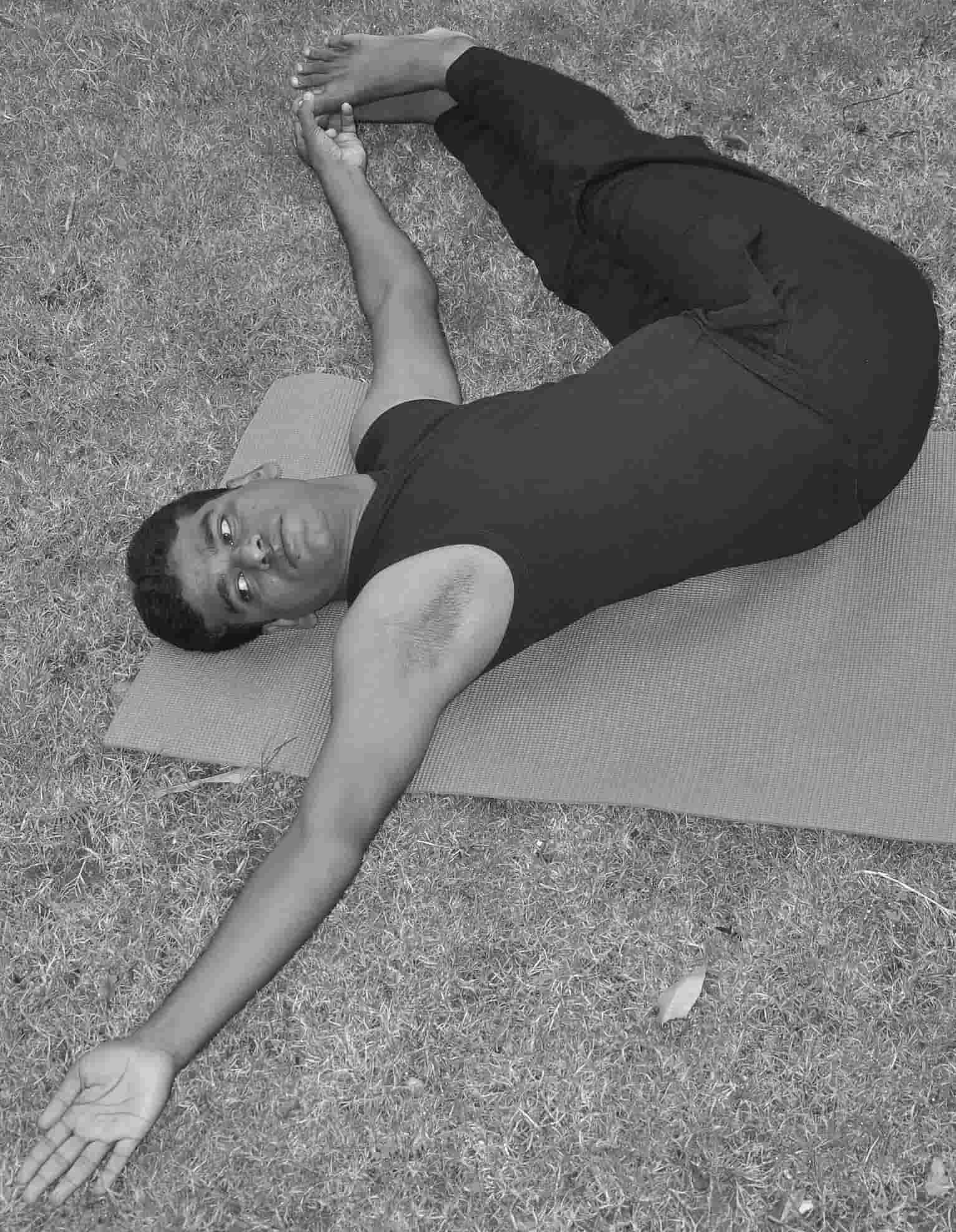
2. Word Meaning and Definition
2.1 Word Meaning
- Jathara: Abdomen or stomach
- Parivartana: Rotation, turning, or revolving
- Asana: Yoga posture or seat
2.2 Definition
Jathara Parivartanasana is a supine twisting asana in which the practitioner brings one leg across the body while the opposite arm extends sideways, creating a rotational stretch along the spine and abdominal region, stimulating internal organs and improving spinal mobility.
It can be practiced as a single-leg twist (Eka Pada Parivartanasana) or double-leg twist (Dwi Pada Parivartanasana) depending on flexibility and therapeutic needs.
3. Method of Practice — Step by Step
Step 1: Preparation
- Lie supine on a yoga mat with legs extended straight and arms resting alongside the body.
- Relax the shoulders, neck, and spine, taking several deep breaths to center awareness.
Step 2: Starting Position
- Bend the right knee and draw it toward the chest.
- Extend the left arm sideways at shoulder height, keeping the palm flat on the mat.
- Keep the right shoulder anchored to the mat to prevent compensatory rotation.
Step 3: Leg Rotation
- Inhale deeply.
- Exhale and rotate the bent right leg across the body toward the left side, aiming to place the knee on or near the mat.
- The torso rotates slightly in the opposite direction to the leg for a counter-twist along the spine.
Step 4: Head Position
- Turn the head to face the right hand, maintaining a gentle neck rotation aligned with the spine.
- If neck discomfort exists, keep the head neutral or aligned with torso.
Step 5: Alignment and Breath
- Keep both shoulders grounded.
- The opposite arm (left) extends and presses firmly to stabilize the twist.
- Breathe slowly and deeply, maintaining the twist without strain.
Step 6: Hold and Release
- Beginners hold for 15–30 seconds; advanced practitioners can hold for 1–2 minutes.
- Release the twist by gently returning the leg to center.
- Repeat on the opposite side to balance muscular and spinal engagement.
4. Alignment Cues
- Shoulders: Press evenly into the mat; avoid lifting either shoulder.
- Spine: Maintain a long spine; rotate without compressing vertebrae.
- Hips: Keep both hips grounded; avoid lifting opposite hip.
- Knee: Bent knee points toward floor; avoid forcing onto mat.
- Neck: Turn gently or keep neutral if restricted.
- Arms: Opposite arm extended to stabilize; fingers relaxed.
- Breath: Maintain slow, diaphragmatic breathing.
5. Benefits
5.1 Physical Benefits
- Increases spinal flexibility and mobility, especially thoracic rotation.
- Stretches glutes, hip flexors, and lower back.
- Stimulates abdominal organs, aiding digestion and detoxification.
- Relieves tension in lower back and shoulders.
- Promotes hip and chest flexibility.
5.2 Physiological Benefits
- Digestive system: Massages intestines and liver, improving peristalsis.
- Circulatory system: Improves blood flow to abdominal organs.
- Endocrine system: Stimulates pancreas and adrenal glands.
- Nervous system: Reduces stress by activating parasympathetic tone.
5.3 Psychological Benefits
- Relieves mild anxiety and fatigue.
- Encourages mindfulness and body awareness.
- Promotes relaxation and stress reduction.
6. Contraindications
- Severe spinal injuries or herniated discs.
- Recent abdominal or spinal surgery.
- Pregnancy (use modifications or avoid twisting).
- Acute hip or knee injury.
- Severe scoliosis or osteoporosis (consult a doctor first).
7. Counterposes
- Apanasana (Knees-to-Chest Pose) — relaxes the spine post-twist.
- Shavasana (Corpse Pose) — integrates effects, relaxes body and mind.
- Supta Baddha Konasana (Reclining Bound Angle Pose) — relaxes hips and lower back.
- Balasana (Child’s Pose) — optional spinal release.
8. Preparatory Practice
- Supine Knee-to-Chest Pose (Apanasana) — releases lower back.
- Supta Padangusthasana (Supine Leg Stretch) — loosens hamstrings and hips.
- Bhujangasana (Cobra Pose) — activates spinal extensors.
- Baddha Konasana (Bound Angle Pose) — opens hips.
9. Modifications
- Use a yoga block under the knee if the leg cannot reach the floor comfortably.
- Keep the head neutral if neck rotation is uncomfortable.
- Bend the opposite leg to reduce tension in lower back.
- Wrap a strap around thigh to stabilize if leg tends to lift.
10. Muscles Involved
- Primary movers: Obliques (internal/external), rectus abdominis, erector spinae.
- Secondary movers: Gluteus maximus, gluteus medius, piriformis, adductors.
- Stabilizers: Core muscles (transverse abdominis), hip stabilizers, shoulder stabilizers.
- Flexibility engagement: Hamstrings, hip flexors, thoracic spine muscles.
11. Kinesiology
- Spinal Rotation: Thoracic and lumbar rotation occurs while maintaining pelvic stability.
- Hip Joint: Flexion and adduction on the twisting side.
- Knee Joint: Flexion maintained on the rotated leg.
- Shoulder Joint: Extension and stabilization of opposite arm.
- Neck: Cervical rotation aligned with torso.
12. Kinematics
- Dynamic weight transfer: From lower back to shoulders.
- Segmental spinal rotation: Controlled rotation across thoracic and lumbar vertebrae.
- Joint angles: Hip adduction and flexion, knee flexion, spinal axial rotation.
- Symmetry: Perform on both sides to ensure balanced rotation.
13. Biomechanism
- Load Distribution: Weight primarily on the shoulder and sacral region, stabilizing torso.
- Pelvic and Core Engagement: Core muscles and glutes stabilize the twist.
- Spinal Mechanics: Vertebrae rotate along transverse plane; intervertebral discs experience torsion (mild and controlled).
- Chest and Abdomen: Opposite side abdominal muscles stretched; stimulated for digestion.
- Shoulder Stabilization: Arm pressing into mat prevents shoulder lift and rotational imbalance.
14. Functional Anatomy & Physiology
- Musculoskeletal System: Strengthens obliques, spinal extensors; stretches hip flexors and glutes.
- Digestive System: Abdominal compression and rotation massages intestines and liver.
- Endocrine System: Stimulates pancreas, adrenals, and thyroid through spinal rotation and abdominal compression.
- Nervous System: Activates parasympathetic tone, reduces stress, enhances relaxation.
- Circulatory System: Improves venous return from lower limbs, stimulates blood flow to viscera.
- Mind-Body Integration: Encourages mindful spinal movement and awareness of alignment.
15. How to Correct and Adjust While Teaching
15.1 Pelvis and Hips
- Cue students to keep both hips grounded to prevent torsional strain.
- Use a block or bolster under the knee for support if necessary.
15.2 Spine
- Emphasize gentle spinal rotation; avoid forcing the twist.
- Encourage students to lengthen the spine before rotation to prevent compression.
15.3 Knee and Leg
- Keep bent knee close to floor, using a block if needed.
- Stabilize opposite leg to prevent lifting or collapse.
15.4 Neck and Head
- Turn head gently in opposite direction of knee.
- If neck is sensitive, keep head neutral.
15.5 Shoulders and Arms
- Press extended arm firmly into mat to stabilize twist.
- Keep shoulder relaxed; avoid shrugging.
15.6 Breathing
- Instruct slow, deep diaphragmatic breaths, lengthening exhalation to release tension.
- Exhale during rotation to deepen twist safely.
16. Conclusion
Jathara Parivartanasana (Supine Spinal Twist) is a therapeutic and accessible twisting asana that combines spinal mobility, abdominal massage, and relaxation.
With proper alignment, mindful breathing, and modifications, it enhances:
- Spinal rotation and flexibility
- Digestive function
- Hip and shoulder mobility
- Core stability
- Stress reduction and mindfulness
It is suitable for beginners, intermediate practitioners, and advanced yoga students as part of a warm-up, cool-down, or therapeutic sequence.
Balanced practice on both sides ensures symmetry in muscular engagement and spinal health. Jathara Parivartanasana exemplifies the holistic nature of yoga — integrating strength, flexibility, breath, and mental focus in a single pose.
QUESTION AND ANSWER
1. The Sanskrit word “Jathara” refers to:
A. Spine
B. Abdomen
C. Leg
D. Chest
Answer: B
2. “Parivartana” in Jathara Parivartanasana means:
A. Stretch
B. Bend
C. Rotation or turning
D. Balance
Answer: C
3. The primary classification of Jathara Parivartanasana is:
A. Forward Bend
B. Backbend
C. Supine Twist
D. Arm Balance
Answer: C
4. The pose primarily stretches which muscles?
A. Quadriceps
B. Obliques and glutes
C. Deltoids
D. Calves
Answer: B
5. Which muscles are actively engaged during the twist?
A. Rectus abdominis and erector spinae
B. Trapezius and deltoid
C. Soleus and tibialis anterior
D. Pectoralis major only
Answer: A
6. Jathara Parivartanasana is beneficial for:
A. Spinal rotation and flexibility
B. Digestive stimulation
C. Hip and shoulder mobility
D. All of the above
Answer: D
7. Which organs are massaged and stimulated by this pose?
A. Liver and intestines
B. Lungs only
C. Heart only
D. Kidneys only
Answer: A
8. Contraindications include:
A. Severe spinal injuries
B. Herniated discs
C. Recent abdominal surgery
D. All of the above
Answer: D
9. Recommended preparatory pose for beginners:
A. Supta Padangusthasana
B. Apanasana (Knees-to-Chest)
C. Bhujangasana
D. All of the above
Answer: D
10. What is the recommended arm position in this pose?
A. Both arms overhead
B. One arm extended sideways for stability
C. Hands clasped behind head
D. Both hands on knees
Answer: B
11. Which side should the head face during the twist?
A. Toward the bent knee
B. Away from the bent knee
C. Neutral only
D. Upward
Answer: B
12. For a deeper stretch, the bent knee can:
A. Be forced to floor
B. Rest on a yoga block if it doesn’t reach
C. Stay lifted at all times
D. Be crossed over the opposite leg
Answer: B
13. Duration for holding the pose for beginners:
A. 5–10 seconds
B. 15–30 seconds
C. 1–2 minutes
D. 5 minutes
Answer: B
14. Which breathing technique is recommended?
A. Rapid shallow breathing
B. Slow, diaphragmatic breathing
C. Breath-holding
D. Forced exhalation only
Answer: B
15. A double-leg variation of Jathara Parivartanasana is called:
A. Eka Pada Parivartanasana
B. Dwi Pada Parivartanasana
C. Ardha Matsyendrasana
D. Setu Bandha Sarvangasana
Answer: B
16. Counterposes after Jathara Parivartanasana include:
A. Apanasana (Knees-to-Chest)
B. Supta Baddha Konasana
C. Shavasana
D. All of the above
Answer: D
17. Which joint is primarily involved in the twist?
A. Shoulder joint
B. Hip joint
C. Spinal vertebrae (thoracic and lumbar)
D. Ankle joint
Answer: C
18. Common modifications for tight hips include:
A. Using a block under the bent knee
B. Keeping opposite leg bent
C. Avoiding head rotation
D. Both A and B
Answer: D
19. Benefits of Jathara Parivartanasana for digestion are due to:
A. Spinal extension
B. Abdominal compression and rotation
C. Arm movement
D. Leg elevation
Answer: B
20. In teaching, if a student’s shoulder lifts off the floor, you should:
A. Ignore it
B. Cue to press both shoulders down
C. Lift head toward knee
D. Straighten the leg forcefully
Answer: B
21. This pose helps stimulate which system for relaxation?
A. Sympathetic nervous system
B. Parasympathetic nervous system
C. Central nervous system only
D. Lymphatic system only
Answer: B
22. Which core muscles stabilize the pelvis in this pose?
A. Transverse abdominis and obliques
B. Pectoralis major
C. Deltoids
D. Trapezius
Answer: A
23. Common errors to avoid:
A. Forcing knee to floor
B. Lifting opposite shoulder
C. Twisting neck excessively
D. All of the above
Answer: D
24. Psychological benefit of practicing this pose:
A. Reduces mild anxiety
B. Improves concentration
C. Induces relaxation
D. All of the above
Answer: D
25. Key teaching cues include:
A. Keep both shoulders grounded
B. Lengthen spine before twisting
C. Breathe deeply and slowly
D. All of the above
Answer: D