
1. Introduction
Yoga, the ancient science of body, mind, and spirit, incorporates postures (asanas) to enhance strength, flexibility, balance, and mental focus. Among these, Ardha Shalabhasana or Half Locust Pose is a prone back-strengthening asana that targets the posterior chain of muscles. It is a preparatory and accessible version of Shalabhasana (Full Locust Pose), suitable for beginners and intermediate practitioners.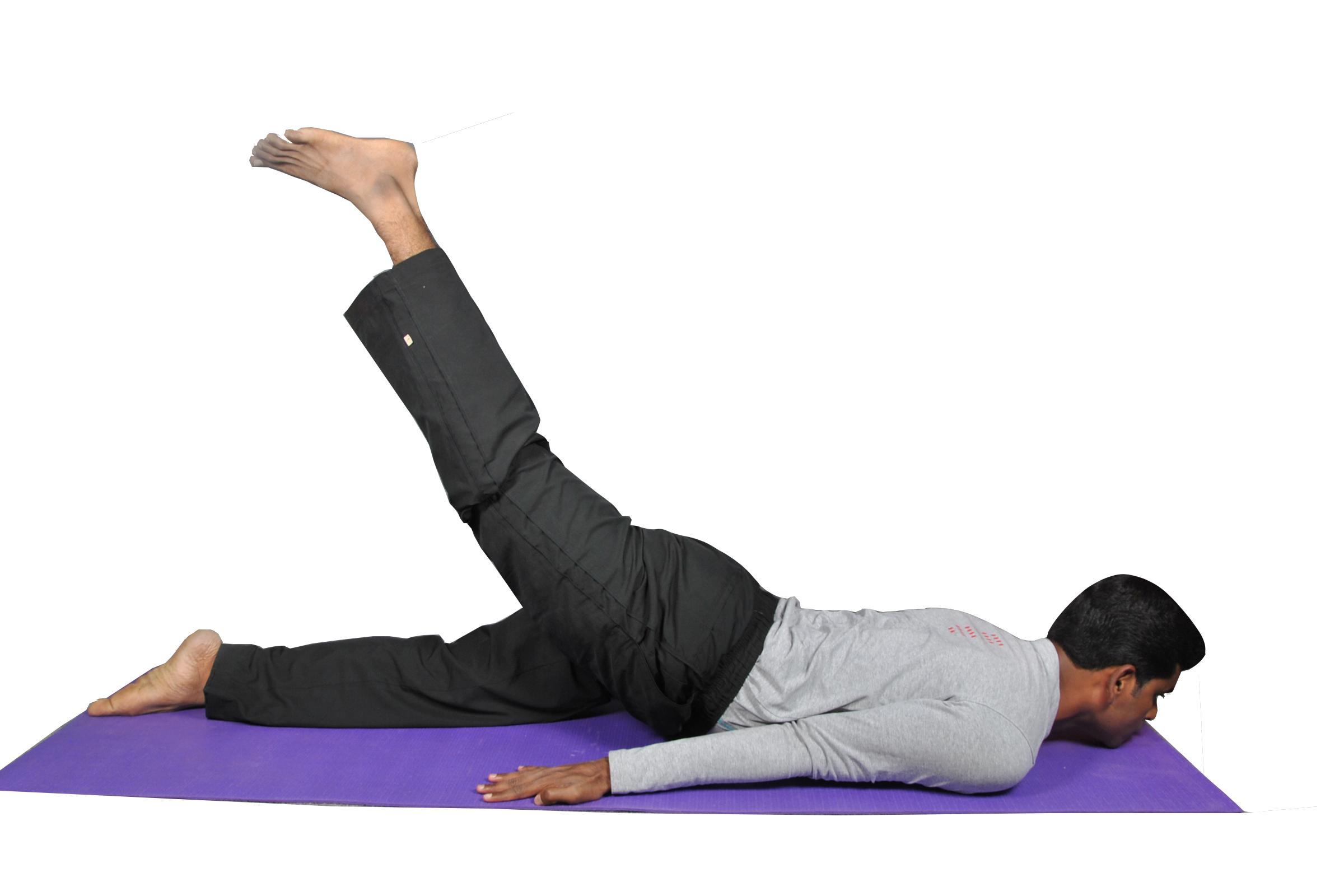
Ardha Shalabhasana strengthens the spine, glutes, hamstrings, and shoulders while promoting postural correction, enhanced breathing, and energy flow along the back body. It is often recommended as a preparatory pose for more advanced backbends and inversions, and as a therapeutic exercise for spinal and musculoskeletal health.
2. Word Meaning and Definition
Word Meaning:
- Ardha: Half
- Shalabha: Locust
- Asana: Posture or Pose
Definition:
Ardha Shalabhasana is a prone posture in which the practitioner lies on the stomach and lifts one leg at a time off the floor while keeping the torso grounded, engaging the back muscles, glutes, and core. This asymmetrical, back-strengthening pose promotes spinal extension, hip mobility, and muscular coordination.
3. Method of Practice – Step by Step
Step 1: Preparatory Position
- Lie prone on a yoga mat with legs extended straight, toes pointing backward.
- Rest the forehead lightly on the mat, hands resting alongside the body, palms down.
- Engage the core slightly to protect the lower back.
Step 2: Lifting the Leg
- Inhale and lift the right leg off the mat, keeping it straight.
- Engage the gluteus maximus, hamstrings, and spinal erectors to maintain elevation.
- Keep the pelvis stable; avoid twisting the hips.
Step 3: Arm Positioning
- Arms may remain alongside the body, palms pressing into the mat.
- Alternatively, hands can be placed under the forehead for neck support.
- Ensure shoulders are relaxed and away from the ears.
Step 4: Holding the Pose
- Maintain the leg lift for 5–10 seconds initially.
- Keep the gaze down or slightly forward; avoid craning the neck.
- Focus on controlled breathing and muscular engagement.
Step 5: Lowering and Repeating
- Exhale and gently lower the leg to the mat.
- Repeat the same process with the left leg.
- Perform 3–5 rounds on each side, gradually increasing duration with practice.
4. Alignment Cues
- Head and Neck: Maintain neutral cervical spine; forehead may rest on hands.
- Shoulders: Draw shoulder blades slightly together and keep them relaxed.
- Spine: Lengthen along the mat; avoid arching excessively.
- Hips and Pelvis: Keep pelvis grounded; avoid rotation.
- Legs: Lift one leg straight, toes pointing backward; knee extended.
- Breathing: Inhale to lift, exhale to lower; maintain rhythmic breath.
5. Benefits of Ardha Shalabhasana
- Spinal Strength and Stability:
- Strengthens erector spinae and spinal stabilizers.
- Improves posture and alleviates slouching.
- Hip and Glute Strength:
- Activates gluteus maximus and hamstrings for hip extension.
- Core Engagement:
- Strengthens abdominals and obliques for spinal support.
- Shoulder and Back Activation:
- Engages posterior deltoids and scapular stabilizers.
- Therapeutic Applications:
- Helps in mild lower back pain and postural correction.
- Enhanced Energy Flow:
- Activates Sushumna Nadi (spinal energy channel) according to yogic tradition.
- Mental Focus:
- Improves concentration and body awareness.
6. Contraindications
- Acute back or spinal injury
- Herniated disc
- Severe hip or knee problems
- Pregnancy (especially advanced stages)
- Recent abdominal or thoracic surgery
7. Counterposes
- Balasana (Child’s Pose): Relieves lower back tension and stretches posterior muscles.
- Adho Mukha Svanasana (Downward-Facing Dog): Stretches posterior chain and shoulders.
- Supta Baddha Konasana: Releases back and hips post-practice.
8. Preparatory Practice
- Bhujangasana (Cobra Pose): Prepares back extensors and glutes.
- Salabhasana (Full Locust Pose) Prep: Build endurance in posterior muscles.
- Setu Bandhasana (Bridge Pose): Strengthens glutes and spine.
- Cat-Cow Stretch: Mobilizes spine for extension.
- Hip Flexor Stretches: Opens hips for leg lifts.
9. Modifications
- Knee Bent Lift: Lift leg with knee bent to reduce strain on hamstrings and lower back.
- Use of Blanket: Place a folded blanket under pelvis for support.
- Shorter Hold Time: Beginners may lift for 3–5 seconds, gradually increasing.
- Partial Range of Motion: Lift leg only a few inches until strength develops.
- Alternating Legs Only: Skip simultaneous leg lifts to reduce strain.
10. Muscles Involved
Primary Muscles Engaged:
- Erector Spinae (spinal extension)
- Gluteus Maximus (hip extension)
- Hamstrings (hip extension and stabilization)
- Posterior Deltoids (if arms used for support)
Secondary Muscles:
- Obliques and Rectus Abdominis (core stability)
- Quadratus Lumborum (pelvic stabilization)
- Latissimus Dorsi (upper back stabilization)
- Gastrocnemius (posterior leg stabilization)
11. Kinesiology and Kinematics
- Joint Movements:
- Spine: Thoracic and lumbar extension
- Hip: Extension of lifted leg
- Shoulder: Scapular stabilization, slight retraction
- Knee: Extension
- Ankle: Plantarflexion
- Movement Planes:
- Sagittal plane: Primary (spinal and hip extension)
- Frontal plane: Minimal (pelvic stability)
- Transverse plane: Minimal
- Type of Muscle Action:
- Concentric: Glutes and erector spinae during lift
- Eccentric: Controlling leg descent
- Isometric: Core and pelvic stabilization
12. Biomechanics and Functional Anatomy
- Spinal Mechanics:
- Strengthens lumbar extensors and promotes neutral alignment.
- Encourages posterior chain recruitment without compression.
- Hip Mechanics:
- Hip extension engages glutes and hamstrings for postural support.
- Muscle Coordination:
- Core stabilizers coordinate with posterior chain for smooth leg lifts.
- Physiological Effects:
- Improves circulation to back muscles.
- Reduces stiffness in thoracic and lumbar regions.
- Enhances proprioception and body awareness.
13. Functional Anatomy & Physiology
- Spine: Strengthens erector spinae and spinal stabilizers.
- Muscular System: Activates glutes, hamstrings, and posterior deltoids.
- Nervous System: Enhances proprioception and mind-body awareness.
- Circulatory System: Improves blood flow to posterior chain.
- Respiratory System: Encourages diaphragmatic engagement indirectly through core stability.
- Joint Health: Maintains hip and spinal mobility.
14. How to Correct and Adjust While Teaching
- Pelvis: Ensure it remains grounded; avoid hip rotation.
- Spine: Maintain neutral spine, avoid hyperextension.
- Shoulders: Keep relaxed; encourage scapular retraction.
- Neck: Avoid craning; forehead may rest on mat or hands.
- Leg Lift: Correct leg height for comfort and safety; avoid over-lifting.
- Core Engagement: Cue transverse abdominis and obliques to stabilize spine.
- Breathing: Encourage inhalation during lift, exhalation during lowering.
- Props: Use folded blanket under pelvis if necessary.
15. Tips for Teaching Ardha Shalabhasana
- Demonstrate one leg lift first; emphasize controlled movement.
- Observe alignment of pelvis, spine, and shoulders.
- Encourage gradual progression for hold duration and leg height.
- Integrate as a preparatory posture for Shalabhasana (full Locust).
- Use verbal and tactile cues to maintain neutral spine and hip stability.
- Highlight mind-body connection; emphasize focus and breath awareness.
Question and answer -1
- The literal meaning of Ardha Shalabhasana is:
a) Full Locust Pose
b) Half Locust Pose ✅
c) Crocodile Pose
d) Locust Pose - The primary aim of Ardha Shalabhasana is:
a) Forward bending
b) Spinal extension and posterior chain strengthening ✅
c) Inversion
d) Hip flexion - Primary muscles engaged include:
a) Gluteus Maximus, Hamstrings, Erector Spinae ✅
b) Quadriceps only
c) Pectorals only
d) Deltoids only - Which muscles stabilize the pelvis during leg lift?
a) Quadriceps
b) Obliques and Quadratus Lumborum ✅
c) Biceps
d) Gastrocnemius only - Contraindications include:
a) Back injury ✅
b) Mild fatigue
c) Stress
d) Sedentary lifestyle - Recommended counterpose after Ardha Shalabhasana:
a) Balasana ✅
b) Headstand
c) Dhanurasana
d) Padmasana - Best preparatory asanas:
a) Bhujangasana, Cat-Cow, Bridge Pose ✅
b) Handstand only
c) Tadasana only
d) Virabhadrasana only - Recommended duration for beginners:
a) 3–5 seconds
b) 3–5 rounds per leg, 5–10 seconds ✅
c) 1 minute
d) 10–15 minutes - Arm positioning options include:
a) Alongside the body ✅
b) Overhead only
c) Crossed behind back
d) Raised above shoulders - Breathing cue during leg lift:
a) Exhale during lift
b) Inhale during lift, exhale lowering ✅
c) Hold breath
d) Rapid shallow breaths
Answer Key:
- b
- b
- a
- b
- a
- a
- a
- b
- a
- b
Question and answer – 2
1. Meaning and Definition
- The literal meaning of Ardha Shalabhasana is:
a) Full Locust Pose
b) Half Locust Pose ✅
c) Crocodile Pose
d) Locust Pose - “Shalabha” in Sanskrit refers to:
a) Locust ✅
b) Snake
c) Crocodile
d) Lotus - “Ardha” means:
a) Full
b) Half ✅
c) Small
d) Extended - The primary aim of Ardha Shalabhasana is:
a) Forward bending
b) Spinal extension and posterior chain strengthening ✅
c) Inversion
d) Hip flexion
2. Method of Practice
- The initial position for Ardha Shalabhasana is:
a) Sit cross-legged
b) Lie prone on the mat ✅
c) Stand with arms overhead
d) Lie supine - During the pose, the leg should be:
a) Lifted straight with toes pointing backward ✅
b) Bent at knees only
c) Crossed under hips
d) Raised overhead - Arm positioning options include:
a) Alongside the body ✅
b) Overhead only
c) Crossed behind back
d) Raised above shoulders - Head position should be:
a) Lifted with neck craned
b) Neutral or resting on hands ✅
c) Turned excessively
d) Pressed hard into mat
3. Alignment and Technique
- Shoulder alignment cue is:
a) Draw shoulder blades together, away from ears ✅
b) Lift shoulders toward ears
c) Compress shoulders
d) Rotate shoulders inward - Spine alignment should be:
a) Neutral with slight lumbar curve ✅
b) Over-arched
c) Flat without curve
d) Twisted - Pelvis should:
a) Rotate with leg lift
b) Remain grounded ✅
c) Tilt backward
d) Lift off mat - Breathing cue:
a) Inhale during lift, exhale lowering ✅
b) Hold breath
c) Rapid shallow breaths
d) Exhale during lift
4. Muscles and Anatomy
- Primary muscles engaged include:
a) Gluteus Maximus, Hamstrings, Erector Spinae ✅
b) Quadriceps only
c) Pectorals only
d) Deltoids only - Secondary muscles include:
a) Obliques, Quadratus Lumborum, Latissimus Dorsi ✅
b) Biceps only
c) Gastrocnemius only
d) Soleus only - Which muscle is primarily active for spinal extension?
a) Rectus Abdominis
b) Erector Spinae ✅
c) Quadriceps
d) Deltoid - Which muscle stabilizes the pelvis during leg lift?
a) Obliques and Quadratus Lumborum ✅
b) Hamstrings
c) Gluteus Medius only
d) Gastrocnemius
5. Benefits
- Ardha Shalabhasana strengthens:
a) Posterior chain ✅
b) Anterior chain only
c) Arms only
d) Neck only - Other benefits include:
a) Improved posture ✅
b) Increased heart rate
c) Compression of lumbar spine
d) Decreased flexibility - Therapeutic application of Ardha Shalabhasana includes:
a) Mild lower back pain relief ✅
b) Cardiovascular endurance
c) High-intensity training
d) Forward bending therapy
6. Contraindications
- Ardha Shalabhasana should be avoided in:
a) Recent spinal injury ✅
b) Mild fatigue
c) General stress
d) Sedentary lifestyle - Which of the following is also a contraindication?
a) Pregnancy (advanced stages) ✅
b) Morning practice
c) Evening relaxation
d) Light stretching - Severe hip or knee problems make the pose:
a) Safer
b) Contraindicated ✅
c) Optional
d) Beneficial
7. Counterposes and Preparatory Asanas
- Recommended counterpose after Ardha Shalabhasana:
a) Balasana (Child’s Pose) ✅
b) Headstand
c) Dhanurasana
d) Padmasana - Preparatory asanas include:
a) Bhujangasana, Cat-Cow, Bridge Pose ✅
b) Handstand only
c) Tadasana only
d) Virabhadrasana only - For beginners, which modification can be used?
a) Knee-bent leg lift ✅
b) Full arm extension
c) Jumping leg lifts
d) Simultaneous leg lifts only
8. Teaching and Adjustment
- Key cue for leg lift:
a) Lift using hamstrings only
b) Engage glutes, hamstrings, and erector spinae ✅
c) Lift without core engagement
d) Keep foot flexed - How to protect lower back?
a) Engage core and maintain pelvis grounded ✅
b) Over-arch spine
c) Rotate pelvis
d) Lift both legs simultaneously - Duration recommendation for beginners:
a) 3–5 rounds per leg, 5–10 seconds ✅
b) 1–2 minutes continuous
c) 30 seconds per leg only
d) Hold 1–2 minutes initially - Props can be used for:
a) Pelvic support ✅
b) Increasing difficulty
c) Arm strengthening
d) Neck strain - Arm positioning should focus on:
a) Supporting head or staying alongside body ✅
b) Crossed behind back
c) Fully extended overhead
d) Dangling off mat
Answer Key
- b
- a
- b
- b
- b
- a
- a
- b
- a
- a
- b
- a
- a
- a
- b
- a
- a
- a
- a
- a
- a
- b
- a
- a
- a
- b
- a
- a
- a
- a