
1. Word Meaning
The Sanskrit term Ardha Matsyendrasana consists of:
- Ardha – meaning “half”
- Matsyendra – referring to the sage Matsyendra, founder of Hatha Yoga tradition
- Asana– meaning “pose” or “seat”
Thus, Ardha Matsyendrasana translates as “Half Lord of the Fishes Pose”, honoring Matsyendra, a legendary yogi who mastered spinal twists. This is a seated spinal twist that improves mobility, digestion, and energy flow, often practiced for detoxification and spinal health.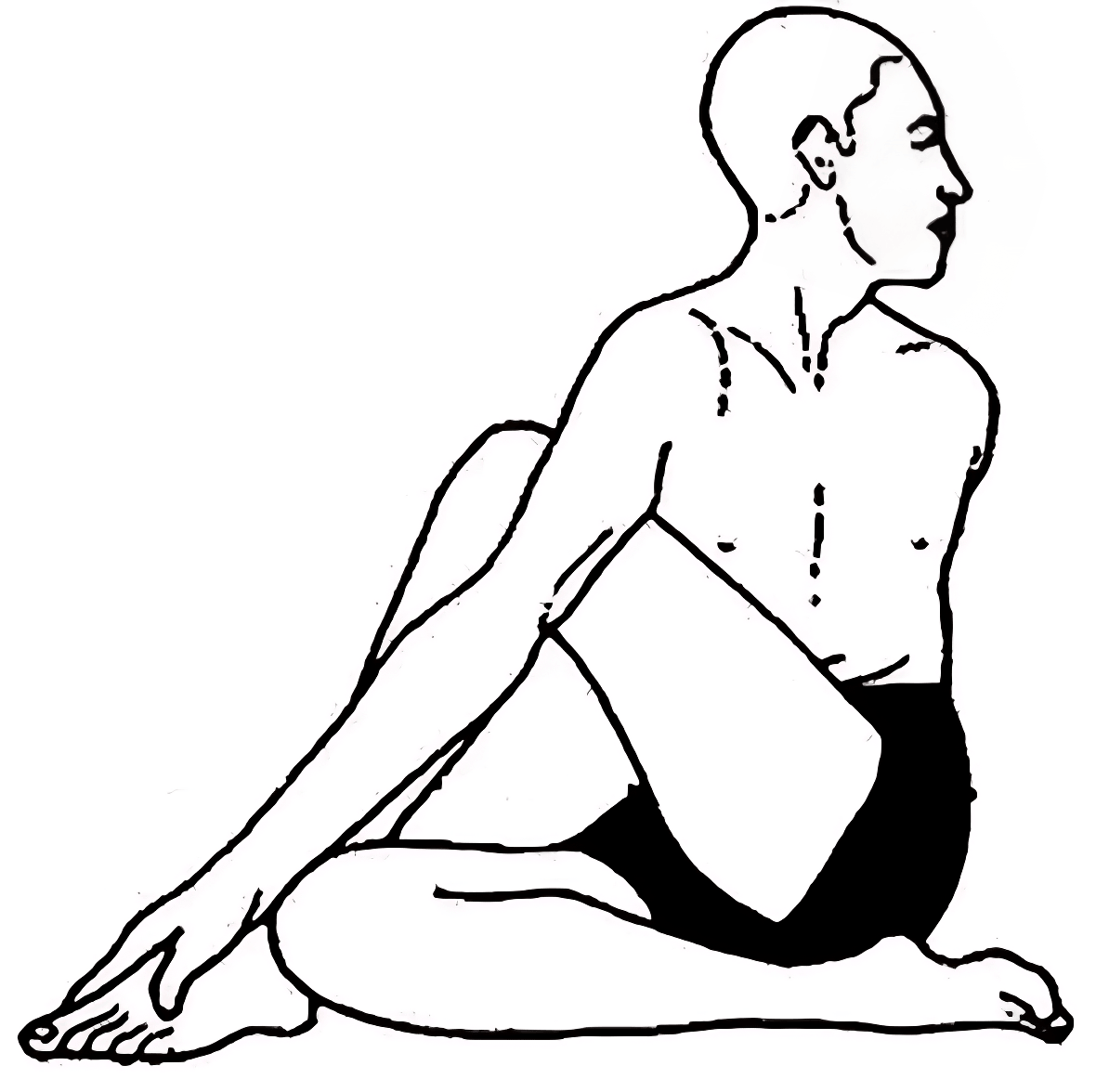
2. Definition
Ardha Matsyendrasana is a seated twisting yoga posture where:
- One leg is bent with foot placed outside the opposite knee
- The torso rotates toward the side of the bent knee
- One arm may hug the bent knee, while the other supports the body
- Spine is elongated and rotated while maintaining stability
This pose is a classic spinal twist, emphasizing rotation of the thoracic and lumbar spine, opening shoulders and chest, and stretching the hips and glutes.
3. Method of Practice – Step by Step
Step 1: Begin in Dandasana
- Sit on the floor with legs extended straight
- Spine upright, shoulders relaxed, hands on the floor
Step 2: Bend the Right Knee
- Bend the right knee and place the right foot on the outside of the left thigh
- Left leg remains extended (or bent depending on flexibility)
Step 3: Position the Left Leg
- For beginners: extend left leg straight
- For advanced variation: bend left knee, placing left foot near right buttock
Step 4: Rotate the Torso
- Inhale, lengthen the spine
- Exhale, rotate torso to the right, bringing left elbow to the outside of the right knee for leverage
Step 5: Place Hands
- Right hand behind the body for support
- Left elbow gently presses against right knee to deepen the twist
- Ensure shoulders are level and relaxed
Step 6: Align Head and Neck
- Turn gaze over right shoulder
- Neck follows spinal rotation naturally
Step 7: Maintain Alignment
- Spine elongated, avoid rounding or collapsing
- Hips grounded on floor
- Core engaged to support lumbar spine
Step 8: Breathing
- Maintain smooth, diaphragmatic breathing
- Inhale to lengthen, exhale to deepen twist gradually
Step 9: Hold the Pose
- Beginners: 20–30 seconds
- Intermediate: 1–2 minutes
- Advanced: 3–5 minutes
Step 10: Release
- Inhale, return to center
- Extend legs back into Dandasana
- Repeat on the opposite side
4. Alignment Cues
- Hips: Both sit bones grounded
- Spine: Elongated and rotated, avoid rounding
- Knees: Right knee outside left thigh, flexed
- Shoulders: Relaxed, away from ears
- Neck: Rotate with spine, gaze over shoulder
- Hands: Left elbow outside right knee, right hand behind for support
5. Benefits of Ardha Matsyendrasana
A. Physical Benefits
- Improves spinal flexibility and mobility
- Stretches shoulders, chest, hips, glutes, and back muscles
- Strengthens obliques, erector spinae, and core muscles
- Enhances postural alignment and spinal stabilization
- Stimulates abdominal organs for digestion and detoxification
B. Physiological Benefits
- Stimulates liver, pancreas, and kidneys
- Improves circulation to abdominal organs
- Assists in elimination and detoxification
- Enhances respiratory efficiency by opening chest
C. Mental Benefits
- Reduces stress and anxiety
- Improves focus and concentration
- Enhances body awareness and proprioception
D. Energetic Benefits
- Activates Manipura (solar plexus) and Svadhisthana (sacral) chakras
- Promotes pranic flow along spinal meridians
6. Contraindications
- Spinal injuries – avoid deep twisting
- Herniated disc – consult a physician or modify
- Knee injuries – modify leg positions
- Pregnancy – avoid deep twists or compressive positions
- Scoliosis or severe back issues – practice under supervision
7. Counterposes
- Paschimottanasana (Seated Forward Bend) – stretches spine after twist
- Jathara Parivartanasana (Supine Spinal Twist) – neutralizes spine
- Balasana (Child’s Pose) – relaxes lower back
- Shavasana (Corpse Pose) – restores equilibrium
8. Preparatory Practices
- Dandasana – seated posture for spinal alignment
- Baddha Konasana – hip opener for flexibility
- Janu Sirsasana – seated forward fold with twist preparation
- Marichyasana I – preparatory seated twist
- Cat-Cow (Marjaryasana/Bitilasana) – mobilizes spine
- Tadasana – standing posture for alignment
9. Modifications
- Sit on a folded blanket to elevate pelvis for better alignment
- Keep left leg extended if flexibility is limited
- Use a yoga strap around foot to assist grip
- Twist only as far as comfortable
- Advanced variation: bend left knee for deeper spinal rotation
10. Muscles Involved
A. Stretched Muscles
- Erector spinae (thoracic and lumbar)
- Obliques (internal and external)
- Gluteus maximus, medius, minimus
- Piriformis
- Latissimus dorsi and posterior deltoid
- Hip rotators and adductors
B. Strengthened Muscles
- Rectus abdominis and obliques (isometric engagement)
- Multifidus and spinal stabilizers
- Rhomboids and trapezius (for chest opening)
C. Joints
- Spine: rotation in thoracic and lumbar regions
- Hips: external rotation and flexion
- Knees: flexion
- Shoulders: abduction and external rotation
11. Kinesiology
- Spinal mechanics: rotation with elongation, avoiding hyperflexion
- Hip mechanics: external rotation and flexion of bent leg
- Core mechanics: isometric engagement stabilizes lumbar region
- Dynamic action: exhale to twist, inhale to lengthen spine
- Shoulder mechanics: stabilize scapulae and chest opening
12. Kinematics
- Sagittal plane: minimal flexion if forward fold is included
- Frontal plane: hips stable, knees abducted
- Transverse plane: rotation of thoracic and lumbar spine
- Joint action: hip external rotation, spinal rotation, shoulder abduction
13. Biomechanics
- Lever principle: Spine acts as lever, rotation occurs around axis of lumbar and thoracic vertebrae
- Force distribution: evenly through sit bones
- Isometric contractions: stabilize core and prevent lumbar strain
- Progressive mobility: gradual rotation improves spinal flexibility safely
14. Functional Anatomy & Physiology
A. Musculoskeletal System
- Stretches obliques, erector spinae, glutes, hip rotators
- Strengthens spinal stabilizers and core
B. Nervous System
- Stimulates proprioceptors in spine, hips, and shoulders
- Calms sympathetic nervous system
C. Circulatory System
- Improves blood flow to abdominal organs and spine
- Enhances venous return
D. Respiratory System
- Expands thoracic cavity, encourages deep breathing
- Enhances lung capacity
E. Digestive System
- Stimulates liver, kidneys, pancreas, and intestines
- Supports detoxification
F. Energetic System
- Activates Manipura and Svadhisthana chakras
- Supports pranic flow along spinal meridians
15. How to Correct and Adjust While Teaching
Common Misalignments
- Spine rounded or collapsed
- Hips lifted off floor
- Knees misaligned
- Shoulders shrugged
- Neck forced
Verbal Adjustments
- “Sit tall on your sit bones”
- “Lengthen spine before twisting”
- “Use your elbow gently against knee”
- “Relax shoulders away from ears”
Hands-On Adjustments
- Support pelvis to ground sit bones
- Guide spinal rotation gently
- Support shoulder for chest opening
- Help position bent knee correctly
16. Variations
- Ardha Matsyendrasana I – straight leg variation
- Ardha Matsyendrasana II – both knees bent
- Seated with forward fold – deeper spinal stretch
- Supported with props – blanket or block for hip or spinal support
17. Philosophical and Energetic Aspect
- Symbolizes detoxification, balance, and inner transformation
- Promotes discipline, focus, and introspection
- Prepares the practitioner for meditation and pranayama practice
18. Conclusion
Ardha Matsyendrasana is a classic seated spinal twist that:
- Physically: improves spinal flexibility, stretches obliques, hips, and shoulders, strengthens core
- Mentally: reduces stress, improves focus, enhances body awareness
- Physiologically: stimulates abdominal organs, improves digestion and circulation
- Energetically: activates chakras and pranic flow
QUESTIONS AND ANSWES
1. What does “Ardha” mean in Sanskrit?
a) Full
b) Half
c) Twist
d) Pose
Answer: b
2. Who is Matsyendra?
a) A deity
b) A legendary yogi and founder of Hatha Yoga
c) A king
d) None
Answer: b
3. What type of asana is Ardha Matsyendrasana?
a) Standing posture
b) Seated spinal twist
c) Backbend
d) Inversion
Answer: b
4. Main joints involved in Ardha Matsyendrasana are:
a) Spine, hips, knees
b) Shoulders and elbows
c) Ankles only
d) Neck only
Answer: a
5. Primary muscles stretched include:
a) Obliques, erector spinae, glutes, hip rotators
b) Quadriceps only
c) Biceps only
d) Forearm muscles
Answer: a
6. Which muscles are strengthened in this pose?
a) Core muscles including rectus abdominis and obliques
b) Trapezius only
c) Hamstrings only
d) Deltoids only
Answer: a
7. Spine alignment in Ardha Matsyendrasana should be:
a) Rounded forward
b) Long and elongated
c) Collapsed
d) Hyperextended
Answer: b
8. How should the gaze be positioned?
a) Over the shoulder toward the twist side
b) Straight ahead
c) Down at floor
d) Eyes closed only
Answer: a
9. Contraindications for this pose include:
a) Herniated disc, severe spinal injuries, knee injuries
b) Healthy spine
c) Beginner level only
d) None
Answer: a
10. Preparatory poses include:
a) Dandasana, Baddha Konasana, Janu Sirsasana, Marichyasana
b) Tadasana only
c) Shavasana only
d) Utkatasana only
Answer: a
11. Counterposes include:
a) Paschimottanasana, Supine Spinal Twist, Balasana
b) Tadasana
c) Garudasana
d) None
Answer: a
12. Hips in Ardha Matsyendrasana should be:
a) Grounded on the floor
b) Lifted
c) Tilted forward
d) Rotated backward
Answer: a
13. Core engagement is important to:
a) Stabilize lumbar spine
b) Force the twist
c) Collapse the torso
d) None
Answer: a
14. The bent knee is placed:
a) Outside opposite thigh
b) Crossed over foot
c) Straight ahead
d) Behind
Answer: a
15. The supporting hand is placed:
a) Behind the body for stability
b) On top of head
c) On opposite knee forcibly
d) None
Answer: a
16. Breath cue during twist:
a) Inhale to lengthen spine, exhale to deepen twist
b) Hold breath
c) Rapid shallow breaths
d) Only exhale
Answer: a
17. Forward fold in advanced variation stretches:
a) Hamstrings and lower back
b) Neck only
c) Shoulders only
d) Arms only
Answer: a
18. Which organ systems benefit from this twist?
a) Digestive organs, liver, kidneys, pancreas
b) Lungs only
c) Heart only
d) None
Answer: a
19. Energetic benefits include activation of:
a) Manipura and Svadhisthana chakras
b) Anahata only
c) Vishuddha only
d) None
Answer: a
20. Duration for beginners:
a) 20–30 seconds
b) 5 minutes
c) 10 minutes
d) 1 second
Answer: a
21. Advanced practitioners may hold the pose for:
a) 3–5 minutes
b) 10 seconds
c) 1 minute
d) None
Answer: a
22. Neck alignment cue:
a) Turn naturally with spinal rotation
b) Forcefully twist independently
c) Keep rigid
d) None
Answer: a
23. Common misalignment:
a) Spine collapsed, shoulders shrugged, hips lifted
b) Spine elongated
c) Shoulders relaxed
d) Hips grounded
Answer: a
24. How to adjust tight hips?
a) Sit on folded blanket, modify leg position
b) Force bent knee down
c) Twist further forcibly
d) None
Answer: a
25. Which preparatory spinal mobilization helps?
a) Cat-Cow (Marjaryasana-Bitilasana)
b) Tadasana
c) Garudasana
d) Shavasana
Answer: a
26. Shoulder action during pose:
a) Relaxed and externally rotated
b) Hunched forward
c) Shrugged
d) Crossed over chest
Answer: a
27. Which muscles stabilize the spine?
a) Multifidus, erector spinae, obliques
b) Quadriceps only
c) Deltoids
d) Neck muscles
Answer: a
28. Kinematics involve rotation primarily in:
a) Transverse plane (thoracic and lumbar spine)
b) Sagittal plane
c) Frontal plane
d) None
Answer: a
29. Hip action in this pose:
a) External rotation and flexion
b) Extension only
c) Adduction only
d) Internal rotation only
Answer: a
30. Verbal teaching cue for spinal twist:
a) “Lengthen your spine before twisting gently”
b) “Collapse lumbar spine”
c) “Force twist”
d) None
Answer: a
31. Benefits for digestion include:
a) Stimulation of liver, pancreas, kidneys, intestines
b) Restriction of blood flow
c) Weakening digestive organs
d) None
Answer: a
32. Forward fold should originate from:
a) Hips, not lumbar rounding
b) Collapsing spine
c) Neck only
d) None
Answer: a
33. Modification for beginners:
a) Extend opposite leg straight, sit on blanket
b) Twist as far as possible
c) Cross arms
d) None
Answer: a
34. Mental benefits include:
a) Reduces stress, improves focus
b) Increases anxiety
c) Weakens concentration
d) None
Answer: a
35. Hands-on adjustment may include:
a) Supporting pelvis or shoulder, guiding knee position
b) Forcing twist
c) Collapsing torso
d) None
Answer: a
36. Which variation bends the opposite leg?
a) Ardha Matsyendrasana II
b) I only
c) III only
d) None
Answer: a
37. Energetic aspect symbolizes:
a) Detoxification, balance, inner transformation
b) Aggression
c) Weakness
d) None
Answer: a
38. Core engagement helps in:
a) Stabilizing lumbar spine and safe twisting
b) Collapsing the twist
c) Forcing range of motion
d) None
Answer: a
39. Which muscles are stretched in shoulders?
a) Posterior deltoids, latissimus dorsi
b) Triceps only
c) Biceps only
d) Forearms
Answer: a
40. Recommended follow-up pose for relaxation:
a) Shavasana or Supine Twist
b) Standing Forward Fold only
c) Tree Pose only
d) None
Answer: a