
1. Word Meaning and Etymology
Anantasana derives from two Sanskrit terms:
Ananta — meaning endless, infinite, eternal, and also one of the names of Lord Vishnu, who reclines on the cosmic serpent Shesha.
Asana — meaning posture or seat.
Thus, Anantasana translates as “Pose of the Endless One,” “Infinite Pose,” or “Vishnu Couch Pose.”
Mythologically, the posture represents Lord Vishnu resting in effortless equilibrium, symbolizing:
- cosmic balance,
- infinite consciousness,
- equanimity,
- relaxation infused with awareness.

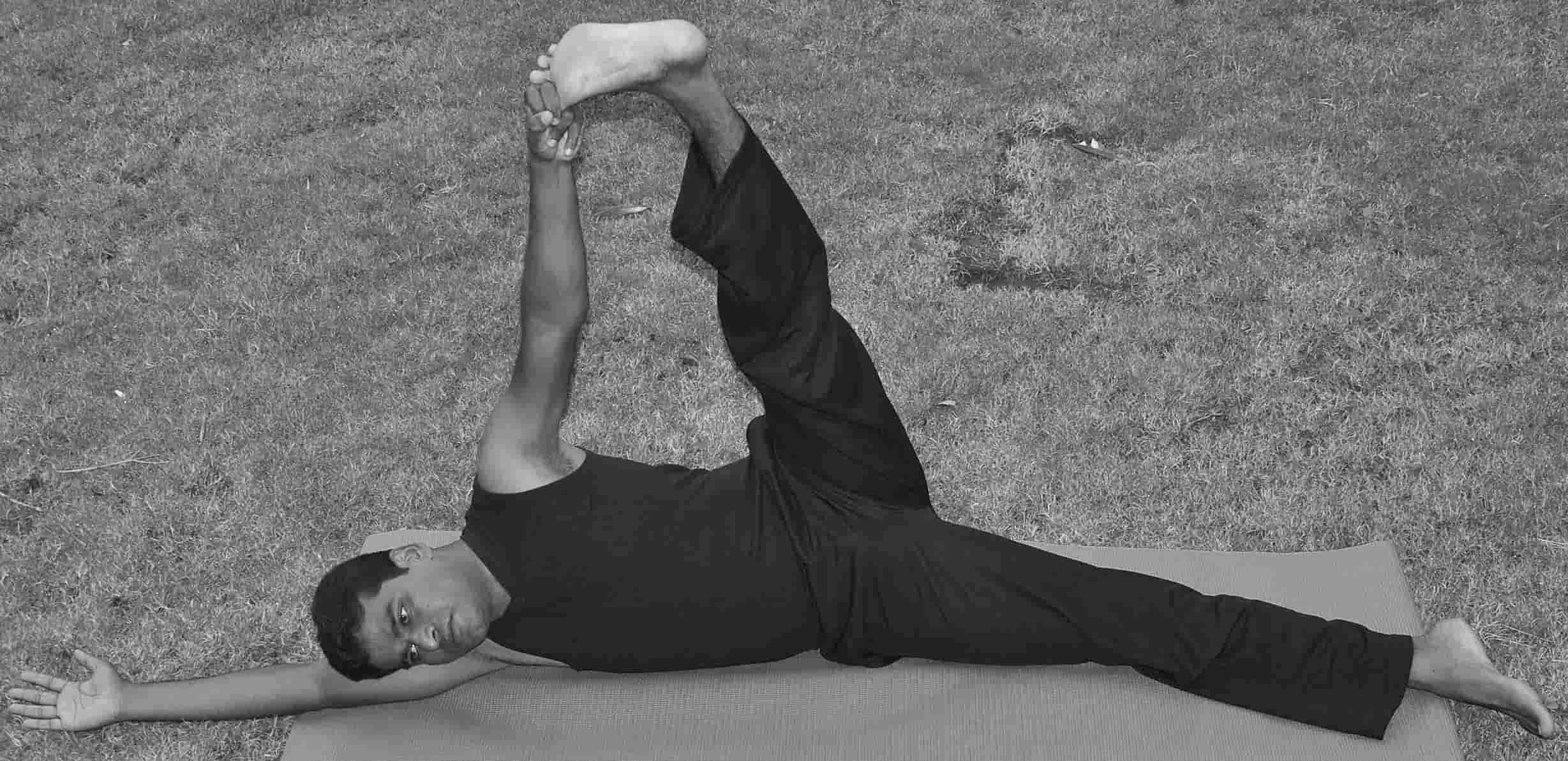
The posture resembles the iconography of Vishnu reclining on his side, supported by one arm while holding a raised leg with serenity and grace.
2. Definition
Anantasana is a supine side-lying balancing posture performed on the floor in which the practitioner lies on one side, supports the head with one arm, lifts the upper leg, and holds the big toe or foot with the upper arm.
Unlike more strenuous balancing poses, Anantasana balances strength, mobility, alignment, and mental steadiness.
3. Method of Practice — Step by Step (Detailed Protocol)
Preparatory Position
- Lie on your back in Supta Tadasana.
- Slowly roll onto your right side.
- Extend the right arm straight along the floor beside the head.
Step 1 — Establish the Base
- Stretch the right arm straight overhead.
- Bend the right elbow and bring the hand to cradle or support the head.
- Align the right shoulder and elbow on the floor to form a stable base.
Step 2 — Align the Body on a Single Line
- Stack the legs, hips, and shoulders directly on top of each other.
- Keep both knees straight.
Engage the obliques and quadratus lumborum (QL) for stability.
Step 3 — Bend and Lift the Upper Leg
- Bend the left knee and draw it toward the torso.
- Use the left hand to grab the big toe (Padangustha grip), or hold the outer foot.
Step 4 — Extend the Leg Upward
- Straighten the left leg by pressing the heel upward.
- Lengthen through the hamstrings while keeping the pelvis neutral.
Step 5 — Maintain Balance
- Activate the core, especially deep stabilizers (TA, obliques).
- Keep the bottom leg extended and firm.
- Avoid falling backward or forward by engaging the side body.
Step 6 — Final Pose Positioning
- Body aligned in a straight line.
- Lower elbow supports the head.
- Upper leg extended vertically or at an angle.
- Gaze softly forward or upward.
Step 7 — Hold the Pose
- Stay for 5–10 slow breaths.
- Maintain smooth ujjayi or diaphragmatic breathing.
Step 8 — Release Slowly
- Exhale, bend the upper knee.
- Release the foot.
- Return to side-lying position.
- Repeat on the other side.
4. Alignment Cues (For Optimal Safety and Form)
1. Body Line and Stability
- “Stack hips and shoulders.”
- “Imagine your body is between two panes of glass.”
- “Press bottom leg firmly into the floor.”
2. Pelvic Position
- “Neutral pelvis—avoid tipping forward or backward.”
- “Lift the lower waist away from the floor.”
3. Leg Extension
- “Straighten the raised knee by pushing through the heel.”
- “Draw the thighbone into the hip socket.”
4. Arm and Head Support
- “Bottom elbow should be directly under the shoulder.”
- “Support your head without collapsing the neck.”
5. Shoulders & Ribs
- “Keep ribs from flaring.”
- “Broaden the collarbones.”
6. Breath
- “Breathe into the side ribs.”
- “Use exhalation to deepen stability, not flexibility.”
5. Benefits of Anantasana
Physical Benefits
- Enhances balance and proprioception.
- Stretches hamstrings, adductors, and calf muscles.
- Strengthens obliques, quadratus lumborum (QL), and transverse abdominis.
- Improves lateral body stability.
- Encourages pelvic alignment.
- Strengthens gluteus medius (important for standing balance).
- Opens the shoulders and chest.
- Releases tension in the lower back.
- Enhances hip joint mobility.
- Improves neuromuscular coordination.
Therapeutic Benefits
- Helps in sciatica relief (mild cases).
- Corrects pelvic asymmetry.
- Beneficial for scoliosis with lateral strengthening.
- Reduces hamstring tightness in athletes.
- Enhances digestive flow by gentle lateral compression.
Energetic & Psychological Benefits
- Improves equanimity and calmness.
- Encourages a state of effortless balance (sattvic state).
- Invokes the symbolic energy of Vishnu—preservation, balance, calm presence.
- Enhances mental focus, steadiness, and internal awareness.
6. Contraindications & Precautions
Absolute Contraindications
- Severe slipped disc or acute lumbar herniation.
- Sciatica flare-ups.
- Vertigo or balance disorders.
- Recent knee ligament injuries.
- Severe shoulder instability.
Relative Contraindications
- Hamstring tears or injuries.
- Wrist or elbow pain (support modifications required).
- Obesity or weak core (requires props).
- Pregnancy (late stage) — may reduce side compression.
Avoid if:
- Student cannot balance even with props.
- Excessive lateral bending creates pain.
- Leg extension strains the hamstring.
7. Counterposes
After Anantasana, the following counterposes help neutralize the spine:
1. Apanasana (Knees-to-Chest Pose)
Releases lower back tension.
2. Supta Matsyendrasana (Supine Twist)
Relieves the side-body tension.
3. Balasana (Child’s Pose)
Restores breathing and resets the spine.
4. Supta Baddha Konasana
Opens groins and calms the nervous system.
8. Preparatory Practices
These warm-up poses help prepare:
Hamstring Preparation
- Supta Padangusthasana
- Uttanasana
- Adho Mukha Svanasana
- Janu Sirsasana
Core Preparation
- Side Plank (Vasisthasana – basic version)
- Forearm plank with side crunches
- Supta Tadasana core activation
Hip Mobility
- Anjaneyasana
- Baddha Konasana
- Supta Ardha Padmasana
Balance Preparation
- Tadasana weight-shifting
- Ardha Chandrasana
- Tree Pose (Vrksasana)
9. Modifications & Variations
Modifications
Use a wall
- Lie with the back touching the wall to maintain alignment.
- Helps students who fall backward.
Use a strap around the foot
- For tight hamstrings.
- Reduces strain on shoulders.
Bend the upper knee slightly
- For reduced hamstring tension.
Use a block under the supporting head arm
- If neck strength is insufficient.
Bottom leg bent
- Increases stability.
Advanced Variations
- Anantasana with leg pulled behind head
- Anantasana with foot held in both hands
- Twisting Anantasana
- Floating Anantasana
(Balancing without lower leg touching the floor)
10. Muscles Involved (Detailed)
Primary Muscles Stretched
- Hamstrings (Biceps femoris, Semimembranosus, Semitendinosus)
- Adductors
- Gastrocnemius
- Tensor fasciae latae (TFL)
Primary Muscles Strengthened
Core muscles
- Transverse abdominis
- Internal and external obliques
- Quadratus lumborum (QL)
Hip stabilizers
- Gluteus medius
- Gluteus minimus
Back muscles
- Erector spinae
- Multifidus
Arm and shoulder muscles
- Deltoids
- Rotator cuff
- Triceps
Secondary Muscles
- Psoas (stabilizer)
- Rectus abdominis
- Peroneals (balance muscles)
11. Kinesiology of Anantasana
Major Joint Actions
Hip flexion
- Upper leg lifts using iliopsoas + rectus femoris.
Knee extension
- Quadriceps contract to straighten the knee.
- Shoulder flexion and abduction
- When gripping the toe.
Lateral stability at spine
- Side body maintains the posture.
Key Kinesiological Principles
- The pose is a closed kinetic chain at the bottom leg and open kinetic chain at the top leg.
- Requires isometric contraction of stabilizers.
- The lifted leg uses active reciprocal inhibition to stretch hamstrings safely.
12. Kinematics (Movement Characteristics)
- Movement occurs in the frontal plane.
- Balance is achieved through micro-adjustments at ankle, hip, and pelvis.
- The spine remains in a neutral lateral alignment.
- Center of gravity shifts towards the lower hip, requiring core activation.
13. Biomechanics of Anantasana
Balance Mechanics
- A single line of support increases need for proprioceptive control.
- Ground reaction force moves through the bottom arm and leg.
- Stability depends on:
- hip abductors,
- QL activation,
- core bracing.
Stretch Mechanics
- Hamstring stretch occurs via:
- hip flexion,
- knee extension,
- posterior pelvic tilt.
Shoulder Biomechanics
- Requires external rotation to safely lift arm overhead.
- Avoids impingement by maintaining space in subacromial area.
14. Functional Anatomy & Physiology
Functional Anatomy
- Deep core (TA + obliques) stabilizes the spine.
- QL prevents collapsing into lower back.
- Hamstring flexibility determines leg height.
- Hip abductors on the bottom side resist tipping.
Physiological Effects
- Stimulates the parasympathetic nervous system (due to reclined posture).
- Improves intercostal muscle expansion → better lateral breathing.
- Enhances circulation in lower limbs.
- Reduces mild lower-back compression by strengthening side-body.
15. How to Correct and Adjust While Teaching
Verbal Cues
- “Lift your lower waist off the floor.”
- “Keep your top hip stacked over bottom hip.”
- “Press through the bottom leg for stability.”
- “Reach the heel upward and soften your jaw.”
Common Mistakes & Corrections
- Falling backward
→ Move hips slightly forward and engage obliques. - Top knee bending
→ Use strap or reduce height. - Neck collapsing
→ Adjust elbow directly under shoulder. - Bottom leg sliding
→ Press heel down and flex foot.
Hands-On Adjustments
- Stability Adjustment
- Press gently on the top hip to stack alignment.
- Leg-Extension Adjustment
- Hold the student’s raised leg lightly to help align.
- Shoulder Adjustment
- Slight lift of the top shoulder for opening.
Safety Tips for Teachers
- Never pull the student’s leg forcefully.
- Avoid pushing hips without consent.
- If student shows instability, move them to wall support.
- Encourage slow, mindful breathing throughout the posture.
Conclusion
Anantasana is a powerful yet graceful posture that combines balance, stretch, strength, alignment awareness, and mental steadiness. Symbolically connected to the divine state of infinite ease embodied by Vishnu, the pose teaches practitioners how to hold stability with softness, strength with relaxation, and awareness with calm presence.
Biomechanically, it enhances lateral stability, hamstring flexibility, shoulder mobility, and core strength. Therapeutically, it supports pelvic alignment, spinal balance, and nervous system relaxation. When taught with proper alignment cues, modifications, and anatomical understanding, Anantasana becomes an essential posture in any yoga practice and an important part of yoga teacher training curriculum.
QUESTION AND ANSWER
1. The Sanskrit word “Ananta” in Anantasana refers to:
A. Eternal / Infinite
B. Serpent
C. Reclining
D. Both A and B
Answer: D
Explanation: “Ananta” means endless/eternal and is also a name for Shesha, the cosmic serpent.
2. Anantasana primarily stretches which major muscle group?
A. Hamstrings
B. Quadriceps
C. Obliques
D. Hip flexors
Answer: A
Explanation: The lifted leg lengthens the hamstrings.
3. Which of the following is a key action for stability in Anantasana?
A. Hyperextending the lower back
B. Pressing the bottom foot into the floor
C. Engaging the core and glute medius
D. Relaxing the body completely
Answer: C
4. The pose is commonly performed in which orientation?
A. Prone
B. Supine
C. Lateral lying (side-lying)
D. Standing
Answer: C
5. Which joint undergoes the most external rotation in the lifted leg?
A. Knee joint
B. Hip joint
C. Ankle
D. Sacroiliac joint
Answer: B
6. Holding the big toe in Anantasana is done using which yogic hand gesture?
A. Anjali mudra
B. Chin mudra
C. Vishnu mudra
D. Yogic toe lock (Padangustha grip)
Answer: D
7. The major stabilizing muscle on the lower side of the torso is:
A. Rectus abdominis
B. Quadratus lumborum
C. Transverse abdominis
D. Sternocleidomastoid
Answer: B
8. Which is a common mistake in alignment?
A. Keeping the bottom leg straight
B. Collapsing the rib cage forward
C. Supporting the head with the lower arm
D. Flexing the lifted foot
Answer: B
9. Anantasana improves which functional movement capacity?
A. Cervical extension
B. Lateral stability & balance
C. Vertical compression strength
D. Lumbar hypermobility
Answer: B
10. A recommended preparatory pose is:
A. Ustrasana
B. Uttanasana
C. Supta Padangusthasana
D. Chakrasana
Answer: C
11. Which variation is recommended for beginners?
A. Using a wall behind the back
B. Holding the foot behind the head
C. Taking the raised leg to full split
D. Twisting the trunk
Answer: A
12. Which condition is a contraindication?
A. Sciatica
B. Tight hamstrings
C. Shoulder instability
D. Mild back stiffness
Answer: C
13. Which cue helps maintain balance?
A. Lift the chest up and forward
B. Lean backward
C. Engage the side waist and press the bottom leg into the mat
D. Point the toe of the lifted foot
Answer: C
14. In kinematics, the lifted leg moves mainly into:
A. Flexion + External rotation + Abduction
B. Flexion + Internal rotation
C. Adduction
D. Extension
Answer: A
15. As per functional anatomy, which muscle helps hold the top leg up?
A. Tibialis posterior
B. Psoas minor
C. Gluteus medius
D. Gastrocnemius
Answer: C
16. To correct a collapsing torso, the teacher should cue:
A. Relax the belly
B. Soften the shoulders
C. Lift from the bottom obliques and lengthen the spine
D. Roll backward slightly
Answer: C
17. Which breathing pattern is ideal during Anantasana?
A. Short and fast
B. Holding the breath at peak stretch
C. Slow diaphragmatic breathing
D. Reverse breathing
Answer: C
18. Which is the best counterpose?
A. Balasana
B. Dhanurasana
C. Ardha Matsyendrasana
D. Savasana
Answer: A
Reason: Releases side body tension and neutralizes spinal alignment.
19. A common modification for tight hamstrings includes:
A. Bending the top knee
B. Flexing the spine more
C. Rolling onto the back
D. Twisting the hips
Answer: A
20. In biomechanics, the pose requires strong engagement of:
A. Hip adductors of the lower leg
B. Hip abductors of the lower leg
C. Triceps
D. Pectoralis minor
Answer: B
21. Which anatomical plane does most of the movement occur in?
A. Sagittal plane
B. Frontal plane
C. Transverse plane
D. Oblique plane
Answer: B
22. Anantasana may help improve symptoms associated with:
A. Hypothyroidism
B. Lateral spinal weakness
C. Insomnia
D. Poor circulation
Answer: B
23. To prevent neck discomfort, a teacher should cue:
A. Drop the shoulder
B. Overextend the lateral flexion
C. Keep the neck long and avoid collapsing into the elbow
D. Look sharply upward
Answer: C
24. During teaching correction, which touch-based adjustment is appropriate?
A. Pressing the top leg forcefully upward
B. Pulling the student’s foot
C. Stabilizing the pelvis gently
D. Pushing the ribs forward
Answer: C
25. The pose best develops which category of strength?
A. Symmetrical bilateral strength
B. Posterior chain
C. Unilateral stability and control
D. Shoulder pressing strength
Answer: C
26. Advanced variation includes:
A. Grabbing the big toe with opposite hand
B. Bringing the leg behind the head
C. Lowering the head to the mat
D. Doing the pose in a chair
Answer: B
27. Which muscle is lengthened on the lower side?
A. Upper trapezius
B. Rectus abdominis
C. Quadratus lumborum
D. Gluteus maximus
Answer: C
28. Which cue promotes safer hamstring stretching?
A. Lock the knee
B. Flex the foot and lengthen evenly through the heel
C. Rotate the hip inward
D. Tense the shoulders
Answer: B
29. Which student should avoid this pose?
A. Woman in second trimester
B. Person recovering from wrist sprain
C. Person with vertigo
D. Person with shoulder dislocation history
Answer: D
30. Best teaching instruction for beginners:
A. “Lean back to balance more easily.”
B. “Use a block or wall for support behind your back.”
C. “Force the leg up even if hamstrings resist.”
D. “Keep your breathing shallow to activate muscles.”
Answer: B