
Posture: Stand with your feet positioned close together and maintain an upright body. Extend your arms straight in front of you, ensuring they remain parallel to the ground at shoulder height.
Exercise A: Shape your fingers to mimic a cobra’s hood, focusing on keeping the entire length of your arms—from the shoulder joints to the fingertips—firm and tense. For maximum effectiveness, apply enough force to cause slight trembling in your arms. Start with five minutes of practice. 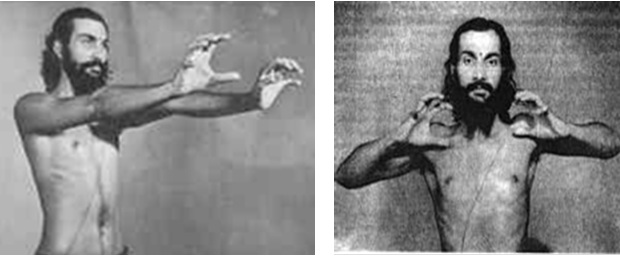
Exercise B: Maintain the same posture as in Exercise A. This time, perform the movement with your arms bent at the elbows while keeping your fingers spread in the form of a cobra’s hood. Begin with five minutes for this exercise as well.
Introduction
Yoga is a holistic science that aims at the harmonious development of the body, mind, and consciousness. While major practices such as asanas, pranayama, and meditation are widely known, the preparatory practices known as Sukshma Vyayama (subtle yogic exercises) form the essential foundation of yogic training. These practices involve gentle, conscious movements that activate specific joints and muscles, improve circulation, and enhance neuromuscular coordination.
In modern life, the hands—and particularly the fingers—are continuously engaged in fine motor activities such as typing, writing, texting, stitching, cooking, and handling tools. Overuse and repetitive strain often lead to stiffness, weakness, reduced dexterity, and fatigue in the fingers.
Anguli-Shakti-Vikasaka is a specialized Sukshma Vyayama practice designed to strengthen and improve the flexibility of the fingers (Anguli). It involves systematic movements of the fingers coordinated with breath awareness and mindful attention.
This practice is simple yet powerful in enhancing hand efficiency, improving coordination, preventing disorders, and maintaining the overall health of the fingers and hands.
Anguli-Shakti-Vikasaka is an essential Sukshma Vyayama practice that enhances the strength, flexibility, and coordination of the fingers. Through systematic movements and breath awareness, it improves joint mobility, circulation, and neuromuscular efficiency.
In modern lifestyles, where repetitive use of fingers is common, this practice provides a simple and effective way to maintain hand health and prevent disorders. Regular practice leads to improved dexterity, reduced fatigue, and enhanced performance in daily activities.
Ultimately, it supports the broader goal of yoga—achieving balance, coordination, and optimal functioning of the body and mind.