
1. Word Meaning and Introduction
Virabhadrasana II is derived from Sanskrit:
- Virabhadra = “mighty warrior” (a fierce form of Lord Shiva created to fight injustice)
- Asana = posture or seat
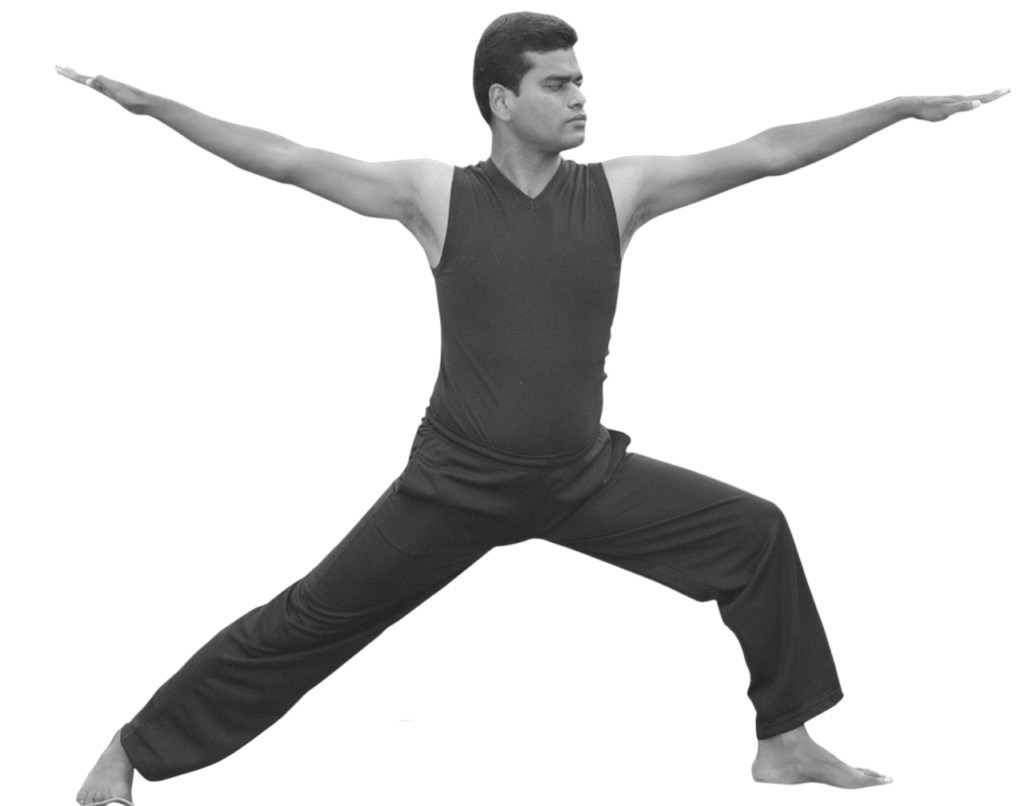
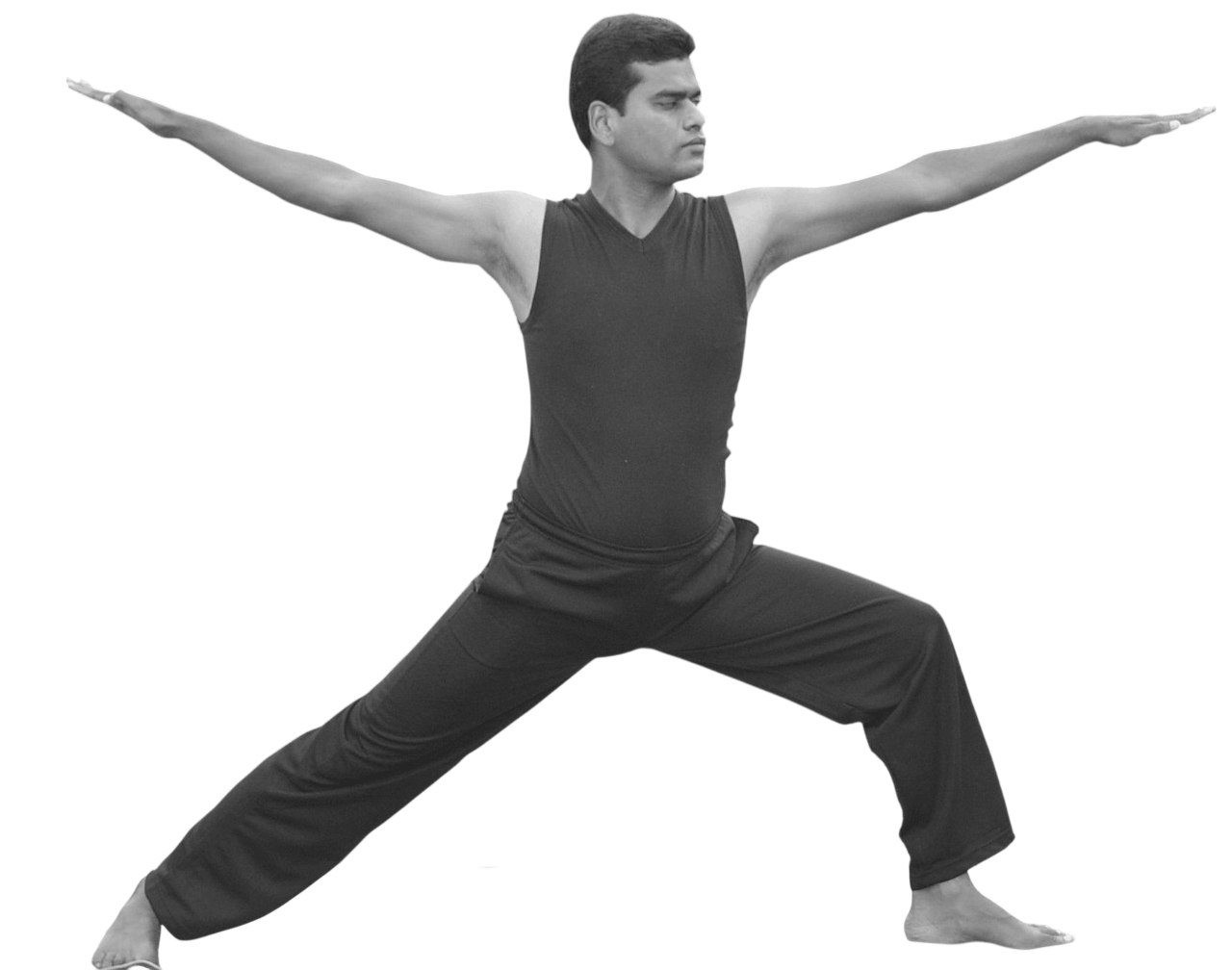
Meaning: “Pose of the Mighty Warrior II.”
The posture symbolizes strength, courage, focus, and readiness. It is one of the most widely practiced standing yoga poses and is part of Sun Salutation sequences, standing pose series, and warrior flows.
Introduction:
- Virabhadrasana II is a powerful standing posture that strengthens the lower body, opens the hips, stretches the torso, and develops focus and stability.
- The pose emphasizes alignment, grounding, and expansion simultaneously.
- The practitioner embodies the qualities of a warrior: alertness, stability, and strength.
2. Definition
Virabhadrasana II is defined as a standing asana in which the body faces sideways with a wide stance, the front leg bent at the knee over the ankle, the back leg straight, arms extended laterally at shoulder height, and gaze directed forward over the front hand, creating a dynamic posture combining strength, stretch, and balance.
Key characteristics:
- Lower body: strong, stable, grounded
- Upper body: arms extended, chest open, shoulders relaxed
- Core: engaged to maintain upright torso and balance
- Neck and head: aligned, gaze over front hand (drishti)
3. Method of Practice – Step by Step
Step 1: Begin in Tadasana (Mountain Pose)
- Stand at the top of the mat.
- Ground feet evenly, legs active.
- Take a deep inhalation.
Step 2: Step Feet Apart
- Step or jump feet wide apart (~3–4 feet depending on height).
- Turn the right foot outward 90°, left foot slightly inward (15–30°).
- Align heels: front heel in line with the back arch.
Step 3: Bend the Front Knee
- Bend the right knee directly over the right ankle, forming ~90° angle.
- Ensure knee does not go past ankle; thigh parallel to floor.
- Engage quadriceps to support the knee.
Step 4: Align the Hips
- Keep pelvis facing sideways, square to side of mat.
- Avoid leaning forward over the bent knee.
- Engage glutes and core for stability.
Step 5: Extend the Arms
- Raise arms parallel to the floor.
- Palms face down; shoulders away from ears.
- Stretch fingertips actively in opposite directions.
Step 6: Torso and Chest
- Lift chest; elongate spine.
- Slightly tuck tailbone to engage lower abdominals.
- Ensure torso remains upright over hips.
Step 7: Head and Gaze (Drishti)
- Turn head to face front hand.
- Gaze softly over middle or index finger.
Step 8: Maintain the Pose
- Hold for 30 seconds to 1 minute.
- Breathe steadily, maintaining stability.
Step 9: Release
- Inhale to straighten front leg.
- Lower arms; step feet together.
- Repeat on the other side.
4. Alignment Cues
Feet and Legs
- Front knee directly over second and third toe.
- Back leg straight; outer edge of back foot grounded.
- Weight distributed evenly, pressing firmly into both feet.
Hips and Pelvis
- Neutral pelvis; no tilting forward or backward.
- Square torso sideways; shoulders aligned with hips.
Spine
- Upright; maintain natural lumbar curve.
- Avoid leaning toward front thigh.
Arms and Shoulders
- Arms extended, parallel to floor.
- Shoulders relaxed away from ears.
- Fingers active, reaching in opposite directions.
Head and Neck
- Gaze forward over front hand.
- Neck long; avoid craning.
Breath
- Steady, deep, even.
- Synchronize inhalation with expansion; exhalation with grounding.
5. Benefits
Physical Benefits
- Strengthens legs, hips, and ankles.
- Opens chest, shoulders, and lungs.
- Enhances stamina and endurance.
- Improves balance and proprioception.
- Lengthens inner thighs and groin.
- Develops core stability and spinal alignment.
- Increases hip flexibility.
- Stimulates lower body circulation.
Physiological Benefits
- Boosts energy and circulation.
- Improves respiratory efficiency.
- Enhances coordination of muscular systems.
Mental Benefits
- Enhances focus and concentration.
- Builds mental stamina and alertness.
- Reduces anxiety through mindful engagement.
Energetic Benefits
- Balances pranic flow in legs and core.
- Stimulates Muladhara and Manipura chakras (stability, willpower).
6. Contraindications
- Knee injuries (especially front knee)
- Hip injuries or recent hip replacement
- Shoulder or neck strain (during arm extension)
- Low blood pressure or dizziness (caution with holding pose)
- Severe ankle instability
Modifications recommended in such cases.
7. Counterposes
- Trikonasana – releases lateral stretch
- Tadasana – resets alignment
- Adho Mukha Svanasana (Downward Dog) – stretches hamstrings
- Virasana – counter hip alignment
8. Preparatory Practice
- Leg Strength: Utkatasana, Chair Pose
- Hip Opener: Baddha Konasana, Butterfly Stretch
- Side Stretch: Ardha Chandrasana
- Spinal Alignment: Tadasana, Mountain Pose
- Balance Training: Tree Pose
9. Modifications
For Beginners
- Reduce stance width.
- Front knee bent less deeply.
- Place a block under back heel if floor too far.
For Shoulder Issues
- Keep hands on hips.
- Reduce arm height below shoulder level.
For Knee Issues
- Slightly bend back leg.
- Avoid deep bend in front knee.
10. Muscles Involved
Primary Muscles
- Quadriceps (front leg)
- Hamstrings (back leg)
- Gluteus maximus, medius, minimus
- Adductors
- Erector spinae
- Deltoids (shoulders)
Secondary Muscles
- Obliques (stabilize torso)
- Rhomboids and trapezius (upper back)
- Intrinsic foot muscles (stability)
- Core muscles (transverse abdominis)
11. Kinesiology
- Hip Flexion/Extension: Front knee flexed (~90°), back leg extended.
- Shoulder Abduction: Arms extended to 90°
- Spinal Neutrality: Erect spine with lateral awareness
- Balance: Weight distributed between front and back foot
- Isometric Contractions: Quadriceps, glutes, core stabilize joints
12. Kinematics
- Joint motion: Front knee flexion, back knee extension, hip abduction/adduction.
- Spinal movement: Minimal, upright alignment.
- Upper limb motion: Shoulder abduction and horizontal extension.
- Functional movement: Controlled static stance; micro-adjustments maintain balance.
13. Biomechanism
- Force distribution: Ground reaction forces through feet and legs.
- Joint stacking: Knee aligned over ankle; hip and shoulders aligned.
- Stability: Core and lower limb co-contraction maintain upright posture.
- Energy efficiency: Static isometric contractions minimize unnecessary muscle activity.
14. Functional Anatomy & Physiology
- Foot/Ankle: Grounded, arches active
- Knee: Quadriceps stabilize, hamstrings co-contract
- Hip: Gluteus medius stabilizes pelvis, adductors lengthen
- Spine: Erector spinae maintain alignment
- Shoulders: Deltoids and trapezius support arm lift
- Respiration: Chest open, ribs expanded for optimal breathing
- Neuromuscular: Balance maintained via proprioception, vestibular feedback
15. How to Correct & Adjust While Teaching
Verbal Cues
- “Front knee over ankle.”
- “Back leg straight and grounded.”
- “Arms parallel; shoulders relaxed.”
- “Gaze over front fingertips.”
- “Engage core to stabilize spine.”
Physical Adjustments
- Support front thigh gently for knee alignment.
- Place a hand under back foot to encourage grounding.
- Encourage shoulder relaxation and chest opening.
Common Errors
- Front knee collapsing inward – cue knee tracking over second toe
- Torso leaning forward – cue upright spine
- Arms drooping – cue arm extension and shoulder release
- Weight on back foot – cue even distribution
QUESTION AND ANSWER
1. What does “Virabhadrasana II” literally mean?
A. Pose of the Peaceful Warrior
B. Pose of the Mighty Warrior II
C. Pose of the Mountain
D. Pose of the Sun Warrior
Answer: B
2. Which deity is associated with Virabhadrasana II?
A. Vishnu
B. Brahma
C. Shiva
D. Ganesh
Answer: C
3. The front foot in Virabhadrasana II is turned:
A. 45° inward
B. 90° outward
C. 180° outward
D. Parallel to back foot
Answer: B
4. The back foot in Virabhadrasana II is turned:
A. Slightly inward (~15°–30°)
B. 90° outward
C. Fully rotated outward
D. Parallel to the front foot
Answer: A
5. How should the front knee be aligned?
A. Over the second and third toes
B. Past the ankle
C. Collapsed inward
D. Straight and locked
Answer: A
6. The back leg in Warrior II should be:
A. Bent slightly
B. Straight and strong
C. Relaxed
D. Rotated inward
Answer: B
7. What is the arm position in Virabhadrasana II?
A. Arms at sides
B. Hands on hips
C. Arms extended laterally at shoulder height
D. Arms overhead
Answer: C
8. The gaze (drishti) in Warrior II is:
A. Forward over front hand
B. Upward
C. Down at the floor
D. Toward back hand
Answer: A
9. Which muscles are primarily strengthened in Virabhadrasana II?
A. Quadriceps and glutes
B. Biceps and triceps
C. Pectorals
D. Cervical muscles
Answer: A
10. Which muscles are stretched in this pose?
A. Hamstrings and calves
B. Adductors of the back leg
C. Lower back and hip flexors
D. Shoulder girdle
Answer: B
11. Core muscles involved in Warrior II include:
A. Rectus abdominis and transverse abdominis
B. Pectoralis minor
C. Biceps brachii
D. Soleus
Answer: A
12. Which part of the spine should remain upright?
A. Cervical only
B. Thoracic only
C. Lumbar only
D. Entire spine
Answer: D
13. Common contraindication for Virabhadrasana II includes:
A. Mild ankle soreness
B. Knee injury
C. Shoulder flexibility
D. Low back strength
Answer: B
14. What is the key biomechanical principle in Warrior II?
A. Locking joints completely
B. Grounding and extending limbs in opposite directions
C. Spinal rotation
D. Shoulder compression
Answer: B
15. Which is a suitable preparatory pose for Warrior II?
A. Tadasana
B. Utkatasana
C. Savasana
D. Balasana
Answer: B
16. Counterpose for Virabhadrasana II is often:
A. Trikonasana
B. Ardha Matsyendrasana
C. Dhanurasana
D. Shavasana
Answer: A
17. Breath in Warrior II should be:
A. Rapid
B. Shallow
C. Steady and deep
D. Suspended
Answer: C
18. Shoulder alignment cue in Warrior II:
A. Shoulders lifted to ears
B. Shoulders forward
C. Shoulders relaxed and away from ears
D. Shoulders rounded
Answer: C
19. Tailbone alignment in Warrior II should be:
A. Tilted anteriorly
B. Tilted posteriorly
C. Neutral, slightly tucked
D. Rotated laterally
Answer: C
20. Weight distribution is:
A. Mostly on front foot
B. Mostly on back foot
C. Even between both feet
D. On toes only
Answer: C
21. Common beginner error:
A. Dropping chest
B. Leaning over front thigh
C. Collapsing back hip
D. All of the above
Answer: D
22. Virabhadrasana II is classified as:
A. Forward bend
B. Standing lateral stretch
C. Backbend
D. Seated posture
Answer: B
23. Which energy center is stimulated?
A. Muladhara and Manipura chakras
B. Anahata
C. Sahasrara
D. Vishuddha
Answer: A
24. To correct knee alignment, teacher cue:
A. “Push knee past toes”
B. “Track knee over middle toes”
C. “Lock the knee”
D. “Bend knee inward”
Answer: B
25. Arms engagement involves:
A. Active reaching in opposite directions
B. Relaxed and limp
C. Pressed down
D. Folded at elbows
Answer: A
26. Head position correction:
A. Drop chin to chest
B. Turn gaze over front hand
C. Look at ceiling
D. Look at back foot
Answer: B
27. How long should the pose be held?
A. 5–10 seconds
B. 30 seconds to 1 minute
C. 3–5 minutes
D. Only 1 breath
Answer: B
28. The pose develops:
A. Flexibility of cervical spine
B. Strength, stability, and focus
C. Cardiovascular endurance only
D. Supination of forearms
Answer: B
29. Which joint receives most corrective attention?
A. Shoulder
B. Knee
C. Elbow
D. Wrist
Answer: B
30. Which preparatory stretch opens hips for this pose?
A. Baddha Konasana
B. Setu Bandhasana
C. Paschimottanasana
D. Uttanasana
Answer: A
31. Front thigh angle should be:
A. Less than 45°
B. About 90°
C. More than 120°
D. Fully straight
Answer: B
32. The back leg supports:
A. Lateral movement
B. Extension and stabilization
C. Flexion only
D. Rotation only
Answer: B
33. Chest cue in Warrior II:
A. Collapse forward
B. Lift and broaden
C. Round shoulders
D. Lower chest
Answer: B
34. Arm height correction cue:
A. Arms below shoulders
B. Arms at shoulder level, parallel
C. Arms overhead
D. Arms crossed
Answer: B
35. Which anatomical system is actively engaged for balance?
A. Vestibular system
B. Digestive system
C. Reproductive system
D. Respiratory only
Answer: A
36. Energy direction cue:
A. Lift through spine, ground through feet
B. Collapse down
C. Only lift arms
D. Only bend knees
Answer: A
37. Neck engagement in Warrior II:
A. Relaxed without craning
B. Hyperextended
C. Flexed forward
D. Rotated laterally
Answer: A
38. If the front knee collapses inward:
A. Encourage knee over toes
B. Straighten completely
C. Rotate hip outward
D. Tilt torso forward
Answer: A
39. Arms active cue:
A. Fingertips pointing opposite directions
B. Fingers curled
C. Relaxed
D. Palms backward
Answer: A
40. Common mental benefit:
A. Reduces focus
B. Enhances mental alertness and courage
C. Causes anxiety
D. Increases confusion
Answer: B
41. To modify for balance issues:
A. Shorten stance
B. Close eyes
C. Lock knees
D. Arms overhead
Answer: A
42. Which muscle is NOT heavily engaged?
A. Quadriceps
B. Gluteus medius
C. Biceps brachii
D. Deltoids
Answer: C
43. Which part of the foot presses into the ground?
A. Outer edge only
B. Big toe, little toe, inner and outer heels
C. Heel only
D. Arch only
Answer: B
44. What type of contraction occurs in legs?
A. Isometric
B. Eccentric only
C. Concentric only
D. None
Answer: A
45. Drishti over front hand improves:
A. Balance and focus
B. Flexibility
C. Cardiovascular output
D. Shoulder mobility
Answer: A
46. Common physical error:
A. Back hip collapsing
B. Front knee past ankle
C. Weight unevenly distributed
D. All of the above
Answer: D
47. Which breath cue is correct?
A. Hold breath
B. Rapid shallow breaths
C. Steady, calm inhalation and exhalation
D. Exhale only
Answer: C
48. Teacher adjustment for arms:
A. Lift shoulders manually
B. Encourage parallel arms and shoulder relaxation
C. Push elbows down
D. Lock elbows
Answer: B
49. Warrior II helps improve:
A. Cardiovascular endurance only
B. Leg strength, balance, hip flexibility, mental focus
C. Finger dexterity
D. Wrist mobility
Answer: B
50. When releasing Warrior II:
A. Straighten front leg and lower arms
B. Jump immediately
C. Twist spine
D. Lock knees
Answer: A