
1. Word Meaning of Parsvottānāsana
The Sanskrit term Parsvottānāsana is composed of:
- Pārśva = side, flank, lateral body
- Uttāna = intense stretch, extension
- Āsana = posture
Hence, Parsvottānāsana = “Intense Side Stretch Pose.”
It is also commonly called the Pyramid Pose because of the triangular shape created by the legs and torso.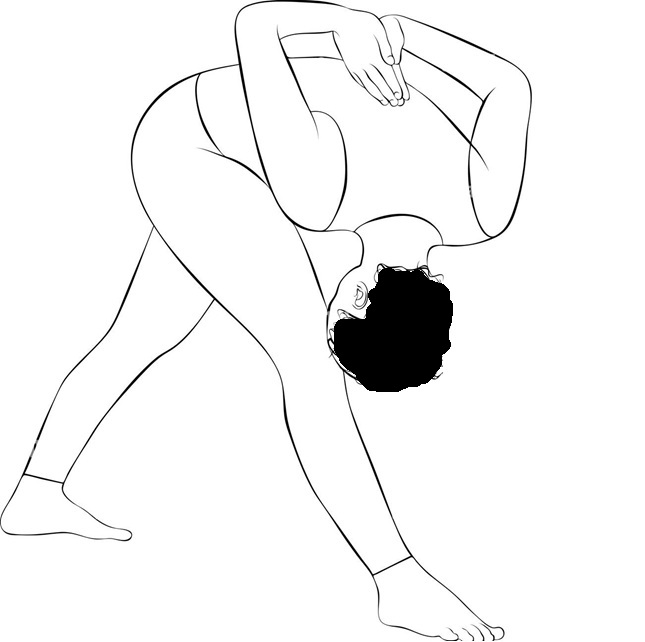
Although the literal meaning emphasizes “side stretch,” the pose provides an intense posterior-chain stretch (hamstrings, calves, spinal muscles) combined with spinal elongation and pelvic stabilization.
2. Definition of Parsvottānāsana
Parsvottānāsana is a standing forward-bending pose performed with:
- Legs in a narrow asymmetrical stance
- Hips square facing forward
- Spine lengthening over the front leg
- Arms placed either:
- In reverse prayer (Pashchima Namaskarasana), or
- Holding elbows, or
- Hands on floor/blocks
It is part of:
- Ashtanga Primary Series
- Hatha Yoga standing sequences
- Iyengar Yoga intermediate standing poses
It improves hamstring flexibility, strengthens postural muscles, and teaches pelvic alignment, balance, calmness, and breath discipline.
3. Method of Practice – Step-by-Step Technique
Step 1: Enter the Starting Position
- Stand in Tadasana.
- Step the left foot back 2.5–3 feet (slightly shorter than Warrior stances).
- Keep the pelvis facing forward.
Step 2: Foot Positioning
- Front foot: faces straight ahead.
- Back foot: angled 30–45° inward.
- Heels: ideally aligned, or slightly heel-to-arch (modification).
- Legs straight, but not hyperextended.
Step 3: Arm Position
Choose one:
- Reverse Prayer (Namaste behind the back)
- Rotate arms internally, press palms together.
- Elbows held behind the back.
- Fingertips on blocks beside front foot.
- Hands on hips if breath restrictions occur.
Step 4: Pelvic Alignment
- Draw right hip back.
- Draw left hip forward.
- Maintain neutral pelvis, not tipping sideways.
- Lift sternum and lengthen spine.
Step 5: Inhale – Prepare
- Lift chest.
- Lengthen spine upward.
- Engage lower belly (Uddiyana/Udara awareness).
Step 6: Exhale – Forward Bend
- Hinge from hip joint, NOT the waist.
- Keep spine long and neutral.
- Fold halfway forward first to check hip alignment.
- Continue folding only as far as hips stay square.
Step 7: Final Position
- Chin gently moves toward shin (not forced).
- Spine extends, crown of head reaching down.
- Shoulders relaxed away from ears.
- Breathing is deep and even.
Step 8: Hold
- 3–10 breaths (beginners)
- Up to 1–2 minutes (advanced)
Step 9: Release
- Inhale, rise with a straight spine.
- Step back into Tadasana.
- Repeat on other side.
4. Alignment Cues (Essential Teaching Points)
Foot & Leg Alignment
- Keep both legs straight, but avoid locking knee joints.
- Press firmly into outer edge of back foot.
- Big toe of front foot rooted firmly.
- Both thighs activated to protect hamstrings.
Pelvis & Spine Alignment
- Keep hips square like headlights facing front.
- Avoid lifting the left hip higher.
- Maintain slight anterior pelvic tilt for proper hinging.
- Lengthen from tailbone through crown.
Shoulders & Chest
- If performing reverse prayer:
- Roll shoulders back and down.
- Open chest without compressing spine.
Breath Alignment
- Inhale lengthens spine.
- Exhale deepens fold.
- Avoid collapsing chest → keep heart lifted.
Common Mistakes
- Twisting pelvis instead of keeping hips square.
- Curving lumbar spine excessively.
- Collapsing into hamstrings.
- Hyperextending front knee.
- Leaning weight too far forward or back.
5. Benefits of Parsvottanāsana
Physical Benefits
- Deep stretch of hamstrings, calves, gluteus maximus, spine.
- Strengthens:
- Quadriceps
- Back extensors
- Feet and ankle stabilizers
- Enhances postural alignment and pelvic stability.
- Improves hip flexion mechanics.
- Opens chest and shoulders (reverse prayer variation).
Therapeutic / Medical Benefits
- Relieves mild lower back stiffness from tight hamstrings.
- Improves digestion due to abdominal compression.
- Calms nervous system → parasympathetic activation.
- Reduces anxiety and increases mental clarity.
- Enhances proprioception and balance.
Energetic Benefits (Pranic Perspective)
- Stimulates Mooladhara, Swadhisthana, and Manipura Chakra.
- Grounding effect due to strong connection through legs.
- Encourages introspection and inward-focused awareness.
6. Contraindications
Absolute Contraindications
- Recent hamstring injury
- Recent hip or spinal surgery
- Herniated lumbar disc (avoid deep forward folds)
- Severe balance disorders
Relative Contraindications (Modify Instead)
- Hypertension (avoid full head-down position)
- Wrist issues (avoid reverse prayer)
- Pregnancy (avoid deep forward flexion)
- Vertigo
- Tight shoulders (modify arm position)
7. Counterposes
After Parsvottanasana, practice:
- Ardha Uttanasana – to neutralize spine
- Tadasana – re-center
- Utkatasana – re-activate legs
- Bhujangasana or Sphinx Pose – mild backbend
- Prasarita Padottanasana – wide-leg release
8. Preparatory Practices
Warm-Up Poses
- Adho Mukha Svanasana
- Uttanasana
- Ardha Uttanasana
- Janu Sirsasana
- Supta Padangusthasana
- Paschimottanasana
- Hamstring warmups: leg swings, active stretches
Shoulder & Chest Preparation
- Gomukhasana arms
- Cow-face arms
- Wall pec stretches
9. Modifications & Variations
For Tight Hamstrings
- Place blocks under hands.
- Reduce forward fold depth.
- Shorten the stance.
For Shoulder Limitations
- Hands on hips
- Hold elbows behind back
- Hands in front of chest
For Balance Issues
- Practice beside a wall
- Widen stance slightly
Advanced Variations
- Parsvottanasana with palms flat on floor
- Chest-to-leg contact with neutral spine
- Forehead to shin (advanced Ashtanga alignment)
10. Muscles Involved
Primary Muscles Stretched
- Hamstrings (Biceps femoris, Semitendinosus, Semimembranosus)
- Gastrocnemius and soleus (calves)
- Gluteus maximus
- Erector spinae
- Tensor fasciae latae
- Piriformis (depending on alignment)
Primary Muscles Activated
- Quadriceps (knee extension)
- Tibialis anterior (front shin)
- Gluteus medius/minimus (pelvic stabilization)
- Deep spinal stabilizers (multifidus)
Muscles of Upper Body (depending on arm position)
- Pectoralis minor/major (stretch)
- Rhomboids & middle trapezius (activation)
- Deltoids (some external rotation)
11. Kinesiology of Parsvottanasana
Major Joint Actions
Hip Joint
- Flexion of front leg hip
- Slight internal rotation of back hip
- Pelvis neutral rotation
Knee Joint
- Extension in both knees
- Isometric quadriceps engagement
Ankle Joint
- Dorsiflexion in front foot
- Plantarflexion activation in back foot for stability
Spine
- Axial extension
- Controlled forward flexion from hip hinge
Muscle Contractions
- Eccentric stretch in hamstrings during lowering.
- Concentric engagement of spinal extensors to maintain long spine.
- Isometric contraction in quads to avoid knee hyperextension.
- Isometric stabilization from gluteus medius/minimus.
12. Kinematics
Movement Sequence Analysis
- Initial alignment sets pelvic orientation.
- Hinge at hip joint while maintaining neutral spine.
- Gravity assists in folding forward.
- Eccentric hamstring lengthening slows forward motion.
- Static end range creates stretch and stabilization simultaneously.
- Return from the pose through concentric spinal extensor activation.
Planes of Movement
- Sagittal plane: forward flexion
- Transverse plane: slight pelvic rotation control
- Frontal plane: balance and hip level maintenance
13. Biomechanics of Parsvottanasana
Center of Gravity
- Shifts forward over the standing front leg.
- Requires ankle, foot, and core stability.
Load Distribution
- Hamstrings bear eccentric tension.
- Back leg bears weight through tibia and ankle stabilizers.
- Spinal extensors prevent collapse.
Biomechanical Risks
- Overstretching hamstrings
- Rounding lumbar spine → increases disc pressure
- Hyperextending front knee
- Twisting pelvis → SI joint stress
Safe Biomechanical Strategies
- Micro-bend in knee if necessary.
- Neutral spine rather than collapsing.
- Use props to avoid excessive spinal flexion.
- Equal weight distribution in both legs.
14. Functional Anatomy & Physiology
Role of Hamstrings
- Control forward bending through eccentric loading.
- Tight hamstrings can anteriorly pull pelvis → limit range.
- Strong quads protect knee during extension.
Spine Mechanics
- Lumbar spine should stay long to avoid shear forces.
- Thoracic spine extends mildly to maintain chest lift.
Pelvic Mechanics
- Anterior pelvic tilt allows proper hip flexion.
- Hips must remain level to prevent SI joint strain.
Respiratory System
- Forward bends encourage:
- Diaphragmatic breathing
- Parasympathetic activation
- Calming of heart rate
Circulatory System
- Forward fold increases venous return.
- In advanced practitioners → lowering of blood pressure (caution in hypertensive students).
Nervous System
- Forward bends quiet the sympathetic system.
- Enhances proprioceptive awareness of alignment.
15. How to Correct and Adjust While Teaching
Verbal Cues
- “Square your hips to the front like headlights.”
- “Lengthen spine before folding.”
- “Keep both legs energized.”
- “Draw the right hip back; left hip forward.”
- “Hinge from hips, not the waist.”
Hands-On Adjustments (Safe Techniques)
1. Hip Alignment Adjustment
- Stand beside student.
- Place hands on outer hips.
- Guide hips square softly.
2. Spinal Lengthening Adjustment
- Place one hand on lower back.
- Gently draw back and upward.
- Cue: “Lengthen here before folding deeper.”
3. Back Leg Grounding
- Press gently into back heel to help student root down.
Avoid Hands-On Adjustments When
- Student has back injury.
- Hamstring injury.
- SI joint pain.
- Anxiety around physical contact.
Prop-Based Corrections
- Blocks under hands.
- Shorter stance for beginners.
- Strap around shoulders for reverse prayer.
Observational Corrections
- Look for hip rotation.
- Watch for rounding spine.
- Check front knee hyperextension.
- Monitor back heel lifting.
- Ensure student is not breath-restricted by reverse prayer pose.
16. Conclusion
Parsvottanasana (Intense Side Stretch Pose) is a multi-dimensional posture that combines:
- Flexibility
- Strength
- Pelvic alignment
- Balance
- Breath awareness
- Mindful introspection
, biomechanics, teaching methodology, and adjustments.
QUESTION AND ANSWER
SECTION 1: Word Meaning & Definition
1. What is the Sanskrit meaning of the term “Parsvottanasana”?
A. Intense forward stretch
B. Intense side stretch
C. Side angle pose
D. Revolved triangle pose
Answer: B
2. Which of the following is the correct English name for Parsvottanasana?
A. Extended Triangle Pose
B. Intense Side Stretch Pose
C. Revolved Side-Angle Pose
D. Standing Forward Bend
Answer: B
3. Parsva in Sanskrit refers to:
A. Back
B. Side
C. Forward
D. Twist
Answer: B
4. Uttana refers to:
A. Gentle stretch
B. Long intense stretch
C. Deep backbend
D. Rotational movement
Answer: B
SECTION 2: Method of Practice (Steps)
5. What is the correct first step for entering Parsvottanasana?
A. Start in Mountain Pose
B. Start in Tadasana
C. Start in High Lunge
D. Start in Downward Dog
Answer: B
6. Which foot is turned out approximately 60–90 degrees in the classical version?
A. Back foot
B. Front foot
C. Both feet
D. Neither foot
Answer: A
7. What is the correct hip alignment in Parsvottanasana?
A. Open hips to the side
B. Square hips to the front
C. Twist the pelvis
D. Rotate hips outward
Answer: B
8. In classical practice, the hands are placed in which mudra behind the back?
A. Anjali Mudra
B. Dhyana Mudra
C. Paschim Namaskar (reverse prayer)
D. Prana Mudra
Answer: C
9. What is the correct drishti for the final position?
A. Upwards
B. Sideways
C. To the toes or floor
D. Between the eyebrows
Answer: C
SECTION 3: Alignment Principles
10. To protect the hamstrings, one should avoid:
A. Micro-bending the knees
B. Hyperextending the front knee
C. Keeping the pelvis square
D. Engaging the quadriceps
Answer: B
11. The spine should be:
A. Rounded in the beginning
B. Lengthened before folding
C. Overarched
D. Compressed downward
Answer: B
12. What is the correct cue for the back heel?
A. Lift the heel
B. Press firmly into the floor
C. Rotate inward
D. Keep it relaxed
Answer: B
13. The hips should be:
A. Tilted backward
B. Dropping toward the back leg
C. Level and facing front
D. Completely twisted
Answer: C
SECTION 4: Benefits
14. Parsvottanasana primarily stretches which area?
A. Back and shoulders
B. Front thighs
C. Hamstrings and spine
D. Quadriceps
Answer: C
15. The pose is therapeutic for:
A. Digestive stimulation
B. Migraine reduction
C. Thyroid stimulation
D. All of the above
Answer: D
16. One energetic effect of Parsvottanasana is:
A. Calming the nervous system
B. Stimulating the sympathetic system
C. Raising blood pressure
D. Increasing aggression
Answer: A
SECTION 5: Contraindications
17. Which condition is NOT a contraindication?
A. Acute hamstring tear
B. Severe low back pain
C. Uncontrolled hypertension
D. Mild anxiety
Answer: D
18. Parsvottanasana should be avoided during:
A. Pregnancy (later stages)
B. Menstruation
C. Early morning
D. After meals
Answer: A
19. People with balance issues may need:
A. Wall support
B. To skip the pose
C. Additional weights
D. A headstand before the pose
Answer: A
SECTION 6: Preparatory & Counterposes
20. Which pose best prepares the hamstrings for Parsvottanasana?
A. Bhujangasana
B. Uttanasana
C. Ustrasana
D. Gomukhasana
Answer: B
21. A suitable counterpose is:
A. Backbends such as Bhujangasana
B. Deep twists
C. Headstands
D. Shoulderstand
Answer: A
22. Which pose helps prepare the hips?
A. Virabhadrasana I
B. Cat-cow
C. Savasana
D. Chair pose
Answer: A
SECTION 7: Modifications
23. A student with tight shoulders may replace reverse prayer with:
A. Gomukhasana arms
B. Holding elbows behind back
C. Hands on top of head
D. Hands in namaste in front
Answer: B
24. To reduce hamstring strain, use:
A. A block under the front foot
B. A block under the hands
C. A strap around the waist
D. A blanket over the head
Answer: B
25. Students with balance issues can:
A. Use a chair
B. Bend the knees
C. Stand with feet wider
D. Use the wall
Answer: D
SECTION 8: Muscles Involved
26. Primary stretch occurs in:
A. Gastrocnemius
B. Hamstrings and adductors
C. Biceps
D. Gluteus medius
Answer: B
27. Which muscle works to stabilize the pelvis?
A. Psoas major
B. Latissimus dorsi
C. Gluteus minimus
D. Rectus abdominis
Answer: A
28. Which muscles lengthen in the posterior chain?
A. Quadriceps
B. Hamstrings + spinal extensors
C. Hip flexors
D. Pectorals
Answer: B
SECTION 9: Kinesiology & Biomechanics
29. The forward folding movement occurs primarily at:
A. Thoracic spine
B. Hip joint
C. Cervical spine
D. Knees
Answer: B
30. What is the primary type of contraction of hamstrings during folding?
A. Concentric
B. Eccentric
C. Isometric
D. Spasmodic
Answer: B
31. The pose improves which biomechanical function?
A. Hip flexion range
B. Shoulder abduction
C. Spinal rotation
D. Knee extension
Answer: A
32. Stability of the back foot depends on:
A. Pronation
B. Supination
C. Ground reaction forces
D. Pelvic lift
Answer: C
SECTION 10: Teaching Methodology & Adjustments
33. Primary verbal cue for beginners:
A. “Bend forward quickly.”
B. “Lengthen the spine before folding.”
C. “Twist the hips outward.”
D. “Lock the knees.”
Answer: B
34. A safe hands-on adjustment is to:
A. Push the student deeper
B. Lift the pelvis and draw it back slightly
C. Force shoulders into reverse prayer
D. Press heavily on their spine
Answer: B
35. Teachers should avoid:
A. Forcing hip square alignment
B. Advising micro-bends
C. Using props
D. Allowing blocks
Answer: A
36. Which cue helps avoid rounding of the spine?
A. “Touch your forehead to the shin.”
B. “Lift the collarbones forward.”
C. “Drop the chest.”
D. “Push down through the shoulders.”
Answer: B
37. Best cue for back foot grounding:
A. “Relax the heel.”
B. “Press through the outer edge of the back foot.”
C. “Shift weight forward.”
D. “Lift the toes.”
Answer: B
38. If the student collapses at the chest, teacher should cue:
A. “Lift the sternum.”
B. “Twist deeper.”
C. “Straighten elbows.”
D. “Lean backward.”
Answer: A
39. A pregnant student should:
A. Do the pose with a wide stance
B. Do it on one leg
C. Do deep forward bending
D. Avoid all standing poses
Answer: A
40. Most important safety cue:
A. “Hold your breath.”
B. “Engage the core and protect the spine.”
C. “Lock the back knee.”
D. “Turn the hips away.”
Answer: B