
1. Word Meaning and Etymology
The Sanskrit term Parsvakonasana is composed of three words:
- Parshva – “side,” “flank,” or “lateral aspect of the body”
- Kona – “angle”
- Asana – “posture” or “seat”
Thus Parsvakonasana translates to “Side Angle Pose” or “Lateral Angle Posture.”
The name reflects the posture’s shape: a deep side-bending, angled stretch from the extended arm to the back heel, creating a long diagonal line across the body. The pose cultivates spatial awareness, grounding, and lengthening through the sides of the torso and rib cage, making it both strengthening and expansive.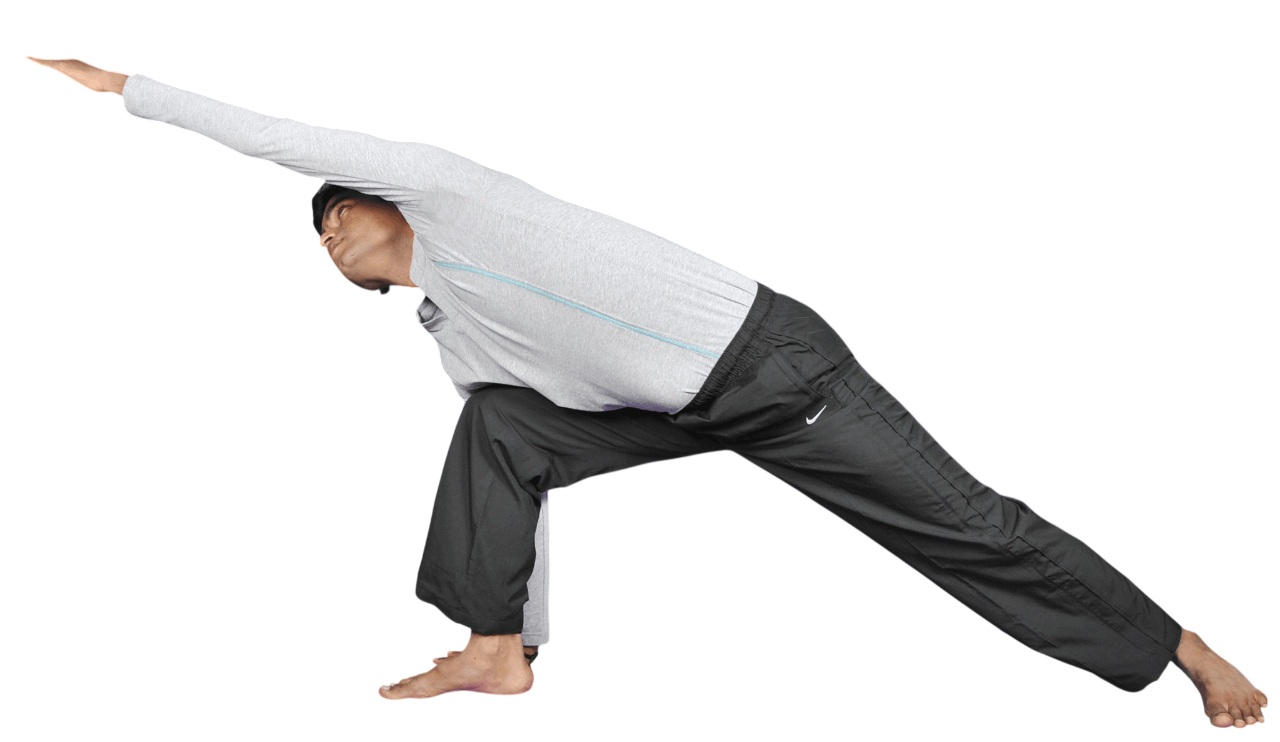
Historically, the pose is mentioned in modern Hatha Yoga texts and widely used in Sivananda, Satyananda, Iyengar, and Ashtanga Vinyasa yoga systems. Iyengar Yoga refined its alignment subtleties, making it a signature standing posture for structural integration and functional alignment.
2. Definition of Parsvakonasana
Parsvakonasana is a foundational standing yoga posture involving a deep lateral stretch of the trunk while maintaining grounded stability through the legs.
It requires:
- a wide stance
- one knee bent to approximately 90°
- the opposite leg straight and rooted
- the top arm extended overhead creating a diagonal side line
- the bottom hand placed on the floor, block, or ankle for support
It emphasizes:
- lateral flexion
- hip opening
- spinal stability
- weight-bearing coordination
- core activation
This asana is classified as:
- Standing Asana
- Lateral Stretching Asana
- Hip-Opening and Strengthening Asana
- Preparatory Pose for Twists, Backbends, and Balancing Asanas
3. Method of Practice (Step-by-Step Instructions)
Step 1 – Begin in Tadasana
- Stand upright
- Ground through the feet
- Establish breath awareness
Step 2 – Move into a Wide Stance
- Step legs 3–4 feet apart
- Arms stretched at shoulder height
Step 3 – Turn the Feet
- Right foot turns out 90°
- Left foot turns slightly inward (15–20°)
- Heel-to-arch alignment for classical form
- Heel-to-heel alignment for beginners
Step 4 – Bend the Front Knee
- Bend the right knee to 90°
- Knee stacked above ankle
- Shin vertical
- Hips descend evenly
- Keep chest square forward initially
Step 5 – Lower the Torso
Options for the lower arm:
A. Classical Version
- Place right hand outside the right foot
- Press palm to the floor
- Rotate torso upward
B. Supported Version
- Place forearm on the thigh
- Maintain elongated spine
C. Deep Version
- Place right arm under the thigh
- Bind behind the back (Baddha Parsvakonasana)
Step 6 – Extend the Top Arm Overhead
- Stretch the left arm over the ear
- Palm facing downward
- Biceps close to the ear
- Create a long diagonal line from back heel to fingertips
Step 7 – Lengthen the Spine and Rotate the Chest
- Roll left rib cage upward
- Broaden collarbones
- Maintain strong core engagement
Step 8 – Breath Coordination
- Inhale to lengthen spine
- Exhale to deepen hips
- Maintain steady breathing
Step 9 – Hold for 5–10 breaths
Step 10 – Release and Repeat on the Other Side
- Inhale to rise
- Straighten the leg
- Reset stance
- Switch sides
4. Alignment Cues (Detailed Teaching Cues)
Foundation and Feet
- Press outer edge of back foot firmly
- Front knee directly above heel
- Back foot turned slightly inward for stability
- Weight distributed evenly
Knee Alignment
- Front knee tracks toward middle toe
- Avoid collapsing inward
- Back leg engaged and straight
Hips and Pelvis
- Hips open sideways without collapsing
- Front thigh parallel to floor
- Pelvis neutral—not excessively tilting
Torso and Spine
- Spine lengthened
- Avoid rounding or collapsing
- Rib cage remains open
- Rotational lift through upper body
Shoulders and Arms
- Top arm lengthens overhead, palm down
- Bottom arm stable but not bearing full body weight
- Shoulders stacked vertically
Head and Neck
- Gaze upward toward the top arm
- If uncomfortable, gaze forward or down
Breathing
- Slow Ujjayi or diaphragmatic breathing
- Maintain stability on exhalation
- Expansion on inhalation
5. Benefits of Parsvakonasana
Physical Benefits
- Strengthens legs, hips, glutes, knees, ankles
- Opens chest and rib cage
- Enhances lateral flexibility
- Strengthens spinal erectors
- Improves hip mobility
- Boosts stamina and endurance
- Stretches side body, intercostal muscles
- Strengthens core muscles
- Improves balance and postural alignment
- Enhances lymphatic drainage
Therapeutic Benefits
- Helpful for scoliosis (specific variations)
- Improves digestion due to abdominal compression/expansion
- Benefits respiratory function
- Reduces lower-back tension
- Enhances gait mechanics
- Helps weight management
Energetic / Pranic Benefits
- Stimulates Manipura Chakra
- Improves pranic flow in Ida-Pingala nadis
- Builds confidence and grounding
- Harmonizes left-right energy channels
Psychological Benefits
- Improves focus and concentration
- Reduces mental fatigue
- Promotes inner strength and stability
6. Contraindications
Absolute Contraindications
- Recent abdominal or thoracic surgery
- Severe knee injury
- Acute sciatica
- Hip replacement (unless supervised)
Relative Contraindications
- High/low blood pressure
- Vertigo
- Chronic ankle instability
- Labral hip tears
Pregnancy
- Avoid deep compression
- Use modified versions
7. Counterposes
- Tadasana – neutral alignment
- Prasarita Padottanasana – release of hips and spine
- Uttanasana – forward fold to calm the spine
- Supta Baddha Konasana – open hips and rest
- Child’s Pose – reset breath and nervous system
8. Preparatory Practices
- Trikonasana – lateral extension
- Utthita Parsvakonasana (simplified)
- Virabhadrasana II – strengthens legs
- Adho Mukha Svanasana – lengthens spine
- Baddha Konasana – opens hips
- Lunges – increases hip flexibility
Joint Mobilizations:
- Hip circles
- Ankle mobilization
- Shoulder openings
- Thoracic rotations
9. Modifications and Variations
1. Forearm on Thigh Variation
- Best for beginners
- Maintains alignment without strain
2. Block Placement
- Under the bottom hand
- Ensures chest remains lifted
3. Wall Support
- Back against wall for chest alignment
- Helps beginners find stability
4. Baddha Parsvakonasana (Bound)
- Deep hip opening
- Requires shoulder mobility
5. Reverse Parsvakonasana
- Arm lifted behind the back
- Creates deeper chest opening
6. Shortened Stance
- For knee pain or hip stiffness
10. Muscles Involved
Primary Muscles (Agonists)
- Quadriceps
- Gluteus maximus/medius
- Hamstrings (stabilizing)
- Adductors
- Obliques
- Latissimus dorsi
- Intercostal muscles
- Tensor fascia lata
Secondary Muscles
- Deltoids
- Serratus anterior
- Erector spinae
- Rectus abdominis
- Psoas (stabilizing)
Stabilizers
- Transverse abdominis
- Multifidus
- Pelvic floor muscles
- Deep rotator muscles of the hip
11. Kinesiology of Parsvakonasana
Movement Components
- Hip Flexion (front leg)
- Hip Abduction & External Rotation (front leg)
- Hip Extension (back leg)
- Knee Flexion (front leg)
- Lateral Trunk Flexion
- Thoracic Rotation
- Shoulder Flexion & Abduction (top arm)
Joint Actions
- Ankle dorsiflexion (front leg)
- Ankle eversion (back leg)
- Pelvic lateral tilt
- Rib expansion
12. Kinematics
Linear Movements
- Downward displacement into front leg
- Horizontal extension of spine
Angular Movements
- Hip joint: large angular displacement
- Knee joint: flexion angle around 90°
- Spinal lateral flexion: 25–40°
- Thoracic rotation: 30–45° depending on mobility
Center of Gravity
- Moves toward the bent knee
- Requires core engagement to prevent collapse
13. Biomechanics of Parsvakonasana
Load Distribution
- Front knee bears compressive load
- Back leg bears tensile load
- Spine undergoes controlled lateral flexion
Force Dynamics
- Ground reaction force stabilizes back foot
- Adductors prevent knee collapse
- Core muscles resist gravitational pull
Mechanical Advantages
- Long diagonal line creates traction effect
- Hip abductors stabilize pelvis
- Serratus anterior supports scapular rotation
14. Functional Anatomy & Physiology
Respiratory Function
- Opens intercostal spaces
- Encourages diaphragmatic breathing
- Improves lung capacity
Digestive System
- Side compression massages abdominal organs
- Enhances peristalsis
Circulatory System
- Mobilizes lymph nodes in groin
- Enhances blood flow to legs and spine
Musculoskeletal Function
- Strengthens gluteus medius → improves gait
- Opens hips → reduces sacroiliac strain
- Strengthens spine → improves posture
Neurophysiological Response
- Increases proprioception
- Enhances vestibular balance
- Stimulates parasympathetic activation through deep breathing
15. How to Correct and Adjust While Teaching
Common Mistakes and Corrections
1. Front Knee Collapsing Inward
Correction:
- Cue “knee over middle toe”
- Encourage activation of gluteus medius
2. Torso Drooping Toward Floor
Correction:
- Cue “lift bottom rib upward”
- Use block under hand
3. Back Foot Lifting
Correction:
- Press outer edge of foot
- Shorten stance
4. Collapsed Shoulder
Correction:
- Pull top shoulder back
- Engage serratus anterior
5. Overarching Lower Back
Correction:
- Engage core
- Tuck tailbone slightly
Hands-On Adjustment Method (If permitted)
For Front Knee Alignment
- Support knee externally
- Encourage outward rotation
For Spine Lengthening
- One hand on rib cage, one on lower back
- Lift upward gently
For Shoulder Opening
- Guide top arm into overhead position
Verbal Cues
- “Reach long from heel to fingertips.”
- “Lift your ribs up and twist.”
- “Ground down to rise up.”
- “Stay stable and breathe fully.”
16. Conclusion
Parsvakonasana is a powerful, foundational standing posture used across all yoga traditions. It strengthens the legs, opens the chest, integrates the core, and enhances spinal mobility through a synergy of grounding and expansion. Its anatomical and biomechanical components make it an essential posture for posture correction, functional range development, and holistic energy flow.
The pose teaches discipline, alignment awareness, and confidence, making it indispensable for beginners and advanced practitioners alike. With proper modifications, mindful alignment, and skilled instruction, Parsvakonasana becomes a transformative tool for physical, mental, and energetic well-being.
QUESTION AND ANSWER
1. What is the Sanskrit meaning of Parsvakonasana?
A. Revolved triangle pose
B. Side angle pose
C. Extended forward bend
D. Side seated stretch
Answer: B
2. Which of the following is the English name of Utthita Parsvakonasana?
A. Extended Side Angle Pose
B. Side Plank Pose
C. Wide-Legged Side Bend
D. Extended Triangle Pose
Answer: A
3. In Parsvakonasana, the front knee ideally bends to:
A. 45°
B. 60°
C. 90°
D. Straight
Answer: C
4. The back foot in Parsvakonasana is usually turned outward by:
A. 10–20°
B. 20–30°
C. 45–60°
D. 90°
Answer: C
5. In classical alignment, where does the front heel point?
A. To the arch of the back foot
B. To the heel of the back foot
C. To the big toe of the back foot
D. To the top of the mat
Answer: A
6. What is the main purpose of the top arm in Utthita Parsvakonasana?
A. Stretch the hip
B. Maintain balance
C. Create a long lateral extension from heel to fingertips
D. Provide weight
Answer: C
7. Which bandha is subtly engaged in Parsvakonasana?
A. Jalandhara Bandha
B. Mula Bandha
C. Udiyana Bandha
D. Maha Bandha
Answer: B
8. In Parsvakonasana, the torso should ideally:
A. Twist deeply
B. Fold forward
C. Stay in line with the front thigh
D. Lean back
Answer: C
9. A beginner modification of Parsvakonasana is:
A. Arm wrapped under the thigh
B. Hand lifted off the floor
C. Elbow placed on the front thigh
D. Twisted version
Answer: C
10. Which of the following is NOT a benefit?
A. Improves digestion
B. Strengthens legs
C. Enhances lateral stretch
D. Increases spinal compression
Answer: D
11. Which condition is contraindicated?
A. Headache
B. Knee injury
C. Stiff shoulders
D. Fatigue
Answer: B
12. Which is a recommended counterpose?
A. Dandasana
B. Uttanasana
C. Adho Mukha Svanasana
D. Balasana
Answer: D
13. Parsvakonasana strongly stretches:
A. Hamstrings
B. Quadratus lumborum
C. Obliques and intercostals
D. Rhomboids
Answer: C
14. Which cue helps maintain pelvic alignment?
A. Lift the back heel
B. Roll the rib cage down
C. Tuck the tailbone slightly
D. Lean forward
Answer: C
15. Which foot bears more weight in proper alignment?
A. Both equally
B. Back foot
C. Front foot
D. Entire body weight shifts to the pelvis
Answer: A
16. Which vinyasa sequence commonly includes Parsvakonasana?
A. Ashtanga Primary Series
B. Sivananda Series
C. Kundalini Kriya sets
D. Iyengar gentle series
Answer: A
17. Proper alignment requires that the front knee:
A. Moves inward
B. Moves outward
C. Stacks directly above the heel
D. Moves beyond the toes
Answer: C
18. What is the orientation of the spine in classical Parsvakonasana?
A. Twisted
B. Laterally stretched
C. Neutral
D. Flexed
Answer: B
19. Which joint undergoes the greatest external rotation?
A. Back hip
B. Front hip
C. Spine
D. Shoulder
Answer: B
20. Which version requires the bottom arm to reach under the leg?
A. Utthita Parsvakonasana
B. Parivrtta Parsvakonasana
C. Baddha Parsvakonasana
D. Ardha Parsvakonasana
Answer: C
✅ SECTION 2: ANATOMY, KINESIOLOGY & BIOMECHANICS
21. Which muscle primarily stabilizes the bent front knee?
A. Gluteus minimus
B. Vastus medialis oblique
C. Biceps femoris
D. Tensor fasciae latae
Answer: B
22. The lateral stretch in Parsvakonasana mainly activates:
A. Internal obliques
B. Quadratus lumborum
C. External obliques + intercostals
D. Psoas major
Answer: C
23. The back leg is strongly engaged in:
A. Hip extension & external rotation
B. Hip flexion & internal rotation
C. Hip adduction
D. Hip circumduction
Answer: A
24. Which stabilizes the back foot arch?
A. Abductor hallucis
B. Tibialis posterior
C. Extensor digitorum
D. Soleus
Answer: B
25. Which joint undergoes lateral flexion?
A. Hip
B. Spine
C. Knee
D. Ankle
Answer: B
26. The extended top arm requires which shoulder action?
A. Internal rotation
B. External rotation + flexion
C. Adduction
D. Depression only
Answer: B
27. In the lower ribs, biomechanical movement is predominantly:
A. Pump-handle
B. Bucket-handle
C. Screw motion
D. Compression
Answer: B
28. Which muscle prevents the front knee from collapsing inward?
A. Adductor magnus
B. Gluteus medius
C. Rectus femoris
D. Pectineus
Answer: B
29. In Parsvakonasana, the neck is in:
A. Full extension
B. Neutral or slight rotation
C. Flexion
D. Compression
Answer: B
30. The bottom arm pressing into the floor activates:
A. Latissimus dorsi
B. Triceps brachii
C. Serratus anterior
D. Coracobrachialis
Answer: C
31. The back leg inner thigh stretch involves:
A. Tensor fascia lata
B. Pectineus
C. Adductor group
D. Piriformis
Answer: C
32. A common kinetic chain error is:
A. Over-engagement of core
B. Lifting the back heel
C. Straightening the front knee
D. Excessive neck rotation
Answer: B
33. Which muscle eccentrically controls the lateral flexion of the spine?
A. Spinal erectors
B. Psoas
C. Latissimus dorsi
D. Rectus abdominis
Answer: A
34. Proper alignment of ribs and pelvis prevents:
A. Hyperflexion
B. Thoracic collapse
C. Shoulder dislocation
D. Hip over-abduction
Answer: B
35. Primary plane of movement in the torso?
A. Sagittal
B. Transverse
C. Frontal
D. Oblique
Answer: C
36. The knee in front leg undergoes:
A. Flexion
B. Extension
C. Rotation
D. Hyperextension
Answer: A
37. The back ankle is in:
A. Plantarflexion
B. Dorsiflexion + eversion
C. Neutral
D. Full inversion
Answer: B
38. Which muscle helps prevent the pelvis from tipping forward?
A. Hamstrings
B. Gluteus maximus
C. Quadriceps
D. Tibialis anterior
Answer: B
39. A common shoulder misalignment is:
A. External rotation
B. Arm crossing midline
C. Collapsing the top shoulder forward
D. Overhead reach
Answer: C
40. Corrective adjustment for collapsing ribs is:
A. Push hips deeper
B. Lift bottom ribcage upward & rotate chest open
C. Straighten the front knee
D. Rotate the head more
Answer: B