
1. Word Meaning
- Parivṛtta – “Revolved,” “Twisted,” “Rotated,” “Turned around.”
- Roots:
- pari = around, all around
- vṛtta = turned, rotated
- Roots:
- Tri – Three
- Koṇa – Angle
- Āsana – Posture or seat
Parivṛtta Trikoṇāsana literally means:
“The Revolved Three-Angle Pose.”
It is the twisted counterpart of Utthita Trikoṇāsana (Extended Triangle Pose), adding a rotational movement along the spinal axis, increasing complexity, strength, balance, and detoxification effect.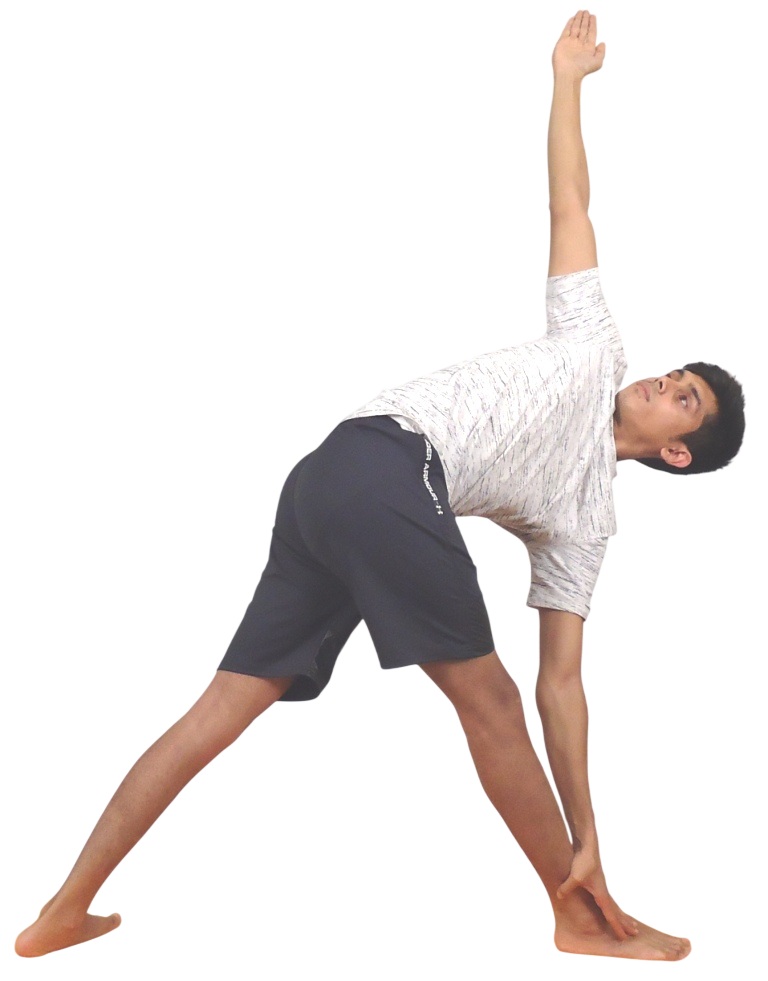
2. Definition
Parivṛtta Trikoṇāsana is a standing, asymmetrical, closed-twist posture combining:
- Hip adduction and stability
- Axial spine rotation
- Hamstring lengthening
- Core engagement
- Deep thoracic opening
It is considered:
- A lateral standing twist
- A balancing asymmetrical pose
- A posture that integrates stability + mobility
- One of the most therapeutic twisting asanas for digestive health, oblique activation, and posture correction.
3. Method of Practice: Step-by-Step Technique
Preparation
Begin from Tāḍāsana at the top of the mat.
Step 1: Setup the Legs (Similar to Trikoṇāsana)
- Step the right leg back into a short lunge stance (2.5–3 feet).
- Turn the back foot to 45–60°.
- Heels may be aligned heel-to-heel or heel-to-arch for better balance.
- Both legs remain straight and active.
Alignment cue:
“Press through all four corners of both feet.”
Step 2: Square the Hips
- Draw the right hip forward
- Draw the left hip back
- Maintain the pelvis facing the front of the mat.
Avoid:
Letting the right hip flare open.
Step 3: Inhale — Lengthen the Spine
- Raise both arms to shoulder height.
- Create axial elongation from tailbone to crown.
Step 4: Exhale — Hinge Forward
- Keep spine long as you fold from the hips over the front leg.
- Avoid rounding the back.
- Stop when your spine is parallel to the floor.
Step 5: Place the Hand
Options:
- Right hand on the outside of the left foot (deep twist).
- Or inside the foot (more accessible).
- Or on a block.
Keep the front knee straight but not hyperextended.
Step 6: Initiate the Twist
- Press into the right hand.
- Twist the ribcage to the left.
- Open left shoulder upward.
Step 7: Extend the Top Arm
- Lift the left arm straight up.
- Rotate the chest to stack shoulders vertically.
- Gaze toward the top hand if balance allows.
Step 8: Maintain the Final Pose
- Breathe deeply for 5–10 breaths.
- Lengthen spine with each inhale; deepen twist with each exhale.
Step 9: Release
- Exhale, unwind the torso.
- Inhale and come up with control.
- Switch sides.
4. Alignment Cues (Teaching-Level Precision)
Feet & Legs
- Press down the outer edge of the back foot.
- Keep both legs straight and engaged.
- Micro-bend front knee to avoid hyperextension.
- Ground all four corners of both feet.
Hips
- “Hips square toward the front of the mat.”
- “Back hip moves forward, front hip moves back.”
- “Do not let the pelvis collapse sideways.”
Spine
- “Lengthen before you twist.”
- “Rotate from the navel upward — not just shoulders.”
- “Avoid collapsing chest toward the thigh.”
Shoulders & Arms
- “Bottom shoulder draws away from the ear.”
- “Top shoulder stacks above bottom shoulder.”
- “Arm rotates externally.”
Neck & Gaze
- Look at:
- The floor (for beginners)
- Side (intermediate)
- Top hand (advanced)
Breath
- Inhale = lengthen
- Exhale = twist deeper
5. Benefits
A. Physical Benefits
- Improves spinal flexibility and mobility
- Strengthens legs, hips, glutes, and core
- Lengthens hamstrings and adductors
- Enhances thoracic spine rotation
- Improves posture and alignment
- Strengthens erector spinae and obliques
- Improves balance and proprioception
B. Therapeutic Benefits
- Stimulates digestive organs
- Improves elimination, metabolism
- Relieves mild constipation
- Supports liver detoxification
- Reduces low-back stiffness when performed correctly
- Corrects postural asymmetry
C. Energetic Benefits
- Balances Idā & Piṅgalā nāḍīs
- Activates Maṇipūra Chakra (solar plexus)
- Promotes mental clarity
- Reduces lethargy
D. Psychological Benefits
- Enhances focus
- Improves mental balance
- Reduces stress and mental fatigue
6. Contraindications
Absolute Contraindications
- Herniated disc
- Acute low-back pain
- Sciatica of acute stage
- Recent abdominal surgery
- Vertigo
- Uncontrolled hypertension
Relative Contraindications
- Pregnant women (avoid deep twists)
- Knee injury
- Hamstring tear
- Cervical spondylosis (avoid neck rotation)
- Severe balance issues
7. Counterposes
To neutralize twisting:
- Tāḍāsana (Mountain Pose)
- Utthita Trikoṇāsana (Extended Triangle)
- Supta Matsyendrasana (Supine Twist — gentle)
- Ardha Uttanasana (Half Forward Fold)
8. Preparatory Practices
Warm-up Postures
- Pārśvottānāsana (Pyramid Pose)
- Utthita Trikoṇāsana
- Ardha Chandrāsana
- Supta Pādānguṣṭhāsana
- Gentle supine twists
Mobility Drills
- Hamstring dynamic stretches
- Hip stability exercises
- Thoracic spine rotation drills
9. Modifications
For Beginners
- Hand on block
- Wider stance
- Bend front knee slightly
- Keep gaze downward
For Limited Flexibility
- Both hands on blocks
- Keep the spine parallel to the floor without twisting too deeply
For Balance Challenges
- Practice near a wall
- Back heel touching wall
- Top hand on wall
For Advanced Practitioners
- Bind variation (wrap the top arm behind the back)
- Deeper narrowing of stance
- Add dynamic rotation during Surya Namaskar B variations
10. Muscles Involved
A. Primary Muscles Working
- Hamstrings (front leg)
- Quadriceps (both legs)
- Gluteus medius & minimus (stabilization)
- Psoas minor & major
- Erector spinae
- External & internal obliques
- Rectus abdominis
- Transverse abdominis
B. Muscles Stretching
- Hamstrings
- Adductors
- Gluteus maximus
- Gastrocnemius
- Latissimus dorsi (mild)
- Thoracolumbar fascia
C. Muscles Stabilizing
- Foot arch stabilizers
- Multifidus
- Quadratus lumborum
- Rotator cuff (shoulder stability)
11. Kinesiology (Movement Science)
Joint Actions
- Ankles: dorsiflexion (front), eversion/inversion adjustments
- Knees: extension
- Hips: flexion (front), extension (back), adduction, stabilization
- Spine: axial rotation + slight extension
- Shoulders: flexion and extension in opposite direction
- Neck: rotary positioning
Muscle Actions
- Hamstring lengthening while quadriceps contract
- Abdominal obliques create twist
- Erector spinae maintain spinal extension
- Glute medius stabilizes pelvis
12. Kinematics
Kinematic principles describe the motion in the pose:
- Closed-chain lower limb stability as both feet ground into the mat.
- Sequential spinal rotation: lumbar → thoracic → cervical.
- Counter-rotation of pelvis stabilizes the base.
- Top arm acts as a lever enhancing thoracic rotation.
- Center of gravity shifts forward, challenging balance.
13. Biomechanics
Understanding biomechanical loads:
A. Forces Acting on the Body
- Ground reaction force from both feet
- Tensile loading through hamstrings
- Compressive + rotational forces on lumbar vertebrae
- Shear force minimized by core activation
B. Pelvic Stability
- Hip adductors stabilize to prevent pelvic shearing
- Obliques control controlled twisting pattern
C. Spinal Safety
- Twist initiated from thoracic spine
- Avoid forcing lumbar vertebrae
14. Functional Anatomy & Physiology
Digestive Physiology
- Compression stimulates intestines
- Encourages peristalsis
- Enhances liver and kidney stimulation
Respiratory Physiology
- Expands intercostal muscles
- Improves diaphragmatic breathing
- Enhances lung capacity
Neuromuscular Physiology
- Improves proprioception
- Enhances neuromuscular coordination
- Strengthens deep stabilizer muscles
15. How to Correct & Adjust While Teaching
A. Verbal Cues
- “Lengthen the spine before twisting.”
- “Keep hips square; avoid letting the back hip open.”
- “Relax the shoulders.”
- “Twist from the ribcage upward.”
B. Hands-On Adjustments
(For trained teachers only)
1. Hip Adjustment
- Stand behind the student.
- Place one hand on outer front hip, one on back hip.
- Gently square the pelvis.
2. Spinal Lengthening
- One hand on sacrum, one on upper back.
- Encourage axial length, not deeper twist.
3. Shoulder Stacking
- Gently guide the top shoulder back.
C. Safety Precautions for Adjustments
- Avoid pressing the low back.
- Never force the twist.
- Keep communication: “Is this okay?”
- Offer props first.
16. Teaching Methodology
- Introduce after warming up hamstrings and spine.
- Demonstrate common mistakes (hip opening, rounded back).
- Teach modifications first, then advanced versions.
- Use props widely.
- Encourage breath-to-movement awareness.
- Always check alignment of hips before twist.
QUESTION AND ANSWER
SECTION 1 — General Knowledge & Sanskrit
1. The Sanskrit term “Parivritta” means:
A. Extended
B. Revolved or twisted
C. Triangular
D. Sideways
Answer: B
2. “Trikonasana” translates to:
A. Circle pose
B. Triangle pose
C. Square pose
D. Revolved pose
Answer: B
3. Parivritta Trikonasana is the:
A. Forward triangle pose
B. Revolved triangle pose
C. Side triangle pose
D. Supported triangle pose
Answer: B
4. Parivritta Trikonasana belongs to which category of asanas?
A. Backbends
B. Standing poses
C. Inversions
D. Restorative poses
Answer: B
5. In classical yoga sequencing, Parivritta Trikonasana is generally practiced:
A. Before warm-up
B. After basic standing poses
C. After inversions
D. As the final pose
Answer: B
SECTION 2 — Method of Practice & Alignment
6. In Parivritta Trikonasana, the back foot is typically:
A. Parallel to the front foot
B. Turned inward 45–60°
C. Turned outward 90°
D. Lifted off the floor
Answer: B
7. The pelvis in Parivritta Trikonasana ideally:
A. Remains open to the side
B. Rotates to face the front leg
C. Stays neutral without movement
D. Moves backward
Answer: B
8. The spine in Parivritta Trikonasana should primarily be:
A. Rounded
B. Laterally flexed
C. Extended and lengthened
D. Compressed downward
Answer: C
9. Which hand typically goes down in the full expression of Parivritta Trikonasana?
A. Same side as the front leg
B. Opposite side of the front leg
C. Both hands on floor
D. Hands on hips
Answer: B
10. Excessive weight on the bottom hand may cause:
A. Better rotation
B. Neck strain
C. Loss of balance and poor alignment
D. Easier breathing
Answer: C
11. The correct gaze (drishti) for full expression is:
A. Down
B. Sideways
C. Toward the top thumb
D. Eyes closed
Answer: C
12. The most important first alignment action is:
A. Twisting deeply
B. Stabilizing the legs and grounding the feet
C. Dropping the head
D. Locking the knees
Answer: B
SECTION 3 — Anatomy & Muscles Involved
13. Which muscle group primarily initiates spinal rotation?
A. Quadriceps
B. Paraspinal muscles and obliques
C. Biceps
D. Gluteus maximus
Answer: B
14. The front leg hamstrings in Parivritta Trikonasana are:
A. Contracting
B. Relaxing
C. Lengthening
D. Rotating
Answer: C
15. Which muscle stabilizes the back leg?
A. Psoas
B. Tibialis anterior
C. Gluteus medius
D. Serratus posterior
Answer: C
16. The main muscle working for balance is:
A. Rectus abdominis
B. Erector spinae
C. Core muscles (deep stabilizers)
D. Latissimus dorsi
Answer: C
17. Which muscle supports the twist of the torso?
A. Internal and external obliques
B. Gastrocnemius
C. Deltoids
D. Quadratus lumborum only
Answer: A
18. The pelvic action in the pose is best described as:
A. Anterior rotation of front hip and internal rotation of back hip
B. Posterior rotation of both hips
C. Abduction of pelvis
D. No pelvic movement
Answer: A
SECTION 4 — Kinesiology, Kinematics, Biomechanics
19. Parivritta Trikonasana is a combination of:
A. Flexion + side bending
B. Forward folding + spinal rotation
C. Extension only
D. Lateral flexion only
Answer: B
20. The twist is safest when initiated from:
A. Lower back
B. Sacrum
C. Thoracic spine
D. Neck
Answer: C
21. Excessive twisting from the lumbar spine can cause:
A. More stability
B. Back strengthening
C. Lumbar compression
D. Longer hamstrings
Answer: C
22. Equal grounding of both feet helps:
A. Reduce spinal length
B. Improve rotational torque safely
C. Make twisting more difficult
D. Increase neck tension
Answer: B
23. Which joint receives the highest rotational force?
A. Knee
B. Cervical spine
C. Thoracic spine
D. Shoulder
Answer: C
SECTION 5 — Benefits
24. Parivritta Trikonasana primarily strengthens:
A. Arms
B. Core and legs
C. Neck
D. Wrists
Answer: B
25. The pose helps improve:
A. Digestive fire and organ stimulation
B. Hearing
C. Shoulder bulk
D. Sleep
Answer: A
26. One of the mental benefits is:
A. Increased agitation
B. Improved concentration and grounding
C. Increased stress
D. Reduced breath control
Answer: B
SECTION 6 — Contraindications & Safety
27. This pose should be modified or avoided in:
A. Healthy athletes
B. People with uncontrolled hypertension
C. Students with flexible hamstrings
D. People practicing meditation
Answer: B
28. Those with vertigo should:
A. Deepen the twist
B. Gaze upward
C. Keep the gaze down
D. Close their eyes
Answer: C
29. Students with sacroiliac (SI) joint issues should:
A. Over-rotate
B. Keep stance narrow and twist gently
C. Lean backward
D. Only twist neck
Answer: B
SECTION 7 — Teaching Methodology & Adjustments
30. The safest teaching cue for beginners is:
A. “Twist as deeply as you can quickly.”
B. “Lengthen spine first, then gradually rotate.”
C. “Lock your knees for stability.”
D. “Lean on your bottom shoulder.”
Answer: B