
1. INTRODUCTION
Padahastāsana is one of the classical standing forward-fold postures of Haṭha Yoga. Deeply rooted in traditional yoga texts like the Haṭha Yoga Pradīpikā and Gheraṇḍa Saṃhitā, it is a vital component of many Sun Salutation (Surya Namaskar) sequences, including Sivananda, Classical Hatha, and Vinyasa approaches. As a vigorous spinal flexion posture combined with gravitational traction, it offers profound therapeutic benefits ranging from muscular flexibility to improvement in circulation and nervous system calming.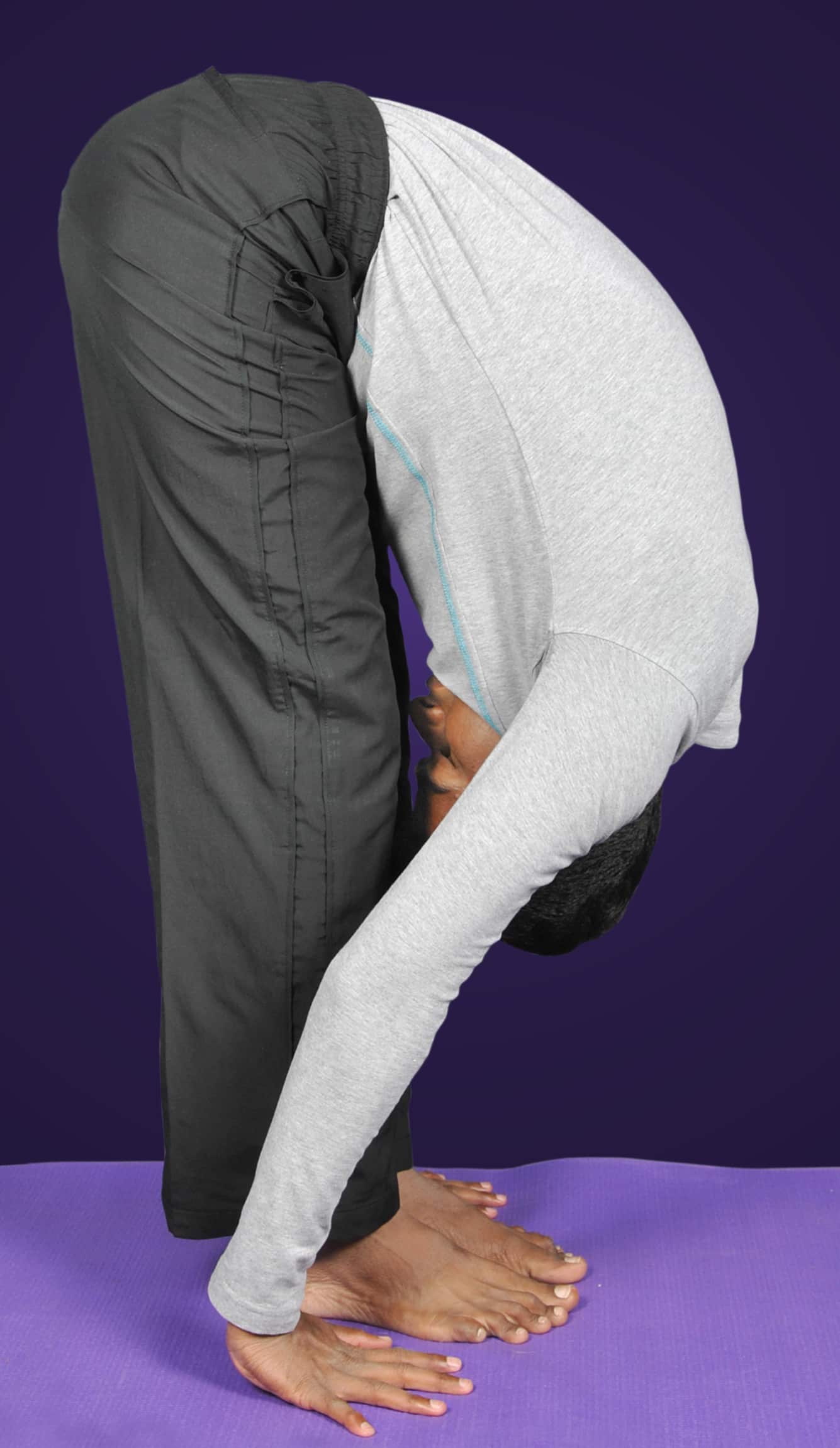
2. WORD MEANING
- Pada = Foot
- Hasta = Hand
- Āsana = Posture or seat
Thus Padahastāsana literally means:
“Hand-to-Foot Pose”
or
“The posture where hands are placed under the feet.”
In many modern styles, Padahastāsana is sometimes confused with Uttanasana (Standing Forward Bend). Traditionally:
- Uttanasana = hands beside/behind feet
- Padahastāsana = palms placed under the feet
Both are forward folds but differ in depth, hand placement, and biomechanical load.
3. DEFINITION
Padahastāsana is a standing forward-bend posture where the practitioner:
- Stands in Samasthiti/Tadasana
- Folds forward from the hips
- Places the palms under the soles of the feet
- Stretches the entire posterior chain (feet to head)
- Maintains lengthened spine with abdominal compression
It is both:
- A flexibility and musculoskeletal posture, and
- A therapeutic forward bend influencing abdominal pressure, parasympathetic activation, and cerebral circulation.
4. METHOD OF PRACTICE (STEP-BY-STEP)
STEP 1 — Preparation
- Stand in Tadasana
- Feet together or hip-width
- Distribute weight evenly across the four corners of both feet
- Spine tall, shoulders relaxed, breath steady
STEP 2 — Engage the Core
- Exhale gently and engage the lower abdomen (Uddiyana support)
- Activate quadriceps to lift kneecaps
- Keep pelvis neutral
STEP 3 — Initiate the Forward Fold
- Inhale, lengthen spine upward
- Exhale, hinge forward from the hip joints
- Avoid rounding the back initially
- Keep knees soft if hamstrings are tight
STEP 4 — Midway Position
- Place fingertips on floor or shins
- Lengthen the spine
- Keep even weight distribution forward and back
STEP 5 — Full Expression
- Slide hands under the feet, palms facing upward
- Toes align with the wrist crease
- Draw the torso down toward the thighs
- Elbows may bend outward
- Allow the head to relax downward
STEP 6 — Breathing
- Slow nasal breathing
- Maintain 5–10 breaths for beginners
- Up to 1–3 minutes for advanced practitioners
STEP 7 — Coming Out of the Pose
- Release hands
- Bend knees slightly
- Engage core
- Roll up vertebra-by-vertebra or rise with a flat back
- Return to Tadasana
5. ALIGNMENT CUES (TEACHER CUEING)
Feet & Legs
- “Press evenly into the four corners of your feet.”
- “Lift the kneecaps gently—activate the quadriceps.”
- “Micro-bend knees if hamstrings grip.”
Hips & Pelvis
- “Hinge from the hips, not the waist.”
- “Draw the sitting bones upward.”
- “Let the pelvis anteriorly tilt for a long spine.”
Spine
- “Initially keep your spine long; avoid collapsing.”
- “Once folded, allow natural spinal flexion.”
Abdomen
- “Navel gently toward spine.”
- “Allow the abdomen to compress against thighs.”
Shoulders & Chest
- “Relax the shoulder blades apart.”
- “Chest draws toward the knees, not the shoulders lifting.”
Neck & Head
- “Let the crown move toward the floor.”
- “Keep neck passive, no strain.”
6. BENEFITS
Physical Benefits
- Lengthens hamstrings, calves, gluteals
- Strengthens quadriceps & hip flexors
- Spinal decompression
- Improves circulation to brain
- Stretches the entire posterior chain
- Improves ankle flexibility
- Supports better posture
- Enhances digestive function
- Relieves menstrual discomfort
- Reduces stiffness in lower back
- Improves balance of autonomic nervous system
- Stimulates liver, kidneys, pancreas
- Reduces varicose vein symptoms
- Helps with sciatica (mild cases)
Mental & Energetic Benefits
- Calms the mind
- Activates parasympathetic nervous system
- Reduces anxiety & stress
- Grounds energy
- Enhances pratyahara (sense withdrawal)
- Improves concentration
- Reduces insomnia
Pranic Benefits
- Stimulates Apana Vayu
- Directs energy downward
- Cools and soothes internal systems
7. CONTRAINDICATIONS
Absolute Contraindications
- Severe back injury (acute slipped disc)
- Vertigo or severe dizziness
- Uncontrolled hypertension
- Glaucoma / retinal detachment
- Recent abdominal surgery
- Hernia (untreated)
Relative Contraindications
- Pregnancy (advanced stages)
- Severe hamstring injury
- Knee ligament injury
- Sciatica (for some, forward fold aggravates symptoms)
- GERD (inversions may increase reflux)
Caution
- Avoid forcing stretch
- Bend knees if lower back rounds excessively
8. COUNTERPOSES
After Padahastāsana, recommend:
- Ardha Uttanasana – Half-lift
- Tadasana – Standing neutral
- Bhujangasana – Gentle backbend
- Ustrasana – Deeper backbend
- Setu Bandhasana – Bridge pose
- Shavasana for relaxation
9. PREPARATORY PRACTICES
Asanas
- Supta Padangusthasana
- Uttanasana
- Ardha Uttanasana
- Adho Mukha Svanasana
- Paschimottanasana
- Janu Sirsasana
- Baddha Konasana
Warm-ups
- Hamstring warm-ups
- Hip-opening sequences
- Cat–Cow
- Pelvic tilts
- Dynamic forward bends
10. MODIFICATIONS & PROPS
For Beginners
- Keep knees soft
- Hands on blocks
- Use wall support for balance
- Hands to shins instead of floor
For Tight Hamstrings
- Stand wider
- Hold elbows (ragdoll pose)
- Use strap around feet
For Lower-Back Sensitivity
- Engage core
- Do not force torso to thighs
- Keep knees bent significantly
11. MUSCLES INVOLVED
Primary Muscles Stretched
- Hamstrings (Biceps femoris, Semitendinosus, Semimembranosus)
- Gastrocnemius & Soleus
- Gluteus maximus
- Erector spinae
- Quadratus lumborum
- Thoracolumbar fascia
- Posterior cervical muscles
Primary Muscles Engaged
- Quadriceps
- Tibialis anterior (to stabilize ankle)
- Iliopsoas (eccentric control)
- Rectus abdominis
- Transversus abdominis
Secondary Muscles
- Gluteus medius & minimus
- Adductors
- Intrinsic foot muscles
- Forearm flexors (when hands under feet)
12. KINESIOLOGY
Primary Joint Actions
- Hip Flexion: 90–120° depending on flexibility
- Lumbar & Thoracic Spinal Flexion
- Knee Extension (eccentric control)
- Ankle Dorsiflexion
Muscle Contractions
- Eccentric:
- Hamstrings regulate descent
- Spinal extensors lengthen
- Concentric:
- Quadriceps engage to stabilize
- Abdominals support forward fold
Balance & Proprioception
- Foot arches adjust
- Shifts in weight between forefoot & heel refine balance
- Mechanoreceptors in fascia activate
13. KINEMATICS
Kinematic components include:
- Movement Initiation
- Hip hinge with spine neutral
- Controlled pelvis movement (anterior tilt)
- Mid-Phase Movement
- Increased spinal flexion
- Knee micro-bend for safety
- End-Range Movement
- Possible spinal rounding
- Wrist & ankle relationship when hands under feet
- Reverse Movement
- Eccentric hamstrings
- Core activation
- Slow spinal extension
14. BIOMECHANISM (BIOMECHANICS)
Gravitational Traction
Forward bending creates traction along:
- Vertebral spaces
- Hamstrings
- Plantar fascia
- Spinal ligaments (posterior chain)
Load Distribution
- Body weight shifts forward
- Anterior chain compresses
- Posterior chain lengthens
- Core engages to prevent collapse
Fascial Influence
- Superficial Back Line (SBL) experiences full-length stretch
(As per Anatomy Trains: plantar fascia → calf → hamstrings → sacrotuberous ligament → erector spinae → scalp fascia)
Intra-Abdominal Pressure
Moderate abdominal compression stimulates:
- Vagus nerve
- Digestive organs
- Lymphatic drainage
Neural Tension
Sciatic nerve glides during deep flexion; too much stretch may irritate.
15. FUNCTIONAL ANATOMY & PHYSIOLOGY
Neuromuscular Effects
- Increased muscle spindle sensitivity initially
- With sustained holding → Golgi tendon organ relaxes muscles
- Promotes flexibility
Cardiovascular Response
- Blood moves toward head
- Parasympathetic activity increases
- Reduced heart rate & blood pressure
Endocrine Influence
Forward bends calm:
- Adrenal stress hormones
- Sympathetic nervous activity
Respiratory Influence
- Diaphragmatic compression
- Enhanced exhalation
- Improves breath awareness
Digestive Physiology
Compression stimulates:
- Colon peristalsis
- Liver & kidney blood flow
16. HOW TO CORRECT & ADJUST WHILE TEACHING (TEACHER’S GUIDE)
Verbal Adjustments
- “Hinge from hips.”
- “Relax your shoulders and neck.”
- “Shift weight gently forward.”
- “Lift kneecaps slightly.”
Visual Demonstration
- Show hip hinge vs. spinal rounding
- Demonstrate safe knee bend
Hands-On Adjustments
(Only with consent.)
1. Lower Back Lengthening
- Stand beside student
- One hand on sacrum, other on upper back
- Guide pelvis into anterior tilt
2. Hamstring Support
- Gently bend knees
- Encourage length before depth
3. Shoulder Relaxation
- Lightly press on upper trapezius
- Encourage head release
4. Spine Extension
- Place hands on side ribs
- Assist in elongating spine without forcing depth
Safety Rules
- Never push down on spine
- Avoid forcing head to knees
- Keep student breathing
- Maintain joint neutrality
CONCLUSION
Padahastāsana is a powerful, classical forward-bend posture offering:
- Deep posterior chain stretching
- Spinal decompression
- Digestive stimulation
- Emotional grounding
- Parasympathetic activation
With proper alignment, anatomical understanding, and safe adjustments, it becomes a transformative tool in yoga practice and teaching.
QUESTION AND ANSWER
SECTION 1 — Sanskrit, Meaning & Definition
1. The Sanskrit term “Padahastāsana” literally means:
A. Hands to the sky pose
B. Hand-to-foot pose
C. Hands behind the back pose
D. Shoulder stretch pose
✔ Answer: B
2. ‘Pada’ refers to:
A. Spine
B. Hands
C. Foot
D. Hip
✔ Answer: C
3. ‘Hasta’ refers to:
A. Hand
B. Head
C. Knee
D. Arm
✔ Answer: A
4. Padahastāsana belongs to which general category of asanas?
A. Backbend
B. Forward bend
C. Twist
D. Lateral bend
✔ Answer: B
5. Padahastāsana is part of which flow in classical traditions?
A. Moon Salutation
B. Sivananda Sun Salutation
C. Standing balance sequence
D. Prone sequence
✔ Answer: B
SECTION 2 — Method of Practice / Steps
6. Padahastāsana generally begins from which foundational pose?
A. Tadasana
B. Vajrasana
C. Adho Mukha Svanasana
D. Utkatasana
✔ Answer: A
7. In the final position of Padahastāsana, the:
A. Hands are placed on knees
B. Hands are placed under the feet
C. Hands rest on the thighs
D. Hands rest behind the back
✔ Answer: B
8. What happens to the spine during the descent into Padahastāsana?
A. Extension
B. Lateral flexion
C. Flexion
D. Rotation
✔ Answer: C
9. To avoid strain in beginners, the teacher should cue:
A. Lock your knees tightly
B. Bend from the upper back
C. Hinge at the hips
D. Round immediately
✔ Answer: C
10. What is the correct breathing pattern?
A. Exhale while bending forward
B. Inhale while bending forward
C. Breath holding throughout
D. Reverse breathing
✔ Answer: A
SECTION 3 — Alignment & Cues
11. In Padahastāsana, the legs should ideally be:
A. Bent always
B. Locked
C. Straight but not hyperextended
D. Rotated externally
✔ Answer: C
12. The safest instruction for neck alignment is:
A. Lift the head up and look forward
B. Keep the neck compressed
C. Relax neck, let the head hang freely
D. Rotate head left and right
✔ Answer: C
13. A key alignment cue for the spine is:
A. Push weight into lower back
B. Force the chest to knees
C. Lengthen the torso downward
D. Collapse the ribs
✔ Answer: C
14. To prevent hamstring injury, avoid:
A. Micro-bending knees
B. Sudden jerky movements
C. Using props
D. Forward hip hinge
✔ Answer: B
15. Proper foot alignment requires:
A. Feet wide apart
B. Feet turned outward
C. Feet parallel, hip-width or together
D. Feet on toes
✔ Answer: C
SECTION 4 — Benefits
16. Padahastāsana mainly stretches which muscle group?
A. Pectorals
B. Hamstrings
C. Quadriceps
D. Deltoids
✔ Answer: B
17. One major physiological benefit is:
A. Stimulates adrenal glands
B. Enhances liver detoxification
C. Increases blood flow to the brain
D. Expands ribcage
✔ Answer: C
18. Which emotional/mental benefit is associated?
A. Heightens sympathetic activation
B. Calms mind and reduces anxiety
C. Increases anger
D. Raises stress hormones
✔ Answer: B
19. Regular practice improves:
A. Digestion
B. Wrist stability only
C. Shoulder mobility
D. Eye health
✔ Answer: A
20. Padahastāsana helps in relieving:
A. Hyperthyroidism
B. Sciatic tension
C. Rotator cuff tears
D. Frozen shoulder
✔ Answer: B
SECTION 5 — Contraindications
21. Which condition is a contraindication?
A. Mild acidity
B. High blood pressure
C. Healthy spine
D. Flexible hamstrings
✔ Answer: B
22. Avoid Padahastāsana during:
A. Pregnancy (late stages)
B. Good digestion
C. Light fatigue
D. Mental clarity
✔ Answer: A
23. Which spinal condition requires caution?
A. Scoliosis
B. Herniated disc
C. Kyphosis
D. All of the above
✔ Answer: D
24. Those with vertigo should:
A. Practice forcefully
B. Avoid dropping the head too low
C. Close eyes tightly
D. Hold breath
✔ Answer: B
25. People with glaucoma should:
A. Practice normally
B. Practice longer
C. Avoid the pose
D. Bend halfway
✔ Answer: C
SECTION 6 — Modifications & Props
26. A common modification for tight hamstrings is:
A. Bend knees slightly
B. Lock the knees
C. Pull heels off floor
D. Lean backward
✔ Answer: A
27. A prop commonly used for beginners:
A. Block under forehead
B. Block under hands
C. Strap on arms
D. Wall behind heels
✔ Answer: B
28. To reduce lower-back strain:
A. Bend from spine
B. Engage core slightly
C. Hyperextend knees
D. Pull head backward
✔ Answer: B
29. For students with wrist pain:
A. Skip placing palms under feet
B. Forcefully insert hands under feet
C. Rotate wrists
D. Press fingertips into floor
✔ Answer: A
30. For hypermobile practitioners:
A. Strengthen hamstrings and core
B. Stretch hamstrings more
C. Relax completely
D. Over-fold deeper
✔ Answer: A
SECTION 7 — Muscles Involved
31. Primary agonist in forward bending:
A. Quadriceps
B. Hamstrings
C. Gluteus medius
D. Deltoids
✔ Answer: B
32. Secondary muscles stretched:
A. Calves
B. Abdominals
C. Pecs
D. Triceps
✔ Answer: A
33. Muscles eccentrically controlling spine flexion:
A. Spinal extensors
B. Hip flexors
C. Obliques
D. Rectus abdominis
✔ Answer: A
34. Engaged muscles during hinge descent:
A. Core stabilizers
B. Erector spinae
C. Quads
D. All of the above
✔ Answer: D
35. Gluteus maximus in this pose acts as:
A. Prime mover
B. Stabilizer
C. Opponent
D. Rotator
✔ Answer: B
SECTION 8 — Kinesiology & Kinematics
36. Movement at hip joint in Padahastāsana:
A. Extension
B. Flexion
C. Abduction
D. Circumduction
✔ Answer: B
37. Movement at spine:
A. Extension
B. Neutral
C. Flexion
D. Rotation
✔ Answer: C
38. Knee kinematics involve:
A. Flexion
B. Extension
C. Circumduction
D. Rotation
✔ Answer: B
39. Ankle movement during forward fold:
A. Plantar flexion
B. Dorsiflexion
C. Inversion
D. Eversion
✔ Answer: B
40. The primary plane of movement is:
A. Transverse
B. Sagittal
C. Coronal
D. Rotational
✔ Answer: B
SECTION 9 — Biomechanics
41. Forward flexion increases tension on:
A. Anterior fascia
B. Posterior fascial chain
C. Lateral fascia
D. Superficial abdomen
✔ Answer: B
42. Where does the center of gravity shift?
A. Backward
B. Forward
C. Sideways
D. Downward only
✔ Answer: B
43. Excessive rounding of back leads to:
A. Hip mobility
B. Disc compression
C. Deeper release
D. Knee opening
✔ Answer: B
44. Hip hinge prevents:
A. Eccentric loading
B. Low back strain
C. Hamstring stretch
D. Core participation
✔ Answer: B
45. Engaging quadriceps helps by:
A. Relaxing hamstrings through reciprocal inhibition
B. Tightening hamstrings
C. Reducing blood flow
D. Creating spinal load
✔ Answer: A
SECTION 10 — Teaching Methodology & Adjustments
46. Best verbal cue for beginners:
A. “Pull yourself down.”
B. “Lengthen your spine and hinge from hips.”
C. “Lock your knees tightly.”
D. “Force your chest to thighs.”
✔ Answer: B
47. Hands-on adjustment for safety:
A. Pressing shoulders aggressively
B. Pushing student downward
C. Supporting hips to fold from pelvis
D. Pulling neck downward
✔ Answer: C
48. A safe correction for rounding lower back is:
A. Slightly bend knees
B. Lock knees
C. Pull student deeper
D. Engage glutes to backbend
✔ Answer: A
49. For dizziness after rising:
A. Stand up fast
B. Hold breath
C. Rise slowly, inhale gradually
D. Sit down immediately
✔ Answer: C
50. Key teaching principle in Padahastāsana:
A. Depth first, alignment later
B. Alignment first, depth later
C. Push beyond limits
D. No warm-up needed
✔ Answer: B