
1. Introduction
Merudandasana, commonly called Spinal Column Pose or Balancing Staff Pose, is a classical yogic posture that integrates balance, core strength, spinal alignment, and breath coordination. It is a semi-advanced seated balance posture that trains the practitioner to stabilize the spine while holding both legs extended upward, forming a “V” shape, similar to variations of Navasana and Ubhaya Padangusthasana. However, Merudandasana is unique because of the neutral spine, the active engagement of the arms, and the direct stimulation of the meru (spinal axis), which is emphasized as the central energy channel in yogic philosophy.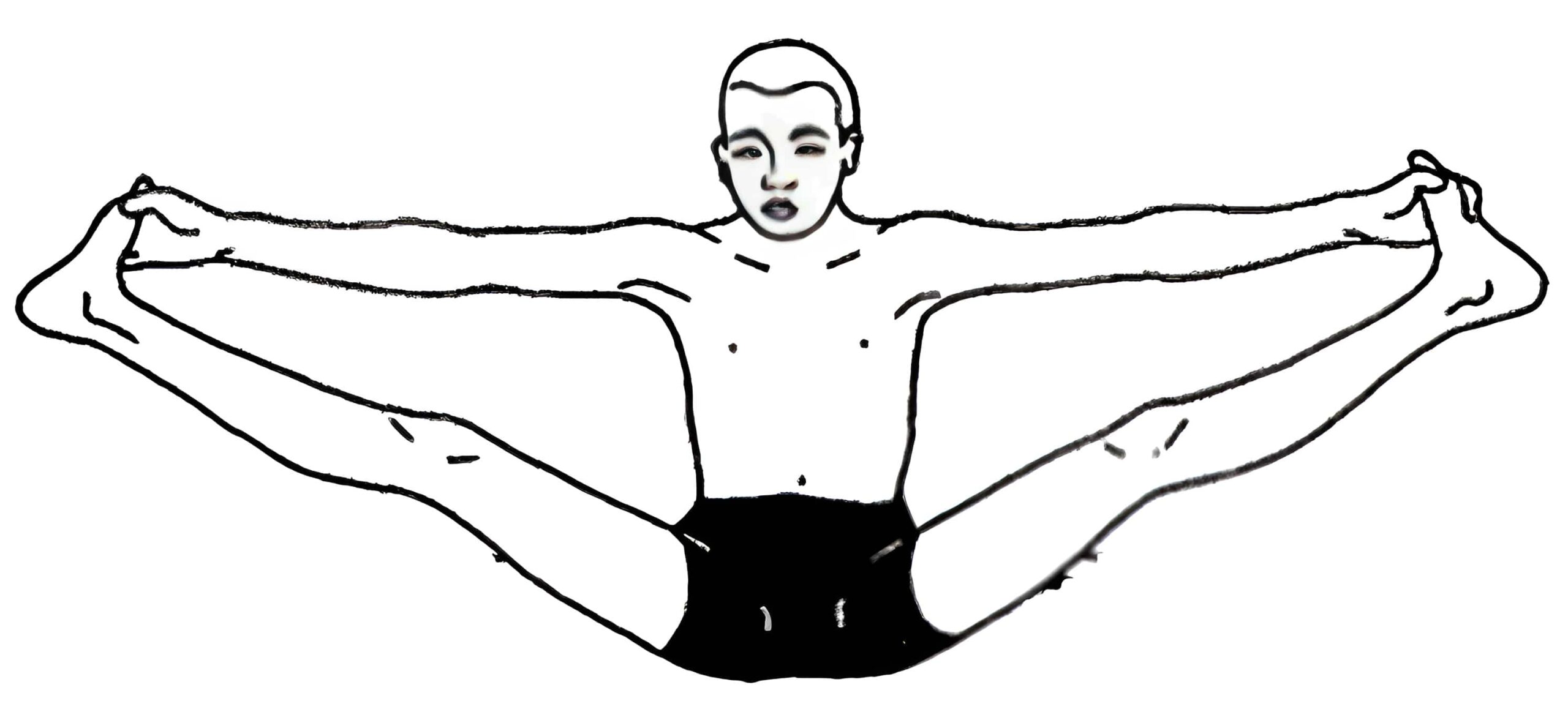
The posture requires physical strength, neuromuscular coordination, and mental focus. It is frequently practiced in traditional Hatha Yoga, Gheranda Samhita-inspired sequences, and is also a component of core strengthening routines in contemporary yoga.
2. Word Meaning
The Sanskrit term Merudandasana is composed of:
• Meru – “Mountain,” “Axis,” or “Spinal Column”
In yogic philosophy, Merudanda refers metaphorically to Mount Meru, the central axis of the cosmos, representing stability, equilibrium, and the core of creation. Anatomically, it represents the vertebral column, the body’s central axis.
• Danda – “Staff,” “Rod,” or “Stick”
Symbolizes straightness, firmness, alignment, and discipline.
• Asana – “Posture”
A steady, comfortable yogic position.
Meaning
Merudandasana means “The Spinal Staff Pose”, representing a straight, stable spinal column held upright like a firm staff.
3. Definition
Merudandasana is a seated balancing posture in which the practitioner lifts both legs, bends the knees, and holds the big toes with the fingers while maintaining an erect spine.
The posture combines:
- static balance
- active core strengthening
- hamstring lengthening
- hip mobility
- deep spinal stabilizer engagement
It teaches the relationship between core activation, pelvic neutrality, and spinal lengthening, making it foundational for more advanced balance postures.
4. Method of Practice – Step-by-Step
Step 1: Initial Position
- Sit in Dandasana with the legs extended.
- Ground the sitting bones.
- Maintain a tall, neutral spine.
Step 2: Bend the Knees and Lift the Legs
- Bring the knees toward the chest.
- Balance slightly back on the sitting bones but avoid collapsing into the lumbar spine.
- Keep the chest lifted.
Step 3: Hold the Big Toes
- Insert index and middle fingers around the big toes (Padangustha grip).
- Maintain the length of the spine.
Step 4: Raise the Legs
- Slowly lift the feet off the ground.
- Bring thighs closer to the torso.
- Balance on the sitting bones without rounding the back.
Step 5: Extend the Legs
- Straighten the knees gradually.
- Create a “V” shape with the body and legs.
- Keep shoulders relaxed and chest open.
Step 6: Breath and Hold
- Stay for 5–10 breaths.
- Keep gaze at the toes or forward.
Step 7: Release
- Bend the knees slowly.
- Lower the feet to the floor.
- Return to Dandasana.
5. Alignment Cues
Spine & Torso
✔ Keep spine neutral, not rounded.
✔ Lift sternum to avoid collapsing.
✔ Engage core gently to support lumbar region.
Shoulders & Arms
✔ Shoulders down away from ears.
✔ Elbows can stay slightly bent, never locked.
✔ Arms energetic but relaxed.
Hips & Pelvis
✔ Sit evenly on both sitting bones.
✔ Avoid excessive posterior tilt.
✔ Maintain hip flexion without straining.
Legs & Feet
✔ Knees move toward straightness without forcing.
✔ Toes flex back toward face.
✔ Hamstrings lengthen gradually without compression.
Gaze
✔ Soft gaze toward toes or forward for balance.
6. Benefits
Physical Benefits
- Strengthens core muscles including rectus abdominis, obliques, transverse abdominis.
- Improves spinal stability through deep stabilizers like the multifidus and erector spinae.
- Enhances hamstring flexibility.
- Improves hip mobility, especially hip flexors and adductors.
- Strengthens quadriceps and hip flexors (iliopsoas).
- Improves neuromuscular balance and proprioception.
- Enhances digestion through abdominal compression.
- Improves circulation to pelvic organs.
- Supports healthy posture by training pelvic alignment.
Mental & Energetic Benefits
- Improves dharana (concentration).
- Boosts confidence and inner stability.
- Stimulates Manipura Chakra (solar plexus energy center).
- Increases mental clarity and reduces sluggishness.
7. Contraindications
Avoid or modify the posture in case of:
Physical Injuries
- Acute or chronic low back pain
- Herniated disc
- Sciatica
- Severe hamstring injury
- Hip or pelvic injury
- Abdominal surgery
- Hernia
Medical Conditions
- High blood pressure
- Vertigo
- Pregnancy (especially second and third trimester)
Cautions
- Avoid pushing legs to full extension if hamstrings are tight.
- Do not collapse into the lumbar spine.
8. Counterposes
After Merudandasana, practice:
- Paschimottanasana – to release hamstrings and spine.
- Apanasana – to soften lower back.
- Supta Baddha Konasana – to relax pelvis.
- Child’s Pose (Balasana) – restores nervous system.
9. Preparatory Practices
To develop hamstring and hip mobility:
- Supta Padangusthasana
- Janu Sirsasana
- Uttanasana
- Upavistha Konasana
For core strengthening:
- Navasana
- Ardha Navasana
- Boat variations
- Plank and Side Plank
For balance and spine alignment:
- Dandasana
- Sukhasana upright sitting
- Staff pose variations
These preparatory poses develop the structural intelligence required for Merudandasana.
10. Modifications of Merudandasana
1. Using a Strap
- Place a strap around the feet for students who cannot reach their toes.
2. Bent Knees Variation
- Keep knees bent and hold behind thighs.
3. Back Support Variation
- Sit with back against a wall.
- Helps maintain neutral spine.
4. One-Leg Variation
- Practice raising one leg at a time.
5. Elevated Hips Variation
- Sit on a folded blanket to reduce hamstring strain.
11. Muscles Involved – Detailed Analysis
Primary Muscles
- Core
- Rectus abdominis
- Transverse abdominis
- Obliques
- Hip Flexors
- Iliopsoas
- Rectus femoris
- Sartorius
- Hamstrings
- Semitendinosus
- Semimembranosus
- Biceps femoris
- Quadriceps
- Vastus group
- Rectus femoris
- Back Muscles
- Erector spinae
- Multifidus
Secondary Muscles
- Adductors
- Hip external rotators
- Shoulder stabilizers (deltoids, rhomboids)
- Finger flexors (toe grip)
12. Kinesiology of Merudandasana
Joint Actions
Hip
- Flexion (major)
- Micro-external rotation
- Neutral abduction/adduction
Knees
- Extension
- Isometric control through quadriceps
Spine
- Axial extension (primary)
- Neutral lumbar curve
- Slight thoracic extension to maintain chest lift
Ankles
- Dorsiflexion (toes toward face)
Muscle Actions
- Eccentric hamstring lengthening
- Isometric core engagement
- Concentric hip flexor action
- Stabilization by deep back muscles
13. Kinematics
Movement Components
- Rising Phase
- hips flex
- spine lengthens upward
- legs lift
- mass shifts to sitting bones
- Balancing Phase
- minimal sway
- equilibrium maintained via micro-adjustments
- controlled breath
- fine motor control in pelvic region
- Lowering Phase
- controlled eccentric lowering of legs
- abdominal muscles slow the descent
- hamstrings maintain tension
Center of Gravity
- Moves upward and slightly posterior
- Stability requires optimal core activation
Base of Support
- Reduced to two sitting bones, increasing balance challenge.
14. Biomechanism of Merudandasana
1. Spine as an Active Axis
The spine acts like the danda (staff). The stability comes from:
- deep core muscles
- spinal stabilizers
- correct pelvic alignment
2. Pelvic Neutrality
Maintaining a neutral pelvis prevents:
- lumbar compression
- disc pressure
- hamstring overstrain
3. Kinetic Chain Activation
Leg lifting activates:
- hip flexors → which pull pelvis
- core muscles → which counter anterior pelvic tilt
- spinal extensors → which prevent rounding
4. Lever Mechanics
- Legs act as long levers.
- More leg extension = more load on core.
- The arms pulling toes counterbalances leg torque.
5. Balance Feedback Loop
- Mechanoreceptors in pelvis, spine, and feet provide constant feedback.
- Micro-adjustments maintain equilibrium.
15. Functional Anatomy & Physiology
Functional Anatomy
- Strengthens lumbo-pelvic stability complex.
- Mobilizes hamstrings and hip joints.
- Strengthens anti-gravity muscles needed for good posture.
Physiology
- Stimulates enteric nervous system → better digestion.
- Activates sympathetic then parasympathetic rebound → balanced energy.
- Enhances respiratory mechanics by freeing diaphragm.
16. How to Correct and Adjust While Teaching
1. For a Rounded Spine
Verbal Cue:
“Lift your chest—lengthen through the crown.”
Hands-On:
Place a palm on upper back and gently guide upward.
2. For Falling Backward
Verbal Cue:
“Press into your sitting bones and engage your lower belly.”
Hands-On:
Support lower back or pelvis while student finds balance.
3. For Tight Hamstrings
Verbal Cue:
“Keep knees bent; grow taller before straightening your legs.”
Modification:
Give straps to hold feet.
4. For Shoulder Tension
Cue:
“Relax your shoulders away from your ears.”
Hands-On:
Gently roll shoulders down and away from neck.
5. For Collapsed Chest
Cue:
“Broaden your collarbones.”
Hands-On:
Light touch at sternum to encourage lift.
6. For Weak Core Stability
Cue:
“Draw the navel gently in; keep spine long.”
7. For Hyperextended Knees
Cue:
“Keep a micro-bend as you lengthen the legs.”
8. For Shaking or Instability
Cue:
“Slow your breath; exhale to stabilize.”
General Teaching Tips
- Encourage gradual progression.
- Avoid forcing toe grip.
- Prioritize spinal integrity over leg extension.
- Use props freely for safer alignment.
- Always warm up core and hamstrings before practice.
Conclusion
Merudandasana is a powerful yogic posture that strengthens the body, enhances balance, and deepens awareness of the spine’s role as the central axis of human movement. By integrating strength, flexibility, breath, and concentration, it embodies the essence of yogic alignment—merging the physical and energetic dimensions of practice. The pose cultivates discipline, awareness, and inner steadiness, symbolizing the stability of Meru, the cosmic axis.
With careful preparation, mindful alignment, functional anatomical understanding, and proper teaching adjustments, Merudandasana becomes accessible and safe for a wide range of practitioners, offering a profound pathway to core strength and spinal intelligence.
QUESTION AND ANSWER
1. What is the literal meaning of the term Merudandasana?
A. Tree posture
B. Spinal column pose
C. Abdominal twist pose
D. Boat pose
Answer: B
2. Merudanda refers to which structure in yogic terminology?
A. Arms
B. Spine
C. Pelvis
D. Ribcage
Answer: B
3. Merudandasana primarily strengthens which area?
A. Shoulders
B. Quadriceps
C. Core and hip flexors
D. Upper back
Answer: C
4. What type of asana is Merudandasana?
A. Standing pose
B. Supine pose
C. Seated balance pose
D. Inversion
Answer: C
5. In Merudandasana, the legs are typically:
A. Crossed
B. Bent at the knees and lifted
C. Straight and wide apart
D. Folded in Padmasana
Answer: C
6. Which joint action occurs at the hip in Merudandasana?
A. Extension
B. Internal rotation
C. Flexion and abduction
D. Adduction
Answer: C
7. A major muscle activated in this pose is:
A. Trapezius
B. Iliopsoas
C. Gluteus maximus
D. Hamstrings
Answer: B
8. Which part of the spine is MOST engaged to maintain the posture?
A. Cervical
B. Sacral
C. Thoracic and lumbar
D. Coccygeal
Answer: C
9. A key alignment cue for Merudandasana is:
A. Rounding the lower back
B. Leaning back excessively
C. Keeping spine tall and neutral
D. Dropping shoulders forward
Answer: C
10. Which counterpose is most appropriate after Merudandasana?
A. Chakrasana
B. Child’s pose
C. Backbend
D. Handstand
Answer: B
11. Which of the following is a good preparatory pose?
A. Savasana
B. Tadasana
C. Dandasana
D. Bhujangasana
Answer: C
12. Merudandasana is NOT recommended for:
A. People with weak core
B. Pregnant women
C. Athletes
D. Students with tight hamstrings
Answer: B
13. The biomechanical demand of the pose is mainly focused on:
A. Thoracic extension
B. Lumbar stabilization and hip flexor engagement
C. Cervical rotation
D. Shoulder flexion
Answer: B
14. What modification suits beginners?
A. Holding feet with hands
B. Keeping knees bent
C. Tilting pelvis posteriorly
D. Folding forward
Answer: B
15. The pose helps improve which functional skill?
A. Inversion control
B. Lower-body strength
C. Balance and proprioception
D. Arm strength
Answer: C
16. Which breathing technique is ideal during the pose?
A. Kapalabhati
B. Fast and shallow breath
C. Steady diaphragmatic breathing
D. Breath retention
Answer: C
17. The hamstrings in this posture are mainly:
A. Shortened
B. Stretched
C. Completely relaxed
D. Uninvolved
Answer: B
18. Which kinesiological movement helps maintain a straight spine?
A. Posterior pelvic tilt
B. Anterior pelvic tilt
C. Cervical hyperextension
D. Knee hyperextension
Answer: B
19. A common mistake in Merudandasana is:
A. Keeping the chest lifted
B. Engaging the abdomen
C. Rounding the back and collapsing chest
D. Keeping legs active
Answer: C
20. A safe adjustment technique includes:
A. Pulling the student’s legs upward
B. Forcing the spine to straighten
C. Supporting the student from the back to lift the chest
D. Pressing down on the knees
Answer: C