
3.3. Introduction
The Upanishads constitute the end part of the four Vedas namely the Rigveda, Yajurveda, Samaveda and Atharvaveda. Hence, they are also known as Vedanta, meaning the end of the Vedas (Veda + Anta).
The meaning of the word Upanishad
Two possible, traditional meanings have been ascribed to the word Upanishad. According to the first, Upanishad (upa+ni+sad) means sitting near or down. It refers to the way the Upanishads were taught to the students in ancient India. Since the knowledge was taught to students who sat near the master, at a lower level or at his feet, while the master sat on a higher seat (asana), his teaching was called Upanishad.
Essence of Upanisad
Upanishad means the knowledge which destroys the bonds of ignorance and leads to liberation. The knowledge of the Upanishads is essentially the knowledge of Supreme Self (Brahman) and the individual Self (Atman). Knowledge of these two eternal realities is considered true knowledge or pure knowledge (sat), in contrast to the worldly knowledge (asat) which is temporary and which leads to ignorance, delusion and bondage to the cycle of births and deaths. Since the knowledge of the Upanishads destroys ignorance, it is considered liberating knowledge. Mahavakyas such as aham brahmasmi (I am Brahman), prajnanam brahma (Brahman is intelligence), tat tvam asi (you are that).
3.4. Mandukya Upanishad
The Mandukya Upanishad (the four states of consciousness)
The Mandukya Upanishad belongs to the Atharvaveda. Although it contains only 12 verses. This Upanishad became the basis for the emergence of the Advaita Vedanta or the philosophy of monism, according to which Brahman alone is the truth and the rest is an illusion. The Upanishad deals with the symbolic significance of the sacred syllable Aum and its correlation with the four states of consciousness, namely the wakeful consciousness, dream state, the state of deep sleep or dreamless sleep and the state of transcendental consciousness in which all divisions and duality disappears and the self alone exists in its pure state, all by itself.
1. Wakefulness—Jagrat (Vaisvanara is the first stage – A) Consciousness
In this state, atman (the Supreme Self) is mainly mis-identified with annamaya kosha (the “sheath composed of food”—the physical body). Thus, the jiva (soul) travels in objectivity and becomes an object itself, mostly ignoring its subjective consciousness. In the waking state, the jiva is caught up with objects (both external and internal) and loses the awareness of its true nature as pure “subject.”
“Seven limbs”: The word limbs is used here to denote parts of the body. The seven limbs are the head, the eyes, the mouth, the breath, the middle part of the body, the kidney, and the feet. They have their counterparts in the universe, namely the heavens, the sun, fire, air, akasa (space), water, and earth.
“Nineteen mouths”: Namely, the five organs of perception (hearing, touch, sight, taste, and smell), the five organs of action (the organs of speech or the tongue), hands (for grasping etc.), feet (for locomotion), generation (for procreation), and excretion, the five pranas (the vital breath in its five aspects: prana, apana, vyana, samana, and udana), the mind (manas), the intellect (buddhi), I-consciousness (ahamkara), and the mind-stuff (chitta). These are, as it were, the mouths or organs by means of which the waking person (Vaisvanara) experiences gross objects. Like the seven limbs, these also are superimposed through avidya (ignorance), upon Atman. The etymological meaning of the word ‘Vaisvanara’ is “common to all men”.
2. Dreaming—Svapna(Taijasa is the second stage- U) Sub-Consciousness
The dream state is the state in which the Supreme Self is mainly misidentified with pranamaya kosha (the “sheath composed of life force”) and manomaya kosha (the “sheath composed of mind”). Thus, the jiva travels in the cognitive world (the imaginative world of dreams), becomes one with that realm, and loses the consciousness of atman (pure subjectivity). Sometimes while in svapna, atman is misidentified with vijnanamaya kosha (the “sheath composed of intellectual knowledge and understanding”) and then there are lucid dreams. In the dream state, the jiva is caught up with internal objects and loses sight of its true nature as pure “subject.”
This physical sensation is absent in the state of dream, but three of the koshas operate in dream. All the five are operative in the waking condition, concentrating their action mostly on the physical body. The physical body is not operative in the dream state, but the vital, the mental and the intellectual sheaths are active. The prana is there, the mind is there, and the intellect is there, in a diminished intensity. We breathe, we think and we understand in the state of dream.
3. Deep Sleep—Sushupti(Pragna the third stage – M) Un-Consciousness
In deep sleep, the Supreme Self is mainly misidentified with anandamaya kosha (the “sheath composed of bliss”—the causal body). The soul travels in a subjective world without being conscious of it, and becomes one with that unconscious subjectivity. Because this state is related to a body, it still has a fine veil of an objective character, but the content of the experience is just bliss. In deep sleep, the jiva is free from objects but has not yet transcended itself.
That means the prana, manas and buddhi are all active in the state of dream minus the physical element – namely, the body consciousness. In the state of deep sleep, none of these are active. Neither the body is operative there, nor the mind, nor the intellect, nor is there any consciousness that we are even breathing. The consciousness is withdrawn entirely from all the sheaths – physical, vital, mental and intellectual. There is only one sheath operating in the state of sleep. That is the causal sheath – the anandamaya kosha, as it is called in Sanskrit.
4. Turya (Turiya fourth sate – om) Super-Consciousness
Turya is the state in which there is no identification with any of the koshas. Instead, there is perfect, pure awareness of Awareness. Thus, there are no incorrect identifications, and avidya (ignorance) vanishes. Only when turya appears do we realize that the seemingly solid physical world in which we live is also like a dream. It is the revelation of the background of the other three states of consciousness (waking, dreaming, and deep sleep).
Beyond the Fourth…
While yogis speak of the Four States of Consciousness, turyatita is considered the fifth. Meaning “beyond the fourth,” it represents the final term of this hierarchy of existence, and is not part of the series. It is, rather, a completely new perspective that transcends and integrates the other three states, being incommensurable with them. Turya (the fourth state) and turyatita are identical in content. We refer to turya when we speak about a transitory condition that appears in some special moments and then goes away, while turyatita is Pure Existence itself. It is the eternal turya in which distinctions between the states of waking, dreaming, and deep sleep dissolve and are embraced in the unique background of Awareness—the pure bliss consciousness in which the entire objective world (the Universe, the body, etc.) is not separated from the Self. A jnani (realized sage) in turyatita never loses the awareness of Awareness.
What are Brainwaves?
At the root of all our thoughts, emotions and behaviors is the communication between neurons within our brains. Brainwaves are produced by synchronized electrical pulses from masses of neurons communicating with each other.
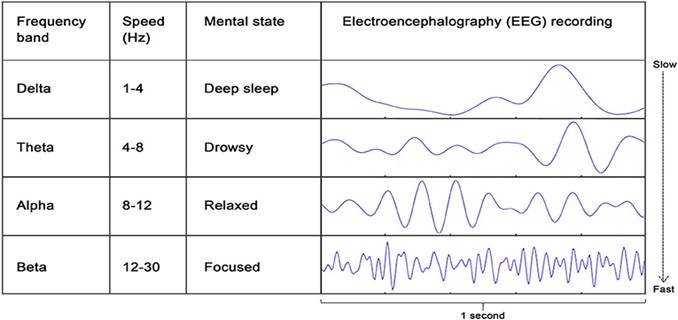
Your brain uses electrical signals to communicate and organize input and process information. Every time your brain completes a task or has an activity, it generates brainwaves. These waves, or traces of electrical activity, can be seen via the brain scan process. Electroencephalogram (EEG) equipment can map the activity in the brain and provide you with a clear picture of the brainwaves a patient is experiencing.
4 Types of Brainwaves
Brainwaves are identified by the electrical patterns they make and their frequency. Each type indicates a different state, from the dreamy, relaxed Delta to the snappy, active Beta waves. Each type is detailed below.
i. Delta Waves (.5 TO 3 HZ)
Delta brainwaves are slow, loud brainwaves (low frequency and deeply penetrating, like a drum beat). They are generated in deepest meditation and dreamless sleep. Delta waves suspend external awareness and are the source of empathy. Healing and regeneration are stimulated in this state, and that is why deep restorative sleep is so essential to the healing process.
ii. Theta Waves (3 TO 8 HZ)
Theta brainwaves occur most often in sleep but are also dominant in deep meditation. Theta is our gateway to learning, memory, and intuition. In theta, our senses are withdrawn from the external world and focused on signals originating from within. It is that twilight state which we normally only experience fleetingly as we wake or drift off to sleep. In theta we are in a dream; vivid imagery, intuition and information beyond our normal conscious awareness. It’s where we hold our ‘stuff’, our fears, troubled history, and nightmares.
iii. Alpha Waves (8 TO 12 HZ)
Alpha brainwaves are dominant during quietly flowing thoughts, and in some meditative states. Alpha is ‘the power of now’, being here, in the present. Alpha is the resting state for the brain. Alpha waves aid overall mental coordination, calmness, alertness, mind/body integration and learning.
iv. Beta Waves (12 TO 38 HZ)
Beta brainwaves dominate our normal waking state of consciousness when attention is directed towards cognitive tasks and the outside world. Beta is a ‘fast’ activity, present when we are alert, attentive, engaged in problem solving, judgment, decision making, or focused mental activity.
Beta brainwaves are further divided into three bands; Lo-Beta (Beta1, 12-15Hz) can be thought of as a ‘fast idle’, or musing. Beta (Beta2, 15-22Hz) is high engagement or actively figuring something out. Hi-Beta (Beta3, 22-38Hz) is highly complex thought, integrating new experiences, high anxiety, or excitement. Continual high frequency processing is not a very efficient way to run the brain, as it takes a tremendous amount of energy.
v. Gamma Waves (38 TO 42 HZ)
Gamma brainwaves are the fastest of brain waves (high frequency, like a flute), and relate to simultaneous processing of information from different brain areas. Gamma brainwaves pass information rapidly and quietly. The most subtle of the brainwave frequencies, the mind has to be quiet to access gamma.
Gamma was dismissed as ‘spare brain noise’ until researchers discovered it was highly active when in states of universal love, altruism, and the ‘higher virtues’. Gamma is also above the frequency of neuronal firing, so how it is generated remains a mystery. It is speculated that gamma rhythms modulate perception and consciousness, and that a greater presence of gamma relates to expanded consciousness and spiritual emergence.
3.2. Neurotransmitters:
•Serotonin and Dopamine: Relaxation can lead to increased levels of neurotransmitters like serotonin and dopamine, which are associated with mood regulation, pleasure, and relaxation.
•Endorphins: The release of endorphins during relaxation contributes to a sense of well-being and reduced perception of pain.