
1. WORD MEANING
The Sanskrit word Madukāsana (often spelled Mandukasana) is derived from:
- “Manduka” / “Maduka” – meaning frog
- “Āsana” – meaning posture, seat, or steady state of the body
Thus, Madukāsana means “The Frog Pose” or “Posture resembling a frog.”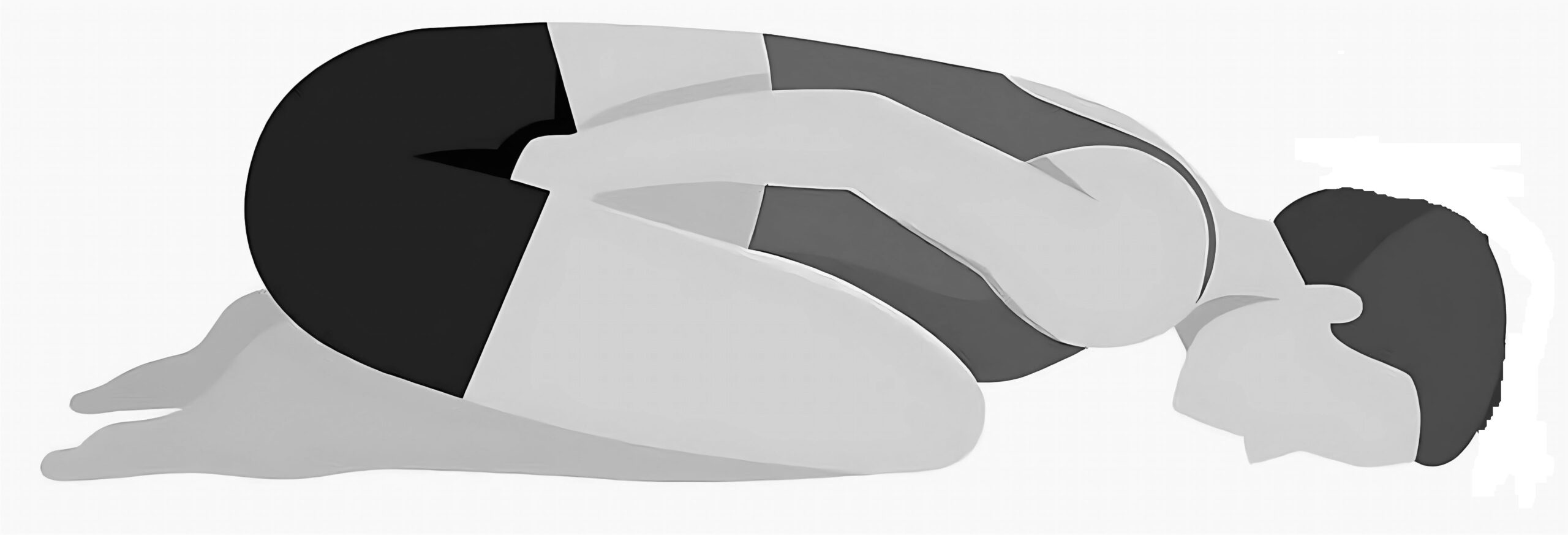
The name reflects the physical shape of the body in the asana—wide knees, grounded pelvis, and spread limbs—similar to a frog resting before a leap.
2. DEFINITION OF MADUKĀSANA
Madukāsana is a classical seated-kneeling posture that deeply opens the hips, stretches the inner thighs, mobilizes the pelvic girdle, and stimulates abdominal organs. It is traditionally used to enhance digestion, reduce stiffness in the hip joints, and promote grounding.
It has two major classical variations:
- Basic Madukāsana (Digestive Frog Pose)
– Kneeling posture with fists pressing the abdomen - Mandukasana (Modern Yogic Frog Pose / Hip Opener Frog)
– On the floor with knees apart, shins outward, pelvis sinking toward the mat
This essay covers both, with emphasis on the traditional Hatha Yoga Mandukasana and the modern hip-opening Frog Pose widely used in contemporary yoga therapy.
3. METHOD OF PRACTICE (STEP–BY–STEP)
A. TRADITIONAL MADUKĀSANA (DIGESTIVE FROG POSE)
Step-by-Step Instructions
- Begin in Vajrasana
Sit on the heels, spine erect, shoulders relaxed, palms on thighs. - Form fists
Make fists with both hands, placing the thumb inside and fingers wrapped. - Place fists on the abdomen
Position them on either side of the navel or slightly below depending on comfort. - Inhale deeply
Lengthen the spine gently. - Exhale and bend forward
Lean forward from the hips bringing the torso down toward the thighs. - Apply pressure
Allow the fists to gently press abdomen, stimulating digestive organs. - Keep neck relaxed
Chin may rest toward the chest; gaze downward. - Hold 30–60 seconds
Breathe naturally but avoid forceful breathing. - Slowly rise on inhalation
Come back to Vajrasana with awareness. - Relax in Vajrasana or Shashankasana
Observe sensations around abdomen and lower spine.
B. MODERN FROG POSE (HIP–OPENING MANDUKASANA)
Step-by-Step Instructions
- Start on all fours
Place knees below hips and hands under shoulders. - Widen the knees
Slide each knee outward as far as comfortable. - Place ankles in line with knees
Shins point sideways; inner edges of feet touch the floor. - Lower the forearms
Bring elbows down below shoulders. - Engage core lightly
Helps protect the lumbar spine. - Sink pelvis toward floor
Allow inner thighs & groin to stretch deeply. - Maintain a long spine
Avoid arching or collapsing lower back. - Hold 1–3 minutes
Breathe deeply and steadily. - To exit
Shift weight forward, bring knees inward slowly, return to tabletop. - Rest in Child’s Pose to neutralize hips.
4. ALIGNMENT CUES
Traditional Mandukasana (Digestive)
- Knees and feet together, seated properly on heels.
- Fists placed symmetrically in the lower abdomen.
- Hinge forward from the hips, not collapsing the chest.
- Maintain a neutral, long spine.
- Keep shoulders broad and relaxed.
- Press abdomen only to a comfortable degree.
Modern Frog Pose (Hip Opener)
- Knees and ankles in one straight line (90° angle at the knee).
- Shins parallel to each other.
- Pelvis heavy but supported—avoid sinking excessively.
- Core engaged gently to avoid lumbar compression.
- Shoulder blades broad, chest lifted slightly.
- Ensure no pain in the knee joint.
- Keep breathing steady, avoid holding breath.
- Maintain symmetry—both thighs should open equally.
5. BENEFITS OF MADUKĀSANA
A. PHYSICAL BENEFITS
Traditional Digestive Mandukasana
- Stimulates pancreas and beneficial for glucose metabolism.
- Improves digestion and helps reduce bloating.
- Enhances circulation in abdominal organs.
- Massages liver, intestines, stomach.
- Reduces abdominal fat accumulation over long-term practice.
- Helps reduce menstrual discomfort.
- Supports post-meal relaxation and digestion.
Modern Frog Pose
- Deep stretch for hip adductors (inner thighs).
- Increases hip mobility (abduction, external rotation).
- Releases tension in groin, pelvis, and inner thighs.
- Reduces stiffness in lower back.
- Enhances pelvic floor relaxation—helpful for stress management.
- Helps athletes and dancers reduce hip tightness.
- Opens fascia of the hips beneficial for Yin Yoga practice.
- Improves blood flow to pelvic organs.
B. ENERGETIC & PSYCHOLOGICAL BENEFITS
- Activates Muladhara Chakra (root stability).
- Releases emotional tension stored in hips.
- Promotes relaxation & grounding.
- Improves breath-body awareness.
- Enhances patience, introspection, and tolerance to stillness.
C. THERAPEUTIC BENEFITS
- Helpful for people with mild constipation.
- May reduce symptoms of PCOS and menstrual irregularity with consistent practice.
- Useful in diabetes management (traditional version).
- Supports rehabilitation of hip stiffness.
- Useful in stress-related digestive issues.
- Helps people with limited hip internal mobility.
6. CONTRAINDICATIONS
Traditional Digestive Mandukasana
- Stomach ulcers
- Hernia
- Severe knee pain or arthritis
- Pregnancy
- Recent abdominal surgery
- Acute digestive disorders
- High blood pressure (avoid excessive forward bending)
Modern Frog Pose (Hip Opener)
- Knee ligament injuries
- Severe hip arthritis
- Sacroiliac joint instability
- Groin tear or acute strain
- Lower-back disc prolapse
- Hypermobile hips
- Pregnancy (avoid deep abduction)
If discomfort occurs, release slowly.
7. COUNTERPOSES
After Traditional Mandukasana:
- Shashankasana (Child’s Pose)
- Supta Vajrasana (Reclining Vajrasana)
- Pawanmuktasana
After Modern Frog Pose:
- Child’s Pose
- Sphinx Pose
- Happy Baby Pose
- Gentle Cat-Cow
These neutralize hip and spine stress.
8. PREPARATORY PRACTICES
For Traditional Digestive Mandukasana
- Vajrasana
- Forward folding (Paschimottanasana)
- Gentle core activation
- Belly breathing
For Modern Frog Pose
- Baddha Konasana (Butterfly)
- Upavistha Konasana (Seated Wide Angle)
- Malasana (Squat)
- Cat-Cow
- Lunges (Anjaneyasana)
- Supta Baddha Konasana
These prepare hips, groin, and pelvis.
9. MODIFICATIONS
Traditional Mandukasana
- Use a cushion under the ankles if Vajrasana is difficult.
- Keep torso slightly elevated instead of fully folding.
- Place fists more toward sides if pressure feels intense.
- Use soft blocks under elbows for support.
Modern Frog Pose
- Place bolster under pelvis for support.
- Use blanket under knees to reduce pressure.
- Adjust knee angle – bring knees less wide.
- Stay on hands instead of forearms.
- Practice half-frog (one leg extended sideways).
- Use wall as support for gentle hip opening.
10. MUSCLES INVOLVED
Primary Muscles Stretched (Modern Frog Pose)
- Adductor longus, brevis, magnus
- Gracilis
- Pectineus
- Internal rotators (when hips externally rotate)
Primary Muscles Engaged
- Core stabilizers (Transverse abdominis)
- Pelvic floor stabilizers
- Gluteus medius and minimus
- Lumbar erectors (for spinal support)
Traditional Mandukasana Muscular Actions
- Rectus abdominis (mild compression)
- Obliques
- Hip flexors relaxed
- Paraspinal muscles lengthen during forward bend
11. KINESIOLOGY
Joint Actions in Modern Frog Pose
- Hip abduction (knees move outward)
- Hip external rotation
- Mild lumbar extension or neutral spine
- Pressing of pelvis downward increases stretch on inner thigh fascia
Joint Actions in Traditional Pose
- Knee flexion (sitting in Vajrasana)
- Trunk flexion (forward bend)
- Compression of abdominal wall
12. KINEMATICS
Movement Patterns
- Controlled eccentric opening of adductors
- Pelvis shifting posteriorly & inferiorly
- Axial elongation of spine
- Static isometric hold for myofascial release
Movement Planes
- Primarily frontal plane (abduction)
- Some sagittal plane involvement in forward movement
- Neutral transverse plane involvement
13. BIOMECHANISM & BIOMECHANICS
A. Force Distribution
In Frog Pose:
- Bodyweight transfers through medial thighs and knees.
- Gravity assists deepening the hip abduction.
- Ground reaction forces support femur and pelvis alignment.
B. Levers & Load
- Hips act as fulcrum.
- Adductors experience tensile force.
- Core stabilizers counteract anterior pelvic tilt.
C. Fascial Stretch
- Inner thigh fascia (adductor fascial complex) lengthens.
- Pelvic floor fascia releases downward.
- Myofascial chains (Deep Front Line) experience decompression.
D. Abdominal Pressure in Traditional Pose
- Fist pressure stimulates digestive organs.
- Enhances peristaltic activity through mechanical activation.
Overall, the biomechanics help improve mobility, digestion, and neuromuscular control.
14. FUNCTIONAL ANATOMY & PHYSIOLOGY
A. Digestive System Stimulation (Traditional Pose)
- Mechanical pressure promotes pancreatic secretion.
- Stimulates liver and abdominal organs.
- Enhances motility of intestines.
- Increases blood flow to abdominal cavity.
B. Pelvic Mobility (Modern Pose)
- Improves hip joint capsule mobility.
- Releases chronic tension from adductor muscles.
- Helps realign pelvic orientation.
- Reduces lumbar strain by distributing movement across pelvis.
C. Nervous System Response
- Deep hip opening triggers parasympathetic activation.
- Helps reduce stress & anxiety.
- Promotes emotional release through pelvic floor relaxation.
D. Musculoskeletal Function
- Enhances range of motion in hips.
- Strengthens stabilizing muscles of pelvis.
- Improves posture and walking efficiency.
15. HOW TO CORRECT & ADJUST WHILE TEACHING
A. Verbal Cues
- “Lengthen your spine before folding.”
- “Keep knees and ankles aligned.”
- “Let the pelvis be heavy.”
- “Engage the core gently.”
- “Breathe into the lower abdomen.”
- “Only go as far as you can breathe comfortably.”
B. Hands-On Adjustments (Safe Teaching)
Traditional Pose
- Support the student’s back if bending is limited.
- Gently guide elbows downward.
- Ensure fists are positioned comfortably.
- Never push the torso forcefully.
Modern Frog Pose
- Place palms on sacrum to encourage neutral alignment.
- Press down lightly on hips only with full consent.
- Support knees with blankets.
- Guide student to reduce depth if knee pain occurs.
C. Observational Corrections
- Avoid collapse in lumbar spine.
- Watch for knee misalignment.
- Ensure symmetry in hip opening.
- Adjust hand or elbow placement.
- Offer props when student strains.
D. Safety Priorities
- Protect knees first.
- Protect lumbar spine.
- Avoid forcing any movement.
- Ensure slow transitions in and out of pose.
CONCLUSION
Madukāsana is a powerful yogic posture with dual applications:
- Traditional Mandukasana
– Enhances digestion, massages internal organs, and supports metabolic health. - Modern Frog Pose
– One of the deepest hip-opening postures in yoga, releasing tension from inner thighs, pelvis, and lower back.
At physical, psychological, and energetic levels, Madukāsana supports grounding, emotional release, digestive health, pelvic mobility, and enhanced mindfulness. Understanding its anatomy, biomechanics, kinesiology, and functional movement patterns allows yoga teachers and practitioners to use the posture safely, effectively, and therapeutically.
With proper alignment, modifications, breath awareness, and mindful adjustments, Madukāsana becomes a transformative asana that promotes holistic well-being.
QUESTION AND ANSWER
SECTION 1: GENERAL & THEORY (Word Meaning, Definition, Classification)
1. The Sanskrit term “Manduka/Maduka” means:
a) Fish
b) Frog
c) Tortoise
d) Peacock
Answer: b) Frog
2. Mandukasana belongs to which category of asanas?
a) Backbends
b) Twists
c) Seated/Kneeling Postures
d) Inversions
Answer: c) Seated/Kneeling Postures
3. Traditional Mandukasana primarily affects which body region?
a) Upper chest
b) Abdomen
c) Shoulders
d) Ankles
Answer: b) Abdomen
4. Modern Frog Pose version mainly targets:
a) Hamstrings
b) Adductors
c) Quadriceps
d) Deltoids
Answer: b) Adductors
5. In Mandukasana, fists are placed on:
a) Lower ribs
b) Pectorals
c) Abdomen on either side of the navel
d) Pelvic crest
Answer: c) Abdomen on either side of the navel
SECTION 2: METHOD OF PRACTICE
6. The traditional pose begins from which posture?
a) Sukhasana
b) Vajrasana
c) Padmasana
d) Tadasana
Answer: b) Vajrasana
7. In modern Frog Pose, the ankles should be:
a) In front of knees
b) Directly under hips
c) In line with knees
d) Together behind the body
Answer: c) In line with knees
8. While entering Frog Pose, the knees move:
a) Forward
b) Backward
c) Closer together
d) Outward (abduction)
Answer: d) Outward (abduction)
9. In traditional Mandukasana, forward bending begins with:
a) Curving the spine
b) Hinging at the hips
c) Twisting torso
d) Dropping shoulders first
Answer: b) Hinging at the hips
10. To exit Frog Pose, a student should:
a) Jump out
b) Pull knees together rapidly
c) Slowly bring knees inward
d) Stand up immediately
Answer: c) Slowly bring knees inward
SECTION 3: ALIGNMENT
11. The spine in Mandukasana should be:
a) Overarched
b) Rigid
c) Neutral and long
d) Bent sideways
Answer: c) Neutral and long
12. In Frog Pose, core engagement helps prevent:
a) Thoracic extension
b) Knee flexion
c) Lumbar collapse
d) Cervical tension
Answer: c) Lumbar collapse
13. Knees in Frog Pose should form approximately:
a) 30° angle
b) 60° angle
c) 90° angle
d) No angle is required
Answer: c) 90° angle
14. A common misalignment in Frog Pose:
a) Ankles too close to pelvis
b) Spine too straight
c) Shoulders lifted
d) Knees ahead of hips
Answer: d) Knees ahead of hips
15. Breath during Mandukasana should be:
a) Held
b) Forced
c) Smooth and natural
d) Very shallow
Answer: c) Smooth and natural
SECTION 4: BENEFITS
16. Traditional Mandukasana stimulates which organ most strongly?
a) Pancreas
b) Heart
c) Lungs
d) Kidneys
Answer: a) Pancreas
17. Frog Pose is especially helpful for relieving tension in:
a) Neck
b) Inner thighs and groin
c) Wrists
d) Ankles
Answer: b) Inner thighs and groin
18. Mandukasana improves digestion by:
a) Increasing chest expansion
b) Compressing abdominal organs
c) Reducing blood flow to the gut
d) Twisting spine
Answer: b) Compressing abdominal organs
19. Frog Pose helps to relax which chakra energetically?
a) Ajna
b) Sahasrara
c) Muladhara
d) Vishuddhi
Answer: c) Muladhara
20. A therapeutic benefit of traditional Mandukasana:
a) Improves memory
b) Beneficial for diabetes management
c) Strengthens shoulders
d) Improves eyesight
Answer: b) Beneficial for diabetes management
SECTION 5: CONTRAINDICATIONS
21. Mandukasana should be avoided in:
a) Anxiety
b) Stomach ulcers
c) Flat feet
d) Low immunity
Answer: b) Stomach ulcers
22. Frog Pose should not be practiced if a person has:
a) Wrist pain
b) Mild cold
c) Groin injury
d) Scalp infection
Answer: c) Groin injury
23. Traditional Mandukasana is contraindicated in:
a) Pregnancy
b) Dry skin
c) Shoulder stiffness
d) Simple muscle soreness
Answer: a) Pregnancy
24. Frog Pose is risky for those with:
a) Tight trapezius
b) Knee ligament issues
c) Weak biceps
d) Long torso
Answer: b) Knee ligament issues
25. Individuals with abdominal surgery should:
a) Avoid traditional Mandukasana
b) Practice deeper variations
c) Use no props
d) Hold the pose longer than normal
Answer: a) Avoid traditional Mandukasana
SECTION 6: MUSCLES & ANATOMY
26. Primary muscle stretched in Frog Pose:
a) Iliopsoas
b) Quadratus lumborum
c) Adductors
d) Erector spinae
Answer: c) Adductors
27. Which muscle group must engage to stabilize pelvis?
a) Biceps
b) Forearm flexors
c) Core muscles
d) Neck extensors
Answer: c) Core muscles
28. Mandukasana compresses the abdomen, affecting:
a) Large intestine
b) Liver and pancreas
c) Diaphragm
d) Femur
Answer: b) Liver and pancreas
29. In Frog Pose, hip joint is in:
a) Flexion
b) Adduction
c) Abduction
d) Rotation only
Answer: c) Abduction
30. Which muscle is passively lengthened in the posture?
a) Deltoids
b) Gracilis
c) Trapezius
d) Gastrocnemius
Answer: b) Gracilis
SECTION 7: KINESIOLOGY & BIOMECHANICS
31. Plane of movement in Frog Pose:
a) Transverse plane
b) Frontal plane
c) Sagittal plane
d) Rotatory plane
Answer: b) Frontal plane
32. Main mechanical force in Mandukasana:
a) Traction
b) Compression
c) Rotation
d) Shear
Answer: b) Compression
33. Ground reaction force in Frog Pose affects:
a) Shoulder girdle
b) Pelvis and femur alignment
c) Forearm rotation
d) Neck muscles
Answer: b) Pelvis and femur alignment
34. Mandukasana stimulates digestive function through:
a) Increased blood pressure
b) Mechanical abdominal compression
c) Spinal twisting
d) Shallow breathing
Answer: b) Mechanical abdominal compression
35. Frog Pose increases mobility in which structure?
a) Knee capsule
b) Hip joint capsule
c) Wrist joint
d) Cervical spine
Answer: b) Hip joint capsule
SECTION 8: FUNCTIONAL PHYSIOLOGY
36. Parasympathetic activation in Frog Pose leads to:
a) Stress increase
b) Anxiety
c) Relaxation response
d) Tachycardia
Answer: c) Relaxation response
37. Adductor stretch improves:
a) Hip stability & range of motion
b) Shoulder mobility
c) Wrist flexibility
d) Respiratory rate
Answer: a) Hip stability & range of motion
38. Abdominal compression in Mandukasana aids:
a) Peristalsis
b) Reduced digestion
c) Muscle spasm
d) Knee rotation
Answer: a) Peristalsis
39. Frog Pose benefits pelvic floor by:
a) Tightening it
b) Relaxing and lengthening it
c) Freezing movement
d) Increasing tension
Answer: b) Relaxing and lengthening it
40. Mandukasana can help regulate:
a) Blood oxygen levels
b) Sugar metabolism
c) Hair growth
d) Blood clotting
Answer: b) Sugar metabolism
SECTION 9: TEACHING, ALIGNMENT & ADJUSTMENTS
41. First safety point in Frog Pose:
a) Neck
b) Knees
c) Elbows
d) Shoulders
Answer: b) Knees
42. A verbal cue for Mandukasana:
a) “Round your spine more.”
b) “Engage biceps.”
c) “Hinge forward and breathe in the belly.”
d) “Lift your pelvis high.”
Answer: c) “Hinge forward and breathe in the belly.”
43. If a student feels knee pain in Frog Pose, teacher should:
a) Press them deeper
b) Ignore pain
c) Reduce knee width / add blankets
d) Make them hold longer
Answer: c) Reduce knee width / add blankets
44. Hands-on adjustment for Frog Pose requires teacher to:
a) Push student forcefully
b) Add downward pressure only with consent
c) Keep silence
d) Twist student’s spine
Answer: b) Add downward pressure only with consent
45. Best counterpose for Frog Pose:
a) Plank
b) Child’s Pose
c) Shoulderstand
d) Camel Pose
Answer: b) Child’s Pose
SECTION 10: APPLICATIONS, MODIFICATIONS & SAFETY
46. Useful prop for beginners in Frog Pose:
a) Belt around ribs
b) Bolster under pelvis
c) Dumbbells
d) Wall ropes only
Answer: b) Bolster under pelvis
47. Modification for traditional Mandukasana:
a) Sit on a block instead of heels
b) Take legs wider
c) Arch the back
d) Keep fists above chest
Answer: a) Sit on a block instead of heels
48. Frog Pose is especially beneficial for individuals with:
a) Shoulder pain
b) Tight hips
c) Outer elbow strain
d) Earache
Answer: b) Tight hips
49. A teacher should stop a student immediately if they feel:
a) Mild stretch
b) Warm sensation
c) Sharp knee pain
d) Smooth breathing
Answer: c) Sharp knee pain
50. Optimal duration for Frog Pose in Yin Yoga style:
a) 10 seconds
b) 20 seconds
c) 1–5 minutes
d) 30 minutes
Answer: c) 1–5 minutes