
1. Word Meaning
The Sanskrit term “Janu Sirsasana” is derived from two words:
- Janu – meaning “knee”
- Sirsa – meaning “head”
- Asana– meaning “pose” or “seat”
Thus, Janu Sirsasana literally translates to “Head-to-Knee Pose.” The name reflects the posture where the head moves toward one knee while maintaining the other leg extended. Symbolically, the posture represents flexibility, introspection, and self-discipline, combining physical stretching with mental focus.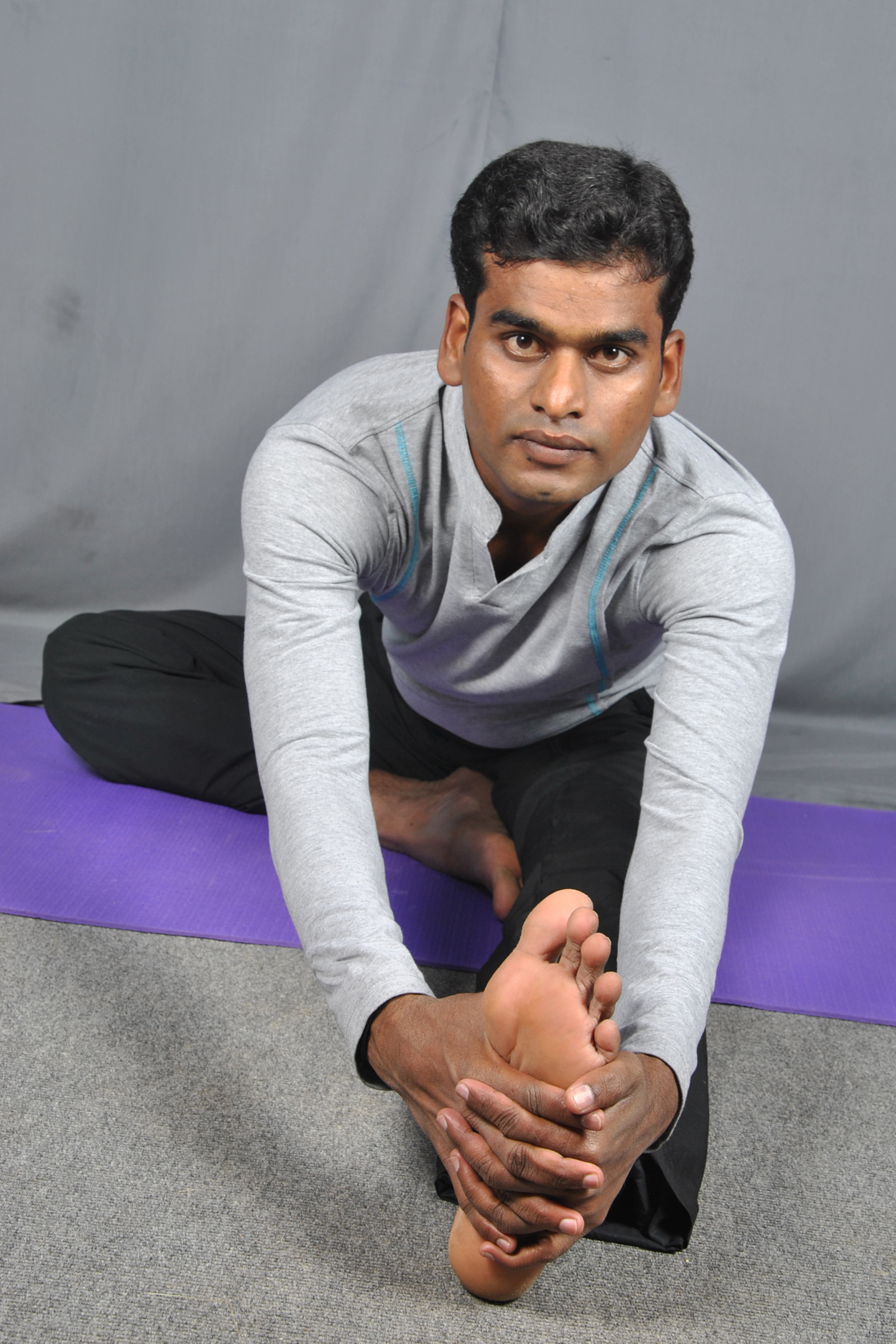
2. Definition
Janu Sirsasana is a seated forward-bending asana in which:
- One leg is extended forward, and the other is bent with the sole of the foot placed against the inner thigh of the extended leg
- The torso bends forward over the extended leg, ideally touching the forehead to the knee
- Hands may reach toward the foot, ankle, or shin, depending on flexibility
- The spine is elongated and extended during the forward fold
Janu Sirsasana is considered a therapeutic asana in Hatha Yoga, enhancing flexibility of hamstrings, spine, and hips, improving digestion, and promoting mental calmness.
3. Method of Practice – Step by Step
Step 1: Begin Seated
- Sit on a firm yoga mat or blanket with both legs extended straight in front (Dandasana base)
- Keep the spine erect, shoulders relaxed
Step 2: Bend One Knee
- Bend the right knee, placing the sole of the foot against the inner left thigh
- Allow the knee to rest naturally on the floor
Step 3: Position the Extended Leg
- Keep the left leg fully extended
- Ensure the foot is flexed, toes pointing upward
Step 4: Align the Hips
- Sit evenly on both sit bones
- Adjust the pelvis to maintain neutral spine alignment
Step 5: Inhale and Lengthen
- Inhale deeply, elongating the spine
- Reach the crown of the head upwards toward the ceiling
Step 6: Exhale and Forward Fold
- Exhale, hinge from the hips, and fold forward over the extended leg
- Keep the spine elongated, avoiding rounding the back
Step 7: Hand Placement
- Hands may reach toward the foot, ankle, shin, or the floor
- Use Yogic grip or hold the toes if possible
Step 8: Head Position
- Gently bring the forehead toward the knee
- If flexibility is limited, keep the head above the thigh
Step 9: Breathing
- Maintain slow, deep, diaphragmatic breathing
- Focus on calm, mindful inhalation and exhalation
Step 10: Hold the Pose
- Beginners: hold 15–30 seconds
- Intermediate: 1–2 minutes
- Advanced: 3–5 minutes, increasing as flexibility improves
Step 11: Exit the Pose
- Inhale, lift torso slowly
- Straighten the bent knee into Dandasana
- Repeat on the other side
4. Alignment Cues
- Hips: Square and evenly grounded
- Extended leg: Straight with toes pointing up, knee engaged
- Bent leg: Sole against inner thigh, knee relaxed toward floor
- Spine: Elongated, neutral, avoiding excessive rounding
- Shoulders: Relaxed, away from ears
- Head: In line with spine, crown reaching forward over thigh
- Hands: Reaching toward foot, ankle, or shin
5. Benefits of Janu Sirsasana
A. Physical Benefits
- Stretches hamstrings, calves, and groins
- Opens hips and shoulders
- Strengthens spinal extensors and core stabilizers
- Improves posture and flexibility
- Stimulates liver, kidneys, and abdominal organs
B. Mental Benefits
- Calms nervous system, reducing stress and anxiety
- Enhances concentration and focus
- Encourages self-reflection and introspection
C. Physiological Benefits
- Improves digestion and elimination
- Relieves mild lower back pain
- Stimulates blood flow to pelvic region and legs
- Enhances flexibility of hamstrings and spine
D. Energetic and Spiritual Benefits
- Activates Muladhara and Manipura chakras
- Balances prana flow through nadis
- Promotes grounding and inner stability
6. Contraindications
- Hamstring injuries – avoid deep forward fold
- Knee injuries – modify or use blanket support
- Hip injuries or tight hips – perform partial fold
- Lower back pain or spinal injuries – keep torso elevated
- Pregnancy (later stages) – avoid deep forward fold
7. Counterposes
- Supta Padangusthasana (Reclined Hand-to-Big-Toe Pose) – stretches hamstrings safely
- Baddha Konasana (Bound Angle Pose) – opens hips
- Ardha Matsyendrasana (Half Spinal Twist) – spinal mobility
- Shavasana (Corpse Pose) – deep relaxation
8. Preparatory Practices
- Dandasana (Staff Pose) – foundation for seated postures
- Baddha Konasana (Bound Angle Pose) – hip opening
- Paschimottanasana (Seated Forward Bend) – hamstring stretch
- Ankle rotations – prepare joints for stability
- Gentle spinal stretches (Cat-Cow) – mobility for forward fold
9. Modifications
- Use a yoga strap around the foot if reaching is difficult
- Place blanket under sit bones for better hip alignment
- Bend the knee slightly on the extended leg if hamstrings are tight
- Use a block or bolster under hands for support
- Practice half Janu Sirsasana, keeping bent knee foot away from inner thigh
10. Muscles Involved
A. Stretched Muscles
- Hamstrings: biceps femoris, semitendinosus, semimembranosus
- Calves: gastrocnemius, soleus
- Adductors: inner thigh muscles
- Spinal erectors: longissimus, iliocostalis
- Gluteals: gluteus maximus and medius
B. Strengthened / Stabilized Muscles
- Core muscles: rectus abdominis, transverse abdominis, obliques
- Spinal stabilizers: erector spinae
- Hip flexors: iliopsoas
- Shoulders: deltoids, trapezius (for alignment)
C. Joints
- Hip external rotation (bent leg)
- Hip flexion (extended leg)
- Knee flexion (bent leg)
- Ankle dorsiflexion (extended leg)
11. Kinesiology
- Hip joint: flexion (forward fold), external rotation (bent leg)
- Knee joint: flexion (bent leg), slight tension in extended leg
- Spine: flexion at lumbar and thoracic regions
- Ankle joint: dorsiflexion of extended foot
12. Kinematics
- Sagittal plane motion: forward flexion
- Joint axes:
- Hip: transverse axis for flexion, vertical axis for rotation
- Knee: sagittal axis for flexion
- Spine: sagittal axis for forward flexion
- Force distribution:
- Weight evenly distributed on sit bones
- Core engagement stabilizes lumbar spine
13. Biomechanics
- Forward folding: stretches hamstrings while maintaining spinal elongation
- Hip flexion and rotation: stabilizes pelvis
- Spinal flexion: requires balance between spinal erectors and abdominal muscles
- Knee and ankle stability: controlled dorsiflexion and joint alignment
- Core engagement: prevents collapse of lumbar spine
14. Functional Anatomy & Physiology
A. Musculoskeletal System
- Enhances flexibility of hamstrings, spine, and hips
- Strengthens spinal stabilizers
- Improves postural alignment and joint mobility
B. Nervous System
- Activates parasympathetic nervous system, promoting relaxation
- Enhances proprioception and body awareness
C. Digestive System
- Compression of abdomen gently stimulates liver, kidneys, pancreas, and intestines
- Improves digestion and elimination
D. Circulatory System
- Improves blood flow to lower limbs and pelvic organs
- Supports venous return and circulation
E. Respiratory System
- Encourages diaphragmatic breathing
- Enhances oxygenation and relaxation response
F. Energetic System
- Stimulates Muladhara and Manipura chakras
- Balances prana flow through nadis
- Promotes grounding and energizing of lower body
15. How to Correct and Adjust While Teaching
Common Misalignments
- Rounded back instead of elongated spine
- Bent or raised extended leg knee
- Bent knee not resting against inner thigh
- Shoulders tensed and raised
Verbal Adjustments
- “Lengthen spine before folding”
- “Press sit bones evenly into mat”
- “Keep shoulders relaxed”
- “Inhale to lengthen, exhale to fold forward”
Hands-On Adjustments
- Support lower back to maintain neutral spine
- Encourage bent knee foot placement
- Gently guide extended leg alignment
- Use props: blocks, straps, blankets
Modifications for Beginners
- Strap around extended foot for forward reach
- Blanket under sit bones for hip elevation
- Partial forward fold if hamstrings tight
16. Variations of Janu Sirsasana
- Ardha Janu Sirsasana (Half Head-to-Knee Pose) – easier for beginners
- Supported Janu Sirsasana – hands on block or bolster
- Twisting Janu Sirsasana – torso rotates toward bent leg
- Extended Arm Forward Fold – deeper spinal stretch
17. Philosophical and Energetic Aspect
- Encourages humility, introspection, and self-discipline
- Symbolizes forward bending as surrender and inward reflection
- Activates root and solar plexus chakras, promoting energy balance
- Prepares practitioner for meditation, pranayama, and mindfulness
18. Conclusion
Janu Sirsasana (Head-to-Knee Forward Bend) is a holistic seated forward bend that integrates physical flexibility, core stability, mental calmness, and energetic balance.
- Physical Benefits: Stretches hamstrings, spine, hips; strengthens core and spinal stabilizers
- Mental Benefits: Reduces stress and anxiety; enhances focus and concentration
- Physiological Benefits: Stimulates abdominal organs; improves digestion and circulation
- Energetic Benefits: Balances prana, activates chakras, promotes grounding
With proper preparatory exercises, modifications, props, and teacher guidance, Janu Sirsasana is safe for all levels of practitioners, providing a bridge between flexibility, meditation, and mindful practice.
QUESTION AND ANSWER
1. What does “Janu” mean in Sanskrit?
a) Head
b) Knee
c) Foot
d) Spine
Answer: b
2. What does “Sirsa” mean?
a) Hand
b) Head
c) Neck
d) Spine
Answer: b
3. Janu Sirsasana is also called:
a) Head-to-Knee Forward Bend
b) Lotus Pose
c) Bound Angle Pose
d) Staff Pose
Answer: a
4. What is the primary purpose of Janu Sirsasana?
a) Forward bending and flexibility
b) Inversion
c) Backbending
d) Arm strengthening
Answer: a
5. In Janu Sirsasana, how is the bent leg positioned?
a) Foot against inner thigh of extended leg
b) Extended forward
c) Behind body
d) Crossed over opposite leg
Answer: a
6. How is the extended leg positioned?
a) Fully straight with toes pointing upward
b) Bent at knee
c) Foot flat on floor
d) Crossed over other leg
Answer: a
7. Which spinal alignment is recommended in Janu Sirsasana?
a) Elongated and neutral
b) Rounded excessively
c) Hyperextended
d) Twisted
Answer: a
8. Which muscles are primarily stretched in Janu Sirsasana?
a) Hamstrings, calves, adductors
b) Deltoids
c) Biceps
d) Trapezius
Answer: a
9. Which muscles are strengthened during Janu Sirsasana?
a) Core muscles and spinal stabilizers
b) Forearm flexors
c) Neck extensors only
d) Calves only
Answer: a
10. Which joints are actively engaged in Janu Sirsasana?
a) Hips, knees, ankles, spine
b) Elbows only
c) Shoulders only
d) Wrists only
Answer: a
11. Recommended preparatory pose for hamstring stretch:
a) Paschimottanasana
b) Tadasana
c) Bhujangasana
d) Adho Mukha Svanasana
Answer: a
12. Preparatory pose for hip opening:
a) Baddha Konasana
b) Ardha Padmasana
c) Sukhasana
d) Shavasana
Answer: a
13. Recommended props for beginners:
a) Blanket under sit bones, strap around foot
b) Chair only
c) Wall only
d) No props
Answer: a
14. Contraindications include:
a) Hamstring or knee injuries
b) Neck stiffness
c) Shoulder tightness only
d) None
Answer: a
15. Common beginner misalignment:
a) Rounded spine, raised extended leg, tension in shoulders
b) Perfect posture
c) Relaxed spine only
d) Hands overhead
Answer: a
16. How should the head be positioned?
a) Forehead toward knee if possible
b) Tilted backward
c) Twisted sideways
d) Hyperextended
Answer: a
17. How should the spine move during the forward fold?
a) Hinge from the hips, maintain elongation
b) Round excessively
c) Twist sideways
d) Hyperextend
Answer: a
18. Ideal breathing in Janu Sirsasana:
a) Slow, deep, diaphragmatic
b) Rapid chest breathing
c) Breath-holding
d) Forceful inhalation
Answer: a
19. Which organ systems are stimulated by Janu Sirsasana?
a) Digestive and circulatory systems
b) Only respiratory
c) Only skeletal
d) Only nervous
Answer: a
20. Mental benefits of Janu Sirsasana include:
a) Reduces stress and anxiety
b) Increases tension
c) Decreases focus
d) Causes restlessness
Answer: a
21. Energetic benefits of Janu Sirsasana:
a) Activates Muladhara and Manipura chakras
b) Blocks pranic flow
c) Only opens Sahasrara
d) None
Answer: a
22. Recommended hand placement:
a) On foot, ankle, shin, or floor
b) Behind back
c) Overhead only
d) None
Answer: a
23. Duration for beginners:
a) 15–30 seconds
b) 5 minutes
c) 1–2 minutes
d) 5–10 minutes
Answer: a
24. Duration for intermediate practitioners:
a) 1–2 minutes
b) 15 seconds
c) 10 minutes
d) 30 seconds
Answer: a
25. Duration for advanced practitioners:
a) 3–5 minutes or longer
b) 30 seconds
c) 1 minute
d) 15 seconds
Answer: a
26. Counterposes suitable after Janu Sirsasana:
a) Supta Padangusthasana, Baddha Konasana, Shavasana
b) Only Tadasana
c) Only Ardha Matsyendrasana
d) None
Answer: a
27. Modification for tight hamstrings:
a) Slightly bend extended leg, use strap
b) Force fold
c) Lift bent knee
d) Push head to knee
Answer: a
28. Modification for tight hips:
a) Place blanket under sit bones
b) Twist torso forcibly
c) Push bent knee outward
d) None
Answer: a
29. Key cue for alignment:
a) “Inhale to lengthen spine, exhale to fold forward”
b) “Round spine immediately”
c) “Lift shoulders to ears”
d) “Lock knees forcefully”
Answer: a
30. Core engagement purpose:
a) Stabilizes lumbar spine and supports fold
b) Strengthens shoulders only
c) Flexes elbows
d) Compresses chest
Answer: a
31. Ankle position for extended leg:
a) Dorsiflexed, toes pointing upward
b) Plantarflexed
c) Inverted only
d) Everted only
Answer: a
32. Which muscle group stabilizes spine during forward fold?
a) Erector spinae, multifidus
b) Hamstrings only
c) Calves only
d) Quadriceps only
Answer: a
33. Philosophical aspect of Janu Sirsasana:
a) Encourages introspection and self-discipline
b) Promotes aggression
c) Creates tension
d) Encourages hyperactivity
Answer: a
34. Variation for beginners:
a) Half Janu Sirsasana
b) Full inversion
c) Backbend
d) Arm balance
Answer: a
35. Suitable yoga props:
a) Strap, blanket, block
b) Chair only
c) None
d) Wall only
Answer: a
36. Common shoulder misalignment:
a) Tensed and raised
b) Relaxed
c) Slightly retracted
d) Neutral
Answer: a
37. Effect on digestion:
a) Stimulates liver, kidneys, intestines
b) Compresses lungs only
c) Decreases blood flow
d) No effect
Answer: a
38. Nervous system effect:
a) Activates parasympathetic system
b) Stimulates sympathetic system excessively
c) Causes stress
d) None
Answer: a
39. Suitable mudra in Janu Sirsasana:
a) Chin or Gyan Mudra
b) Hasta Mudra only
c) Anjali Mudra only
d) None
Answer: a
40. What is emphasized in exiting the pose?
a) Inhale, lift torso slowly, straighten bent knee
b) Exhale, jump up quickly
c) Twist abruptly
d) Lean forward forcibly
Answer: a
41. Knee alignment cue:
a) Bent knee sole rests against inner thigh
b) Knee off floor
c) Knee flexed outward forcibly
d) Knee hyperextended
Answer: a
42. Head positioning if flexibility is limited:
a) Keep head above thigh
b) Force forehead to knee
c) Twist head
d) Tilt back
Answer: a
43. Common spinal misalignment:
a) Rounded lower back instead of elongation
b) Neutral spine
c) Slightly lifted chest
d) Shoulders relaxed
Answer: a
44. Energetic benefits:
a) Balances prana and activates lower chakras
b) Depletes energy
c) Only opens throat chakra
d) No effect
Answer: a
45. Suitable breathing cue:
a) “Breathe deeply into abdomen and spine”
b) “Hold breath”
c) “Rapid shallow breathing”
d) “Forceful chest breathing”
Answer: a
46. Muscles stretched in bent leg:
a) Hip external rotators and adductors
b) Biceps only
c) Deltoids
d) None
Answer: a
47. Muscles stretched in extended leg:
a) Hamstrings and calves
b) Trapezius
c) Deltoids
d) Quadriceps only
Answer: a
48. Energy system activated:
a) Parasympathetic system
b) Sympathetic system only
c) Skeletal only
d) None
Answer: a
49. Recommended hold time for meditation preparation:
a) 1–5 minutes
b) 15 seconds
c) 30 seconds
d) 10 minutes
Answer: a
50. Teaching verbal cue:
a) “Lengthen spine, fold gently over extended leg, breathe slowly”
b) “Push head to knee forcibly”
c) “Round spine aggressively”
d) “Lift shoulders to ears”
Answer: a