
1. Word Meaning
Halasana is derived from Sanskrit:
- Hala = plow
- Asana = posture
Hence, Halasana literally means “Plow Pose”, named because the body resembles a traditional plow with the legs extending over the head toward the floor. This pose is considered a rejuvenating and therapeutic yoga posture widely used in Hatha Yoga and classical yoga texts.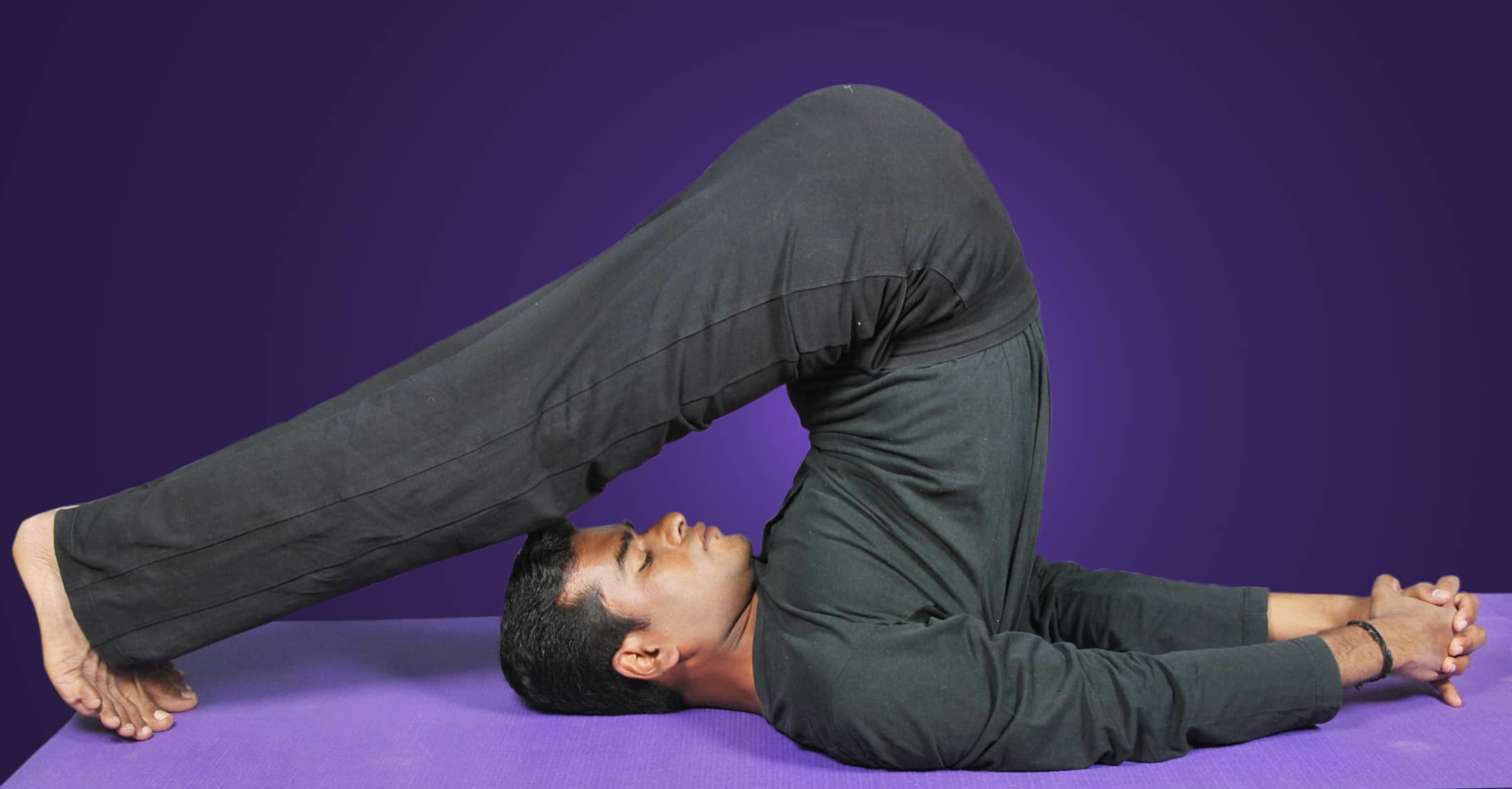
2. Definition
Halasana is an inverted yoga posture in which the practitioner lies supine, lifts the legs overhead, and brings the toes to the floor behind the head. It is classified as a forward bending, spinal flexion, and inversion posture, primarily targeting the spine, hamstrings, shoulders, and abdominal muscles. The pose promotes spinal flexibility, calmness of mind, and enhanced circulation.
Halasana is often practiced as part of the Sarvangasana series or as a standalone posture in Hatha, Iyengar, and therapeutic yoga. It is considered a beneficial pose for the thyroid and abdominal organs, improving metabolism and nervous system balance.
3. Method of Practice (Step by Step)
Step 1: Preparation
- Lie supine on a yoga mat with arms resting along the sides.
- Legs extended and feet together, keeping the spine in a neutral position.
- Take a few deep breaths to relax the body.
Step 2: Engaging Core Muscles
- Engage abdominal muscles (rectus abdominis, transverse abdominis) to lift the legs.
- Press lower back into the mat to stabilize the pelvis and protect the lumbar spine.
Step 3: Lifting the Legs
- Inhale and lift both legs slowly overhead, keeping them straight and together.
- Support the lower back with palms under the sacrum if needed, for beginners or limited flexibility.
Step 4: Bringing Toes Toward the Floor
- Exhale and allow the legs to descend over the head, attempting to place the toes on the floor behind the head.
- Keep legs extended and toes together.
- Maintain spinal extension and avoid collapsing the chest.
Step 5: Arm and Shoulder Placement
- Place arms flat on the mat with palms down for stability, or interlace fingers behind the back to open shoulders (advanced).
- Keep shoulders away from ears, ensuring they remain grounded.
Step 6: Holding the Pose
- Hold the posture for 15–60 seconds initially, gradually increasing with practice.
- Breathe slowly and evenly, focusing on lengthening the spine and relaxing the neck.
Step 7: Exiting the Pose
- Support the back with hands and slowly roll the spine down vertebra by vertebra.
- Bring legs to a neutral supine position with knees slightly bent if needed.
- Rest in Savasana or Apanasana to allow the spine to relax.
4. Alignment Cues
- Spine: Elongate and avoid collapsing thoracic or lumbar regions.
- Shoulders: Press into the mat to stabilize and avoid neck compression.
- Neck: Keep cervical spine long; do not turn the head.
- Legs: Keep knees straight and toes together.
- Arms: Flat on mat or interlaced behind back; engage shoulders for support.
- Core: Engage abdominal muscles for pelvic lift and spinal alignment.
5. Benefits
Physical Benefits
- Stretches spine, shoulders, hamstrings, and calves.
- Strengthens back muscles and core stabilizers.
- Improves spinal flexibility and posture.
- Stimulates thyroid and parathyroid glands, regulating metabolism.
- Enhances circulation to the brain and upper body.
Physiological Benefits
- Improves digestion and tones abdominal organs.
- Enhances venous return from lower extremities.
- Reduces fatigue and mental stress through inversion.
- Stimulates nervous system by increasing parasympathetic activity.
Mental Benefits
- Promotes calmness and relaxation.
- Reduces anxiety and mild depression.
- Improves focus and concentration.
6. Contraindications
- Neck injuries or cervical instability
- Severe hypertension or heart conditions
- Glaucoma or retinal disorders
- Pregnancy (especially second and third trimester)
- Herniated disc or severe back pain
Note: Always consult a physician for pre-existing conditions. Use modifications for safety.
7. Counterposes
- Matsyasana (Fish Pose): Opens the chest and counteracts forward spinal flexion.
- Savasana: Relaxes spine and muscles.
- Apanasana: Knees-to-chest pose, releasing lower back tension.
- Setu Bandhasana (Bridge Pose): Gentle extension and spinal realignment.
8. Preparatory Practice
- Sarvangasana (Shoulder Stand): Prepares shoulders and inversion practice.
- Paschimottanasana: Prepares hamstrings and posterior chain.
- Bhujangasana (Cobra Pose): Warms spine and back muscles.
- Adho Mukha Svanasana (Downward Dog): Opens hamstrings, calves, and shoulders.
9. Modifications
- Use hands to support lower back for beginners.
- Place folded blanket under shoulders to relieve cervical spine pressure.
- Bend knees slightly if hamstrings or lower back are tight.
- Do not attempt full toe placement initially; place legs at an angle.
10. Muscles Involved
Primary muscles stretched:
- Hamstrings (Biceps Femoris, Semitendinosus, Semimembranosus)
- Calves (Gastrocnemius, Soleus)
- Erector Spinae
- Cervical extensors
Primary muscles engaged:
- Abdominals (Rectus Abdominis, Transverse Abdominis, Obliques)
- Quadriceps for leg extension
- Gluteus Maximus (stabilizing pelvis)
- Deltoids and Trapezius (shoulder stabilization)
11. Kinesiology
- Joint Actions:
- Hip: Flexion with leg lift
- Spine: Cervical flexion, thoracic and lumbar flexion
- Shoulder: Extension or adduction depending on arm placement
- Knee: Extension
Muscle Contractions:
- Isometric: Core stabilizers and shoulder muscles
- Eccentric: Hamstrings while lowering legs (if done slowly)
- Concentric: Abdominals while lifting legs
- Plane of Movement: Sagittal primarily, with slight frontal plane adjustment for balance.
12. Kinematics
- Lifting legs overhead involves spinal flexion and hip flexion, requiring coordination between core, hamstrings, and shoulder girdle.
- Toe placement behind head requires hip mobility and hamstring length, while cervical spine remains neutral.
- Maintaining balance prevents lateral pelvic tilt or spinal collapse.
13. Biomechanics
- The body acts as a lever: legs are the moving segment, supported by the spine and core.
- Pelvic lift requires force from abdominals and hip flexors.
- Shoulder-ground contact supports body weight and reduces cervical load.
- Inversion mechanics enhance venous return and reduce gravitational strain on lower limbs.
14. Functional Anatomy & Physiology
- Nervous System:
- Stimulates proprioceptors and spinal alignment awareness.
- Enhances parasympathetic activity, promoting relaxation.
- Musculoskeletal System:
- Stretches posterior chain (spine, hamstrings, calves).
- Strengthens core stabilizers for spinal support.
- Circulatory System:
- Inversion increases blood flow to the brain.
- Improves venous return from lower extremities.
- Endocrine System:
- Stimulates thyroid and parathyroid via cervical compression and inversion.
15. How to Correct and Adjust While Teaching
Common Mistakes
- Neck compression due to lack of shoulder support
- Spinal collapse in thoracic or lumbar region
- Bent or misaligned knees
- Feet not together or misaligned toes
- Correction Strategies
- Place a blanket under shoulders to support cervical spine.
- Instruct core engagement and slow spinal roll-down exit.
- Use hands under sacrum for beginners.
- Keep knees slightly bent if flexibility is limited.
Hands-On Adjustments
- Support pelvis with hands for stabilization.
- Guide shoulder blades toward mat to increase chest lift.
- Assist leg placement if feet cannot reach floor, or use strap.
Verbal Cueing
- “Press your shoulders into the mat to protect the neck.”
- “Engage your core and lift legs slowly, keeping spine long.”
- “Breathe deeply and evenly as you lengthen your posterior chain.”
16. Variations of Halasana
- Supported Halasana: Blanket or block under shoulders for neck protection.
- Ardha Halasana: Half Plow Pose; one leg bent, other extended.
- Legs to Side Variation: Stretches obliques and improves spinal rotation.
- Padahastasana (Hands under Feet): Advanced variation for spinal stretch.
17. Therapeutic Applications
- Sciatica relief: gentle posterior chain stretch.
- Thyroid and endocrine health: cervical inversion stimulates glands.
- Lower back stiffness: stretches erector spinae and posterior muscles.
- Calms nervous system: reduces anxiety and mild depression.
- Digestive benefits: massages abdominal organs and improves digestion.
18. Safety and Precautions
- Avoid neck rotation during the pose.
- Use support for beginners.
- Do not force legs to floor if hamstrings are tight.
- Exit slowly to prevent dizziness or spinal strain.
- Avoid in high blood pressure, heart disease, glaucoma, or pregnancy.
19. Conclusion
Halasana (Plow Pose) is a powerful inversion and spinal flexion asana that combines flexibility, strength, and therapeutic benefits. Its key advantages include:
- Spinal lengthening and flexibility
- Hamstring, calf, and shoulder stretch
- Core stabilization and pelvic alignment
- Improved circulation and thyroid stimulation
- Mental calmness and stress reduction
With mindful practice, modifications, and proper alignment, Halasana is suitable for both beginner and advanced practitioners, serving as a key posture in Hatha yoga, therapeutic yoga, and spinal health programs.
QUESTION AND ANSWER
1. What does “Hala” in Halasana mean?
A. Horse
B. Plow
C. Tree
D. Bridge
Answer: B – “Hala” means Plow, hence Halasana = Plow Pose.
2. What type of posture is Halasana classified as?
A. Backbend
B. Forward bend and inversion
C. Balancing
D. Twist
Answer: B – It is a forward bending and inverted posture.
3. Which muscles are primarily stretched in Halasana?
A. Quadriceps and hip flexors
B. Hamstrings, calves, erector spinae
C. Deltoids and triceps
D. Pectorals and latissimus dorsi
Answer: B – Hamstrings, calves, and erector spinae are the primary stretched muscles.
4. Which muscles are primarily engaged in Halasana?
A. Core (rectus abdominis, obliques), glutes, quadriceps
B. Soleus and gastrocnemius only
C. Pectorals and biceps
D. Neck flexors only
Answer: A – Core stabilizers, glutes, and quadriceps are actively engaged.
5. Which preparatory pose is suitable for Halasana?
A. Sarvangasana (Shoulder Stand)
B. Adho Mukha Svanasana (Downward Dog)
C. Bhujangasana (Cobra Pose)
D. All of the above
Answer: D – All of the above help prepare shoulders, spine, and posterior chain.
6. Which joint action occurs at the hips in Halasana?
A. Extension
B. Flexion
C. Abduction
D. Adduction
Answer: B – Hip flexion occurs while lifting legs overhead.
7. Which gland is stimulated in Halasana due to cervical pressure?
A. Adrenal
B. Thyroid
C. Pineal
1. What does “Hala” in Halasana mean?
A. Horse
B. Plow
C. Tree
D. Bridge
Answer: B – “Hala” means Plow, so Halasana = Plow Pose.
2. What type of yoga posture is Halasana?
A. Backbend
B. Forward bend and inversion
C. Balancing pose
D. Twist
Answer: B – Halasana is a forward bending and inverted posture.
3. Which muscles are primarily stretched in Halasana?
A. Quadriceps and hip flexors
B. Hamstrings, calves, and erector spinae
C. Deltoids and triceps
D. Pectorals and latissimus dorsi
Answer: B – Hamstrings, calves, and erector spinae are the main muscles stretched.
4. Which muscles are primarily engaged in Halasana?
A. Core (rectus abdominis, obliques), glutes, quadriceps
B. Soleus and gastrocnemius only
C. Pectorals and biceps
D. Neck flexors only
Answer: A – Core muscles, glutes, and quadriceps are actively engaged for stability.
5. Which preparatory poses are beneficial for Halasana?
A. Sarvangasana (Shoulder Stand)
B. Paschimottanasana
C. Bhujangasana (Cobra Pose)
D. All of the above
Answer: D – All of the above prepare the spine, shoulders, and hamstrings.
6. Which joint action occurs at the hip during Halasana?
A. Extension
B. Flexion
C. Abduction
D. Adduction
Answer: B – The hips are in flexion when legs are lifted overhead.
7. Which glands are stimulated during Halasana due to cervical compression?
A. Thyroid and parathyroid
B. Adrenal
C. Pineal
D. Pituitary
Answer: A – Thyroid and parathyroid glands are stimulated.
8. What is the main benefit of Halasana on circulation?
A. Increases venous return from the legs
B. Reduces cerebral blood flow
C. Weakens heart function
D. Reduces oxygenation of upper body
Answer: A – Halasana enhances venous return and increases blood flow to the upper body.
9. Which of the following is a contraindication for Halasana?
A. Low blood pressure
B. Neck injury
C. Mild back stiffness
D. Shoulder tightness
Answer: B – Neck injury is a key contraindication due to cervical stress.
10. What is the correct arm placement for beginners in Halasana?
A. Flat on the mat with palms down
B. Interlaced behind the back
C. Arms raised overhead
D. Crossed on chest
Answer: A – Beginners should place arms flat on the mat for support.
11. Which spinal region is primarily flexed in Halasana?
A. Cervical
B. Thoracic and lumbar
C. Sacral only
D. None
Answer: B – Thoracic and lumbar spine experience flexion while the cervical spine remains long.
12. What is the correct method to exit Halasana safely?
A. Jump forward
B. Roll spine down vertebra by vertebra
C. Drop legs suddenly
D. Lift arms overhead
Answer: B – Slowly roll the spine down vertebra by vertebra to protect neck and back.
13. Which counterpose is most suitable after Halasana?
A. Matsyasana (Fish Pose)
B. Adho Mukha Svanasana (Downward Dog)
C. Trikonasana
D. Tadasana
Answer: A – Matsyasana counteracts spinal flexion and opens the chest.
14. How does Halasana affect the nervous system?
A. Activates sympathetic nervous system
B. Enhances parasympathetic activity
C. Causes nervous system fatigue
D. Reduces proprioception
Answer: B – Halasana enhances parasympathetic activity, promoting relaxation.
15. Which modification is suitable for beginners?
A. Place a folded blanket under shoulders
B. Keep legs bent
C. Support lower back with hands
D. All of the above
Answer: D – All these modifications make Halasana safe and accessible for beginners.
16. Which of the following is an advanced variation of Halasana?
A. Ardha Halasana (Half Plow Pose)
B. Padahastasana (Hands under Feet)
C. Leg-to-side variation
D. All of the above
Answer: D – These are all advanced variations.
17. Which plane of motion is primarily involved in Halasana?
A. Sagittal plane
B. Frontal plane
C. Transverse plane
D. Diagonal plane
Answer: A – Halasana is primarily performed in the sagittal plane.
18. What is the main purpose of engaging the core during Halasana?
A. To increase spinal compression
B. To stabilize pelvis and protect lumbar spine
C. To stretch hamstrings more
D. To balance on hands
Answer: B – Core engagement stabilizes the pelvis and protects the lumbar spine.
19. How does Halasana benefit digestion?
A. Compresses abdominal organs and improves tone
B. Reduces stomach activity
C. Increases fat storage
D. Has no effect
Answer: A – Halasana stimulates and tones abdominal organs, aiding digestion.
20. Which of the following precautions is recommended for Halasana?
A. Avoid turning head in pose
B. Avoid practicing with high blood pressure
C. Support neck with blanket if needed
D. All of the above
Answer: D – All precautions are important for safe practice.