
1. Word Meaning
The Sanskrit term “Gomukhasana” is derived from:
- Go – meaning “cow”
- Mukha – meaning “face”
- Asana – meaning “pose” or “seat”
Thus, Gomukhasana translates to “Cow Face Pose”, named for the position of the legs resembling a cow’s face. The pose symbolizes steadiness, alignment, and focus, targeting both hip and shoulder mobility.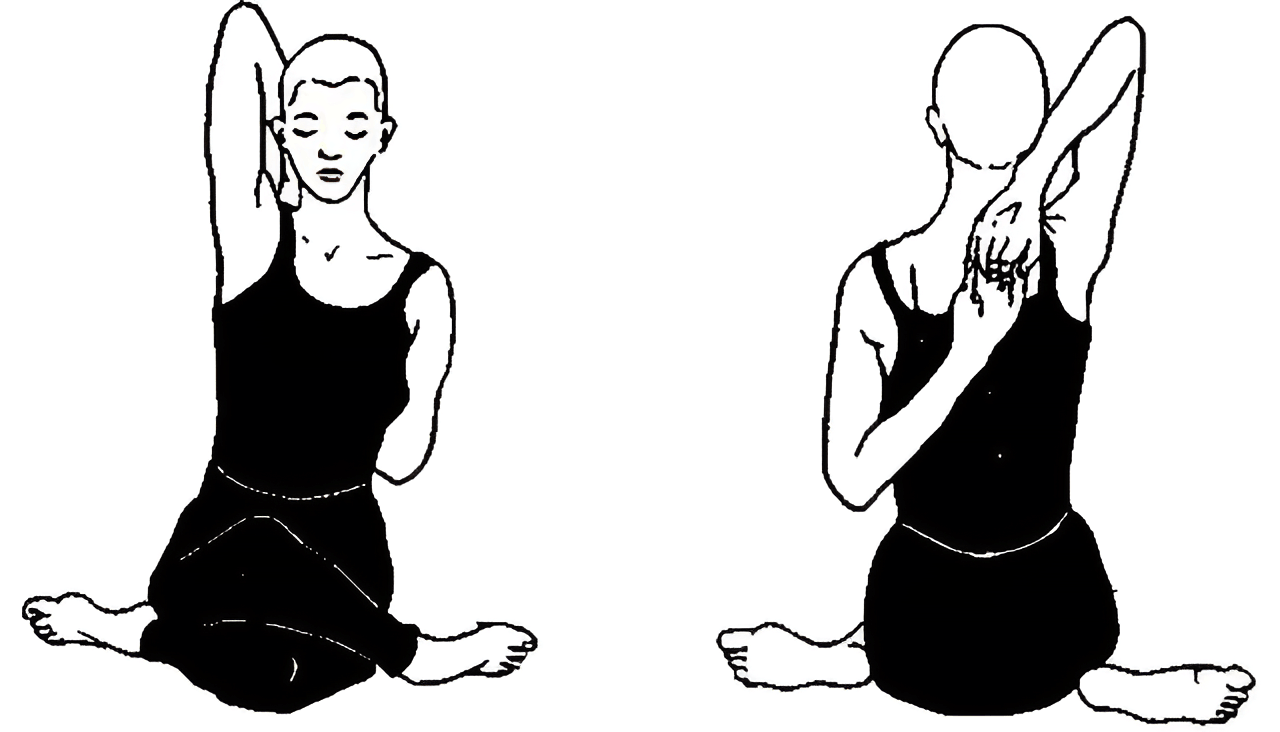
2. Definition
Gomukhasana is a seated posture that emphasizes:
- Hip and shoulder flexibility
- Stretching the gluteal and chest muscles
- Spinal alignment and upright seated posture
It is classified as a meditative and deep stretch pose, often used in pranayama, seated meditation, and asana sequences. It combines:
- Lower body hip rotation
- Upper body shoulder and chest opening
Gomukhasana enhances both static flexibility and dynamic control while stimulating internal organs.
3. Method of Practice – Step by Step
Step 1: Begin in Dandasana
- Sit with legs extended forward, spine upright, shoulders relaxed
- Ensure sit bones are grounded evenly
Step 2: Leg Position
- Bend the right knee and bring the right foot toward the left hip
- Cross the left leg over, stacking the knees, with left foot near right hip
- Knees should be stacked, with feet beside opposite hips
Step 3: Arm Position
- Raise the right arm overhead, bend the elbow, and allow the hand to drop behind the back
- Extend the left arm behind the back, palm facing forward, and try to clasp the right hand or fingers
- Use a strap if hands do not meet
Step 4: Spine Alignment
- Sit tall, lengthen spine, lift chest
- Shoulders drawn back and down
- Head aligned with spine
Step 5: Breathing
- Inhale to lengthen spine
- Exhale to relax shoulders and deepen stretch
- Maintain calm, smooth diaphragmatic breathing
Step 6: Hold
- Beginners: 15–30 seconds per side
- Intermediate: 30–60 seconds per side
- Advanced: 1–2 minutes per side
Step 7: Release
- Release hands gently
- Straighten legs into Dandasana
- Repeat on the other side
4. Alignment Cues
- Hips: Sit evenly on both sit bones
- Spine: Lengthen through thoracic and lumbar regions
- Knees: Stacked vertically, avoid lateral twisting
- Arms: Elbow pointing upward (top arm), downward (bottom arm)
- Hands: Clasp or use strap to bridge gap
- Shoulders: Draw down and back
- Head: Neutral, gaze forward
- Breath: Even and steady
5. Benefits of Gomukhasana
A. Physical Benefits
- Opens hips, glutes, thighs, and outer hips
- Stretches shoulders, chest, and arms
- Strengthens spinal erectors and core
- Improves posture and balance
- Enhances mobility for seated meditation
B. Mental Benefits
- Calms mind and reduces stress
- Improves focus and concentration
- Encourages introspection and mindfulness
C. Physiological Benefits
- Stimulates abdominal organs
- Improves circulation in lower extremities
- Relieves mild sciatica and hip tension
D. Energetic Benefits
- Activates Anahata (heart) and Manipura (solar plexus) chakras
- Balances prana flow in upper and lower body
6. Contraindications
- Knee injuries – caution with stacked legs
- Shoulder or rotator cuff injuries – avoid deep arm stretch
- Lower back pain – maintain upright spine, use props
- Pregnancy – avoid deep hip rotations
- Tight hamstrings or wrists – modify or use strap
7. Counterposes
- Dandasana (Staff Pose) – neutral seated position
- Baddha Konasana (Bound Angle Pose) – gentle hip opening
- Shavasana – relaxation after deep stretch
- Adho Mukha Svanasana – stretches posterior body and releases shoulders
8. Preparatory Practice
- Dandasana – seated posture for alignment
- Baddha Konasana – hip mobility
- Garudasana arms (Eagle arms) – shoulder flexibility
- Anjaneyasana – hip flexor stretch
- Thread the Needle Pose – shoulder opening
9. Modifications
- Use yoga strap or towel to bridge hand gap
- Sit on blanket or block for elevated hips to reduce knee strain
- Keep bottom arm elbow slightly bent if shoulder tight
- Half Gomukhasana – only lower body hip stacking
10. Muscles Involved
A. Stretched Muscles
- Hips and legs: gluteus maximus, gluteus medius, piriformis, quadriceps, hamstrings
- Shoulders and arms: deltoids, triceps, biceps, teres major/minor
- Chest: pectoralis major and minor
B. Strengthened Muscles
- Core muscles (rectus abdominis, transverse abdominis, obliques)
- Spinal erectors (erector spinae, multifidus)
- Stabilizers of scapula (rhomboids, trapezius)
C. Joints
- Hip: flexion, external rotation
- Knee: flexion
- Shoulder: flexion, abduction, external rotation
- Elbow: flexion/extension
11. Kinesiology
- Hip: Flexion and external rotation
- Knee: Flexion
- Shoulder: Flexion and abduction (top arm), internal rotation (bottom arm)
- Spine: Upright, neutral, slight thoracic extension
- Elbow: Flexion and extension to clasp hands
12. Kinematics
- Sagittal plane: Spine alignment
- Frontal plane: Hip stacking and rotation
- Transverse plane: Shoulder rotation and hand clasping
- Force distribution: Weight evenly on sit bones and stabilizing muscles
13. Biomechanics
- Stacked knees reduce lateral stress
- Arm clasp stretches shoulder girdle and chest
- Spine remains upright, reducing lumbar compression
- Engagement of core and scapular stabilizers prevents collapse
- Props (strap, block) adjust leverage to minimize strain
14. Functional Anatomy & Physiology
A. Musculoskeletal System
- Strengthens and stretches muscles of hip, shoulder, chest, and spine
- Increases joint mobility and functional flexibility
- Enhances muscle coordination
B. Nervous System
- Stimulates proprioceptors in hips, shoulders, and core
- Calms autonomic nervous system
- Improves mind-body connection
C. Circulatory System
- Enhances blood flow in glutes, thighs, shoulders, arms
- Reduces tension and promotes venous return
D. Respiratory System
- Chest expansion improves lung capacity and diaphragmatic breathing
E. Energetic System
- Opens heart and solar plexus chakras
- Balances anterior-posterior pranic flow
15. How to Correct and Adjust While Teaching
Common Misalignments
- Hips uneven or tilting forward/back
- Knees misaligned, causing knee strain
- Shoulders shrugged or collapsed
- Spine rounded
Verbal Adjustments
- “Stack knees, sit evenly on both sit bones”
- “Lengthen spine, draw shoulders down and back”
- “Reach hands toward each other gently”
Hands-On Adjustments
- Support knees to maintain vertical alignment
- Guide arm placement and hand clasp
- Encourage core engagement to stabilize spine
Modifications
- Use strap between hands
- Half Gomukhasana for beginners
- Sit on block to reduce hip tension
16. Variations
- Half Gomukhasana: Only hip stacking, no arm clasp
- Gomukhasana with strap: Hands bridged with strap
- Gomukhasana twist: Seated spinal twist with arms in Gomukhasana
- Reclined Gomukhasana: On back with legs stacked and arms stretched overhead
17. Philosophical and Energetic Aspect
- Represents steadiness, mindfulness, and inner focus
- Enhances concentration and meditation readiness
- Symbolizes balance between upper and lower body, mind and body
- Encourages prana flow and heart opening
18. Conclusion
Gomukhasana (Cow Face Pose) is a powerful seated posture integrating hip and shoulder flexibility, core stabilization, and spinal alignment.
- Physical Benefits: Opens hips and shoulders, strengthens back and core
- Mental Benefits: Calms mind, improves focus
- Physiological Benefits: Stimulates circulation, digestion, and respiration
- Energetic Benefits: Activates heart and solar plexus chakras
Through mindful alignment, preparatory poses, and modifications, Gomukhasana is safe for beginners and advanced practitioners, offering a holistic approach to flexibility, strength, and meditation readiness.
QUESTION AND ANSWER
1. What does “Go” mean in Sanskrit?
a) Face
b) Cow
c) Horse
d) Pose
Answer: b
2. What does “Mukha” mean?
a) Cow
b) Face
c) Foot
d) Hand
Answer: b
3. What is the English translation of Gomukhasana?
a) Cow Face Pose
b) Downward Dog
c) Seated Forward Bend
d) Staff Pose
Answer: a
4. What is the main focus of Gomukhasana?
a) Hip and shoulder flexibility
b) Arm balance
c) Forward bend
d) Backbend
Answer: a
5. Base position for Gomukhasana?
a) Dandasana
b) Sukhasana
c) Vajrasana
d) Padmasana
Answer: a
6. How should the knees be positioned?
a) Stacked vertically, one over the other
b) Spread wide apart
c) Bent outward
d) Straight forward
Answer: a
7. How are the feet positioned?
a) One foot near opposite hip
b) Feet crossed
c) Both forward
d) One extended, one bent
Answer: a
8. How should the arms be positioned?
a) One arm overhead bent, the other behind back
b) Both overhead straight
c) Hands on knees
d) Both forward
Answer: a
9. What can be used if the hands do not meet?
a) Yoga strap
b) Blanket under knees
c) Wall support
d) Nothing
Answer: a
10. Spine cue:
a) Sit tall and lengthen through thoracic and lumbar regions
b) Round the spine
c) Collapse shoulders
d) Lean forward
Answer: a
11. Breathing cue:
a) Smooth, diaphragmatic, inhale to lengthen, exhale to deepen stretch
b) Hold breath
c) Rapid shallow breaths
d) Forceful inhalation
Answer: a
12. Recommended hold time for beginners:
a) 15–30 seconds per side
b) 5 minutes
c) 2 minutes
d) 1–2 seconds
Answer: a
13. Recommended hold time for advanced practitioners:
a) 1–2 minutes per side
b) 5 seconds
c) 15 seconds
d) 10 minutes
Answer: a
14. Hips cue:
a) Sit evenly on both sit bones
b) Tilt forward
c) Tilt backward
d) Lift one hip
Answer: a
15. Shoulder cue:
a) Draw shoulders down and back
b) Shrug shoulders
c) Round forward
d) Lift ears to shoulders
Answer: a
16. Head and neck cue:
a) Neutral
b) Tilt back aggressively
c) Tilt forward
d) Turn sideways
Answer: a
17. Contraindications include:
a) Knee injuries, shoulder injuries, lower back pain, pregnancy
b) Tight calves only
c) Wrist injuries only
d) None
Answer: a
18. Counterposes include:
a) Dandasana, Baddha Konasana, Shavasana, Adho Mukha Svanasana
b) Tadasana only
c) Ardha Matsyendrasana only
d) None
Answer: a
19. Preparatory practices include:
a) Dandasana, Baddha Konasana, Garudasana arms, Anjaneyasana, Thread the Needle
b) Only Tadasana
c) Only standing poses
d) None
Answer: a
20. Common misalignment:
a) Hips uneven or tilting forward/back
b) Perfect spine
c) Shoulders relaxed
d) Correct foot placement
Answer: a
21. Modification for beginners:
a) Use strap to bridge hand gap
b) Force hand clasp
c) Ignore knee alignment
d) Lift knees
Answer: a
22. Modification for hip tension:
a) Sit on block or folded blanket
b) Sit flat on floor
c) Stand up
d) Bend forward
Answer: a
23. Stretched muscles include:
a) Gluteus maximus, gluteus medius, piriformis, quadriceps, deltoids, triceps, pectoralis major
b) Biceps only
c) Calves only
d) Hamstrings only
Answer: a
24. Strengthened muscles include:
a) Core (rectus abdominis, transverse abdominis, obliques), spinal erectors, scapular stabilizers
b) Biceps only
c) Calves only
d) None
Answer: a
25. Joints engaged include:
a) Hips, knees, shoulders, elbows
b) Only shoulders
c) Only knees
d) None
Answer: a
26. Kinesiology of hips:
a) Flexion and external rotation
b) Extension only
c) Abduction only
d) Rotation only
Answer: a
27. Kinematics planes involved:
a) Sagittal (spine), frontal (hip stacking), transverse (shoulder rotation)
b) Only sagittal
c) Only frontal
d) Only transverse
Answer: a
28. Biomechanics principle:
a) Engage core and stabilizers, maintain upright spine, use props if needed
b) Collapse hips
c) Round spine
d) Shrug shoulders
Answer: a
29. Energetic benefits:
a) Opens heart (Anahata) and solar plexus (Manipura) chakras
b) Depletes energy
c) Only throat chakra
d) None
Answer: a
30. Mental benefits include:
a) Calms mind, improves focus and concentration
b) Increases stress
c) Causes agitation
d) None
Answer: a
31. Physiological benefits:
a) Improves circulation, stimulates abdominal organs, relieves hip tension
b) Weakens joints
c) Reduces lung capacity
d) None
Answer: a
32. Arm cue for bottom arm:
a) Elbow bent, palm facing forward
b) Fully extended forcibly
c) Twisted sideways
d) Relaxed
Answer: a
33. Arm cue for top arm:
a) Elbow bent, fingers pointing down the back
b) Extended backward forcibly
c) Sideways
d) Relaxed
Answer: a
34. Use of strap:
a) Bridges hand gap if hands don’t meet
b) Forces elbow bend
c) Supports knees only
d) None
Answer: a
35. Core engagement purpose:
a) Stabilize spine and maintain posture
b) Collapse torso
c) Twist spine
d) None
Answer: a
36. How to exit safely:
a) Release hands, straighten legs slowly, relax
b) Forcefully twist
c) Jump out
d) Collapse forward
Answer: a
37. Recommended duration for meditation readiness:
a) 30–60 seconds per side
b) 5 seconds
c) 5 minutes only
d) 2 seconds
Answer: a
38. Variation for beginners:
a) Half Gomukhasana (hip stacking only)
b) Full advanced expression only
c) Wall support only
d) None
Answer: a
39. Common alignment error:
a) Uneven hips
b) Spine upright
c) Arms in proper position
d) Knees stacked
Answer: a
40. Foot cue:
a) Foot near opposite hip
b) Foot extended forward
c) Cross feet
d) Lift toes
Answer: a
41. Chest cue:
a) Open chest fully, broaden collarbones
b) Collapse forward
c) Round shoulders
d) Lift shoulders
Answer: a
42. Nervous system benefit:
a) Stimulates proprioception and calms autonomic nervous system
b) Causes imbalance
c) Overstimulates nerves
d) None
Answer: a
43. Circulatory system benefit:
a) Enhances blood flow in glutes, thighs, shoulders, arms
b) Reduces blood flow
c) Weakens heart
d) None
Answer: a
44. Respiratory benefit:
a) Expands chest, improves lung capacity
b) Compresses lungs
c) Reduces oxygen intake
d) None
Answer: a
45. Recommended props:
a) Strap, block, blanket
b) Chair only
c) Wall only
d) None
Answer: a
46. Shoulder precautions:
a) Avoid forcing arms behind back if shoulder injury
b) Ignore pain
c) Overextend
d) Shrug aggressively
Answer: a
47. Philosophical aspect:
a) Enhances mindfulness, focus, and inner steadiness
b) Encourages agitation
c) Promotes haste
d) None
Answer: a
48. Energetic alignment:
a) Balances prana flow in upper and lower body
b) Drains energy
c) Disrupts chakras
d) None
Answer: a
49. Arm clasping caution:
a) Use strap if hands do not meet
b) Force hands together
c) Ignore misalignment
d) None
Answer: a
50. Teaching verbal cue for beginners:
a) “Stack knees, lift spine, draw shoulders down, use strap if needed”
b) “Force hands, collapse spine”
c) “Ignore hips”
d) “Shrug shoulders”
Answer: a