
1. WORD MEANING
The Sanskrit word Garuḍāsana is composed of two elements:
- Garuḍa – the mighty eagle, king of birds, vehicle (vāhana) of Lord Vishnu
- Āsana – posture, seat, or stable position
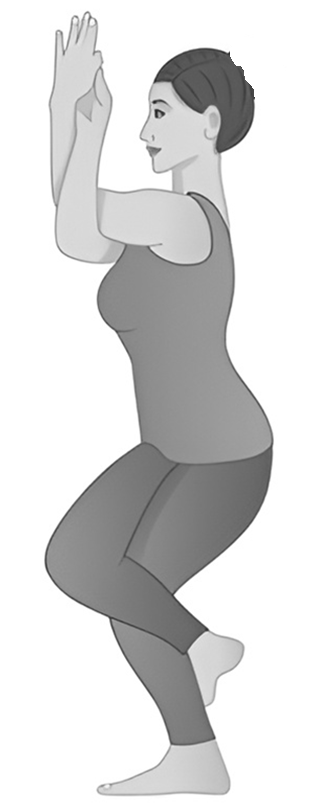
Thus Garuḍāsana translates to “The Eagle Pose”.
Symbolically, Garuḍa represents:
- keen vision
- unwavering focus
- dynamic balance
- ability to rise above obstacles
- agility, speed, and spiritual strength
The pose replicates the coiling and binding qualities of an eagle’s wings and legs mid-flight.
2. DEFINITION
Garuḍāsana (Eagle Pose) is a classical standing balance posture where the practitioner wraps one leg over the other and entwines the arms together, maintaining a controlled, vertical alignment of the spine. It is a:
- balancing
- hip-opening
- core-activating
- shoulder-mobilizing
- neuromuscular coordination-enhancing
asana.
It demands proprioception, concentration, and muscular integration, making it highly effective for nervous system training and joint stabilization.
3. METHOD OF PRACTICE (STEP-BY-STEP)
Step 1: Starting Position
- Begin in Tadasana.
- Ground through both feet.
- Engage thighs slightly and lengthen spine.
Step 2: Prepare for Balance
- Shift weight onto the right foot.
- Keep the right knee soft but stable.
Step 3: Leg Wrapping
- Lift the left leg and cross it over the right thigh.
- Press the inner thighs together.
- If balance permits, wrap the left foot behind the right calf.
Step 4: Arm Wrapping
- Extend both arms forward parallel to the floor.
- Cross the right arm over the left at the elbows.
- Bend the elbows and bring the forearms up.
- Wrap the forearms so the palms touch or face each other.
Step 5: Final Position
- Draw elbows slightly down and forward.
- Sink hips gently as if lowering into a chair.
- Keep the spine tall and chest broad.
Step 6: Hold
- Breathe steadily for 5–10 breaths.
- Maintain gaze (dṛṣṭi) at a fixed point.
Step 7: Release
- Gently unwind arms.
- Unwrap legs.
- Return to Tadasana and repeat on the opposite side.
4. ALIGNMENT CUES (DETAILED TEACHING CUES)
Feet & Legs
- Ground through the standing foot’s four corners.
- Do not lock the standing knee; maintain micro-bend.
- Inner thighs hug toward midline.
- Wrapped foot (if behind calf) hooks lightly—not forced.
Hips & Pelvis
- Keep pelvis square to the front.
- Avoid hip hiking or rotating outward.
- Maintain neutral lumbar curve.
Arms & Shoulders
- Elbows lift to shoulder height.
- Shoulder blades spread without shrugging upward.
- Palms press lightly—no strain.
Core & Spine
- Activate transverse abdominis to stabilize.
- Keep spine vertical, not leaning forward.
- Lengthen through back of neck.
Gaze (Dṛṣṭi)
- Focus at the horizon level.
- Maintain stillness for balance.
5. BENEFITS
Physical Benefits
- Enhances balance and stability
- Increases ankle, knee, and hip joint strength
- Improves proprioception
- Mobilizes shoulders, scapula, thoracic spine
- Strengthens glutes, quadriceps, hamstrings, calves
- Improves circulation in lower limbs
- Helps release tension from upper back and shoulders
- Develops coordination and motor control
Physiological Benefits
- Trains the vestibular system
- Improves neuromuscular synchronization
- Stimulates parasympathetic tone
- Enhances vascular flow in compressed areas
- Improves joint lubrication (synovial fluid production)
Mental & Emotional Benefits
- Boosts concentration and focus
- Stabilizes wandering mind
- Encourages mental sharpness and discipline
- Reduces anxiety through grounding
- Offers meditative stillness in balance
Symbolic / Yogic Benefits
- Represents overcoming obstacles
- Enhances inner vision and clarity
- Builds courage and spiritual stamina
6. CONTRAINDICATIONS
Avoid or modify in cases of:
- Recent knee injuries (meniscus, ACL, ligament tears)
- Severe ankle instability
- Frozen shoulder or rotator cuff injury
- Sciatica (without proper modification)
- Varicose veins (avoid deep wrapping)
- Pregnancy (rarely recommended due to balance risk)
- Vertigo or severe balance issues
- Hypertension (avoid holding breath or straining)
7. COUNTERPOSES
To release shoulders, hips, and legs:
Shoulder / Arm Counterposes
- Gomukhasana arms
- Wrist and shoulder rolls
- Garudāsana arm release stretch
Hip / Leg Counterposes
- Uttanasana
- Tadasana with gentle shaking
- Supta Padangusthasana
- Baddha Konasana
Spinal Neutralization
- Cat–Cow
- Ardha Uttanasana
8. PREPARATORY PRACTICES
Warm-ups for Balance
- Tadasana with weight shifting
- Tree Pose (Vrksasana)
- Standing knee lifts
Hip/Leg Preparation
- Utkatasana
- Garudāsana leg prep (leg crossover without balance)
- Ankle strengthening drills
Shoulder/Arm Preparation
- Eagle arm stretch
- Shoulder blade mobilization
- Cat–Cow with scapular movement
9. MODIFICATIONS
For Beginners / Limited Balance
- Wrap only the legs or only the arms—not both.
- Keep toes of raised leg on the floor (kickstand).
- Use a wall to stabilize balance.
For Limited Hip Mobility
- Don’t wrap calf; instead cross thighs only.
For Limited Shoulder Mobility
- Hold opposite shoulders instead of wrapping arms.
For Pregnancy
- Keep stance wider and avoid deep balancing.
10. MUSCLES INVOLVED
Primary Muscles Active
- Gluteus medius/minimus (hip stabilization)
- Quadriceps (knee extension)
- Hamstrings (leg support)
- Adductors (inner thigh engagement)
- Calves (gastrocnemius/soleus) (balance)
- Transverse abdominis (core stability)
- Erector spinae (spine alignment)
Shoulders & Arms
- Deltoids
- Rhomboids
- Trapezius
- Rotator cuff muscles
Feet
- Intrinsic foot muscles aiding balance.
11. KINESIOLOGY (MOVEMENT ANALYSIS)
Leg Mechanics
- Adduction of both thighs
- Internal rotation of standing thigh
- Flexion of standing knee
- Wrapping action creates closed-chain stability
Arm Mechanics
- Horizontal adduction (arms crossing)
- Internal rotation of upper arms
- Flexion of elbows
- Protraction of scapulae
Core Mechanics
- Isometric stabilization
- Deep core muscles maintain vertical balance
12. KINEMATICS (JOINT ACTIONS)
Ankle
- Micro-movements to maintain balance
- Eversion/inversion adjustments
Knee
- Flexion
- Co-contraction of quadriceps + hamstrings
Hip
- Adduction
- Minimal internal rotation
- Flexion of standing hip
Spine
- Axial extension
- Neutral alignment
Shoulders
- Flexion + internal rotation
- Elbow flexion
13. BIOMECHANISM (BIOMECHANICAL PRINCIPLES)
Balance Mechanism
- Standing foot becomes a stabilizing platform.
- Center of gravity narrows due to leg crossing.
- Requires vestibular + proprioceptive + visual integration.
Compression and Release Effect
- Thighs, shoulders, and arms experience mild compression.
- Upon release, improved blood circulation and lymphatic flow occurs.
Joint Stability
- Co-contraction around knee and ankle protects ligaments.
- Adductors create midline tension improving pelvic stability.
Scapular Mechanics
- Protraction helps open space in posterior scapular region.
14. FUNCTIONAL ANATOMY & PHYSIOLOGY
Nervous System
- Enhances neuroplasticity
- Improves balance pathways
- Activates cerebellar coordination
Musculoskeletal System
- Strengthens stabilizers (gluteus medius, TA, obliques)
- Improves joint integrity
- Builds functional closed-chain strength
Endocrine & Circulatory System
- Balancing postures calm stress hormones
- Stimulates parasympathetic response
Respiratory System
- Encourages controlled breathing despite compression
- Strengthens intercostal control
15. HOW TO CORRECT & ADJUST WHILE TEACHING
General Teaching Principles
- First cue grounding, then alignment, then layer complexity.
- Observe pelvis: ensure square alignment.
- Avoid forcing students into full wraps.
Verbal Cues
- “Ground through your standing foot.”
- “Hug everything toward the midline.”
- “Lift elbows to shoulder height.”
- “Keep your spine tall—not leaning forward.”
Hands-On Adjustments (Safe Techniques)
Leg Adjustment
- Support student’s balance by gently touching outer hip.
- Guide thigh crossover without pushing knee.
- Ensure foot wrapping is optional, not forced.
Arm Adjustment
- Lightly guide elbows upward.
- Encourage palms to align, but don’t pull.
Spine Adjustment
- Place one hand on back of head and one on sacrum.
- Encourage vertical stacking.
Common Mistakes & Corrections
1. Leaning forward excessively
- Solution: Cue core activation
“Lift through your chest and lengthen spine.”
2. Hip hiking
- Cue pelvis neutrality
“Drop left hip slightly; keep hips square.”
3. Shoulders shrugging
- Cue shoulder blade glide
“Relax shoulders down away from ears.”
4. Weak ankle stability
- Cue grounding
“Spread toes and root through all four corners of the foot.”
Use of Props
- Wall support for beginners
- Block under foot for more comfort
- Strap for arm wrapping
CONCLUSION
Garuḍāsana is much more than a balance posture. It trains:
- stability
- neuromuscular intelligence
- concentration
- joint integrity
- full-body integration
- symbolic qualities of clarity and courage
It remains a cornerstone in modern yoga, especially in TTC trainings, because it perfectly combines tradition, biomechanics, functional anatomy, and meditative discipline.
QUESTION AND ANSWER
1. The Sanskrit word “Garuda” refers to:
A. A mountain
B. A mythical eagle
C. A serpent
D. A sage
Answer: B
2. Garudāsana primarily belongs to which category of asanas?
A. Forward bend
B. Balancing pose
C. Prone backbend
D. Supine relaxation
Answer: B
3. Which is the starting position for Garudāsana?
A. Vajrasana
B. Samasthiti / Tadasana
C. Dandasana
D. Sukhasana
Answer: B
4. In Garudāsana, the leg that wraps over is generally:
A. The stronger leg
B. The weaker leg
C. Any leg; depends on the sequence
D. The leg that is behind
Answer: C
5. The arms in Garudāsana are:
A. Folded behind the back
B. Extended overhead
C. Twisted like double helix in front of the chest
D. Kept on the waist
Answer: C
6. A key alignment cue for Garudāsana is:
A. Open the hips outward
B. Keep the hips square and facing forward
C. Lean backward
D. Bend the spine deeply
Answer: B
7. Which joint experiences the most axial loading in Garudāsana?
A. Wrist
B. Knee
C. Ankle
D. Hip joint
Answer: C
8. The main muscles strengthened in Garudāsana include:
A. Latissimus dorsi and triceps
B. Gluteus medius and quadriceps
C. Biceps and deltoids
D. Erector spinae
Answer: B
9. The arm binding in Eagle Pose mainly stretches:
A. Pectoral muscles
B. Upper trapezius and rhomboids
C. Biceps
D. Lower back muscles
Answer: B
10. Which modification helps beginners perform Garudāsana?
A. Wall support for balance
B. Jump into the pose
C. Perform on one toe only
D. Add ankle weights
Answer: A
11. Which of the following is NOT recommended for students with knee injury?
A. Half-Eagle (no knee wrapping)
B. Chair-assisted Eagle
C. Deep twisting of the standing knee
D. Arm-only Eagle
Answer: C
12. Which counterpose best complements Garudāsana?
A. Shashankasana
B. Tadasana with arm stretch
C. Matsyasana
D. Bhujangasana
Answer: B
13. A common mistake in Garudāsana is:
A. Keeping the core active
B. Dropping the chest down
C. Gazing softly forward
D. Engaging the inner thighs
Answer: B
14. A teacher correction cue for wobbling in Garudāsana is:
A. “Close your eyes”
B. “Fix your gaze on a drishti point”
C. “Lean backward to balance”
D. “Hold your breath”
Answer: B
15. The primary drishti used in Garudāsana is:
A. Nasagra
B. Angushtha
C. Bhrumadhya (center of eyebrows)
D. Parshva
Answer: C
16. In biomechanics, Garudāsana improves:
A. Spinal compression
B. Proprioception and neuromuscular coordination
C. Cervical instability
D. Thoracic kyphosis
Answer: B
17. The torso in Garudāsana should remain:
A. Twisted with the legs
B. Neutral and upright
C. Tilted sideways
D. Hyper-extended backward
Answer: B
18. In kinematics, the action of the lower body includes:
A. Hip abduction + external rotation
B. Hip adduction + internal rotation
C. Knee hyperextension
D. Pelvic anterior tilt
Answer: B
19. Which pranayama best supports balance in Garudāsana?
A. Bhastrika
B. Kapalbhati
C. Ujjayi
D. Sitali
Answer: C
20. The pose is contraindicated for:
A. Mild shoulder tightness
B. Uncontrolled hypertension
C. Flat feet
D. Underweight students
Answer: B
21. Which is a functional anatomical benefit of Garudāsana?
A. Strengthens pelvic stabilizers
B. Reduces blood pressure
C. Increases spinal extension
D. Enhances jaw mobility
Answer: A
22. When teaching beginners, the best verbal cue for arm alignment is:
A. “Pull elbows wide apart”
B. “Lift elbows up and forward”
C. “Drop elbows toward the belly”
D. “Push elbows behind the body”
Answer: B
23. For hypermobile students, a safe adjustment is:
A. Encourage deeper twists
B. Soften the knee wrap and limit the bind
C. Loosen the core muscles
D. Allow locking the knee joint
Answer: B
24. A common alignment error in the legs is:
A. Too much ankle dorsiflexion
B. Standing knee collapsing inward
C. Core activation
D. Balanced pelvis
Answer: B
25. Garudāsana improves which psychological quality the most?
A. Aggression
B. Restlessness
C. Concentration
D. Fear
Answer: C
26. When correcting sway in the hips, the teacher should say:
A. “Lift your hips higher”
B. “Square your hips to the front”
C. “Shift weight toward the heel”
D. “Push hips to the side”
Answer: B
27. The arm bind stretches which part of the shoulder complex?
A. Anterior capsule
B. Posterior capsule
C. Biceps tendon
D. Supraspinatus only
Answer: B
28. Which preparatory pose supports Garudāsana?
A. Adho Mukha Svanasana
B. Gomukhasana arms
C. Shavasana
D. Setu Bandhasana
Answer: B
29. A teacher must AVOID physical adjustments that:
A. Stabilize the pelvis
B. Force the knee wrap
C. Guide the drishti
D. Assist balance
Answer: B
30. The main energetic effect of Garudāsana is on:
A. Muladhara Chakra only
B. Ajna Chakra (due to drishti)
C. Anahata Chakra
D. Vishuddhi Chakra
Answer: B