
1. Introduction
Bhekasana, commonly referred to as Frog Pose, is an advanced prone yoga posture that provides a deep stretch to the quadriceps, hip flexors, shoulders, and anterior torso. It is primarily a backbend asana that emphasizes hip flexor flexibility, spinal extension, and shoulder mobility.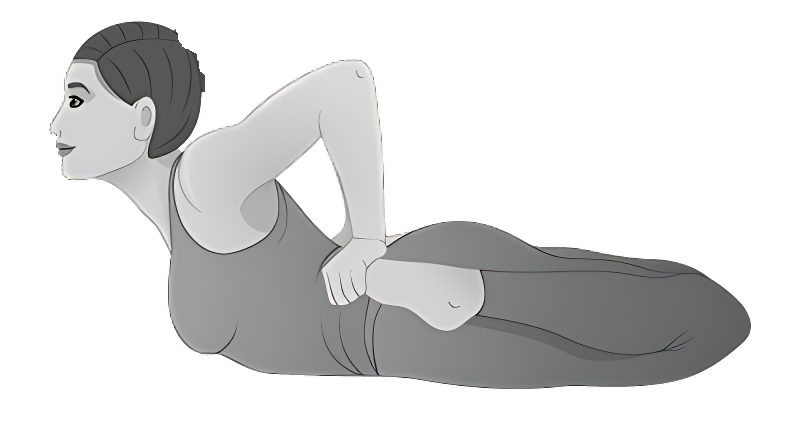
This asana derives its name from the frog-like shape of the body, with thighs externally rotated and hands pressing the feet toward the floor. Bhekasana is both therapeutic and strengthening, enhancing spinal flexibility, postural alignment, and emotional balance.
As a deep backbend, Bhekasana challenges the practitioner to combine strength, flexibility, and breath awareness, making it suitable for intermediate to advanced students.
2. Word Meaning and Definition
Word Meaning:
- Bheka: Frog
- Asana: Pose or posture
Definition:
Bhekasana is a prone posture in which the practitioner lies on the stomach, bends the knees, and reaches the hands backward to grasp the feet, pressing them toward the floor while lifting the chest. This position resembles a frog, with thighs externally rotated, legs flexed, and torso lifted, creating a strong anterior stretch.
Sanskrit Interpretation:
- “Bheka” symbolizes flexibility, groundedness, and the playful shape of the frog.
- “Asana” emphasizes stability and meditative focus in the posture.
- Bhekasana encourages strength, openness, and balanced energy flow, particularly through the anterior chain of the body.
3. Method of Practice – Step by Step
Step 1: Starting Position
- Begin in prone position (lying face down).
- Legs extended straight, arms relaxed by the sides, and forehead resting on the mat.
Step 2: Bend the Knees
- Inhale and slowly bend both knees, bringing heels toward the glutes.
- Keep thighs hip-width apart and aligned.
Step 3: Reach Back with Hands
- Extend arms backward, palms facing down.
- Reach for the feet, grasping the ankles firmly.
Step 4: Press Feet Toward the Floor
- Apply gentle downward pressure with the hands, bringing the tops of the feet toward the mat.
- Engage the quadriceps to assist in pressing the feet down.
Step 5: Lift the Chest
- Inhale deeply and lift the chest and head off the mat.
- Draw shoulder blades down and back, opening the chest fully.
Step 6: Hold the Pose
- Maintain steady, rhythmic breathing.
- Hold the posture for 20–40 seconds, gradually increasing with experience.
Step 7: Releasing the Pose
- Exhale and release the feet, extending the legs.
- Rest the forehead on the mat and arms alongside the body.
4. Alignment Cues
- Hands: Firmly grasp the ankles, applying even pressure.
- Shoulders: Draw scapulae down and back; avoid shrugging.
- Chest: Open forward and upward; avoid collapsing.
- Hips: Keep thighs hip-width apart and pressed toward the mat.
- Legs: Quadriceps engaged, knees hip-width apart.
- Feet: Tops of feet pressing gently toward the mat.
- Spine: Maintain smooth spinal extension without compression.
- Head/Neck: Neutral or slightly extended; gaze forward.
- Breath: Deep, rhythmic, coordinated with lifting and pressing movements.
5. Benefits of Bhekasana
- Spinal Flexibility:
- Deepens spinal extension, improving mobility of thoracic and lumbar regions.
- Hip Flexor Stretch:
- Lengthens psoas major, rectus femoris, and sartorius.
- Quadriceps Stretch:
- Enhances anterior thigh flexibility.
- Shoulder Opening:
- Strengthens deltoids and stretches anterior shoulder and chest muscles.
- Chest Expansion:
- Opens thoracic cavity, improving lung capacity and respiratory efficiency.
- Postural Improvement:
- Corrects forward-slumping posture by strengthening back muscles.
- Therapeutic Effects:
- Stimulates abdominal organs, aiding digestion and metabolism.
- Improves circulation and lymphatic drainage.
- Energetic Benefits:
- Opens Anahata (heart) chakra, fostering emotional openness and self-confidence.
6. Contraindications
- Knee injuries (especially ACL or meniscus issues)
- Shoulder or wrist injuries
- Lower back problems or herniated discs
- Neck injury
- Pregnancy (especially late stages)
- High or uncontrolled blood pressure
- Recent surgery in abdomen, spine, or lower limbs
7. Counterposes
- Balasana (Child’s Pose): Relieves spinal and anterior muscle tension.
- Matsyasana (Fish Pose): Balances spinal extension.
- Supta Matsyendrasana (Supine Spinal Twist): Neutralizes spinal rotation and stretch.
- Setu Bandhasana (Bridge Pose): Gently reverses hyperextension.
8. Preparatory Practices
- Bhujangasana (Cobra Pose): Prepares spine for extension.
- Salabhasana (Locust Pose): Strengthens back muscles.
- Dhanurasana (Bow Pose): Opens chest, hip flexors, and quadriceps.
- Ardha Bhekasana (Half Frog Pose): Gradual introduction to full foot grasp.
- Low Lunge (Anjaneyasana): Stretches hip flexors.
- Plank Pose: Strengthens core and shoulders for stability.
9. Modifications
- Strap Assistance: Loop a yoga strap around the feet if hands cannot reach.
- One Leg at a Time: Lift one leg first to gradually increase flexibility.
- Cushion Support: Place a folded blanket under hips or chest for comfort.
- Partial Lift: Lift chest only without pressing feet fully.
- Shorter Hold Duration: Beginners can hold for 10–15 seconds.
10. Muscles Involved
Primary Muscles:
- Quadriceps (knee extension and hip flexion)
- Hip flexors (iliopsoas, sartorius)
- Erector spinae (spinal extension)
- Deltoids (shoulder stabilization)
- Trapezius (scapular stabilization)
Secondary Muscles:
- Pectoralis major and minor (chest opening)
- Hamstrings (posterior thigh stretch in extension)
- Forearm flexors (grip and wrist stabilization)
- Obliques (core stabilization)
- Gluteus maximus and medius (hip stabilization)
11. Kinesiology and Kinematics
- Joints Involved:
- Spine: Thoracic and lumbar extension
- Hip: Flexion (lifted foot)
- Knee: Flexion
- Shoulder: Flexion, external rotation
- Elbow: Flexion
- Planes of Movement:
- Sagittal: Spinal extension and thoracic lift
- Frontal: Shoulder abduction slightly
- Transverse: Minimal rotation for symmetry
- Muscle Actions:
- Concentric: Erector spinae, glutes, deltoids
- Eccentric: Quadriceps and hip flexors
- Isometric: Core stabilizers, scapular stabilizers
12. Biomechanics and Functional Anatomy
- Spinal Mechanics:
- Lumbar and thoracic extension; anterior compression of vertebral discs avoided with proper lift.
- Hip Mechanics:
- External rotation and flexion of the thigh; stabilizes pelvis and lumbar spine.
- Shoulder Mechanics:
- Shoulder flexion and scapular retraction stabilize the upper body.
- Wrist/Elbow Mechanics:
- Weight-bearing stabilizes distal upper limbs; prevents hyperextension.
- Physiological Effects:
- Stimulates cardiovascular circulation, enhances proprioception, and improves breathing efficiency.
13. Functional Anatomy & Physiology
- Musculoskeletal System:
- Strengthens back extensors, quadriceps, shoulders, and core.
- Nervous System:
- Enhances proprioception, coordination, and body awareness.
- Respiratory System:
- Expands chest cavity, improving lung ventilation.
- Digestive System:
- Abdominal organ compression enhances digestion.
- Cardiovascular System:
- Mild anterior pressure promotes venous return.
- Energetic Effects:
- Opens heart chakra, fostering emotional and energetic balance.
14. Teaching and Adjustments
- Hands/Feet:
- Ensure secure grip; use strap if hands cannot reach.
- Shoulders:
- Draw scapula down and back; avoid shrugging.
- Pelvis:
- Engage glutes and quadriceps to lift hips without compressing lower back.
- Spine:
- Maintain smooth extension; avoid hyperextension or lumbar collapse.
- Neck:
- Neutral or slightly extended; gaze forward.
- Breathing:
- Inhale to lift, exhale to stabilize.
- Props:
- Blanket or block under pelvis or chest for beginners.
- Progression:
- Begin with partial lift or one leg, gradually advancing to full pose.
15. Variations
- Ardha Bhekasana (Half Frog Pose): Lift only one leg at a time.
- Strap-Assisted Bhekasana: For limited reach or shoulder flexibility.
- Cushion Support: Under chest or hips for beginners.
- Dynamic Flow: Alternate lift and release to increase mobility gradually.
16. Conclusion
Bhekasana is a deep anterior stretch and backbend that develops flexibility, strength, and postural awareness. Proper preparation, alignment, and gradual progression are essential to safely access its benefits. By integrating thoracic and lumbar extension, hip flexor and quadriceps stretch, and shoulder opening, Bhekasana promotes physical, physiological, and energetic balance.
With careful instruction, modifications, and consistent practice, this posture can enhance spinal health, respiratory efficiency, and emotional openness, making it a valuable addition to advanced yoga practice and teacher training curricula.
Question and with answers – Bhekasana
1. Meaning and Definition
- The literal meaning of Bhekasana is:
a) Frog Pose ✅
b) Bow Pose
c) Cobra Pose
d) Child’s Pose - “Bheka” in Sanskrit means:
a) Snake
b) Frog ✅
c) Bird
d) Bow - Bhekasana is primarily classified as a:
a) Forward bend
b) Lateral twist
c) Backbend ✅
d) Seated posture - The pose emphasizes:
a) Spinal flexion
b) Spinal extension and anterior stretch ✅
c) Only arm strengthening
d) Only leg balance - Bhekasana symbolizes:
a) Strength and stability
b) Flexibility and groundedness ✅
c) Forward movement
d) Meditation only
2. Method of Practice
- The starting position for Bhekasana is:
a) Supine
b) Prone ✅
c) Standing
d) Seated - Which part of the leg is grasped?
a) Foot/ankle ✅
b) Knee
c) Thigh
d) Calf - Chest and pelvis are lifted:
a) To increase anterior stretch ✅
b) Not lifted
c) Only pelvis
d) Only chest - Hand placement:
a) Palms on feet with fingers pointing toward toes ✅
b) Palms under chest
c) Palms on mat
d) Behind head - Duration for beginners:
a) 5–10 seconds
b) 20–40 seconds ✅
c) 1–2 minutes
d) 3–5 minutes
3. Alignment Cues
- Shoulders:
a) Shrugged
b) Drawn down and back ✅
c) Round forward
d) Compressed - Thighs:
a) Pressed toward the mat and hip-width apart ✅
b) Together and relaxed
c) Spread widely
d) Lifted off mat - Quadriceps:
a) Engaged ✅
b) Relaxed
c) Only left active
d) Only right active - Spine:
a) Smooth extension ✅
b) Compressed
c) Flexed
d) Rotated excessively - Neck:
a) Neutral or slightly extended ✅
b) Hyperflexed
c) Twisted
d) Not important
4. Muscles and Anatomy
- Primary muscles stretched:
a) Quadriceps, hip flexors, anterior chest ✅
b) Hamstrings only
c) Back only
d) Neck only - Secondary muscles involved:
a) Deltoids, trapezius, forearms ✅
b) Only calves
c) Only neck
d) Only glutes - Core muscles engaged:
a) Obliques and rectus abdominis ✅
b) Only lower back
c) Only hip flexors
d) Only chest - Shoulder stabilization involves:
a) Deltoids and trapezius ✅
b) Hamstrings
c) Quadriceps
d) Gastrocnemius - Posterior chain support:
a) Erector spinae and glutes ✅
b) Pectorals only
c) Neck only
d) None
5. Benefits
- Improves:
a) Spinal extension ✅
b) Forward bending only
c) Shoulder rotation only
d) Wrist strength only - Stretches:
a) Quadriceps, hip flexors, anterior torso ✅
b) Hamstrings only
c) Back only
d) Neck only - Respiratory benefit:
a) Expands thoracic cavity ✅
b) Restricts lung capacity
c) No effect
d) Only warms body - Digestive benefit:
a) Stimulates abdominal organs ✅
b) Slows digestion
c) No effect
d) Only relaxes intestines - Energetic benefit:
a) Opens heart chakra ✅
b) Opens root chakra only
c) Opens throat chakra only
d) No energetic effect
6. Contraindications
- Avoid Bhekasana in case of:
a) Knee injury ✅
b) Mild fatigue
c) Light stretching
d) Daily walking - Shoulder injury:
a) Safe
b) Contraindicated ✅
c) Optional
d) Encouraged - Lower back injury:
a) Safe
b) Contraindicated ✅
c) Optional
d) Encouraged - Pregnancy:
a) Late stages—avoid ✅
b) Safe
c) Encourage full lift
d) No modification needed - High blood pressure:
a) Safe
b) Practice cautiously ✅
c) Encouraged
d) No effect
7. Counterposes and Preparatory Asanas
- Recommended counterpose:
a) Child’s Pose (Balasana) ✅
b) Cobra
c) Plank
d) Locust - Preparatory asanas:
a) Bhujangasana, Salabhasana, Dhanurasana ✅
b) Standing Forward Bend only
c) Sukhasana
d) Sirsasana - Beginner modification:
a) Use strap for feet ✅
b) Full lift immediately
c) Wall support not needed
d) Only twist torso - Core strengthening prep:
a) Plank ✅
b) Tadasana
c) Balasana
d) Savasana - Hip flexibility prep:
a) Low Lunge (Anjaneyasana) ✅
b) Mountain Pose
c) Seated Twist
d) Tree Pose
8. Teaching and Adjustments
- Hand/foot grip:
a) Secure grasp; strap optional ✅
b) Loose grip
c) Only one hand
d) Not needed - Shoulder cue:
a) Draw scapula down/back ✅
b) Shrug shoulders
c) Round forward
d) Compress chest - Pelvis cue:
a) Engage glutes and quadriceps ✅
b) Relax
c) Lift only chest
d) Rotate forward - Spine cue:
a) Smooth extension ✅
b) Compress lumbar
c) Hyperflex
d) Twist excessively - Neck cue:
a) Neutral or slightly extended ✅
b) Hyperextended
c) Flexed
d) Twisted - Breath cue:
a) Inhale to lift, exhale to stabilize ✅
b) Hold breath
c) Shallow rapid
d) Exhale to lift - Hold duration for beginners:
a) 20–40 seconds ✅
b) 1–2 minutes
c) 5–10 minutes
d) 5 seconds - Leg engagement:
a) Quadriceps active ✅
b) Relaxed
c) Only calves active
d) Knees flexed - Prop assistance:
a) Strap or blanket ✅
b) Only chair
c) Only block
d) Not allowed
9. Variations
- Ardha Bhekasana:
a) One leg at a time ✅
b) Both legs full
c) Hands under head
d) Wall support - Strap-assisted:
a) For limited flexibility ✅
b) Only for advanced
c) Dangerous
d) Optional - Chest support variation:
a) Blanket under chest ✅
b) Only feet support
c) Only head
d) Only knees - Dynamic flow:
a) Alternate lift and release ✅
b) Static only
c) Only lift legs
d) Only lift torso - Shortened hold:
a) Helpful for beginners ✅
b) Only for advanced
c) Dangerous
d) Not recommended - Counterposes post-Bhekasana:
a) Child’s Pose, Supta Matsyendrasana ✅
b) Plank
c) Dhanurasana
d) Headstand
Answer Key
- a
- b
- c
- b
- b
- b
- a
- a
- a
- b
- b
- a
- a
- a
- a
- a
- a
- a
- a
- a
- a
- a
- a
- a
- a
- a
- b
- b
- a
- b
- a
- a
- a
- a
- a
- a
- a
- a
- a
- a
- a
- a
- a
- a
- a
- a
- a
- a
- a
- a