
Ardha Uttanasana(Standing Half Forward Bend Pose)
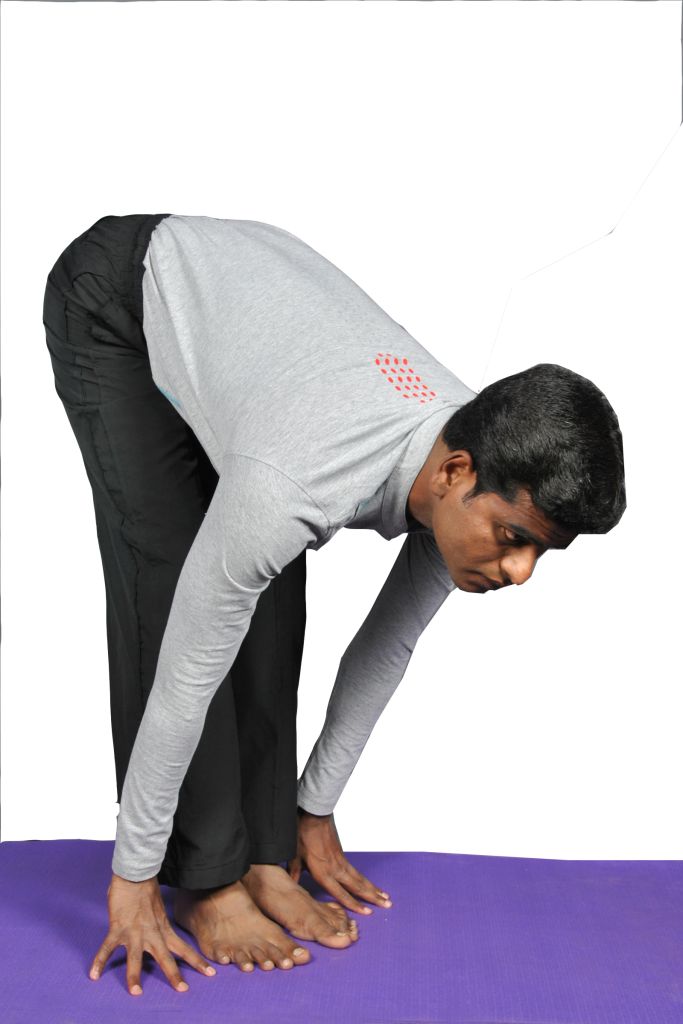
Ardha Uttanasana(Standing Half Forward Bend Pose) This is the half standing half forward bend. Start in Tadasana. From there fold forward completely from the lower back until you can touch your forehead to your legs in Uttanasana. From here rise up half way on an inhale, until your back is flat and parallel to the ground. You can balance on your fingertips here. Then exhale and return to your full forward fold. Precaution: Back concerns Late pregnancy Glaucoma Cardiac Problem Benefits: Strengthens and stretches the spinal muscles. Lengthens and stretches the hamstrings and opens the posterior of the hips. Stimulates the stomach, intestine, liver, spleen, and kidneys. Helps preventing constipation and menstrual problems. Improves digestion. Enhances blood flow to the head region.
Vrksasana(tree pose)
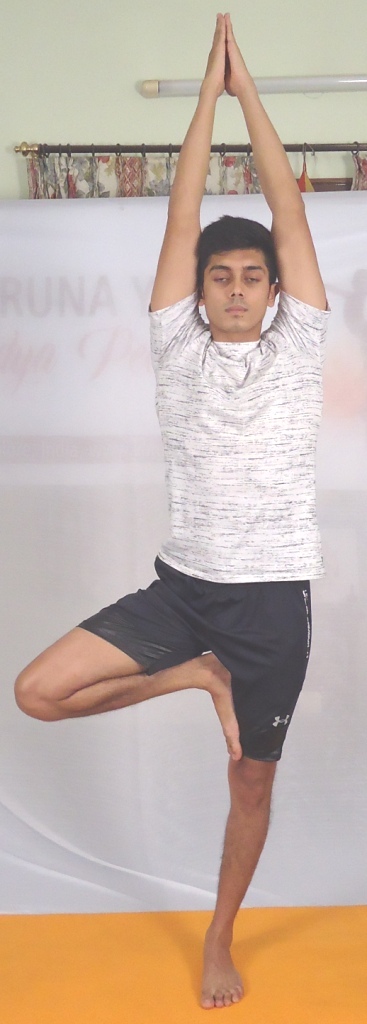
Vrksasana(Tree Pose) This is the tree pose. You must stand straight and erect. Your hands must be locked straight by your sides, your heels and big toes of your feet touching each other. Now bend the right knee and bring the right foot and place it in the left inner thigh. Now, make sure your right knee is pointing outwards with your foot pointing downwards. You are bearing your weight evenly on the left foot. Make sure your hips are pointing forwards and raise your hands over your head, keeping your elbows locked straight on either side of your ears. Stay like this for thirty seconds breathing easily. Then relax and return to Tadasana. Precaution: High blood pressure. Students with this condition should refrain from lifting the arms overhead. Benefits: Builds concentration, focus, and postural balance. Reduces stress, it is nearly impossible to worry and remain balanced at the same time. Develops strength and stability in the feet and ankles. Stabilizes and strengthens both superficial and deep hip muscles. Removes fatigue of legs.
Tadasana (Mountain Pose or Palm Tree Pose)
This is the mountain pose. You must stand straight and erect. Your hands must be locked straight by your sides, your heels and big toes of your feet touching each other. Your weight is equally distributed across your feet and your knee caps are pulled up as your knees are tightened and your hips contracted. Your spine is straight and your neck is straight. Now raise your hands over your head, keeping your elbows locked straight on either side of your ears. Stay like this for thirty seconds breathing easily. Then relax and return to Tadasana. Precaution: No precaution for this pose. Benefits: Align whole body evenly both left and right side of body. Remove lower back pain and reduces breathing rate, improves lungs holding capacity. Strengthen ankle, knee, hip, spine and shoulder joints. Concentration and calmness in mind.
Samasthiti (Equal Standing Pose or Upright Pose)
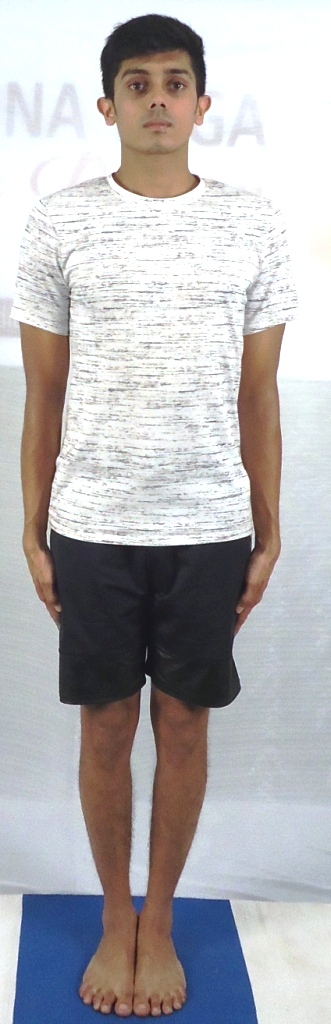
This is the upright pose. You must stand straight and erect. Your hands must be locked straight by your sides, your heels and big toes of your feet touching each other. Your weight is equally distributed across your feet and your knee caps are pulled up as your knees are tightened and your hips contracted. Your spine is straight and your neck is straight. Stay here breathing easily. Precaution: No precaution. Benefits: Builds symmetry and balance in body alignment and overall posture. Tones the lower extremities. Strengthens the arches. Improves strength in the spinal and abdominal musculature. Improves overall posture. Align whole body evenly both left and right side of body. Remove lower back pain and reduces breathing rate, improves lungs holding capacity. Strengthen ankle, knee, hip, spine and shoulder joints. Concentration and calmness in mind.
YOGA FOR KNEE PAIN (OSTEO-ARTHRITIS)
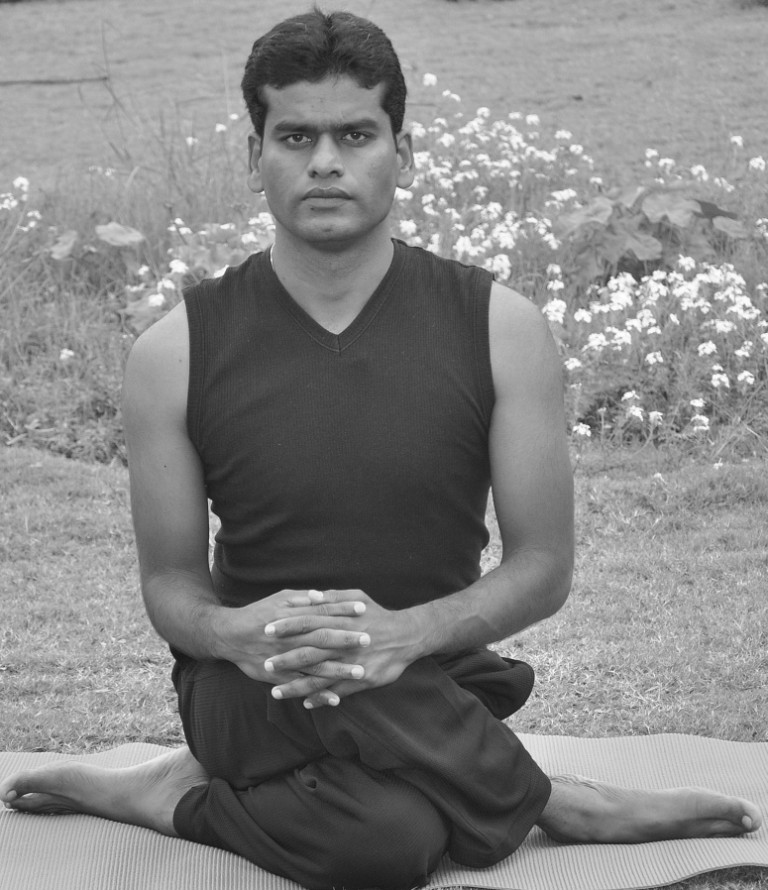
Knee Pain Techniques Toe Bending (forward & backward) Ankle bending (forward & backward) Ankle Rotation (clockwise & anti-clockwise) Knee bending & straightening Knee Rotation (clockwise & anti-clockwise) Knee Cap loosening & tightening Knee cap passive rotation (forward, backward, right side, left side, clockwise & anti-clockwise) Half Butterfly Full Butterfly Savasana 1. Toe Bending (forward & backward)
Karuna Yoga Vidya Peetham
Karuna Yoga Vidya Peetham’s Advanced Teacher Training program is designed for those students who have completed an approved 200 Hour Teacher Training as designated by the Yoga Alliance, USA. The 300-Hour advanced yoga teacher training course builds upon the fundamental concepts taught in the 200-hour course and deepens your understanding and practice. The 300 Hour Yoga Teacher Training Course in Bangalore, India prepares you to teach yoga principles, methods, alignment, modifications and techniques that are more advanced than those in the 200-hour course. In the 300-hour program we concentrate on the art of teaching yoga, the sequencing of yoga classes based on multi-style yoga. It includes Vinyasa, Hatha, Ashtanga, Gentle & Yin yoga, alignment & adjustments, and the healing aspect of yoga. This is a second level of training which allows you to advance your yoga teaching skills and become an expert in many teaching styles for many different kinds of students. Our experienced teachers will train you in several aspects of Yoga: starting from asanas, pranayama, mudra, bandha, shatkarma, dharana, pratyahara & dhayana. You will be taken through the art of designing yoga classes, to functional anatomy, physiology, kinesiology, biomechanics and yoga philosophy. There will be a focus on practicals and teaching methodology. As our groups are small you will have an opportunity to teach a lot, and improve your practical skills. We give each of our students personal care and constant feedback. Our aim is to prepare you to be an independent, wise and flexible teacher who is able to customize a class to every client, even the most challenging one. We also train you to take classes for students with special needs and health issues.
Astavakrasana (Eight-Angle Pose)
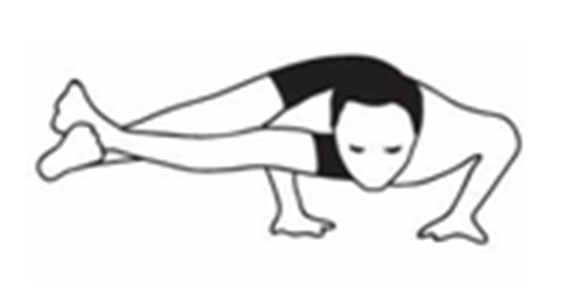
This is the eight angle pose. Start by sitting on the mat with your legs stretched out in front of you. Place your hands on the mat beside the hips with your palms facing down on the mat and move your shoulder blades down closer to the chest. Bend the right knee and place it on the upper right arm, using your right hand. Your left leg is stretched out on the floor. Now draw the left heel towards the groin as you lock the left foot with the right. Inhale and press your palms into the floor. As you straighten the arms your body will lift off the floor. While breathing easily straighten the legs with the feet still locked. The legs will be pointing to the right. Your arms are bent like in the staff pose. Breathe easily for about thirty seconds and then slowly move out of the pose. Precaution: Should not be attempted until the arms and shoulders have become very strong. People with heart ailments, high blood pressure, back conditions or problems in the hips. Benefits: Strengthens the wrists and arms and also develops the muscles of the abdomen. It strengthens the wrists, the arm and leg muscles, and the muscles of the abdomen.
Padma Mayurasana (Lotus Peacock Pose)
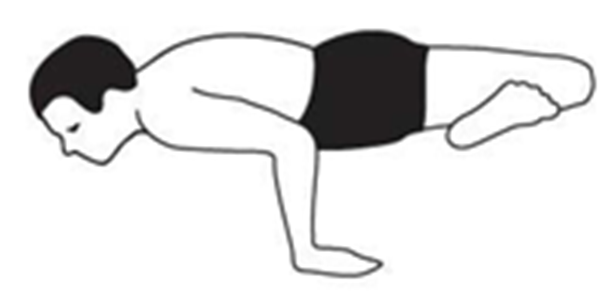
This is the lotus peacock pose. Sit in padmasana and then balance on the knees. Place the palms on the floor facing backwards so the fingers point towards the lower body. Bend the elbows and bring them closer together. Then lean forward and push the elbows against the abdomen. Lean forward and balance the whole body on the arms, the chest resting on the upper arms. Now stay here for thirty seconds, breathing easily. Then come out of the pose and relax. Precaution: People suffering from peptic or duodenal ulcers, hyperacidity, hernia or high blood pressure should not practice this asana. Pregnant women are strictly advised not to attempt this asana. Benefits: Tones the abdominal region of the body, because due to the pressure of the elbows against the abdominal aorta, blood circulates properly in the abdominal organs. This improves digestive power and prevents the accumulation of toxins in the system. It develops and strengthens the elbows, forearms and wrists.
Mayurasana(Peacock Pose)
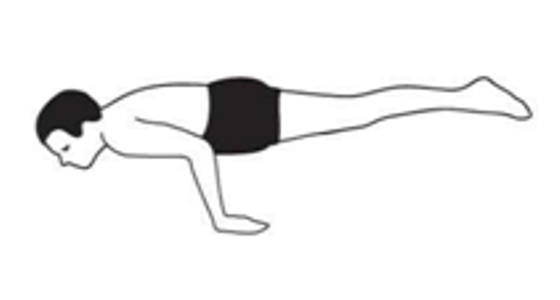
This is the peacock pose. Kneel on the floor with a small space between the knees. Bend forward and place the palms backwards on the floor so the fingers point towards the toes. Bend the elbows and get the forearms close together. Rest the chest on the backs of the upper arms. Now exhale and stretch the legs out and straighten them so the entire weight of the body is balanced on the arms. Breathe easily here for about thirty seconds. Then lower back down and rest. Precaution: People suffering from peptic or duodenal ulcers, hyperacidity, hernia or high blood pressure should not practice this asana. Pregnant women are strictly advised not to attempt this asana. Benefits: Tones the abdominal region of the body, because due to the pressure of the elbows against the abdominal aorta, blood circulates properly in the abdominal organs. This improves digestive power and prevents the accumulation of toxins in the system. It develops and strengthens the elbows, forearms and wrists.
Bakasana(Crane or Crow Pose)
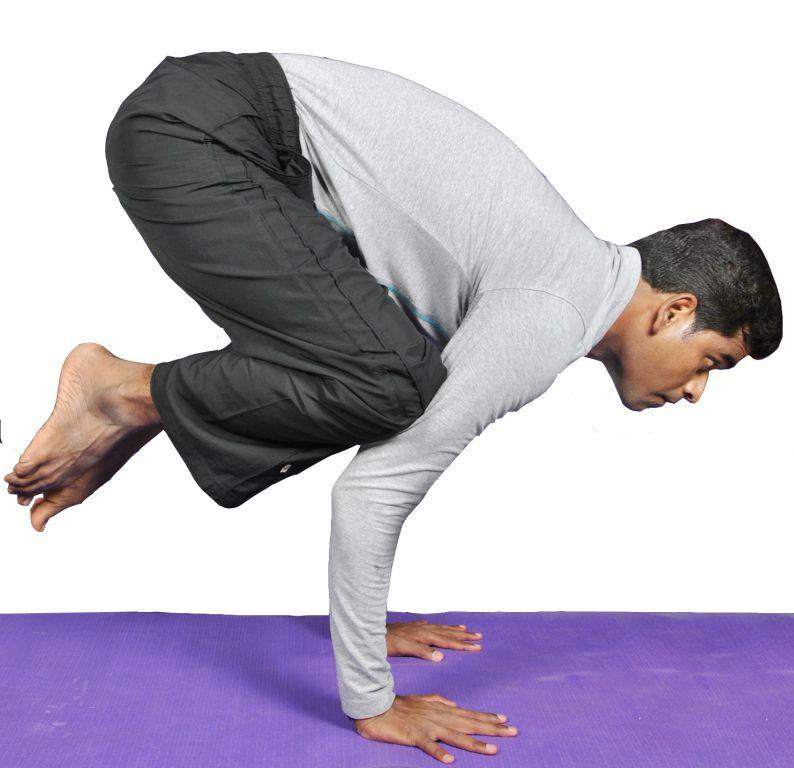
This is the crane pose. Start by squatting on the floor with your hands place on front of the body, your feet together and heels on the floor. Widen the knees and rise up on your toes. Bend the elbows, place the bent knees into the arms with the shins on the backs of the upper arms near the armpits. Contract the abdomen to rise off the floor. Balance the entire body on the hands. Stay here breathing easily for thirty seconds. Then lower back down onto your feet and relax. Precaution: People with high blood pressure, heart disease or cerebral thrombosis, Wrist injury should not attempt this practice. Benefits: Strengthens the arms and wrists. Strengthens the abdominal muscles. Stretches the low back. Develops the sense of physical balance.