
1. Introduction
Yoga postures (asanas) are designed to integrate strength, flexibility, and mindfulness. Among lateral bending postures, Ardhakati Cakrasana, known as Half Side Wheel Pose, stands out for enhancing spinal mobility, lateral flexibility, and muscular balance.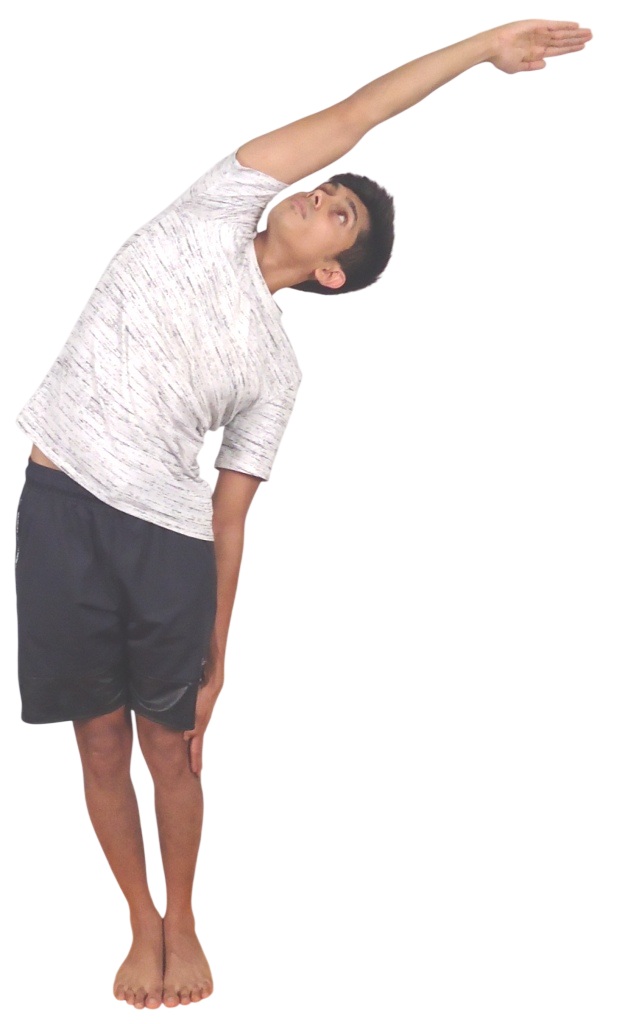
This asana is a standing lateral bend that opens the intercostal muscles, obliques, and shoulders while simultaneously engaging core, legs, and stabilizing muscles. Regular practice improves posture, balance, respiratory capacity, and mental focus, making it a vital pose in Hatha Yoga and vinyasa sequences.
2. Word Meaning and Etymology
The Sanskrit name Ardhakati Cakrasana is composed of:
- Ardha – Half
- Kati – Waist or side
- Cakra – Wheel or circular movement
- Asana – Pose
Thus, Ardhakati Cakrasana translates to “Half Side Wheel Pose”, indicating a half lateral bend of the waist resembling a wheel. The pose symbolizes flow, flexibility, and expansion, reflecting the circular motion of energy in the body.
3. Definition of Ardhakati Cakrasana
Ardhakati Cakrasana is a standing lateral bend asana that:
- Involves spinal lateral flexion
- Opens thoracic cage and intercostal muscles
- Engages core, obliques, shoulders, and legs
- Improves balance and coordination
Classical Definition:
Ardhakati Cakrasana is a yoga posture characterized by standing on one or both feet while bending laterally from the waist, stretching the side body, and maintaining balance with grounded feet and an extended arm.
4. Method of Practice: Step by Step
Step 1: Starting Position
- Stand in Tadasana (Mountain Pose) with feet hip-width apart.
- Distribute weight evenly across both feet.
- Engage quadriceps and lift kneecaps lightly.
Step 2: Prepare the Arms
- Raise the right arm overhead in line with the ear.
- Keep the left arm relaxed at the side or resting on the waist.
Step 3: Lateral Bend
- Inhale deeply, then exhale and bend to the left from the waist.
- Extend the right arm overhead and reach to the left side, creating a lateral stretch.
Step 4: Alignment
- Keep feet firmly grounded.
- Lengthen both sides of the torso to prevent compression.
- Engage the core muscles to support the spine.
Step 5: Breathing and Hold
- Maintain the pose for 15–30 seconds, breathing smoothly and evenly.
- Feel the stretch along the obliques, intercostals, and shoulders.
Step 6: Return and Repeat
- Inhale and slowly return to Tadasana.
- Repeat on the opposite side for bilateral symmetry.
5. Alignment Cues
- Feet: Grounded, hip-width apart, evenly distributing weight.
- Knees: Slightly flexed or straight; avoid locking.
- Hips: Keep aligned; avoid twisting forward.
- Spine: Lengthened, lateral bend without compressing ribs.
- Arms: One overhead, reaching fully; opposite arm stabilizing.
- Head & Neck: Neutral, following the line of the spine.
6. Benefits of Ardhakati Cakrasana
Physical Benefits:
- Improves lateral flexibility of the spine and thoracic mobility.
- Stretches intercostal muscles, obliques, shoulders, and latissimus dorsi.
- Strengthens core, back muscles, and quadriceps.
- Enhances balance, coordination, and posture.
Mental Benefits:
- Cultivates focus, awareness, and mindfulness.
- Reduces mental stress through controlled breathing and lateral extension.
Physiological Benefits:
- Expands lungs, improving respiratory capacity.
- Stimulates digestive organs, aiding digestion.
- Promotes circulation along the lateral torso.
7. Contraindications
- Spinal injuries: Avoid if experiencing disc issues or vertebral instability.
- Shoulder injuries: Modify or keep arm lower.
- Low blood pressure or dizziness: Bend slowly; avoid rapid lateral shifts.
- Pregnancy: Avoid deep lateral bends, especially in later trimesters.
- Sciatica or lower back pain: Practice cautiously with micro-bend in knees.
8. Counterpose
After Ardhakati Cakrasana, suitable counterposes include:
- Tadasana (Mountain Pose) – resets posture.
- Paschimottanasana (Seated Forward Bend) – stretches the back and spine in the opposite direction.
- Adho Mukha Svanasana (Downward Dog) – releases tension along lateral muscles.
9. Preparatory Practice
Preparatory poses to enhance flexibility and safety in Ardhakati Cakrasana include:
- Tadasana (Mountain Pose) – for grounding and alignment.
- Vrksasana (Tree Pose) – improves balance and stabilizes legs.
- Trikonasana (Triangle Pose) – familiarizes lateral stretch and spinal extension.
- Side stretches with arms raised – loosens intercostals and obliques.
- Cat-Cow (Marjaryasana-Bitilasana) – warms up the spine and mobilizes vertebrae.
10. Modifications
- Beginner: Keep elbow bent slightly, reduce lateral bend, or rest hand on hip.
- Intermediate: Fully extend the arm overhead, focus on elongation of the spine.
- Advanced: Combine with a gentle backbend, reaching overhead while bending laterally.
- Pregnancy or limited mobility: Bend minimally and avoid twisting; maintain core engagement.
11. Muscles Involved
Primary Muscles Stretched:
- Obliques (internal and external)
- Latissimus dorsi
- Intercostal muscles
- Quadratus lumborum
- Shoulder abductors
Primary Muscles Engaged:
- Core muscles: rectus abdominis, transverse abdominis, obliques
- Gluteus medius and minimus (stability)
- Quadriceps (stabilizing lower body)
- Deltoids (raising and holding arm)
Secondary Muscles:
- Spinal erectors (for lateral support)
- Foot and ankle stabilizers
- Neck extensors (maintaining head alignment)
12. Kinesiology
- Spinal joints: Lateral flexion, mild rotation if reaching overhead.
- Hip joints: Stabilization; slight abduction for balance.
- Shoulder joint: Flexion and abduction of raised arm.
- Knee joint: Slight flexion to maintain balance.
- Ankle joint: Plantarflexion or dorsiflexion for stability.
13. Kinematics
- Weight distribution: Centered over feet, slight shift away from bending side.
- Range of Motion (ROM):
- Spinal lateral flexion: 15–30°
- Shoulder flexion: 150°
- Hip stabilization: 0–10° abduction
- Center of Mass: Shifts slightly opposite to lateral bend, maintained by core.
14. Biomechanism
- Lever mechanics: The torso acts as a lever over the spine; raised arm as a counterbalance.
- Torque generation: Core muscles prevent excessive lateral compression.
- Balance mechanics: Ankle, knee, and hip stabilizers maintain base.
- Stretch-tension relationship: Obliques and intercostals undergo eccentric stretch while opposite muscles contract isometrically.
15. Functional Anatomy & Physiology
- Musculoskeletal function: Strengthens lateral torso muscles and stabilizers; improves flexibility.
- Neuromuscular coordination: Enhances proprioception, postural control, and balance.
- Circulatory effects: Improves blood flow along lateral body; mild stimulation of abdominal organs.
- Respiratory effects: Expands intercostal muscles, enhancing diaphragmatic breathing.
- Neurological effects: Activates parasympathetic system for relaxation and mental clarity.
16. How to Correct and Adjust While Teaching
Common Errors & Corrections:
- Collapsed torso: Cue elongation of spine; keep ribs lifted.
- Twisted hips: Encourage pelvis alignment; keep hips square.
- Locked knees: Micro-bend to prevent strain.
- Shoulder tension: Relax shoulders; lift through fingertips.
- Weight shift to feet improperly: Cue even grounding; engage core.
Hands-on Adjustments:
- Stabilize pelvis and lower spine.
- Guide raised arm to proper alignment.
- Support lateral stretch by pressing gently on ribs or oblique.
Verbal Cues:
- “Lift the crown of your head, lengthen your side body.”
- “Press your feet evenly into the mat, engage your core.”
- “Reach through the fingertips, but avoid collapsing your ribs.”
17. Conclusion
Ardhakati Cakrasana, the Half Side Wheel Pose, is a lateral bending standing asana that integrates strength, flexibility, balance, and mindfulness. It stretches the obliques, intercostals, shoulders, and spine while strengthening core, legs, and stabilizers.
Understanding alignment, muscles involved, biomechanical principles, and preparatory modifications ensures safe and effective practice. With consistent practice, Ardhakati Cakrasana enhances postural stability, lateral flexibility, respiratory capacity, and mental focus, embodying the holistic principles of yoga.
QUESTION AND ANSWER
1. Basic Knowledge
- The Sanskrit meaning of Ardhakati Cakrasana is:
A) Full Wheel Pose
B) Half Side Wheel Pose ✅
C) Garland Pose
D) Triangle Pose - Ardhakati Cakrasana primarily involves:
A) Forward bending
B) Lateral bending ✅
C) Twisting
D) Inversion - The pose is classified as a:
A) Standing lateral bend ✅
B) Supine backbend
C) Seated twist
D) Inversion - The raised arm in Ardhakati Cakrasana serves to:
A) Stabilize the spine
B) Enhance lateral stretch ✅
C) Compress the ribs
D) Rotate the pelvis
2. Alignment & Technique
- The feet in Ardhakati Cakrasana should be:
A) Hip-width apart, grounded ✅
B) Close together
C) Crossed
D) One in front of the other - Knee alignment:
A) Locked
B) Slightly bent for stability ✅
C) Hyperextended
D) Folded inward - Spinal alignment:
A) Lateral bend with elongation ✅
B) Rounded forward
C) Twisted
D) Compressed - Common alignment cue for hips:
A) Keep squared and stable ✅
B) Rotate forward
C) Tilt backward
D) Lift off floor
3. Muscles Involved
- Primary muscles stretched in Ardhakati Cakrasana:
A) Obliques, intercostals, latissimus dorsi ✅
B) Biceps
C) Quadriceps only
D) Pectorals - Primary muscles engaged for stability:
A) Core (rectus abdominis, obliques, transverse abdominis) ✅
B) Forearm flexors
C) Neck extensors only
D) Hamstrings only - Secondary muscles involved:
A) Quadriceps, gluteus medius, shoulder stabilizers ✅
B) Triceps
C) Wrist extensors only
D) Pectorals - Shoulder muscles engaged:
A) Deltoids and rotator cuff ✅
B) Forearms only
C) Neck flexors
D) Hamstrings
4. Kinesiology & Biomechanics
- Ardhakati Cakrasana involves which primary joint action?
A) Spinal lateral flexion ✅
B) Shoulder extension only
C) Hip flexion only
D) Knee extension only - Shoulder joint action:
A) Abduction and flexion ✅
B) Internal rotation only
C) Extension only
D) No action - The pose is classified as:
A) Open kinetic chain
B) Closed kinetic chain ✅
C) Plyometric
D) Passive stretch - Center of mass shifts:
A) Opposite the lateral bend ✅
B) Forward
C) Backward
D) No shift
5. Benefits
- Physical benefits include:
A) Lateral spine flexibility, oblique stretch, shoulder mobility ✅
B) Only arm strengthening
C) Vision improvement
D) Arm hypertrophy only - Mental benefits include:
A) Focus, mindfulness, stress reduction ✅
B) Increases anxiety
C) Reduces attention
D) Only physical benefits - Physiological benefits:
A) Expands lungs and improves respiration ✅
B) Compresses ribcage
C) Weakens core
D) Reduces circulation - Digestive benefits:
A) Stimulates abdominal organs through lateral stretch ✅
B) Compresses spine only
C) Reduces metabolism
D) None
6. Contraindications
- Ardhakati Cakrasana should be avoided in:
A) Spinal injuries ✅
B) Healthy spine
C) Normal flexibility
D) Good balance - Shoulder injuries:
A) Modify arm position or avoid deep stretch ✅
B) Extend fully regardless
C) Compress shoulder
D) Cross arms - Pregnant women:
A) Avoid deep lateral bends, modify with minimal stretch ✅
B) Full lateral bend
C) Twisting allowed
D) No modification needed - People with dizziness or low blood pressure should:
A) Bend slowly, avoid sudden lateral movement ✅
B) Jump into lateral bend
C) Close eyes
D) Lean backward
7. Preparatory & Counter Poses
- Preparatory poses:
A) Tadasana, Trikonasana, Side Stretches ✅
B) Shoulderstand only
C) Forward bends only
D) Downward Dog only - Counterposes after Ardhakati Cakrasana:
A) Tadasana, Paschimottanasana ✅
B) Another lateral bend
C) Standing jump
D) Shoulderstand
8. Modifications
- Beginner modification:
A) Slight lateral bend, elbow bent, arm resting on waist ✅
B) Full lateral bend immediately
C) Twist torso fully
D) Lift heels - Intermediate variation:
A) Arm extended fully overhead, reach through fingertips ✅
B) Keep arm down
C) Fold torso forward
D) Side plank only - Advanced variation:
A) Combine lateral bend with gentle backbend ✅
B) Keep neutral torso only
C) Fold torso forward
D) Arms crossed
9. Teaching & Adjustments
- Common error: torso collapsing. Correction:
A) Cue elongation and lift ribs ✅
B) Compress ribs
C) Fold knees
D) Lift opposite hip - Hips twisting forward:
A) Cue pelvis alignment, hips squared ✅
B) Encourage twist
C) Lean forward
D) Lift heels - Locked knees:
A) Micro-bend for safety ✅
B) Force straight
C) Hyperextend
D) Cross legs - Shoulder tension:
A) Relax shoulders, lift through fingertips ✅
B) Shrug shoulders
C) Rotate arms backward
D) Lock elbows
10. Functional Anatomy & Physiology
- Primary muscles stretched:
A) Obliques, intercostals, latissimus dorsi ✅
B) Quadriceps only
C) Pectorals
D) Neck flexors - Core muscles activated:
A) Rectus abdominis, obliques, transverse abdominis ✅
B) Forearms only
C) Trapezius
D) Deltoids - Neurological effect:
A) Improves proprioception, balance, lateral awareness ✅
B) Reduces vision
C) Stimulates hearing
D) None - Respiratory effect:
A) Expands intercostals, improves breathing ✅
B) Restricts lung expansion
C) Shallow breathing
D) None - Joint stabilization occurs primarily at:
A) Ankles, knees, hips, shoulders ✅
B) Elbows only
C) Wrists only
D) Neck only