
1. Word Meaning & Etymology
The Sanskrit term Ardha Uttānāsana comes from:
- Ardha = half, partial, incomplete
- Uttāna = intense stretch
- Ut = upward or intense
- Tan = to extend, stretch, lengthen
- Āsana = posture or seat
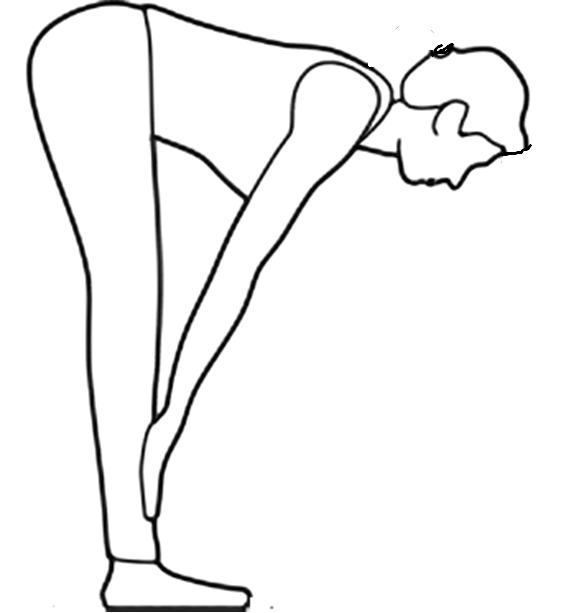
Thus, Ardha Uttānāsana translates to:
“The Half Intense Stretch Pose”
or
“Half Standing Forward Bend”
It is often practiced in Vinyāsa transitions, Sun Salutations, and alignment-based Hatha sequences as a reset posture that lengthens the spine, activates the core, and organizes neuromuscular alignment.
2. Definition
Ardha Uttānāsana is a standing half-forward bend where the spine is held in a long, neutral or slightly extended position, the chest lifts forward, and the legs remain straight or slightly bent. It integrates:
- Hip flexion
- Spinal axial elongation
- Lengthening of the posterior chain
- Isometric activation of the back muscles
- Engagement of the core
- Proprioceptive correction of posture
It is both:
- A transitional pose (common in Surya Namaskar)
- A standalone posture for correcting postural misalignment and improving spinal organization
3. Method of Practice — Step-by-Step
Starting Position
Stand in Tāḍāsana, feet hip-width or together, grounded evenly.
Step 1 — Forward Fold Entry
- Exhale and fold at the hips (not waist).
- Maintain neutral spine entry.
- Place fingertips or palms on the floor or shins.
Step 2 — Prepare the Base
- Distribute weight evenly across all four corners of the feet.
- Slightly bend the knees if hamstrings are tight.
- Activate quadriceps to stabilize legs.
Step 3 — Lengthen the Spine
- Inhale and extend the spine forward.
- Lift chest away from the pelvis.
- Move sternum forward, tailbone back.
Step 4 — Hands Placement Options
- Fingertips on floor beside feet
- Palms on shins
- Blocks under hands
- Hands to thighs (beginners)
- Hands on a chair/table (therapeutic version)
Step 5 — Align the Torso
- Keep neck in line with spine.
- Draw shoulder blades toward the spine and slightly downward.
- Broaden collarbones.
Step 6 — Activate Core & Legs
- Slightly draw navel inward for stability.
- Engage quadriceps to liberate hamstrings.
- Maintain hip creases deep and long.
Step 7 — Final Posture
Stay for 5–10 breaths, maintaining:
- Spinal length
- Stable legs
- Even breath
- Balanced weight distribution
Step 8 — Exit
Exhale to fold deeper into Uttanāsana, or inhale to rise to Tāḍāsana.
4. Alignment Cues (Professional TTC Level)
Feet & Legs
- Press all four corners of feet; avoid collapsing arches.
- Internally rotate thighs slightly to widen sacrum.
- Lift kneecaps by engaging quadriceps.
Hips
- Fold from hip joints, not from lumbar spine.
- Keep pelvis neutral or slightly anteriorly tilted.
- Avoid over-tucking or hyper-arching.
Spine
- Lengthen from sacrum to crown.
- Maintain lumbar-natural curve.
- Avoid rounding (flexion) or collapsing chest.
Shoulders & Chest
- Draw scapulae gently toward spine.
- Broaden clavicles.
- Avoid shrugging shoulders.
Neck & Head
- Keep neck long, gaze down.
- Avoid hyperextending or dropping head too much.
Breath
- Inhale to lengthen spine.
- Exhale to deepen fold while maintaining alignment.
5. Benefits
Physical Benefits
- Lengthens posterior kinetic chain (hamstrings, calves, back extensors)
- Improves spinal alignment and posture
- Strengthens back and core muscles isometrically
- Opens chest and improves breathing patterns
- Enhances proprioception and neuromuscular coordination
- Reduces compression in lumbar spine
- Relieves tension in neck and shoulders
Functional / Lifestyle Benefits
- Improves forward-bending mechanics (daily movements)
- Assists people with prolonged sitting patterns
- Enhances standing posture awareness
Physiological Benefits
- Promotes circulation throughout legs and pelvis
- Stimulates abdominal organs in the extended version
- Enhances diaphragm movement
Energetic Benefits
- Balances Apana Vayu (downward-moving energy)
- Activates Prana Vayu through expansion of chest
- Stabilizes Muladhara and Manipura chakras
Mental & Emotional Benefits
- Enhances grounding
- Improves focus and mental clarity
- Reduces mental fatigue
- Induces mindful awareness of posture
6. Contraindications
Absolute Contraindications
- Acute lower back pain
- Severe herniated disc
- Recent abdominal surgery
- Severe hamstring injury
- Vertigo during bending
Relative / Moderate Contraindications
- High blood pressure (avoid holding breath)
- Sciatica (modify knee bend, avoid overstretching)
- Pregnancy (avoid deep forward folds)
- Knee instability (keep micro-bend)
- Wrist issues (use shins/blocks)
Cautions
- Avoid hyperextending knee joints
- Avoid rounding back due to hamstring tightness
- Maintain neutral spinal alignment throughout
7. Counterposes
These poses balance the effects of Ardha Uttanasana:
- Tadasana
- Bhujangasana
- Shalabhasana
- Anjaneyasana
- Supta Baddha Konasana
- Ardha Chakrasana
- Setu Bandhasana
Counterposes focus on:
- Back extension
- Hip opening
- Spinal neutralization
8. Preparatory Practices
Warm-up Movements
- Cat–Cow (Marjaryasana–Bitilasana)
- Dynamic hamstring stretches
- Pelvic tilts
- Standing hip hinges
Preparatory Asanas
- Uttanasana
- Prasarita Padottanasana
- Adho Mukha Svanasana
- Supta Padangusthasana
- Apanasana
- Ardha Chandrasana
These prepare spine, core, hips, and hamstrings.
9. Modifications & Variations
For Beginners
- Hands on blocks
- Slightly bent knees
- Wider stance
- Use wall support
For Limited Mobility
- Hands on chair or table
- Reduce angle of hip flexion
- Keep spine extended rather than deep folding
For Advanced Practitioners
- Hands on floor with straight legs
- Arms extended forward (shoulder-height)
- Full neutral spine control
Special-Therapeutic Modifications
- For back pain: micro-bend knees + hands on thighs
- For sciatica: avoid overstretching hamstrings
- For pregnancy: widen stance
10. Muscles Involved (Primary & Secondary)
Prime Movers & Active Muscles
Lower Body
- Hamstrings (lengthening)
- Gastrocnemius & Soleus (lengthening)
- Quadriceps (active knee extension)
- Gluteus maximus (eccentric control)
- Hip flexors (maintain hip crease)
Spine & Core
- Erector spinae (isometric extension)
- Multifidus
- Transverse abdominis
- Rectus abdominis (mild engagement)
- Obliques (stabilization)
Upper Body
- Serratus anterior (stabilizing)
11. Kinesiology
Joint Actions
Hip Joint:
- Flexion (primary)
Knee Joint:
- Extension (or slight flexion)
Ankle Joint:
- Neutral or slight dorsiflexion
Spine:
- Axial extension
- Lumbar neutral
- Thoracic extension
- Cervical neutral
Muscle Actions
- Hamstrings: passive lengthening
- Quads: active knee extension
- Back extensors: maintain long spine
- Core: stabilizes pelvis
12. Kinematics
Movement Analysis
- Forward motion from hips
- Controlled descent
- Spinal lengthening toward horizontal plane
- Center of gravity shifts forward slightly
- Weight evenly on feet
13. Biomechanics
Mechanical Principles in Ardha Uttanasana
- Hip hinge maintains lumbar neutrality
- Length-tension relationship in hamstrings
- Reciprocal inhibition: quadriceps vs hamstrings
- Axial elongation reduces spinal compression
- Pelvic anterior tilt facilitates stretch
Force Distribution
- Majority of load on hamstrings
- Moderate eccentric load on glutes
- Isometric load on spinal muscles
- Ground reaction forces stabilize balance
14. Functional Anatomy & Physiology
Functional Role of the Posture
- Teaches proper hinge mechanics
- Corrects dysfunctional forward-bending patterns
- Improves posterior fascial chain pliability
- Enhances breathing capacity through thoracic expansion
Physiological responses
- Enhanced blood flow to brain
- Improved lymphatic drainage
- Parasympathetic activation
- Myofascial rehydration
15. How to Correct & Adjust While Teaching
Verbal Cues
- “Lengthen your spine forward.”
- “Keep your neck long.”
- “Activate your legs.”
- “Hinge from the hips, not the waist.”
- “Broaden your collarbones.”
- “Shift weight slightly forward.”
Hands-on Adjustments (Safe TTC Techniques)
1. Spine Lengthening Adjustment
- Place palms lightly on upper back
- Encourage sternum forward
2. Hip Hinge Correction
- Place one hand on sacrum
- Guide pelvis into slight anterior tilt
3. Shoulder Alignment
- Lightly guide scapulae down and back
4. Hamstring Safety
- Encourage micro-bend
- Never force knees to straighten
Teaching Precautions
- Avoid pushing student into deeper fold
- Maintain neutral head alignment
- Respect individual hamstring flexibility
- Never press heavily on lower back
QUESTION AND ANSWER
SECTION 1 — Meaning, Definition & General Theory
1. The Sanskrit term “Ardha Uttānāsana” literally means:
a) Half intense forward bend
b) Full forward stretch
c) Standing backbend
d) Side stretch posture
✔ Answer: a
2. Ardha Uttānāsana is typically practiced in which orientation?
a) Supine
b) Prone
c) Standing
d) Seated
✔ Answer: c
3. Ardha Uttānāsana is classified as which type of yoga posture?
a) Lateral flexion
b) Forward fold
c) Backbend
d) Inversion
✔ Answer: b
4. Ardha Uttānāsana is commonly included in which vinyasa sequence?
a) Surya Namaskar
b) Chandra Namaskar
c) Shatkarma
d) Pranayama warm-ups
✔ Answer: a
5. The primary goal of Ardha Uttānāsana is to create:
a) Spinal hyperextension
b) Neutral, long spine
c) Deep hip compression
d) Shoulder elevation
✔ Answer: b
SECTION 2 — Method of Practice & Steps
6. In the classical method, the spine in Ardha Uttānāsana should be:
a) Rounded
b) Extended and neutral
c) Compressed
d) Hyperextended
✔ Answer: b
7. What should the practitioner do with the knees?
a) Always lock the knees
b) Keep knees slightly bent if hamstrings are tight
c) Bend deeply
d) Turn knees inward
✔ Answer: b
8. The neck alignment in Ardha Uttānāsana should be:
a) Looking straight up
b) Dropped downward
c) In line with spine
d) Rotated to one side
✔ Answer: c
9. What is the correct action of the hips in Ardha Uttānāsana?
a) Hips move forward toward toes
b) Hips shift backward
c) Hips rotate inward
d) Hips drop down
✔ Answer: b
10. Hands may be placed:
a) On shins
b) On blocks
c) On floor fingertips
d) All of the above
✔ Answer: d
SECTION 3 — Alignment Principles
11. The most important alignment principle is:
a) Touching the floor
b) Lengthening the spine from sacrum to crown
c) Deep ankle dorsiflexion
d) Shoulder elevation
✔ Answer: b
12. Which cue is used to avoid lower-back rounding?
a) “Soften the knees”
b) “Lift the tailbone slightly”
c) “Broaden collarbones”
d) All of the above
✔ Answer: d
13. Wrong alignment often seen:
a) Spine rounding
b) Shoulders collapsing
c) Weight shifting to toes only
d) All of the above
✔ Answer: d
14. Correct foot alignment in Ardha Uttānāsana:
a) Feet wider than hips
b) Feet hip-width and parallel
c) Feet turned outward
d) Feet touching
✔ Answer: b
15. If a student hyperextends knees, the teacher should cue:
a) “Lift kneecaps strongly”
b) “Micro-bend the knees”
c) “Shift weight forward”
d) “Straighten legs more”
✔ Answer: b
SECTION 4 — Benefits
16. One primary physical benefit of Ardha Uttānāsana is:
a) Strengthens hamstrings
b) Lengthens posterior chain
c) Increases shoulder mass
d) Compresses lumbar region
✔ Answer: b
17. The pose helps improve posture by:
a) Flattening the thoracic curve permanently
b) Training spinal elongation
c) Weakening back extensors
d) Collapsing scapulae
✔ Answer: b
18. Energetically, Ardha Uttānāsana promotes:
a) Excess heat
b) Cooling
c) Grounding and balance
d) Lethargy
✔ Answer: c
19. Ardha Uttānāsana helps improve which everyday movement?
a) Jumping
b) Lifting objects safely
c) Running speed
d) Twisting motions
✔ Answer: b
20. Therapeutically, Ardha Uttānāsana may help:
a) Severe disc herniation
b) Improve mild back stiffness
c) Worsen sciatica
d) Reduce ankle mobility
✔ Answer: b
SECTION 5 — Contraindications & Precautions
21. People with which condition should avoid deep forward folding?
a) Hyperthyroidism
b) High blood pressure (uncontrolled)
c) Low back pain mild
d) Tight calves
✔ Answer: b
22. Students with vertigo should:
a) Hold breath
b) Avoid head-down positions
c) Rotate neck
d) Practice with eyes closed
✔ Answer: b
23. In pregnancy, the teacher should cue:
a) Deep abdominal compression
b) Widening the feet
c) Folding completely down
d) Holding longer
✔ Answer: b
24. Hamstring injury students should:
a) Straighten knees fully
b) Bend deeply
c) Avoid the pose or use props
d) Stretch aggressively
✔ Answer: c
25. Severe low back pain requires:
a) Rounding the spine
b) Chair support or skipping the pose
c) Hands behind the back
d) Locked knees
✔ Answer: b
SECTION 6 — Preparatory & Counterposes
26. Which is a good preparatory pose?
a) Tadasana
b) Uttanasana
c) Adho Mukha Svanasana
d) All of the above
✔ Answer: d
27. Counterpose for Ardha Uttānāsana:
a) Standing backbend
b) Mountain pose
c) Seated twist
d) Shoulderstand
✔ Answer: b
28. Which pose prepares hamstrings best?
a) Sukhasana
b) Downward Dog
c) Bhujangasana
d) Ustrasana
✔ Answer: b
29. Counterpose for excessive spinal extension:
a) Child’s pose
b) Crow pose
c) Boat pose
d) Chakrasana
✔ Answer: a
30. Preparatory mobility exercise:
a) Cat-cow
b) Camel pose
c) Bow pose
d) Wheel pose
✔ Answer: a
SECTION 7 — Kinesiology, Anatomy & Biomechanics
31. Primary muscles lengthened:
a) Hip flexors
b) Hamstrings and gastrocnemius
c) Quadriceps
d) Deltoids
✔ Answer: b
32. Primary muscles activated:
a) Erector spinae
b) Pectoralis minor
c) Hip external rotators
d) Abdominals only
✔ Answer: a
33. Hip joint movement in Ardha Uttānāsana is primarily:
a) Hip flexion
b) Hip extension
c) Hip abduction
d) Hip rotation
✔ Answer: a
34. Knee joint action:
a) Flexion
b) Extension (with micro-bend)
c) Rotation
d) Adduction
✔ Answer: b
35. Spinal movement is:
a) Flexion
b) Neutral extension
c) Rotation
d) Lateral flexion
✔ Answer: b
36. The scapulae should:
a) Elevate
b) Retract and depress slightly
c) Rotate upward strongly
d) Protract
✔ Answer: b
37. Primary stabilizing muscles:
a) Gluteus maximus
b) Transverse abdominis
c) Rotator cuff
d) Biceps
✔ Answer: b
38. Ardha Uttānāsana strengthens:
a) Quadriceps isometrically
b) Hamstrings concentrically
c) Glutes eccentrically
d) Biceps isometrically
✔ Answer: a
SECTION 8 — Modifications & Teaching Adjustments
39. Best modification for tight hamstrings:
a) Hands on blocks
b) Knees locked
c) Feet wide apart
d) Head up more
✔ Answer: a
40. A teacher should adjust a rounded back by:
a) Pushing the student downward
b) Cueing knees to soften and chest forward
c) Forcing legs straight
d) Lifting the arms overhead
✔ Answer: b