
1. Word Meaning
The name Bharadvajasana is derived from:
- Bharadvaja: The name of an ancient sage in Hindu tradition, revered for wisdom and meditation.
- Asana: Pose or posture.
Literal Translation:
“Bharadvaja’s Pose” or “Sage Bharadvaja’s Twist.”
The pose is a seated spinal twist designed to promote spinal flexibility, detoxification, and energetic balance, reflecting the sage’s qualities of focus and introspection. It is considered both a meditative and therapeutic posture, combining spinal rotation with hip mobility.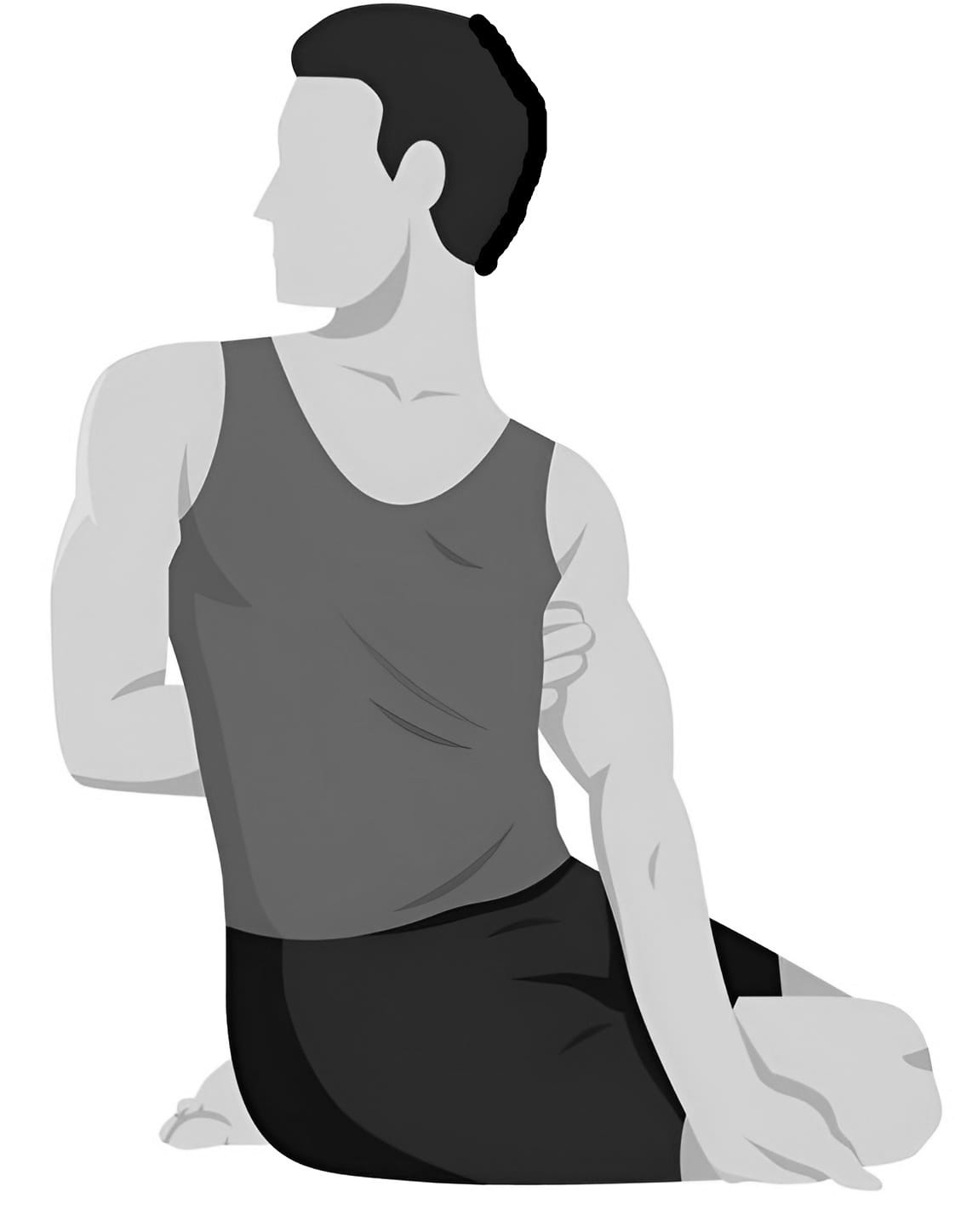
2. Definition
Bharadvajasana is a seated twisting posture that:
- Involves rotation of the thoracic and lumbar spine
- Requires hip flexion and knee flexion (with one leg bent and tucked, the other folded to the side)
- Utilizes arm placement to deepen spinal rotation
- Combines spinal elongation, torsion, and gentle compression of abdominal organs
Functionally, it:
- Stretches the spine, shoulders, and hips
- Strengthens core muscles and spinal stabilizers
- Stimulates internal organs for digestion and detoxification
- Enhances mind-body awareness and meditative focus
It is considered a therapeutic asana in yoga for back pain, digestion, and postural improvement.
3. Method of Practice – Step by Step
Step 1: Sit in a Comfortable Base
- Begin seated on the floor, legs extended forward (Dandasana)
- Sit bones grounded evenly
- Spine elongated, shoulders relaxed
Step 2: Bend the Legs
- Right leg: Fold knee and place foot near left hip or side of left thigh
- Left leg: Bend and tuck behind or beside the right thigh, with foot near the outer right hip
- Adjust legs to ensure knee comfort
Step 3: Prepare the Twist
- Inhale, lengthen spine
- Exhale, rotate torso toward the side of bent leg
- Use opposite hand to grasp outer bent knee or thigh
- Other hand placed behind for support
Step 4: Deepen the Twist
- Keep spine long
- Draw navel slightly inward to engage core
- Shoulders relaxed, head turns gently in the direction of the twist
- Hold the bind gently
Step 5: Maintain the Pose
- Steady, mindful breath
- Hold 30–60 seconds initially
- Gradually increase to 2–3 minutes as flexibility improves
Step 6: Release
- Inhale to untwist torso
- Release arms, straighten legs to Dandasana
- Repeat on the opposite side
4. Alignment Cues
- Hips: Sit bones grounded evenly
- Spine: Elongated from sacrum to crown
- Legs: Comfortably folded, knees not strained
- Shoulders: Relaxed, avoid hunching
- Head and Neck: Aligned with spinal rotation, gaze over shoulder
- Arms: Support torso, assist rotation without forcing
5. Benefits of Bharadvajasana
A. Physical Benefits
- Enhances spinal mobility and flexibility
- Stretches shoulders, chest, and hips
- Strengthens core stabilizers and spinal extensors
- Improves postural awareness and balance
B. Physiological Benefits
- Compresses and massages abdominal organs, aiding digestion
- Stimulates liver, spleen, and kidneys
- Promotes circulation and detoxification
- Improves lung capacity and respiration
C. Mental and Emotional Benefits
- Calms mind, reduces stress and anxiety
- Enhances focus, concentration, and meditative awareness
- Encourages self-reflection and mindfulness
D. Energetic Benefits
- Balances prana flow along sushumna, ida, and pingala nadis
- Opens heart and solar plexus chakras
- Encourages grounding through seated base and rotation through spine
6. Contraindications
- Recent spinal injuries or herniated discs
- Severe knee, hip, or ankle injuries
- Pregnancy (avoid deep twists)
- Shoulder injuries (if using arm binds)
- Severe digestive disorders or hernias
7. Counterposes
- Paschimottanasana (Seated Forward Bend): release spinal tension
- Supta Baddha Konasana (Reclined Bound Angle Pose): hip release
- Shavasana (Corpse Pose): relaxation
- Gentle supine twists: balance spinal rotation
8. Preparatory Practice
- Dandasana: spinal alignment
- Ardha Matsyendrasana: gentle twists
- Baddha Konasana: hip opening
- Janu Sirsasana: hamstring and spinal preparation
- Seated spinal stretches and gentle shoulder rotations
9. Modifications
- Sit on a folded blanket to elevate hips
- Keep back leg extended if knee is tight
- Use block behind pelvis for support
- Place hands lightly on knee instead of deep bind
- Maintain gentle twist if shoulders or spine are tight
10. Muscles Involved
A. Stretched Muscles
- Erector spinae (spinal extensors)
- Multifidus and rotatores (deep spinal stabilizers)
- Latissimus dorsi, trapezius, rhomboids
- External obliques and intercostals
- Hip rotators: piriformis, gluteus medius, gluteus minimus
- Quadratus lumborum
B. Strengthened Muscles
- Core stabilizers: rectus abdominis, transverse abdominis, obliques
- Spinal extensors for maintaining upright posture
- Shoulder stabilizers: deltoids, rotator cuff
C. Joints
- Spine: thoracic and lumbar rotation
- Hips: flexion and external rotation
- Shoulders: flexion and rotation
- Knees: flexion
11. Kinesiology
- Spinal mechanics: axial rotation with elongation
- Hip mechanics: flexion and external rotation for seated stability
- Shoulder mechanics: rotation and stabilization in arm bind
- Core mechanics: isometric engagement to protect lower back
12. Kinematics
- Sagittal plane: slight anterior-posterior movements during inhalation/exhalation
- Frontal plane: minimal lateral deviation
- Transverse plane: primary rotation at thoracic and lumbar spine
- Dynamic action: inhale to lengthen, exhale to deepen twist
13. Biomechanics
- Lever mechanics: arms used to gently rotate torso
- Ground reaction forces: transmitted through sit bones
- Spinal torsion: controlled rotation to mobilize vertebrae
- Isometric contraction: core and back muscles stabilize the spine
14. Functional Anatomy & Physiology
A. Musculoskeletal System
- Strengthens core and spinal stabilizers
- Stretches spine, shoulders, and hips
- Maintains postural integrity
B. Nervous System
- Stimulates proprioception and body awareness
- Activates parasympathetic nervous system for relaxation
C. Respiratory System
- Encourages deep diaphragmatic breathing
- Expands thoracic cavity
D. Digestive System
- Twisting motion massages internal organs, aids digestion
E. Circulatory System
- Enhances venous return and stimulates blood flow
F. Energetic System
- Stimulates pranic flow along posterior and lateral body channels
- Balances energy between root, sacral, and solar plexus chakras
15. How to Correct and Adjust While Teaching
Common Misalignments
- Collapsed chest, rounded shoulders
- Overarching lumbar spine
- Uneven sit bones
- Excessive neck rotation
- Knee discomfort
Verbal Cues
- “Sit evenly on both sit bones”
- “Lengthen spine before twisting”
- “Rotate from thoracic spine, not lower back”
- “Relax shoulders and neck”
Hands-On Adjustments
- Guide pelvis to neutral
- Support knee or foot for hip comfort
- Ensure spine elongation
- Adjust shoulder placement to avoid strain
16. Variations
- Seated Bharadvajasana I: foot closer to body, hands on knees
- Bharadvajasana II: deeper bind using yoga strap
- Supported Bharadvajasana: use blocks under sit bones
- Gentle twist: for beginners or limited mobility
17. Philosophical and Energetic Aspect
- Promotes focus, mindfulness, and introspection
- Encourages detoxification and balance
- Symbolizes wisdom and stability of Sage Bharadvaja
- Combines grounding through seated base with rotation for energy flow
18. Conclusion
Bharadvajasana is a seated spinal twist integrating:
- Spinal rotation and elongation
- Hip and knee flexibility
- Shoulder and thoracic mobility
- Core stabilization and mindfulness
It benefits:
- Physical health: spinal flexibility, posture, shoulder and hip mobility
- Physiological functions: digestion, circulation, detoxification
- Mental health: focus, stress relief, meditation
- Energetic balance: pranic flow, chakra alignment
With mindful practice, alignment awareness, and modifications, Bharadvajasana is suitable for intermediate to advanced practitioners, supporting holistic body-mind integration and embodying traditional yogic wisdom.
QUESTION AND ANSWER
1. The name “Bharadvajāsana” is derived from:
a) Sage Patanjali
b) Sage Kapila
c) Sage Bharadvāja
d) Sage Vyāsa
Answer: c
2. Bharadvajāsana primarily belongs to which category of asanas?
a) Forward bends
b) Twists
c) Backbends
d) Inversions
Answer: b
3. The primary movement occurring in Bharadvajāsana is:
a) Lumbar flexion
b) Thoracic rotation
c) Cervical lateral flexion
d) Hip extension
Answer: b
4. Which body part MUST remain long and neutral to protect the spine in Bharadvajāsana?
a) Cervical spine
b) Thoracic spine
c) Lumbar spine
d) Sacrum
Answer: c
5. Which muscle is MOST involved in initiating spinal rotation in this pose?
a) Iliopsoas
b) Erector spinae
c) External obliques
d) Gluteus medius
Answer: c
6. Which muscle acts as a stabilizer during seated spinal twists?
a) Transverse abdominis
b) Rectus abdominis
c) Latissimus dorsi
d) Biceps femoris
Answer: a
7. A key alignment cue in Bharadvajāsana is:
a) Round the spine gently
b) Lean backward as you twist
c) Lift through the sternum before twisting
d) Press the knees downward
Answer: c
8. Bharadvajāsana helps improve:
a) Kyphosis
b) Digestive function and spinal mobility
c) Hip extension strength
d) Lung capacity only
Answer: b
9. Which of the following is a common CONTRAINDICATION for deep twists?
a) Weak core
b) Recent abdominal surgery
c) Tight hamstrings
d) Low blood pressure
Answer: b
10. What is the safest breathing method during Bharadvajāsana?
a) Breath retention during twist
b) Inhale while deepening twist
c) Exhale while deepening twist
d) Fast breathing
Answer: c
11. Which joint contributes most to the rotation in this pose?
a) Lumbar spine
b) Thoracic spine
c) Hip joint
d) Sacroiliac joint
Answer: b
12. In Bharadvajāsana, the lumbar spine should:
a) Twist deeply
b) Stay upright and minimally rotate
c) Round forward
d) Lean back
Answer: b
13. A common error in Bharadvajāsana is:
a) Using props
b) Twisting from the pelvis instead of ribcage
c) Keeping the shoulders level
d) Engaging the core
Answer: b
14. Best modification for a student with tight hips in Bharadvajāsana:
a) Sit on a folded blanket or block
b) Lift legs up
c) Bend the spine backward
d) Practice in supine position only
Answer: a
15. Which muscle group lengthens most during the twist?
a) Quadriceps
b) Abdominal obliques
c) Pectorals
d) Soleus
Answer: b
16. The biomechanical action at the ribcage in Bharadvajāsana is:
a) Approximation
b) Expansion during inhalation and rotation
c) Depression
d) Protraction
Answer: b
17. Correct adjustment principle for teachers during this pose:
a) Forcefully rotate student deeper
b) Stabilize pelvis and guide ribcage twist gently
c) Pull shoulders backward firmly
d) Push knees down
Answer: b
18. Which is the ideal counterpose after Bharadvajāsana?
a) Bhujangasana
b) Paschimottanasana
c) Neutral seated posture or gentle forward bend
d) Sarvangasana
Answer: c
19. Kinematic sequence of Bharadvajāsana begins with:
a) Twisting first, then lengthening
b) Lengthening spine first, then rotating
c) Tilting pelvis forward, then rounding back
d) Pressing knees down before twisting
Answer: b
20. Which modification reduces stress on the knees?
a) Straighten both legs
b) Use a bolster under the hips
c) Keep both legs in Dandasana
d) Cross-legged version instead of kneeling
Answer: d