
1. INTRODUCTION
Bhadrasana, traditionally translated as the “Auspicious Pose,” “Gracious Pose,” or “Noble Pose,” is one of the classical seated postures described in ancient yogic texts such as the Hatha Yoga Pradipika and the Gheranda Samhita. It is a posture known for its simplicity, profound grounding effect, meditative quality, and gentle opening of the inner groin and hips. Though often overlooked in modern yoga, Bhadrasana was historically considered a posture suitable for long meditative sitting, pranayama practice, and energy regulation. Its steady and calming nature makes it particularly suitable for beginners, elderly practitioners, and anyone who requires a stable, low-stress posture for inner work.
The pose structurally resembles a gentle version of Baddha Konasana, but with feet slightly forward and knees relaxed, often supported by the floor or props. The pelvic diaphragm, adductor group, and spinal stabilizers form the anatomical foundation of the posture, while the mind’s calmness, breath regulation, and energetic channeling contribute to its therapeutic and meditative dimension.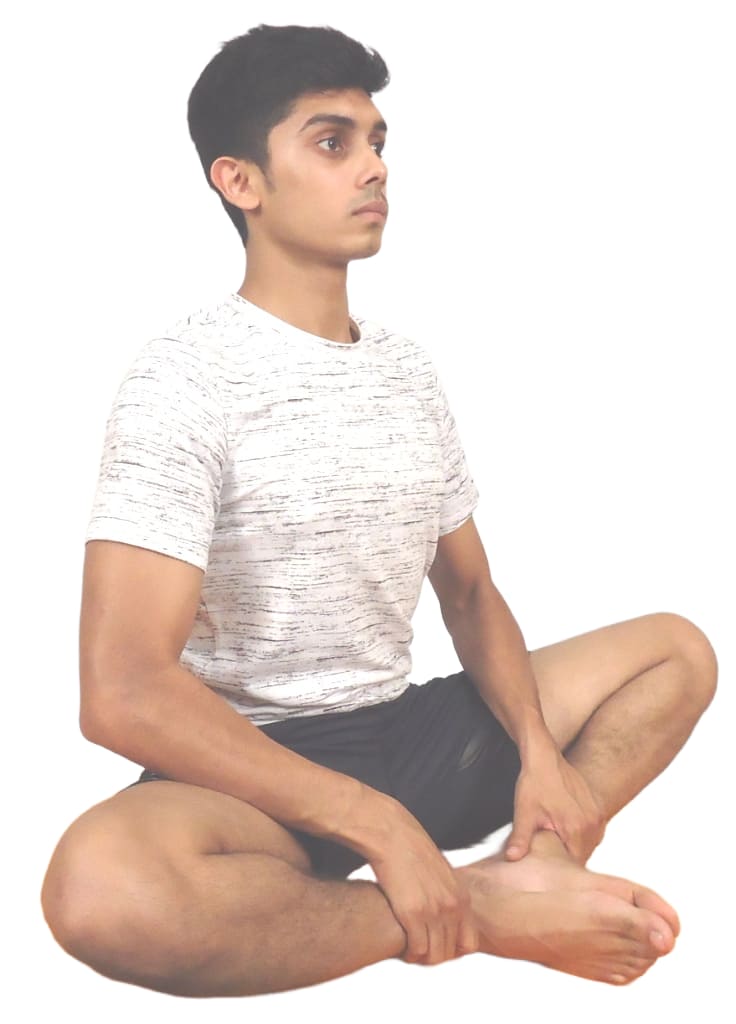
This essay presents a comprehensive exploration of Bhadrasana from classical yogic, anatomical, biomechanical, kinesiological, physiological, and teaching perspectives.
2. WORD MEANING AND DEFINITION
2.1 Word Meaning
- “Bhadra” in Sanskrit means:
- Auspicious
- Blessed
- Noble
- Excellent or gracious
- “Asana” means posture or position.
Thus, Bhadrasana translates to “The Auspicious Posture”, symbolizing a state of dignity, grounding, and meditative readiness. Traditionally, an “auspicious” pose is one conducive to spiritual practice, mental clarity, and inner harmony.
2.2 Definition
Bhadrasana is a seated, symmetrical, meditative posture in which:
- The practitioner sits with the soles of the feet together
- Knees gently drop outward
- Spine remains upright
- Hands rest on the inner legs or feet
- Breath flows naturally
- Body remains stable and relaxed
It is classified under:
- Seated Postures (Upavesha-sthiti)
- Meditative Postures (Dhyana-asanas)
- Hip-opening Postures
Textual references emphasize its suitability for long sitting and its balancing effect on the muladhara (root) and svadhisthana (sacral) chakras.
3. METHOD OF PRACTICE: STEP-BY-STEP
A systematic approach ensures safety, alignment, and deep experience.
3.1 Preparatory Steps
- Sit on the mat with legs extended (Dandasana).
- Relax jaw, shoulders, and breath.
- Bring awareness to the pelvis and spine.
3.2 Step-by-Step Method
Step 1: Starting Position
Sit on the floor with legs stretched straight in front in Dandasana.
Keep the spine tall and the weight evenly distributed on both sitting bones.
Step 2: Bring Feet Together
Bend the knees and bring the soles of the feet together.
Let the knees fall outward naturally.
Feet should be:
- 6–18 inches away from the pelvis depending on comfort
- Symmetrical
- Relaxed but stable
Step 3: Hold the Feet or Ankles
- Hold the feet with both hands
or - Rest hands on inner shins or knees (more traditional form)
Step 4: Adjust the Pelvis
- Tilt the pelvis slightly forward
- Allow natural lumbar curve
- Avoid rounding or excessive arching
Step 5: Lengthen the Spine
Imagine the crown of the head lifting gently.
Engage lower abdomen for support.
Keep neck neutral.
Step 6: Relax Shoulders and Chest
- Shoulders roll down
- Chest naturally open
- Arms relaxed
Step 7: Breathe and Hold
Maintain slow, rhythmic abdominal breathing.
Hold for 1–5 minutes for beginners or 10–30 minutes for meditation.
Step 8: Release
To come out:
- Release feet
- Bring knees together using hands
- Extend legs forward gently
4. ALIGNMENT CUES (TEACHER CUES)
For the Spine
- “Lift through your crown.”
- “Keep your spine natural, not rigid.”
- “Sit on your sitting bones, not tailbone.”
For the Knees
- “Let your knees drop outward without forcing.”
- “Support the knees with cushions if needed.”
For the Pelvis
- “Gently tilt pelvis forward for a tall spine.”
- “Feel equal weight on both sitting bones.”
For the Chest & Shoulders
- “Keep chest broad but soft.”
- “Relax shoulders away from ears.”
For Hands
- “Hold the feet lightly, avoid pulling.”
For Breath
- “Allow breath to widen into the belly and pelvis.”
5. BENEFITS OF BHADRASANA
5.1 Physical Benefits
Hip & Groin
- Opens adductor muscles
- Enhances hip joint mobility
- Strengthens pelvic floor
- Improves alignment of pelvis
Spine
- Encourages upright posture
- Strengthens spinal stabilizers
- Reduces slouching
- Supports diaphragmatic breathing
Digestive and Abdominal Organs
- Enhances peristalsis
- Supports healthy elimination
- Stimulates abdominal viscera
- Improves circulation to pelvis
Reproductive Health
- Beneficial during menstruation
- Improves reproductive organ function
- Supports prenatal and postnatal relaxation
Feet, Ankles, Knees
- Improves circulation
- Enhances joint mobility
- Strengthens stabilizing muscles
5.2 Mental & Emotional Benefits
- Calms the mind
- Improves focus for meditation
- Reduces anxiety and restlessness
- Grounds energy in the lower chakras
- Promotes mental stability and clarity
5.3 Energetic and Spiritual Benefits
- Opens Muladhara and Svadhisthana chakras
- Supports energy flow in pelvis
- Enhances pranic circulation
- Promotes grounding
6. CONTRAINDICATIONS
Bhadrasana is gentle, but certain conditions require caution.
Absolute Contraindications
- Severe knee injury (MCL/meniscus tear)
- Hip labrum tear
- Acute groin strain
Relative Contraindications
- Sciatica (if sitting on floor aggravates pain)
- Severe lower back stiffness
- Post-abdominal surgery
- Osteoarthritis of the hips/knees
Pregnancy
Generally safe, but:
- Knees should be supported
- No strong forward bending pressure
- Use props
7. COUNTERPOSES
Bhadrasana can be followed by:
7.1 Immediate Counterposes
- Dandasana
- Knee-to-chest (Pavanmuktasana)
- Gentle leg extension
7.2 Complementary Counterposes
- Child’s Pose (Balasana)
- Seated Forward Bend (Paschimottanasana)
- Butterfly Flutters (dynamic)
8. PREPARATORY PRACTICES
8.1 Warm-ups for Hips
- Butterfly movements (Titali)
- Hip circles
- Wide-knee Child’s Pose
8.2 Warm-ups for Adductors
- Seated wide-angle pose
- Standing side lunges
8.3 Warm-ups for Pelvis
- Cat–cow movements
- Pelvic tilts
8.4 Breath Preparation
- Belly breathing
- Ujjayi breathing
- Simple awareness meditation
9. MODIFICATIONS & PROPS
9.1 Knee Support
- Cushions under knees
- Blocks under thighs
9.2 Pelvic Support
- Sit on folded blanket or bolster
- Helps maintain upright spine
9.3 Back Support
- Use wall behind for spinal support
9.4 Foot Position Modification
- Feet placed further forward
(reduces knee & groin strain)
9.5 Reclined Variation
- Supta Bhadrasana (lying down butterfly)
This is excellent for:
- Pregnant students
- Lower-back-sensitive individuals
- Deep pelvic relaxation
10. MUSCLES INVOLVED
10.1 Muscles Stretched
- Adductor Longus
- Adductor Brevis
- Adductor Magnus
- Gracilis
- Pectineus
10.2 Muscles Activated
- Pelvic floor muscles
- Iliopsoas (as stabilizer)
- Spinal erectors
- Transverse abdominis
- Obliques (mild engagement)
10.3 Muscles Stabilized
- Quadriceps (knee support)
- Gluteus medius/minimus (hip stabilization)
- Hamstrings (pelvic anchoring)
11. KINESIOLOGY OF BHADRASANA
Kinesiology describes joint movements and muscle actions.
11.1 Hip Joint
Movements involved:
- Abduction (knees outward)
- External rotation
- Slight flexion
Primary muscles:
- Adductors stretch
- Gluteus medius/minimus stabilize
11.2 Knee Joint
Position:
- Flexed position
- Stabilized by quadriceps and ligaments
11.3 Spine
Movements:
- Axial elongation
- Neutral curves maintained
Muscles:
- Erector spinae
- Multifidus
- Core stabilizers
11.4 Pelvis
Movement:
- Anterior pelvic tilt (gentle)
to allow upright spine
12. KINEMATICS
Kinematics deals with movement patterns based on geometry of motion.
12.1 Frontal Plane
- Knee abduction
- Hip opening
12.2 Sagittal Plane
- Slight hip flexion
- Spinal alignment
12.3 Transverse Plane
- External rotation of femur
It is a multi-planar posture, involving subtle coordination and balance of lower limb joints.
13. BIOMECHANISM & BIOMECHANICS
Biomechanics explain forces, load distribution, and structural behavior.
13.1 Joint Loading
- Moderate load at hip joints
- Gentle stress on knee ligaments
- Pelvic floor uplift and stabilization
13.2 Pelvic Dynamics
- With slight anterior tilt, lumbar curve aligns
- Enables diaphragmatic breathing
- Distributes weight evenly
13.3 Adductor–Pelvis Relationship
When knees drop outward:
- Adductors elongate
- Pelvic diaphragm relaxes
- Improves blood flow and lymph return
13.4 Breath Mechanics
Bhadrasana increases:
- Diaphragmatic range
- Intra-abdominal pressure control
- Parasympathetic dominance
14. FUNCTIONAL ANATOMY & PHYSIOLOGY
Functional anatomy is the relationship between structure and movement.
14.1 Respiratory Function
Upright spine improves:
- Lung expansion
- Diaphragm descent
- Efficient oxygen exchange
14.2 Pelvic and Abdominal Physiology
This posture enhances:
- Pelvic blood circulation
- Reproductive organ nourishment
- Improved lymphatic drainage
- Enhanced bowel motility
14.3 Nervous System
- Promotes parasympathetic activation
- Calms the limbic system
- Improves focus and concentration
14.4 Musculoskeletal Function
- Improved hip mobility
- Pelvic stability
- Strengthening of deep core
14.5 Endocrine Benefits
- Stimulates reproductive hormonal balance
- Supports stress regulation via adrenal calming
- Balances sacral chakra energetically
15. HOW TO CORRECT & ADJUST WHILE TEACHING
Safety, respect, and consent are essential.
15.1 Verbal Adjustments
- “Let your spine grow tall.”
- “Allow knees to drop naturally, without force.”
- “Breathe into your pelvis.”
- “Relax shoulders and jaw.”
15.2 Hands-on Adjustments (only with consent)
For Hips
- Gently press inner thighs downward with soft palms
- Ensure no pain or strain
For Pelvis
- Guide student’s pelvis into slight forward tilt
- Press lower back upward for elongation
For Spine
- One hand between shoulder blades lifting
- Other hand stabilizing lower back
15.3 Adjusting Limitations
Knee Sensitivity
- Place cushions under knees
- Move feet forward
Hip Tightness
- Sit on a bolster
- Keep knees higher
Low Back Rounding
- Elevate sitting bones
- Use wall support
15.4 Teaching for Different Body Types
For Beginners
- Knee support
- Shorter holds
- Reclined variation
For Seniors
- Use chair-assisted Bhadrasana
- Focus on breath and comfort
For Pregnant Students
- Wider leg base
- Keep spine supported
- Use bolsters under thighs
16. BHADRASANA IN TRADITIONAL TEXTS
Hatha Yoga Pradipika (Chapter 1)
Mentions Bhadrasana as:
- A meditative posture
- A pose that stabilizes the mind
- A posture to awaken kundalini
Gheranda Samhita
Describes it as:
- Ideal for pranayama
- Good for pelvic vitality
- Enhances inner awareness
17. PSYCHOLOGICAL AND MEDITATIVE DIMENSION
Bhadrasana is not merely a stretching pose.
It is a mind-body integration posture.
Psychological Effects
- Reduces internal agitation
- Supports emotional grounding
- Balances sacral emotional energy
Meditative Effects
- Enhances stillness
- Improves breath awareness
- Facilitates concentration
- Supports mantra practice
18. CONCLUSION
Bhadrasana stands as a gentle, stable, and profoundly grounding posture central to yogic meditation practices. With its roots deep in classical yoga texts and its benefits spanning from physical to psychological to energetic dimensions, it is a posture every yoga practitioner—beginner to advanced—can safely engage with. Its ability to open the hips, stabilize the pelvis, elongate the spine, calm the nervous system, and prepare the mind for meditation makes it a valuable tool in any yogic or therapeutic setting.
From a modern anatomical perspective, Bhadrasana supports hip external rotation, enhances joint mobility, lengthens the adductor group, stabilizes spinal musculature, and encourages diaphragmatic breathing. Functionally, it improves core stability, pelvic health, digestive efficiency, and emotional balance.
QUESTION AND ANSWER
SECTION 1 — MEANING, DEFINITION & HISTORY
1. The Sanskrit word “Bhadra” means:
a) Powerful
b) Blessed, Auspicious
c) Fierce
d) Bird
Answer: b) Blessed, Auspicious
2. Bhadrasana is also known as:
a) Hero Pose
b) Gracious Pose
c) Peacock Pose
d) Warrior Pose
Answer: b) Gracious Pose
3. Bhadrasana is traditionally practiced in which position?
a) Standing
b) Prone
c) Seated
d) Supine
Answer: c) Seated
4. Bhadrasana is commonly used in:
a) Meditation and pranayama
b) Inversions
c) Intense backbends
d) Strength training
Answer: a) Meditation and pranayama
5. According to classical texts, Bhadrasana helps in stabilizing:
a) Breath
b) Mind
c) Shoulders
d) Knees
Answer: b) Mind
SECTION 2 — METHOD OF PRACTICE
6. Bhadrasana begins from:
a) Vajrasana
b) Sukhasana
c) Tadasana
d) Padmasana
Answer: a) Vajrasana
7. In Bhadrasana, the feet are typically:
a) Crossed
b) Widened outward
c) Pressed together in front of the pelvis
d) Stacked on top of each other
Answer: c) Pressed together in front of the pelvis
8. The knees in Bhadrasana should:
a) Lift up
b) Be pressed down forcefully
c) Fall outward gently
d) Move behind the hips
Answer: c) Fall outward gently
9. Hands are placed:
a) On the knees
b) On the ankles/feet
c) Behind the back
d) On the neck
Answer: b) On the ankles/feet
10. The spine during Bhadrasana is:
a) Rounded
b) Overextended
c) Neutral and tall
d) Bent sideways
Answer: c) Neutral and tall
SECTION 3 — ALIGNMENT CUES
11. A key alignment cue is:
a) Pull the knees to the floor aggressively
b) Relax legs while lifting spine
c) Tighten shoulders
d) Tilt strongly backward
Answer: b) Relax legs while lifting spine
12. Pelvis should be in:
a) Anterior tilt
b) Posterior tilt
c) Neutral alignment
d) Over-arched position
Answer: c) Neutral alignment
13. Feet in Bhadrasana resemble:
a) Triangle shape
b) Diamond shape
c) Square shape
d) Crescent shape
Answer: b) Diamond shape
14. A common misalignment is:
a) Shoulders relaxed
b) Spine tall
c) Knees lifted high
d) Hips grounded
Answer: c) Knees lifted high
15. To avoid lower-back strain, the teacher should cue:
a) Relax belly completely
b) Engage lower abdomen lightly
c) Lift shoulders
d) Tuck chin excessively
Answer: b) Engage lower abdomen lightly
SECTION 4 — BENEFITS
16. Bhadrasana strengthens and stabilizes the:
a) Neck
b) Pelvic floor
c) Wrists
d) Shoulder joint
Answer: b) Pelvic floor
17. Bhadrasana is therapeutic for:
a) Sciatica
b) Constipation
c) Hypertension
d) Sinusitis
Answer: b) Constipation
18. One of the mental benefits is:
a) Increases aggression
b) Improves concentration
c) Causes frustration
d) Hyperstimulates the brain
Answer: b) Improves concentration
19. The pose helps open:
a) Groin and hips
b) Wrists
c) Upper back
d) Calves
Answer: a) Groin and hips
20. Bhadrasana is supported in meditation because it:
a) Enhances knee pressure
b) Stabilizes spine and pelvis
c) Increases breathlessness
d) Hardens the muscles
Answer: b) Stabilizes spine and pelvis
SECTION 5 — CONTRAINDICATIONS
21. People with which condition should avoid deep Bhadrasana?
a) Mild cold
b) Knee injury
c) Tiredness
d) Sore throat
Answer: b) Knee injury
22. Groin strain requires:
a) Forcing knees down
b) Practicing for long hours
c) Mild version with support
d) Full posture only
Answer: c) Mild version with support
23. Severe lower-back pain patients should:
a) Avoid the pose
b) Do a deeper fold
c) Keep feet far away
d) Hold for long duration
Answer: a) Avoid the pose
24. Post-surgery (abdominal) practitioners should:
a) Do it daily
b) Avoid until healed
c) Use advanced variation
d) Do it standing
Answer: b) Avoid until healed
25. Sciatica aggravated by flexion requires:
a) Props support
b) Forcing knees down
c) Deep forward bending
d) Fast breathing
Answer: a) Props support
SECTION 6 — PREPARATORY PRACTICE
26. A good warm-up for Bhadrasana is:
a) Surya Namaskar
b) Hip circles
c) Headstand
d) Cobra pose
Answer: b) Hip circles
27. Which pose prepares groin muscles?
a) Paschimottanasana
b) Upavistha Konasana
c) Tadasana
d) Bhujangasana
Answer: b) Upavistha Konasana
28. A helpful stretch before Bhadrasana:
a) Hamstring stretch
b) Butterfly pose (Titliasana)
c) Sphinx pose
d) Shoulder rotation
Answer: b) Butterfly pose
29. For tight hips, the best preparatory movement is:
a) Knee locking
b) Cat-cow
c) Hip external rotation
d) Shoulder adduction
Answer: c) Hip external rotation
30. For meditation preparation, one should practice:
a) Intense family breathing
b) Slow diaphragmatic breathing
c) Fast kapalabhati
d) Loud chanting
Answer: b) Slow diaphragmatic breathing
SECTION 7 — MODIFICATIONS & PROPS
31. A common modification is:
a) Elevate hips with a cushion
b) Bind arms behind the back
c) Arch back deeply
d) Fold one leg only
Answer: a) Elevate hips with a cushion
32. If knees hurt, the teacher should recommend:
a) Removing all props
b) Raising the hips higher
c) Pushing knees to floor
d) Rounding the spine
Answer: b) Raising the hips higher
33. For pregnant practitioners, modification includes:
a) Knees together
b) Gentle wide-knee supported version
c) Strong abdominal contraction
d) Deep hip flexion
Answer: b) Gentle wide-knee supported version
34. For very tight groin, which prop helps?
a) Strap around thighs
b) Block under elbows
c) Bolsters under knees
d) Strap behind neck
Answer: c) Bolsters under knees
35. To keep the spine tall, one can use:
a) Wall support
b) Weights on shoulders
c) Rounded back
d) Deep twist
Answer: a) Wall support
SECTION 8 — MUSCLES INVOLVED
36. Primary muscles lengthened in Bhadrasana:
a) Adductors
b) Quadriceps
c) Triceps
d) Deltoids
Answer: a) Adductors
37. Primary muscles engaged:
a) Obliques
b) Pelvic floor and lower back stabilizers
c) Biceps
d) Tibialis anterior
Answer: b) Pelvic floor and lower back stabilizers
38. Secondary stretching occurs in:
a) Neck extensors
b) Gluteus maximus
c) Psoas minor
d) Internal hip rotators
Answer: d) Internal hip rotators
39. Spine is held long due to activation of:
a) Erector spinae
b) Deltoids
c) Gastrocnemius
d) Brachialis
Answer: a) Erector spinae
40. Knee joint stability depends on:
a) Hamstrings
b) Gluteal complex
c) Ligaments and adductors
d) Wrist flexors
Answer: c) Ligaments and adductors
SECTION 9 — KINESIOLOGY, KINEMATICS & BIOMECHANICS
41. Main joint action in Bhadrasana:
a) Hip external rotation + abduction
b) Hip adduction
c) Knee extension
d) Shoulder rotation
Answer: a) Hip external rotation + abduction
42. Bhadrasana improves pelvic floor responsiveness via:
a) Compression
b) Relaxation
c) Both contraction and relaxation cycles
d) Vibration
Answer: c) Both contraction and relaxation cycles
43. Ground reaction force affects:
a) Pectorals
b) Pelvis and hip stability
c) Wrist joints
d) Elbow flexion
Answer: b) Pelvis and hip stability
44. Primary plane of movement is:
a) Transverse plane
b) Sagittal plane
c) Frontal plane
d) Multi-planar
Answer: c) Frontal plane
45. The spine remains:
a) Flexed
b) Extended (neutral lengthening)
c) Rotated
d) Collapsed
Answer: b) Extended (neutral lengthening)
SECTION 10 — TEACHING, CORRECTIONS & ADJUSTMENTS
46. A safe verbal cue is:
a) “Press knees down hard.”
b) “Lift chest and relax groin.”
c) “Lock your knees.”
d) “Round spine forward.”
Answer: b) “Lift chest and relax groin.”
47. To correct knee discomfort, the teacher should:
a) Push knees outward
b) Elevate hips and support knees
c) Shorten breath
d) Twist torso
Answer: b) Elevate hips and support knees
48. Hands-on adjustment is applied by:
a) Pressing knees down strongly
b) Lifting spine up from shoulders gently
c) Twisting hips
d) Forcing feet closer
Answer: b) Lifting spine up from shoulders gently
49. Best counterpose for Bhadrasana:
a) Camel pose
b) Child’s pose
c) Handstand
d) Wheel pose
Answer: b) Child’s pose
50. A teacher must stop the student if they feel:
a) Gentle pull
b) Light warmth
c) Sharp knee or groin pain
d) Relaxation
Answer: c) Sharp knee or groin pain