
1. Word Meaning
The Sanskrit word “Sukha” translates to “ease,” “comfort,” or “happiness”, and “Asana”means “posture” or “seat”.
Thus, Sukhasana is the “Easy or Comfortable Pose”, symbolizing mental and physical ease, serenity, and groundedness. It is considered a foundational meditation posture in Hatha Yoga, allowing a practitioner to maintain upright spine, calm the mind, and develop breath awareness.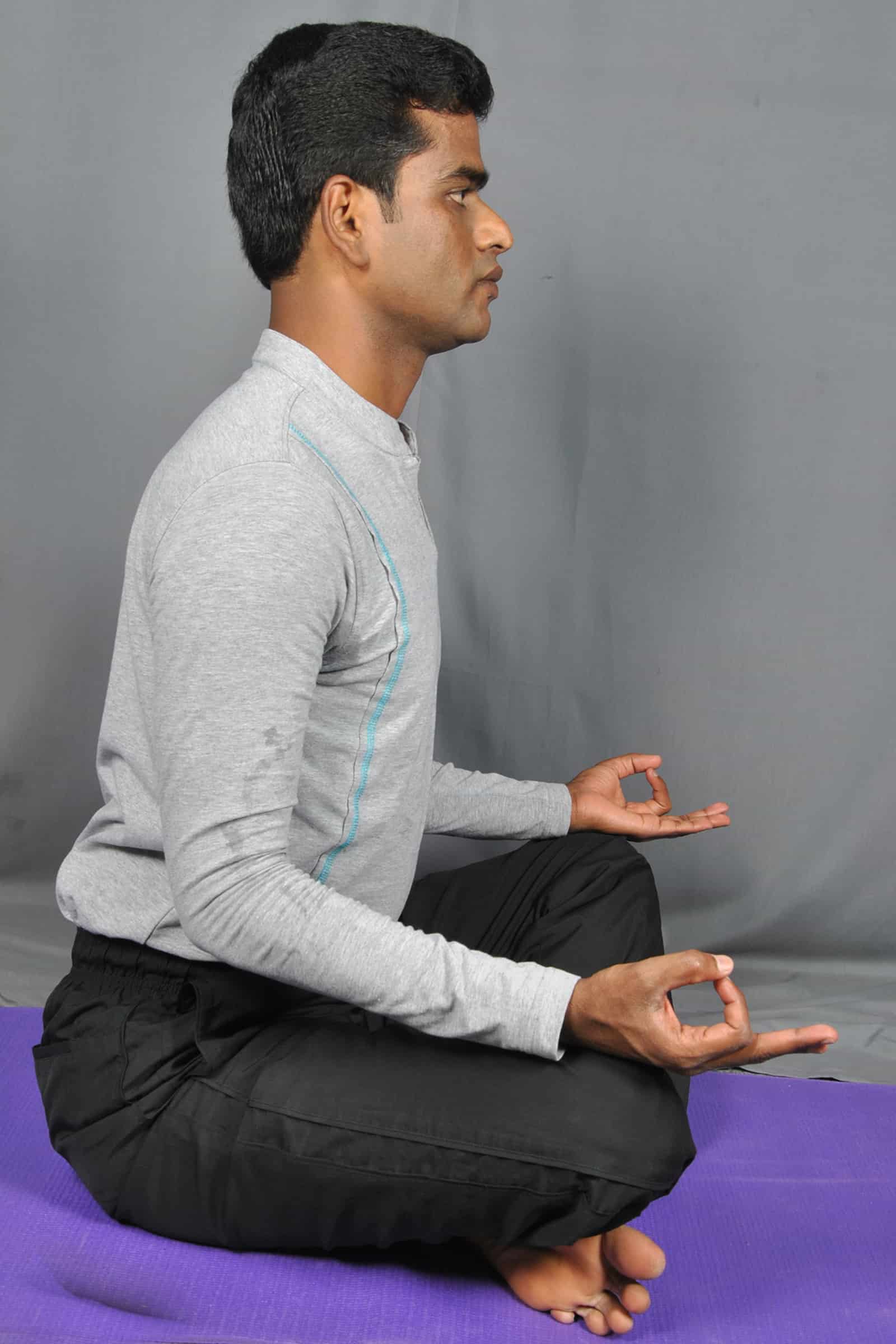
2. Definition
Sukhasana is a cross-legged seated posture characterized by:
- Sitting on the floor with legs crossed comfortably
- Hands resting on knees or thighs
- Spine upright, chest open, shoulders relaxed
- Neck and head aligned in a neutral position
It is accessible to most beginners, though proper alignment and preparatory stretching can enhance comfort and prevent strain.
Sukhasana is often used as a meditation seat, pranayama posture, or starting point for yoga sequences.
3. Method of Practice – Step by Step
Step 1: Prepare the Sitting Area
- Sit on a yoga mat or blanket to cushion the sit bones
- Optionally, place a folded blanket or bolster under the hips for elevation
Step 2: Cross the Legs
- Bring one leg forward and then cross the other leg over, aligning ankles comfortably
- Feet rest under knees or shins
Step 3: Adjust Hips
- Ensure sit bones are grounded evenly
- Slightly tilt the pelvis forward to allow natural lumbar curve
- Use a small cushion or folded blanket if hips are tight
Step 4: Lengthen Spine
- Inhale to lengthen through the crown of the head
- Exhale to relax shoulders, allowing chest to open
Step 5: Position Hands
- Rest hands on knees with palms up or down
- Optionally, place fingers in Gyan Mudra (thumb and index finger touching)
Step 6: Align Head and Neck
- Keep chin parallel to floor
- Neck relaxed, eyes soft or closed
Step 7: Breathing
- Practice natural diaphragmatic breathing or pranayama techniques
- Maintain awareness of breath
Step 8: Hold Pose
- Beginners: 1–3 minutes
- Advanced practitioners: 10–20 minutes during meditation or pranayama
Step 9: Exit Safely
- Lift legs gently and release the cross
- Shake out knees and ankles to restore circulation
4. Alignment Cues
Hips
- Sit evenly on both sit bones
- Elevate hips slightly to reduce knee or ankle strain
Knees and Ankles
- Knees relaxed toward floor
- Ankles not compressed or strained
Spine
- Lengthen through lumbar and thoracic spine
- Avoid slouching or excessive arching
Shoulders
- Shoulder blades move slightly down and back
- Chest open but not forced
Neck
- Neutral position, head aligned with spine
- Avoid forward head tilt
Hands
- Rest naturally on knees or thighs
- Palms up for receptive energy, palms down for grounding
5. Benefits of Sukhasana
Physical Benefits
- Improves Posture – promotes upright spine and spinal awareness
- Opens Hips – gently stretches hip adductors
- Strengthens Core – encourages engagement of deep spinal stabilizers
- Supports Meditation – comfortable position for long sitting
- Relieves Lower Back and Knee Tension – when practiced with correct alignment
- Prepares for Advanced Poses – foundation for Padmasana, Vajrasana, and pranayama
Energetic Benefits
- Stimulates Muladhara (Root Chakra) for grounding
- Enhances Pranayama by stabilizing torso for diaphragmatic breathing
Psychological Benefits
- Reduces stress and anxiety
- Enhances focus and concentration
- Encourages mindfulness and emotional balance
6. Contraindications
- Knee injuries – avoid cross-legged positions or use props
- Ankle injuries – avoid pressure on ankle joints
- Severe hip tightness – use elevation to prevent strain
- Lower back pain or herniated discs – use blanket under hips to reduce lumbar stress
- Circulatory issues in lower limbs – take breaks to avoid numbness
7. Counterposes
After Sukhasana, it is beneficial to release hips and lower back:
- Supta Baddha Konasana (Reclined Bound Angle Pose) – stretches inner thighs
- Apanasana (Knees-to-Chest Pose) – releases lower back
- Balasana (Child’s Pose) – gently flexes spine
- Shavasana (Corpse Pose) – complete relaxation
8. Preparatory Practices
For Hips
- Baddha Konasana (Bound Angle Pose)
- Anjaneyasana (Low Lunge)
- Janu Sirsasana (Head-to-Knee Forward Bend)
For Spine
- Marjaryasana–Bitilasana (Cat-Cow)
- Bhujangasana (Cobra Pose)
- Salabhasana (Locust Pose)
For Shoulders
- Gomukhasana arms
- Shoulder rolls
9. Modifications
- Blanket or Cushion Under Hips
- Elevates hips for more comfort
- Reduces knee and ankle strain
- Sit Against Wall
- Provides spinal support for beginners
- Encourages upright posture
- Knee Support
- Folded blankets under knees if they do not reach the floor
- Prevents discomfort or strain
- Leg Position Adjustment
- Place feet closer to body or slightly apart for more comfort
- Avoid forceful cross-legged positions
10. Muscles Involved
A. Stretched Muscles
- Hip adductors (inner thighs)
- Piriformis (deep hip rotators)
- Gluteus medius and minimus (mild stretch)
B. Strengthened / Stabilized Muscles
- Erector spinae (spinal stabilizers)
- Transverse abdominis
- Obliques (core stability)
- Multifidus (deep spinal support)
- Shoulder stabilizers (trapezius, rhomboids)
11. Kinesiology
- Primary Motions:
- Hip external rotation and abduction
- Spine upright, minimal extension/flexion
- Joint Actions:
- Knee flexion
- Hip external rotation
- Ankle dorsiflexion and plantarflexion (minimal)
- Movement Type:
- Static isometric hold for spine and core
- Gentle passive stretch for hips
12. Kinematics
- Plane of Movement: Frontal and transverse for hip rotation
- Axis: Vertical axis (for hip rotation)
- Joint Mobility:
- Hips: external rotation
- Knees: flexion without excessive torque
- Spine: neutral, lengthened
- Force Distribution:
- Even across sit bones and lower limbs
- Core engagement reduces lumbar compression
13. Biomechanics
- Hip Joint: External rotation supported by adductors and glutes
- Knee Joint: Maintains flexion without torque; prone to strain if unsupported
- Spinal Biomechanics: Neutral alignment minimizes compression
- Shoulder Biomechanics: Relaxed, scapular stabilization prevents upper back tension
- Sit Bone Pressure: Can be reduced using props for beginners or tight hips
14. Functional Anatomy & Physiology
A. Musculoskeletal
- Supports hip external rotation and spinal upright alignment
- Strengthens postural muscles (core, spinal stabilizers)
- Improves ankle, knee, and hip joint awareness
B. Nervous System
- Stimulates parasympathetic nervous system
- Enhances focus, calmness, and body awareness
- Improves proprioception in lower limbs and pelvis
C. Circulatory System
- Mild enhancement of lower limb circulation
- Reduces venous congestion in sedentary practitioners
D. Respiratory System
- Opens thoracic cavity, encouraging diaphragmatic breathing
- Supports pranayama practice with stable torso
15. Teaching Methodology
Common Misalignments
- Slouched spine
- Hips uneven
- Knees lifted excessively
- Tension in shoulders or neck
Corrections
- Elevate hips with blanket or bolster
- Align sit bones evenly
- Engage core and lengthen spine
- Relax shoulders and neck
Hands-on Adjustments
- Light pressure on sit bones to guide balance
- Gentle support for knees or ankles
- Cue head and neck neutral alignment
Cueing Tips
- “Sit tall through your spine, crown of the head reaching upward”
- “Ground sit bones evenly into floor or props”
- “Relax shoulders away from ears”
- “Breathe into your lower belly”
Advanced Teaching Notes
- Encourage extended meditation practice
- Combine with pranayama and mindfulness
- Adjust props for prolonged sitting comfort
16. Variations
- Padmasana (Lotus Pose) from Sukhasana – advanced hip opening
- Sit on Bolster with Legs Crossed – restorative support
- Wall-Supported Sukhasana – maintains upright spine for beginners
- Arms Variations – resting on knees, in Gyan Mudra, or hands in lap
17. Philosophical Aspect
- Sukhasana symbolizes ease, grounding, and serenity
- Prepares mind for meditation and inner awareness
- Encourages mindful posture, body awareness, and breath control
- Fosters equanimity and emotional stability
18. Conclusion
Sukhasana, the Easy Pose, is a foundational seated posture in yoga practice that:
- Supports meditation and pranayama
- Opens hips gently and strengthens postural muscles
- Enhances spinal alignment, diaphragmatic breathing, and proprioception
- Encourages mental clarity, emotional balance, and stress reduction
With proper alignment, props, and guidance, Sukhasana is accessible to beginners and beneficial for advanced practitioners as a preparatory, restorative, and meditative posture.
QUESTION AND ANSWER
1. What does “Sukha” mean in Sanskrit?
a) Effort
b) Ease or comfort
c) Strength
d) Balance
Answer: b
2. Sukhasana is commonly known as:
a) Lotus Pose
b) Easy Pose
c) Hero Pose
d) Reclined Pose
Answer: b
3. Which chakra is primarily stimulated in Sukhasana?
a) Muladhara (Root)
b) Anahata (Heart)
c) Vishuddha (Throat)
d) Ajna (Third Eye)
Answer: a
4. What is the main benefit of Sukhasana?
a) Strengthens legs for standing poses
b) Provides comfortable seat for meditation and pranayama
c) Deep backbend
d) Side stretching
Answer: b
5. Which part of the spine should be emphasized in Sukhasana?
a) Slouched lumbar spine
b) Neutral spine, upright thoracic and lumbar
c) Hyperextended cervical spine
d) Flexed thoracic spine
Answer: b
6. The primary joint action at the hips is:
a) Internal rotation
b) External rotation
c) Flexion
d) Extension
Answer: b
7. Which muscles are gently stretched in Sukhasana?
a) Quadriceps
b) Hip adductors and piriformis
c) Hamstrings
d) Gastrocnemius
Answer: b
8. Which muscles stabilize the spine in Sukhasana?
a) Erector spinae, obliques, multifidus, transverse abdominis
b) Latissimus dorsi
c) Soleus and gastrocnemius
d) Deltoids
Answer: a
9. Common contraindication for Sukhasana is:
a) Mild shoulder stiffness
b) Knee injury
c) Tight hamstrings
d) Neck strain
Answer: b
10. A good modification for tight hips is:
a) Fold arms behind back
b) Place folded blanket or bolster under hips
c) Cross legs more tightly
d) Lift knees actively
Answer: b
11. Hands resting on knees with palms up is associated with:
a) Receptive energy
b) Grounding
c) Aggressiveness
d) Balance only
Answer: a
12. Hands resting on knees with palms down emphasizes:
a) Grounding
b) Energy opening
c) Core strengthening
d) Shoulder flexion
Answer: a
13. Recommended duration for beginners is:
a) 10–15 minutes
b) 1–3 minutes
c) 20–30 seconds
d) 30 minutes
Answer: b
14. Which preparatory pose helps open hips for Sukhasana?
a) Balasana (Child’s Pose)
b) Baddha Konasana (Bound Angle Pose)
c) Dandasana (Staff Pose)
d) Adho Mukha Svanasana (Downward Dog)
Answer: b
15. Which preparatory pose helps lengthen spine?
a) Marjaryasana–Bitilasana (Cat-Cow)
b) Padmasana (Lotus Pose)
c) Sukhasana
d) Vajrasana
Answer: a
16. What is the correct position for knees in Sukhasana?
a) Elevated above hips
b) Relaxed toward floor
c) Compressed together
d) Twisted outward
Answer: b
17. What is a common misalignment in beginners?
a) Hips too elevated
b) Spine slouching forward
c) Hands in lap
d) Palms up
Answer: b
18. Which props are commonly used for Sukhasana?
a) Blanket under hips
b) Wall support for spine
c) Cushions under knees
d) All of the above
Answer: d
19. Proper head and neck alignment in Sukhasana is:
a) Hyperextended
b) Neutral, aligned with spine
c) Tilted forward
d) Rotated to one side
Answer: b
20. Breathing practice in Sukhasana emphasizes:
a) Rapid short breaths
b) Shallow chest breathing
c) Deep diaphragmatic breathing
d) Breath-holding
Answer: c
21. Which is a suitable counterpose after Sukhasana?
a) Supta Baddha Konasana
b) Balasana (Child’s Pose)
c) Apanasana (Knees-to-Chest Pose)
d) All of the above
Answer: d
22. Sukhasana prepares the body for:
a) Forward bends
b) Meditation and pranayama
c) Handstands
d) Twists only
Answer: b
23. Which core muscles are engaged for upright posture?
a) Rectus abdominis, transverse abdominis, obliques
b) Hamstrings
c) Quadriceps
d) Gastrocnemius
Answer: a
24. Which shoulder alignment cue is correct?
a) Shrug toward ears
b) Relax, shoulder blades down and back
c) Compress forward
d) Twist outward
Answer: b
25. How can beginners reduce knee strain?
a) Elevate hips with cushion
b) Force knees down
c) Tighten core excessively
d) Cross legs more tightly
Answer: a
26. Which muscles are passively stretched?
a) Hip adductors
b) Piriformis
c) Gluteus medius
d) All of the above
Answer: d
27. Which energy principle does Sukhasana encourage?
a) Patience and ease
b) Aggression
c) Hyperactivity
d) Restlessness
Answer: a
28. Which preparatory shoulder exercise is beneficial?
a) Gomukhasana arms
b) Shoulder rolls
c) Extended puppy pose
d) All of the above
Answer: d
29. Advanced variation of Sukhasana includes:
a) Hands in Gyan Mudra
b) Sitting on elevated cushion
c) Sit against wall with spine supported
d) All of the above
Answer: d
30. Which anatomical system benefits from upright posture in Sukhasana?
a) Nervous system
b) Circulatory system
c) Respiratory system
d) All of the above
Answer: d
31. Which precaution is necessary for ankle injuries?
a) Avoid cross-legged posture or use props
b) Force feet flat
c) Ignore discomfort
d) None
Answer: a
32. Which preparatory hip flexor stretch helps in Sukhasana?
a) Anjaneyasana (Low Lunge)
b) Tadasana (Mountain Pose)
c) Trikonasana
d) Shavasana
Answer: a
33. Hands-on adjustment may include:
a) Lightly pressing sit bones for balance
b) Forcing knees down
c) Pulling legs apart
d) Compressing neck
Answer: a
34. Sukhasana supports:
a) Meditation
b) Pranayama
c) Mindfulness practice
d) All of the above
Answer: d
35. Which variation is restorative for long sitting?
a) Bolster under hips
b) Cushion under knees
c) Wall-supported spine
d) All of the above
Answer: d
36. Sit bones should:
a) Tilt forward
b) Ground evenly
c) Tilt backward
d) Lift off mat
Answer: b
37. Neck alignment cue is:
a) Lengthen through crown of head
b) Compress neck
c) Tilt forward
d) Rotate sideways
Answer: a
38. Breath cue during meditation in Sukhasana:
a) Focus on natural, slow diaphragmatic breath
b) Rapid chest breathing
c) Breath-holding
d) Forced inhale/exhale
Answer: a
39. Which joint is minimally engaged in Sukhasana?
a) Hips
b) Knees
c) Ankles
d) Elbows
Answer: d
40. Sitting on a cushion in Sukhasana:
a) Reduces strain on knees
b) Elevates hips for better spine alignment
c) Enhances comfort
d) All of the above
Answer: d
41. Sukhasana is suitable for:
a) Beginners
b) Advanced practitioners
c) Meditation and pranayama
d) All of the above
Answer: d
42. Common benefit of Sukhasana for nervous system:
a) Parasympathetic activation
b) Sympathetic activation
c) Hyperactivity
d) Stress increase
Answer: a
43. Exit cue for students:
a) Lift legs slowly, shake knees and ankles
b) Roll abruptly
c) Jump to standing
d) Twist torso suddenly
Answer: a
44. Which muscles are passively stretched in advanced practice?
a) Gluteus medius
b) Piriformis
c) Hip adductors
d) All of the above
Answer: d
45. Sukhasana is foundational for:
a) Padmasana (Lotus Pose)
b) Pranayama
c) Meditation
d) All of the above
Answer: d
46. Common mental benefit includes:
a) Stress reduction
b) Increased anxiety
c) Hyperactivity
d) Fatigue
Answer: a
47. Which preparatory practice strengthens the spine?
a) Cat-Cow
b) Bhujangasana
c) Salabhasana
d) All of the above
Answer: d
48. Which cue helps maintain upright posture?
a) “Lengthen spine, crown reaching upward”
b) “Slouch slightly”
c) “Lean forward”
d) “Tilt head down”
Answer: a
49. Palms up in Sukhasana are associated with:
a) Receptive energy
b) Grounding
c) Aggression
d) Muscle strengthening
Answer: a
50. Which system is primarily supported for meditation?
a) Nervous system
b) Circulatory system
c) Musculoskeletal system
d) All of the above
Answer: d