
1. Introduction
Yoga, an ancient system of physical, mental, and spiritual practices, emphasizes postures (asanas) to enhance strength, flexibility, balance, and mindfulness. Among the foundational seated poses, Vajrasana is considered one of the most therapeutic and meditative asanas, often recommended for digestion, meditation, and pranayama practices.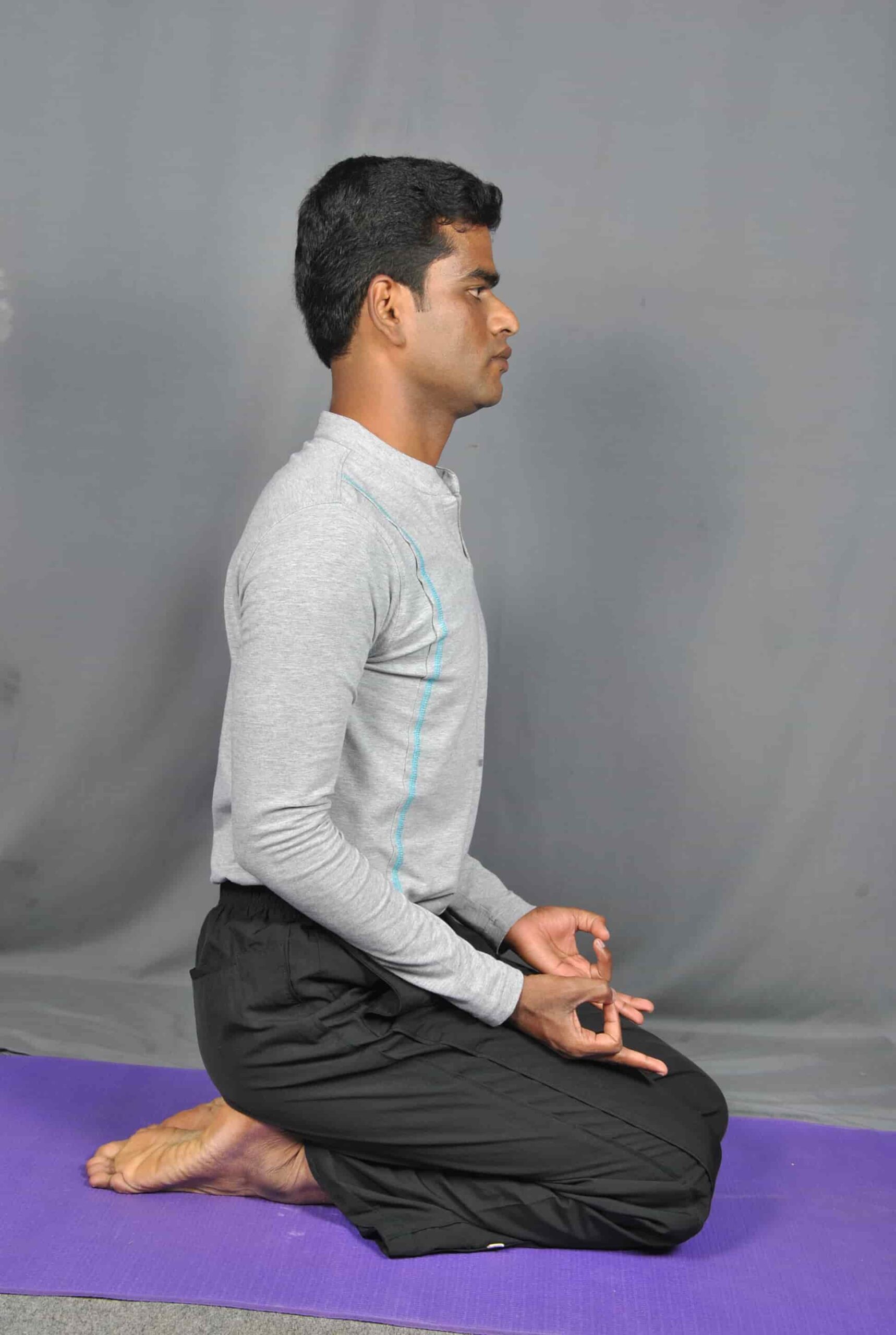
The name Vajrasana is derived from Sanskrit and symbolizes steadfastness, stability, and inner focus, reflecting the qualities of a diamond or thunderbolt—strong, unyielding, and radiant. This posture is widely utilized in Hatha Yoga, meditation practices, and therapeutic yoga sequences, forming the basis for various breathing techniques and seated meditative practices.
2. Word Meaning and Etymology
The Sanskrit term Vajrasana is composed of:
- Vajra – Thunderbolt or Diamond, symbolizing firmness, strength, and clarity
- Asana – Pose or posture
Thus, Vajrasana translates as “Thunderbolt Pose” or “Diamond Pose”, denoting steadiness, immovability, and inner resilience. Traditionally, it is also referred to as Vajra Asana and is considered a prone foundation for meditation and pranayama.
3. Definition of Vajrasana
Vajrasana is a kneeling seated posture in which the practitioner sits with the buttocks resting on the heels, knees together, and spine erect, creating a stable base for meditative and pranayama practices.
Classical Definition:
Vajrasana is a foundational seated asana emphasizing spinal alignment, pelvic stability, and lower limb grounding, promoting physical steadiness and mental focus.
4. Method of Practice: Step by Step
Step 1: Starting Position
- Begin in a standing position (Tadasana / Mountain Pose) with feet together.
Step 2: Kneel Down
- Gently bend both knees and lower your body to sit on the heels.
- Keep knees together or slightly apart depending on comfort.
Step 3: Foot Positioning
- Place feet together, tops of feet flat on the mat.
- Toes may be pointing backward, with the base of the big toes touching.
Step 4: Spine Alignment
- Keep the spine erect with shoulders relaxed.
- Place hands on thighs, palms facing down.
Step 5: Head and Neck
- Keep the head neutral, chin slightly tucked, gaze forward or close eyes.
Step 6: Breathing
- Inhale and exhale deeply, evenly, and calmly, focusing on the meditative state.
Step 7: Duration
- Begin with 1–5 minutes, gradually increasing up to 15–30 minutes as comfort allows.
Step 8: Release
- To exit, gently lift the hips, straighten the legs, and return to Tadasana or a comfortable standing/seated position.
5. Alignment Cues
- Knees: Knees together or slightly apart; ensure comfort.
- Feet: Toes flat on mat, big toes touching; heels support the buttocks.
- Pelvis: Resting on heels; evenly distributed weight.
- Spine: Erect, neutral alignment; avoid slouching.
- Shoulders: Relaxed, away from ears.
- Arms & Hands: Rest on thighs, palms down or gently on knees.
- Head & Neck: Neutral, gaze forward or closed eyes.
6. Benefits of Vajrasana
Physical Benefits:
- Improves digestion by facilitating blood flow to abdominal organs
- Strengthens lower back, pelvic muscles, and lower limbs
- Promotes joint flexibility in ankles, knees, and hips
- Supports postural alignment and spinal stability
Mental & Emotional Benefits:
- Enhances concentration, focus, and meditation
- Reduces stress, anxiety, and mental tension
- Cultivates a sense of grounding and stability
Physiological / Therapeutic Benefits:
- Aids gastric and intestinal activity; often recommended after meals
- Stimulates circulatory and nervous systems
- Helps in relief from sciatica, lower back pain, and mild joint stiffness
7. Contraindications
- Knee injuries: Avoid deep kneeling; use cushions or alternative poses
- Ankle injuries: Use support under feet for comfort
- Severe joint pain or arthritis: Avoid or modify with props
- Pregnancy (late stages): May be uncomfortable; use alternate seated poses
8. Counterposes
- Balasana (Child’s Pose) – releases knees, ankles, and spine
- Supta Vajrasana (Reclined Thunderbolt) – gentle variation for stretching anterior body
- Tadasana (Mountain Pose) – reestablishes neutral alignment after prolonged kneeling
9. Preparatory Practice
- Sukhasana (Easy Pose) – seated posture for beginners
- Anjaneyasana (Low Lunge) – stretches knees and hips
- Adho Mukha Svanasana (Downward Dog) – strengthens lower limbs
- Gomukhasana legs and shoulder stretch – prepares knees, hips, and shoulders
10. Modifications
- Beginner: Place a folded blanket between heels and buttocks for comfort
- Intermediate: Sit with knees together, spine erect, hands on thighs
- Advanced: Sit for longer duration with deep, meditative breathing
- Injury adaptation: Use yoga block under buttocks; support knees and ankles
11. Muscles Involved
Primary Muscles Stretched:
- Quadriceps and hip flexors
- Tibialis anterior and ankle stabilizers
- Knee ligaments (gently)
Primary Muscles Engaged:
- Erector spinae and core muscles for spinal support
- Pelvic floor muscles
- Gluteus maximus and medius (isometric engagement for stability)
Secondary Muscles:
- Shoulder stabilizers (if arms extended forward)
- Neck extensors and flexors (neutral alignment)
12. Kinesiology
- Hip Joint: Flexion with pelvis resting on heels
- Knee Joint: Flexed, supporting body weight
- Ankle Joint: Plantarflexion; dorsum of foot on mat
- Spine: Neutral, slight lumbar curve supported by isometric back muscles
- Shoulders: Relaxed, neutral rotation
13. Kinematics
- Weight Distribution: Evenly through knees, shins, and feet
- Range of Motion (ROM):
- Knee flexion: ~135°
- Hip flexion: ~90°
- Ankle dorsiflexion: ~20°–25°
- Center of Mass: Low, centered over knees and shins
14. Biomechanism
- Load Bearing: Knees and ankles support seated weight; pelvis stabilizes posture
- Joint Stability: Quadriceps, hamstrings, and ankle stabilizers engage isometrically
- Spinal Alignment: Erect spine ensures minimal disc compression and optimal posture
- Circulatory Impact: Kneeling enhances abdominal organ blood flow for digestion
15. Functional Anatomy & Physiology
- Musculoskeletal Function: Strengthens lower limb stabilizers, spinal erectors, pelvic floor muscles
- Neuromuscular Coordination: Enhances proprioception and static balance
- Digestive System: Facilitates gastric and intestinal function
- Respiratory System: Supports diaphragmatic breathing and calm respiration
- Neurological Benefits: Encourages focus, relaxation, and meditation
16. How to Correct and Adjust While Teaching
Common Errors & Corrections:
- Slouched Spine: Cue to lift sternum and elongate spine
- Pelvis Not Resting on Heels: Use folded blanket for support
- Knee Discomfort: Cushion or block under knees
- Ankle Pain: Adjust foot position or support dorsum with folded cloth
Hands-on Adjustments:
- Guide pelvis onto heels
- Stabilize shins and feet for comfort
- Support lumbar spine to maintain erect posture
Verbal Cues:
- “Sit evenly on your heels, spine long and tall”
- “Relax shoulders and soften jaw”
- “Breathe slowly and focus inward”
17. Conclusion
Vajrasana is a foundational seated yoga posture offering a combination of physical stability, joint flexibility, spinal alignment, and meditative focus. It is particularly valuable for digestive health, meditation, and pranayama practices. With attention to alignment, modifications, and preparatory sequences, Vajrasana is safe for most practitioners and cultivates steadiness, mental calmness, and physiological benefits, earning its title as the “Thunderbolt Pose”.
QUESTION AND ANSWER
1. Basic Knowledge
- The Sanskrit meaning of Vajrasana is:
A) Thunderbolt or Diamond Pose ✅
B) Bow Pose
C) Seated Forward Bend
D) Warrior Pose - Vajrasana is primarily classified as:
A) Kneeling seated posture ✅
B) Standing balance pose
C) Supine backbend
D) Arm balance - The primary use of Vajrasana in yoga is:
A) Meditation and pranayama ✅
B) High-intensity strength training
C) Arm stretching
D) Jumping and balancing - Vajrasana is also called:
A) Diamond Pose ✅
B) Cat Pose
C) Triangle Pose
D) Lotus Pose
2. Alignment & Technique
- In Vajrasana, the knees should be:
A) Together or slightly apart ✅
B) Fully apart with legs crossed
C) Locked straight
D) Bent backward - The feet should be positioned:
A) Toes pointing backward, tops flat on the mat ✅
B) Toes pointing forward
C) Heels raised
D) Toes crossed over each other - Spine alignment in Vajrasana:
A) Erect and neutral ✅
B) Slouched forward
C) Hyperextended backward
D) Twisted - Hands in Vajrasana are usually placed:
A) On thighs, palms down ✅
B) Crossed behind back
C) Raised overhead
D) Supporting ears
3. Muscles Involved
- Primary muscles stretched in Vajrasana:
A) Quadriceps, tibialis anterior, hip flexors ✅
B) Biceps only
C) Forearm muscles only
D) Neck muscles only - Muscles engaged for spinal support:
A) Erector spinae and core muscles ✅
B) Only calf muscles
C) Only pectorals
D) Forearms only - Secondary muscles involved:
A) Pelvic floor muscles, gluteus medius, ankle stabilizers ✅
B) Neck flexors only
C) Biceps only
D) None - Shoulders in Vajrasana should be:
A) Relaxed, away from ears ✅
B) Tensed and lifted
C) Pulled forward
D) Rotated backward
4. Kinesiology & Biomechanics
- Hip joint action in Vajrasana:
A) Flexion, resting on heels ✅
B) Extension only
C) Abduction only
D) Rotation only - Knee joint action:
A) Flexed ~135°, supporting weight ✅
B) Fully extended
C) Hyperextended
D) Locked - Ankle joint position:
A) Plantarflexion, dorsum of foot on mat ✅
B) Dorsiflexion
C) Inversion only
D) Eversion only - Type of posture:
A) Static seated posture ✅
B) Standing balance
C) Forward fold
D) Arm balance
5. Benefits
- Physical benefits:
A) Improves digestion, spinal stability, lower limb strength ✅
B) Strengthens arms only
C) Improves vision
D) Only stretches shoulders - Mental benefits:
A) Promotes meditation, focus, and calmness ✅
B) Increases anxiety
C) Reduces concentration
D) None - Physiological benefits:
A) Enhances abdominal organ circulation, supports digestion ✅
B) Compresses spine
C) Weakens core
D) Reduces limb strength - Recommended duration for beginners:
A) 1–5 minutes ✅
B) 30–60 seconds
C) 1 hour
D) 10 seconds
6. Contraindications
- Avoid Vajrasana in:
A) Knee or ankle injuries ✅
B) Normal healthy joints
C) Good flexibility
D) None - Late-stage pregnancy:
A) May cause discomfort; use alternate seated pose ✅
B) No precautions needed
C) Bind legs tightly
D) Jump into pose - Severe joint arthritis:
A) Use cushion or avoid posture ✅
B) Sit directly on heels
C) Force knees together
D) None - Lower back pain:
A) Keep spine erect; avoid slouching ✅
B) Fold forward deeply
C) Hyperextend spine
D) Twist torso
7. Preparatory & Counter Poses
- Preparatory poses:
A) Sukhasana, Anjaneyasana, Adho Mukha Svanasana, Gomukhasana arms ✅
B) Shoulderstand only
C) Tree Pose only
D) Forward fold of both legs only - Counterposes:
A) Balasana, Tadasana, Supta Vajrasana ✅
B) Forward bend on knees only
C) Side plank only
D) Seated twist only
8. Modifications
- Beginner modification:
A) Place folded blanket under buttocks ✅
B) Lift knees off mat
C) Fold forward completely
D) Cross arms behind back - Advanced variation:
A) Maintain posture for 15–30 minutes with deep meditation ✅
B) Stand up immediately
C) Lift pelvis slightly
D) Fold torso - Injury adaptation:
A) Use props to support knees and ankles ✅
B) Sit directly without support
C) Force knees together
D) Avoid spinal support
9. Teaching & Adjustments
- Common error: Slouched spine. Correction:
A) Cue to elongate spine and lift chest ✅
B) Allow collapse
C) Shrug shoulders
D) Fold knees - Pelvis not resting on heels. Correction:
A) Use folded blanket or block ✅
B) Sit on knees only
C) Lift chest
D) Cross legs - Knee discomfort correction:
A) Cushion under knees ✅
B) Hyperextend knees
C) Rotate legs forcibly
D) Ignore discomfort - Shoulder tension correction:
A) Relax shoulders, arms resting on thighs ✅
B) Shrug shoulders
C) Lift arms overhead
D) Cross arms behind back
10. Functional Anatomy & Physiology
- Primary muscles stretched:
A) Quadriceps, tibialis anterior, hip flexors ✅
B) Hamstrings only
C) Neck muscles only
D) Forearm muscles only - Core muscles activated:
A) Erector spinae, abdominals, pelvic floor muscles ✅
B) Only biceps
C) Only trapezius
D) None - Neurological benefits:
A) Improves focus, balance, and proprioception ✅
B) Reduces concentration
C) Stimulates hearing
D) None - Circulatory effect:
A) Enhances blood flow to abdominal organs ✅
B) Only affects arms
C) Reduces circulation
D) None - Joint stabilization primarily at:
A) Knees, ankles, hips ✅
B) Elbows only
C) Neck only
D) Shoulders only