
1. WORD MEANING
The Sanskrit term Uṣṭra means camel, and āsana means posture or seat.
Thus, Ustrāsana translates to “Camel Posture.”
The name is derived from the resemblance of the pose to a camel’s arched neck and lifted chest. In classical yoga symbolism, the camel represents endurance, courage, the ability to move through harsh conditions, and the inner reservoir of strength. Ustrasana, with its heart-opening extension, metaphorically invokes openness, resilience, and the softening of emotional rigidity.
2. DEFINITION
Ustrasana is a kneeling, intermediate-level spinal extension (backbend) posture that stretches the entire front body while strengthening the posterior chain. It is a posture that requires coordinated action of the pelvis, core musculature, thighs, and spine to safely generate extension from the thoracic region while preserving lumbar integrity.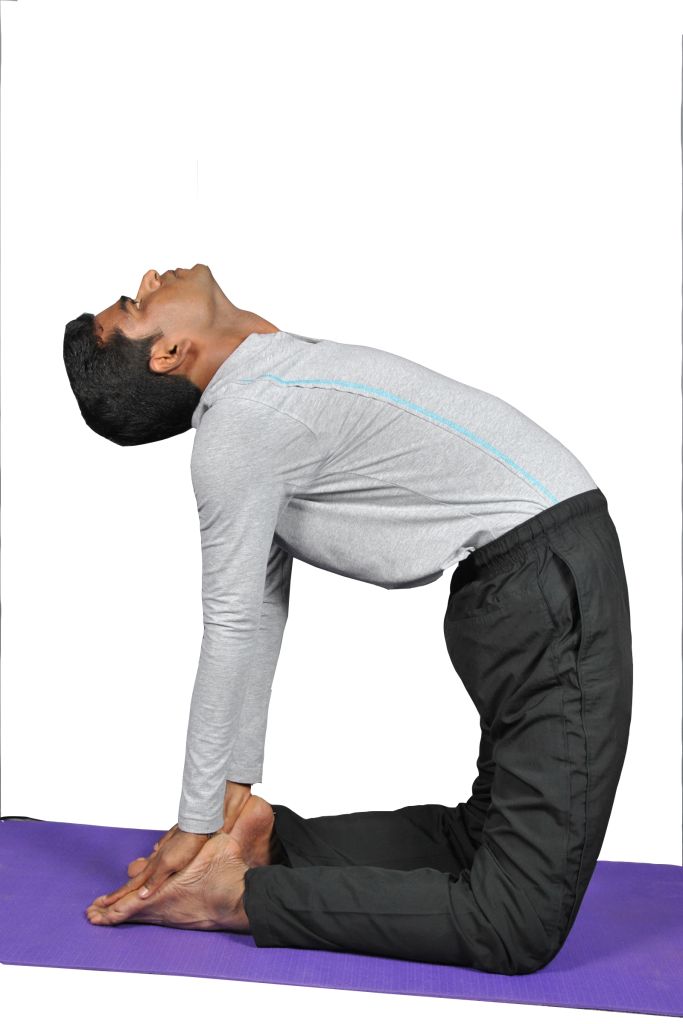
It is classified as:
- A deep heart-opener
- A front-body opener
- A backbending posture
- A kneeling foundation pose
- A pose that enhances lung capacity and spinal mobility
When executed properly, Ustrasana distributes the backbend evenly across the spine, opens the throat, chest, abdomen, hip flexors, and shoulders, while grounding through the legs for stable support.
3. METHOD OF PRACTICE (STEP-BY-STEP)
A. Traditional Ustrasana (Full Camel Pose)
- Start in Vajrasana (Thunderbolt Pose).
Sit on your heels with spine erect and breath steady. - Come into a high kneeling position.
Knees hip-width apart, thighs vertical, toes pointing straight back. - Place hands on the sacrum.
Fingers pointing downward; draw elbows inward. - Lift the sternum upward.
Encourage thoracic extension before attempting lumbar extension. - Engage the thighs.
Press shins down, activate quads, and lengthen through psoas. - Begin backward journey.
Inhale, expand chest; exhale slightly and lean back from the thoracic spine. - Reach one hand at a time to the heels.
If necessary, tuck toes to bring heels closer. - Open the chest fully.
Lift sternum; lengthen spine; avoid compressing the lower back. - Drop the head back gently.
Or keep neck neutral if cervical extension feels unsafe. - Maintain the posture.
Breathe deeply for 5–10 breaths while stabilizing thighs. - Exit safely.
Bring hands to sacrum, chin to chest, and rise slowly.
4. ALIGNMENT CUES
For Lower Body
- Knees hip-width apart, not wider.
- Thighs vertical like two pillars.
- Press shins down for grounding.
- Avoid squeezing glutes excessively (causes lumbar compression).
- Slight internal rotation of thighs reduces sacroiliac strain.
For Pelvis
- Neutral pelvis—not tucking or thrusting forward dramatically.
- Pubic bone gently lifts toward navel to support lower back.
For Spine
- Initiate the backbend from the upper back, not lower back.
- Imagine sternum lifting to sky.
- Keep lumbar area long; avoid collapsing.
For Chest & Shoulders
- Broaden collarbones.
- Rotate shoulders back and down.
- Avoid flaring ribs aggressively.
For Neck
- Lengthen cervical spine.
- Option: Neutral neck if dizziness occurs.
5. BENEFITS OF USTRASANA
Physical Benefits
- Spinal mobility: Enhances thoracic extension.
- Improves posture: Opens rounded shoulders.
- Opens front body: Stretches chest, abdomen, hip flexors, and quadriceps.
- Strengthens back body: Engages spinal extensors and glutes.
- Expands lungs: Improves respiratory capacity.
- Stimulates digestive organs: Gentle abdominal stretch promotes motility.
- Strengthens pelvic floor and core stabilizers.
Energetic (Pranic) Benefits
- Opens Anahata Chakra (Heart chakra)
- Stimulates Vishuddhi Chakra (Throat chakra)
- Enhances emotional release and heart-opening qualities
Psychological Benefits
- Reduces anxiety and emotional rigidity
- Encourages confidence, courage, and energy
- Improves mental clarity
6. CONTRAINDICATIONS
Avoid or modify in the following situations:
- Severe lower-back pain or lumbar disc issues
- Cervical spondylosis
- Knee injury or surgery
- Vertigo, migraine, or dizziness
- High or low blood pressure (caution)
- Hernia or abdominal surgery recovery
- Pregnancy (especially advanced stages)
The focus is always on safety and individual anatomical needs.
7. COUNTERPOSES
After Ustrasana, the spine requires neutralization.
Recommended counterposes include:
- Balasana (Child’s Pose) — safest immediate counterpose
- Adho Mukha Virasana
- Vajrasana
- Supta Baddha Konasana (gentle opening)
- Marjaryasana–Bitilasana (Cat–Cow)
- Forward bends such as Paschimottanasana
- Apanasana (Knees-to-chest)
These help reverse the extension and restore neutrality.
8. PREPARATORY PRACTICES
A. Warm-Up Poses
- Cat–Cow
- Low lunges
- Shoulder rolls
- Dynamic chest opening
B. Hip Flexor Openers
- Anjaneyasana
- Supta Virasana
- Setu Bandhasana (Bridge Pose)
C. Thoracic Mobility Work
- Sphinx Pose
- Cobra (Bhujangasana)
- Puppy Pose (Uttana Shishosana)
D. Quadriceps Stretching
- Hero Pose
- Standing quad stretch
E. Spinal Strengthening
- Shalabhasana
- Dhanurasana (modification)
Preparing the spine and front body ensures a safe experience and reduces injury risk.
9. MODIFICATIONS OF USTRASANA
1. Toes-Tucked Variation
For students with tight quadriceps or reduced spinal mobility
→ makes heels higher and easier to reach.
2. Hands-on-Sacrum Variation
Used for beginners or those who cannot reach heels.
Provides lift and stability.
3. Ardha Ustrasana (Half Camel Pose)
One arm reaches heel while opposite arm extends upward.
4. Wall-supported Ustrasana
Back of pelvis touches a wall for stability and reduced lumbar compression.
5. Chair-Assisted Camel
Hands grip a chair behind for support; ideal for seniors, overweight students, or those with weak back muscles.
6. Block Between Thighs
Encourages activation of adductors and prevents splaying knees.
7. Using Bolster Behind
Hands rest on a bolster instead of heels.
Each modification makes Ustrasana accessible to different body types.
10. MUSCLES INVOLVED
A. Muscles Stretched
- Quadriceps group (rectus femoris)
- Psoas major
- Iliacus
- Abdominals (rectus abdominis)
- Intercostals
- Sternocleidomastoid (neck extension)
- Serratus anterior
B. Muscles Strengthened
- Erector spinae
- Gluteus maximus (mild activation)
- Hamstrings (stabilization)
- Adductors (thigh stability)
- Rhomboids & middle trapezius
- Posterior deltoids
C. Stabilizing Muscles
- Transverse abdominis
- Multifidus
- Pelvic floor muscles
- Deep spinal stabilizers
11. KINESIOLOGY
In Ustrasana, the primary movements occur in the:
A. Spine
- Thoracic extension
- Lumbar extension (controlled, not excessive)
- Cervical extension (optional)
B. Hips
- Slight hip extension
- Lengthening of hip flexors
C. Knees
- Deep flexion (close to 130° – 140°)
D. Shoulders
- Extension and external rotation
- Scapular retraction
Kinesiological Summary
Ustrasana combines spinal extension + hip extension + shoulder flexion/extension depending on arm placement. It requires coordinated eccentric lengthening (front body) and concentric contraction (back body).
12. KINEMATICS OF USTRASANA
Kinematics deals with movement quality and joint sequencing.
A. Movement Sequence
- The pose begins with an upward lift through the sternum.
- Thoracic vertebrae extend first.
- Lumbar spine extends gradually.
- Hip flexors lengthen eccentrically.
- Shoulders externally rotate.
- Pelvis stays neutral, preventing lumbar compression.
B. Axes and Planes
- Movement occurs in the sagittal plane
- Around a transverse axis (spinal extension arc)
C. Distribution Goal
Balanced extension across all vertebral segments, not collapsing into L4–L5 region.
D. Breath-Driven Kinematics
- Inhale → lifts sternum → increases thoracic extension
- Exhale → deepens hip opening and stabilizes core
13. BIOMECHANISM OF USTRASANA
Biomechanics explains force, leverage, and load distribution.
A. Base Support
- Knees and shins form a stable base.
- Pressing shins firmly reduces load on knees.
B. Force Lines
- Upward force from core + chest
- Downward force from shins
- Backward arc through spine
C. Avoiding Compression
- Too much lumbar thrust → facet joint compression
- Incorrect pelvis tilt → sacroiliac strain
- Over-extension in cervical spine → nerve irritation
D. Key Biomechanical Principles
- Thoracic extension must lead.
- Hip flexors must lengthen.
- Rib cage must not flare excessively.
- Core must stabilize the lumbar area.
E. Scapulothoracic Mechanics
- Scapula retract + depress for shoulder extension
- Opens clavicular head of pectoralis major
14. FUNCTIONAL ANATOMY AND PHYSIOLOGY
A. Respiratory System
- Expands rib cage
- Increases lung capacity
- Improves diaphragm mobility
B. Cardiovascular System
- Increases blood flow to thoracic cavity
- Stimulates sympathetic nervous activity (energizing)
C. Digestive System
- Stretches abdominal organs
- Stimulates peristalsis
D. Endocrine System
- Opens throat — influencing thyroid region
- Chest opening affects thymus area
E. Nervous System
- Deep backbends activate sympathetic system
- When balanced with breath → induces emotional release
F. Musculoskeletal System
- Improves posture
- Strengthens rear chain
- Enhances spinal integrity
15. HOW TO TEACH, CORRECT, AND ADJUST USTRASANA
A. Teaching Methodology
- Start with warm-ups: lunges, cat–cow, chest expansion.
- Explain purpose: heart opener, thoracic extension.
- Demonstrate slowly.
- Emphasize safety in lumbar region.
- Use props early.
- Build progressively: hands on sacrum → toes tucked → full expression.
B. Common Mistakes and Corrections
1. Collapsing into the lower back
Correction:
- Cue to lift sternum and engage core.
- Use hands on sacrum instead of heels.
2. Knees splaying outward
Correction:
- Place block between thighs.
- Cue inner thigh activation.
3. Over-extending neck
Correction:
- Keep cervical spine neutral.
4. Hips pushing too far forward
Correction:
- Cue “hips over knees,” not in front of them.
C. Safe Hands-On Adjustments
1. Pelvis Stabilization
Stand behind student.
Place hands gently on sides of pelvis.
Cue: “Lift your sternum upward.”
2. Thoracic Lift
Hands under the student’s shoulder blades.
Guide chest upward, not backward.
3. Heel Support Adjustment
Help student place hands on blocks or bolster behind heels.
Safety Guidelines
- Do not push student deeper into backbend.
- Always ask consent.
- Avoid touching vulnerable areas like lower ribs or lumbar region.
16. VARIATIONS OF USTRASANA (DETAILED)
A. Ardha Ustrasana (Half Camel)
- One hand on heel, other arm extended upward
- Reduces strain
- Great preparatory version
B. Ustrasana with Toes Tucked
- Heels elevated
- Ideal for beginners with limited spinal mobility
C. Ustrasana with Hands on Hips
- Builds awareness of thoracic extension
- Strengthens back muscles
D. Wall-Assisted Camel
- Back touches wall
- Prevents excessive spinal collapse
E. Chair Camel Variation
- Hands on chair behind body
- Reduces need for deep knee flexion
- Supports elderly or injured students
F. Dynamic Camel Flow
- Inhale: rise
- Exhale: lean back
- Enhances thoracic mobility
G. Supported Camel with Bolster
- Bolster behind heels rises the floor
- Good for limited shoulder mobility
17. DEEPER PHILOSOPHICAL & MINDFULNESS ASPECTS
Traditional yoga considers backbends as postures that:
- awaken dormant energy
- open emotional blockages
- foster courage and vulnerability
- invite compassion and self-acceptance
Ustrasana, as a heart-opening pose, exposes the chest and throat — symbolically expressing trust, surrender, and emotional openness.
18. CONCLUSION
Ustrasana is one of the most significant heart-opening postures in the yoga tradition. When practiced with anatomical intelligence and mindful alignment, it offers immense physical, psychological, and energetic benefits. It builds strength in the posterior chain, opens the entire front body, and improves postural habits.
The posture demands a balanced distribution of spinal extension, strong thigh engagement, active core stabilization, and steady breath. With proper modification and guidance, Ustrasana becomes accessible, therapeutic, and transformative for practitioners of all levels.
Understanding the kinesiology, biomechanics, functional anatomy, and safe teaching methodology ensures that the posture is not only beautiful but also sustainable and injury-free. Ustrasana teaches openness, resilience, and the courage to embrace life fully.
QUESTION AND ANSWER
1. What is the literal meaning of the Sanskrit word “Ustrasana”?
a) Cow pose
b) Camel pose
c) Lion pose
d) Horse pose
Answer: b
2. Ustra in Sanskrit refers to which animal?
a) Bull
b) Wolf
c) Camel
d) Monkey
Answer: c
3. Ustrasana primarily belongs to which category of asanas?
a) Forward bends
b) Backbends
c) Twisting postures
d) Balancing postures
Answer: b
4. Ustrasana is traditionally practiced in which base position?
a) Standing
b) Supine
c) Kneeling
d) Seated
Answer: c
5. Which spinal movement is dominant in Ustrasana?
a) Flexion
b) Hyperextension
c) Rotation
d) Lateral flexion
Answer: b
6. Which region of the spine experiences the most controlled extension in proper alignment?
a) Sacral
b) Lumbar
c) Thoracic
d) Cervical
Answer: c
7. In Ustrasana, the thighs should remain:
a) Rotated externally
b) Rotated internally
c) Neutral rotation
d) Strongly abducted
Answer: c
8. What action protects the lumbar spine?
a) Engaging glutes excessively
b) Engaging lower abdominals
c) Dropping the head back
d) Pushing hips backward
Answer: b
9. What is the correct placement of knees?
a) Wider than hips
b) Narrower than hips
c) Hip-width apart
d) Touching
Answer: c
10. Which muscle group stretches deeply in Ustrasana?
a) Hamstrings
b) Hip flexors
c) Rotator cuff
d) Adductors
Answer: b
11. Which muscle group contracts to extend the spine?
a) Quadriceps
b) Erector spinae
c) Gluteus minimus
d) Adductors
Answer: b
12. Which part of the chest benefits the most?
a) Lower lungs
b) Middle and upper chest
c) Only the diaphragm
d) Side ribs
Answer: b
13. Excess pressure on lumbar vertebrae occurs when:
a) Hips move forward
b) Glutes are lightly engaged
c) Chest lifts upward
d) Hips fall behind knees
Answer: d
14. A common mistake is:
a) Keeping thighs perpendicular
b) Lifting sternum
c) Compressing the lower back
d) Lengthening the neck
Answer: c
15. Which is not a typical benefit of Ustrasana?
a) Improved digestion
b) Strengthening back muscles
c) Enhanced lung capacity
d) Overstretching the hamstrings
Answer: d
16. Ustrasana strongly stimulates which chakra?
a) Muladhara
b) Anahata
c) Manipura
d) Ajna
Answer: b
17. Which is a contraindication for deep Ustrasana?
a) Mild shoulder tightness
b) Knee surgery
c) Healthy spine
d) Slight fatigue
Answer: b
18. Which variation is easier?
a) Full Ustrasana with heels
b) Hands on lower back
c) Thighs wide
d) Backbend on toes
Answer: b
19. Which variation makes the pose deeper?
a) Supported camel (blocks)
b) Half camel
c) Dropping head fully back
d) Dynamic camel
Answer: c
20. The safest neck position is:
a) Compression into cervical curve
b) Excessive extension
c) Neutral or slightly extended
d) Chin tightly tucked
Answer: c
21. Which cue helps prevent knee strain?
a) Knees wider than hips
b) Press shins down
c) Shift weight backward
d) Tighten hamstrings
Answer: b
22. What action opens the thoracic cage?
a) Drawing elbows inward
b) Lifting the sternum upward
c) Holding breath
d) Dropping shoulders forward
Answer: b
23. Engaging the quadriceps helps because:
a) It protects cervical muscles
b) It stabilizes knees and hips
c) It stretches the arms
d) It rotates the spine
Answer: b
24. What is the ideal breathing pattern?
a) Inhale fully before backbend
b) Hold breath
c) Exhale into collapse
d) Shallow breathing
Answer: a
25. Which muscle lengthens most in thighs?
a) Hamstrings
b) Quadriceps
c) Gastrocnemius
d) Hip flexors
Answer: d
26. What is the safest exit from the pose?
a) Drop hips back suddenly
b) Relax glutes completely
c) Lift chest first, then come up
d) Twist the spine out
Answer: c
27. Which is a good counterpose?
a) Chakrasana
b) Balasana
c) Utkatasana
d) Vasisthasana
Answer: b
28. Which joint experiences extension?
a) Wrist
b) Knee
c) Spine
d) Ankle
Answer: c
29. Which joint behaves isometrically?
a) Shoulder joint
b) Knee joint
c) Thoracic spine
d) Quadriceps
Answer: b
30. Which shoulder cue is correct?
a) Elevate shoulders toward ears
b) Roll shoulders back and down
c) Round upper back
d) Collapse chest
Answer: b
31. Which version is best for beginners?
a) Full camel
b) Dynamic paired camel
c) Hands on sacrum
d) One-arm camel
Answer: c
32. Which muscle engages to stabilize pelvis?
a) Gluteus medius
b) Serratus anterior
c) Biceps brachii
d) Tibialis anterior
Answer: a
33. If the student feels pinching in lower back, the teacher should cue:
a) Push hips backward
b) Lift sternum and engage core
c) Drop the head further
d) Bend the knees
Answer: b
34. What movement of the scapulae supports chest opening?
a) Protraction
b) Retraction
c) Elevation
d) Depression only
Answer: b
35. What modification helps students with tight quadriceps?
a) Feet turned outward
b) Toes tucked
c) Knees touching
d) Arms overhead
Answer: b
36. Which structure should never bear weight?
a) Spine
b) Heel
c) Neck
d) Shins
Answer: c
37. Which tissue is mainly lengthened in hip flexors?
a) Iliopsoas
b) Gluteus medius
c) Hamstrings
d) Tensor fascia lata
Answer: a
38. Over-engaging glutes may cause:
a) Knee protection
b) Lumbar compression
c) Core stability
d) Chest lifting
Answer: b
39. Students with spondylolisthesis should:
a) Avoid deep backbends
b) Practice daily camel
c) Drop head fully
d) Use hand support
Answer: a
40. Which movement initiates entering the pose?
a) Push hips back
b) Lift chest upward
c) Bend elbows
d) Round spine
Answer: b
41. What plane of movement is Ustrasana primarily in?
a) Transverse
b) Frontal
c) Sagittal
d) Horizontal
Answer: c
42. What is the typical breathing focus?
a) Belly breathing
b) Thoracic expansion
c) Breath retention
d) Reverse breathing
Answer: b
43. Which prop helps beginners?
a) Bolster under chest
b) Blocks beside ankles
c) Belt around thighs
d) All of the above
Answer: d
44. What direction should the pelvis move?
a) Posterior tilt
b) Anterior tilt
c) Strong lateral tilt
d) Neutral tilt with lift
Answer: d
45. In full camel, palms press onto:
a) Knees
b) Ankles or heels
c) Lower back
d) Shins
Answer: b
46. What ensures spinal decompression?
a) Breathing deeply
b) Engaging core and lifting sternum
c) Dropping belly
d) Overarching lumbar spine
Answer: b
47. Which is the safest exit cue?
a) Head first
b) Chest first
c) Hips first
d) Arms first
Answer: b
48. Which energy center is opened the most?
a) Root
b) Sacral
c) Heart
d) Crown
Answer: c
49. Which physiological system benefits greatly?
a) Urinary
b) Respiratory
c) Reproductive
d) Integumentary
Answer: b
50. Which is not advised for beginners?
a) Using blocks
b) Support on sacrum
c) Dynamic warm-ups
d) Forcing hands to heels
Answer: d