
1. Introduction
Yoga, an ancient system of holistic well-being, emphasizes asanas to balance body, mind, and breath. Among restorative postures, Balasana (Child’s Pose) holds a significant place due to its gentle stretch, calming effect, and meditative quality.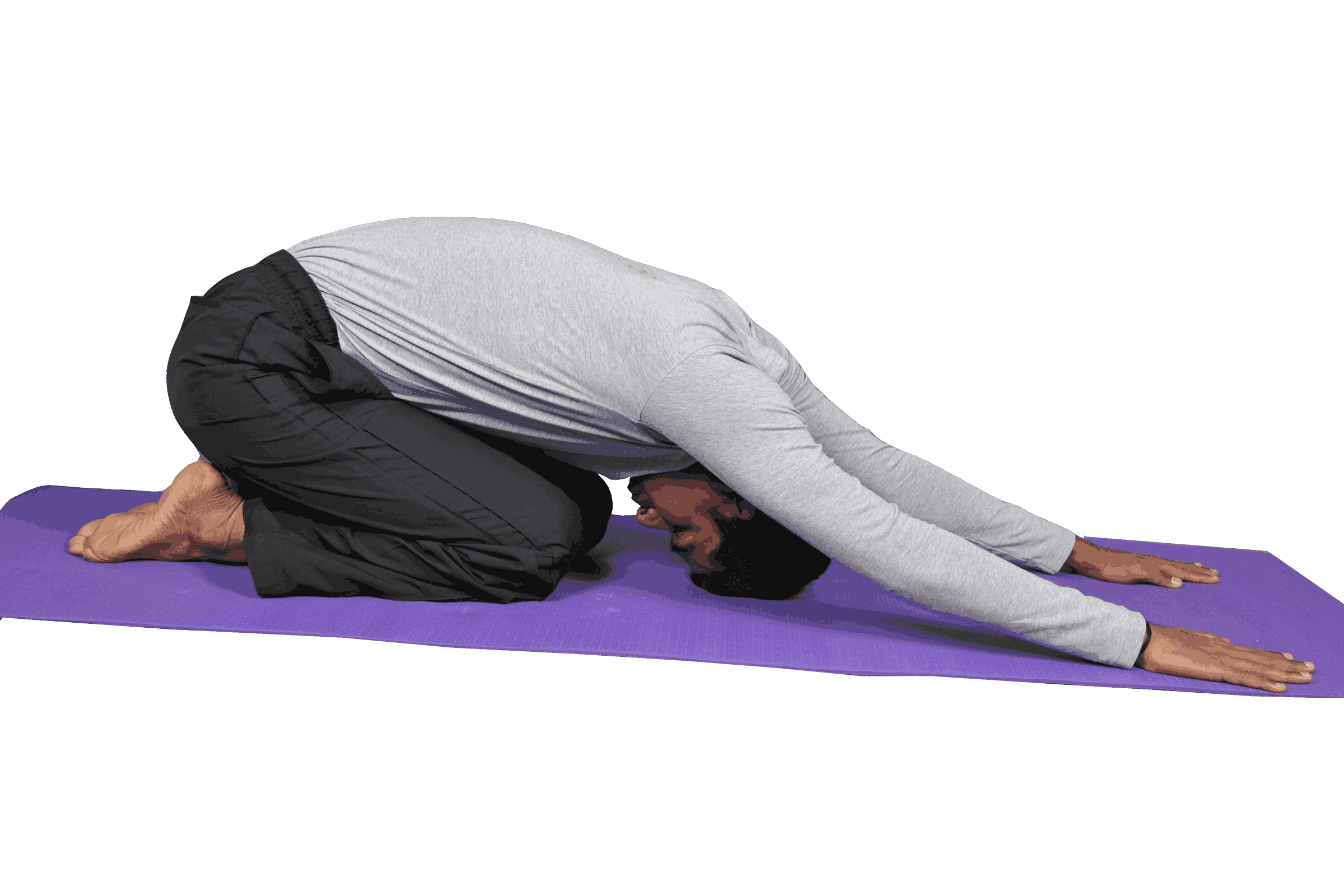
Balasana is widely practiced as a restorative pose, commonly used to release tension, counteract fatigue, and prepare for more strenuous asanas. It is a foundational posture in Hatha, Iyengar, and therapeutic yoga practices, often integrated into sequences as a recovery and grounding posture.
2. Word Meaning and Etymology
The Sanskrit term Balasana is derived from:
- Bala – Child
- Asana – Pose
Hence, Balasana translates as “Child’s Pose”, symbolizing innocence, surrender, and restful introspection. Its shape mimics the fetal position, encouraging relaxation and inward focus.
3. Definition of Balasana
Balasana is a restorative, kneeling forward fold where the practitioner sits on the heels, folds the torso forward, and rests the forehead on the mat while arms can be positioned forward, alongside the body, or extended backward.
Classical Definition:
Balasana is a gentle forward-bending, restorative asana that stretches the spine, hips, and shoulders, while promoting physical relaxation and mental calmness.
4. Method of Practice: Step by Step
Step 1: Starting Position
- Begin in Virasana (kneeling) or Vajrasana (seated on heels).
Step 2: Fold Forward
- Exhale, fold the torso forward over thighs.
- Bring the forehead to the mat or a prop if necessary.
Step 3: Arm Positioning
- Option 1: Extend arms forward alongside ears for an active stretch.
- Option 2: Place arms alongside the body with palms upward for a restorative variation.
Step 4: Hip & Leg Alignment
- Buttocks rest on heels; knees may be together or apart for comfort.
- Ankles relaxed, tops of feet flat on mat.
Step 5: Spine & Head
- Spine lengthened, chest resting on thighs, forehead on floor.
Step 6: Breathing
- Inhale and exhale slowly and deeply, focusing on relaxation and calmness.
Step 7: Duration
- Hold for 30 seconds to 5 minutes, extending gradually for meditation or restorative practice.
Step 8: Release
- Slowly lift the torso and return to kneeling or seated position.
5. Alignment Cues
- Knees: Together or slightly apart; adjust for comfort.
- Hips: Resting on heels; use prop if needed.
- Spine: Elongated from sacrum to crown.
- Arms: Extended forward or alongside body; relaxed.
- Shoulders: Relaxed, away from ears.
- Head & Neck: Forehead on mat or support; neck neutral.
6. Benefits of Balasana
Physical Benefits:
- Gently stretches spine, shoulders, hips, knees, and ankles.
- Promotes spinal alignment and posture awareness.
- Relieves tension in back, neck, and shoulders.
Mental & Emotional Benefits:
- Reduces stress, anxiety, and fatigue.
- Enhances mindfulness and inward focus.
- Cultivates sense of grounding, calmness, and surrender.
Physiological Benefits:
- Supports digestion and circulatory flow to abdominal organs.
- Stimulates the parasympathetic nervous system, promoting relaxation.
- Can relieve headaches and mild back pain.
7. Contraindications
- Knee injuries: Modify with cushion between thighs and heels.
- Ankle injuries: Support ankle and top of feet with props.
- Pregnancy (late stages): Widen knees for comfort; avoid pressure on abdomen.
- Severe lower back or hip injuries: Use props or avoid deep forward fold.
8. Counterposes
- Bhujangasana (Cobra Pose) – gently counteracts forward fold
- Setu Bandhasana (Bridge Pose) – stretches anterior chain
- Tadasana (Mountain Pose) – resets posture and balance
- Savasana (Corpse Pose) – for complete relaxation
9. Preparatory Practice
- Vajrasana / Hero’s Pose – familiarizes with kneeling
- Cat-Cow (Marjaryasana-Bitilasana) – mobilizes spine
- Anjaneyasana (Low Lunge) – prepares knees and hip flexors
- Thread the Needle Pose – prepares shoulders and back
10. Modifications
- Beginner: Use folded blanket under buttocks or forehead for comfort.
- Intermediate: Knees apart for deeper hip opening; arms extended forward.
- Advanced: Extend arms fully forward with forehead to mat; focus on deep breathing.
- Pregnancy / Injury Adaptation: Widen knees; support chest and head with bolster or cushion.
11. Muscles Involved
Primary Muscles Stretched:
- Erector spinae (spine)
- Latissimus dorsi (back and shoulders)
- Gluteus maximus (hips)
- Quadriceps (knees)
- Ankle dorsiflexors
Primary Muscles Engaged:
- Core stabilizers (transverse abdominis, obliques)
- Pelvic floor muscles
- Shoulder stabilizers (if arms extended)
Secondary Muscles:
- Neck extensors
- Chest (pectorals)
- Hip adductors and abductors (depending on knee position)
12. Kinesiology
- Hip Joint: Flexion as thighs meet torso
- Knee Joint: Flexed, bearing weight of buttocks
- Ankle Joint: Plantarflexed, tops of feet on mat
- Shoulder Joint: Flexion if arms forward, or neutral if arms alongside body
- Spine: Forward flexion with slight spinal elongation
13. Kinematics
- Weight Distribution: Distributed between knees, shins, and sometimes forearms.
- Range of Motion (ROM):
- Hip flexion: ~120°
- Knee flexion: ~135°
- Shoulder flexion: 0–180° depending on arm position
- Center of Mass: Low, over knees and shins
14. Biomechanism
- Load Bearing: Knees, shins, and feet stabilize body weight
- Joint Stabilization: Core and lower limb muscles provide balance
- Spinal Mechanics: Spine elongates, reducing compressive forces
- Circulatory Impact: Supports blood flow to abdominal organs and extremities
- Nervous System: Activates parasympathetic response, enhancing relaxation
15. Functional Anatomy & Physiology
- Musculoskeletal Function: Stretches back, shoulders, hips; strengthens core stabilizers
- Neuromuscular Coordination: Improves proprioception and body awareness
- Digestive System: Gentle compression of abdomen aids digestion
- Respiratory System: Encourages diaphragmatic, deep breathing
- Neurological Effect: Reduces stress, improves mental focus, promotes relaxation
16. How to Correct and Adjust While Teaching
Common Errors & Corrections:
- Buttocks lifted from heels: Use blanket under pelvis; cue to sit back
- Knees too tight causing discomfort: Separate knees slightly
- Shoulders tense / elevated: Cue to relax shoulders, extend arms gently
- Forehead not touching floor: Use block, bolster, or folded blanket
Hands-on Adjustments:
- Guide pelvis onto heels for stability
- Support forehead with cushion if needed
- Align arms for comfort and stretch
Verbal Cues:
- “Relax your torso, allow your spine to lengthen”
- “Soften shoulders and release tension”
- “Breathe slowly and feel your body grounded”
17. Conclusion
Balasana (Child’s Pose) is a restorative, grounding, and meditative asana suitable for all levels. It gently stretches the back, hips, shoulders, and knees, while promoting relaxation, focus, and parasympathetic activation.
With attention to alignment, modifications, and preparatory practices, Balasana serves as an essential pose in yoga sequences for recovery, meditation, and therapeutic interventions. Its symbolic representation of the child fosters surrender, introspection, and mental calmness, making it a cornerstone of restorative yoga practice.
QUESTION AND ANSWER
1. Basic Knowledge
- The Sanskrit meaning of Balasana is:
A) Warrior Pose
B) Bow Pose
C) Child’s Pose ✅
D) Thunderbolt Pose - Balasana is primarily classified as:
A) Restorative kneeling forward fold ✅
B) Standing balance pose
C) Supine backbend
D) Arm balance - The primary use of Balasana in yoga is:
A) Meditation and relaxation ✅
B) Strengthening arms
C) Jumping and balancing
D) High-intensity cardio - Balasana is symbolically meant to represent:
A) Strength and power
B) Surrender and introspection ✅
C) Speed and agility
D) Victory
2. Alignment & Technique
- In Balasana, the knees should be:
A) Together or slightly apart ✅
B) Fully apart with legs crossed
C) Locked straight
D) Bent backward - The hips should:
A) Rest on heels ✅
B) Lift off the heels
C) Rotate forward
D) Hyperextend - The spine in Balasana should be:
A) Slouched
B) Elongated and relaxed ✅
C) Hyperextended
D) Twisted - The arms can be positioned:
A) Alongside body or extended forward ✅
B) Always overhead
C) Crossed behind back
D) Bent backward - The forehead should:
A) Touch the mat or a prop ✅
B) Remain elevated
C) Turn sideways only
D) Rest on hands only
3. Muscles Involved
- Primary muscles stretched in Balasana:
A) Erector spinae, latissimus dorsi, gluteus maximus ✅
B) Only biceps
C) Forearm muscles
D) Neck flexors only - Primary muscles engaged for stabilization:
A) Core muscles (transverse abdominis, obliques) ✅
B) Only calves
C) Only quadriceps
D) Only trapezius - Secondary muscles stretched:
A) Shoulders, chest, hip adductors ✅
B) Biceps only
C) Forearms only
D) Neck only - Knee and ankle joints experience:
A) Flexion and gentle stretch ✅
B) Full extension
C) Hyperextension
D) None
4. Kinesiology & Biomechanics
- Hip joint action in Balasana:
A) Flexion ~120° ✅
B) Extension
C) Abduction only
D) Rotation only - Knee joint action:
A) Flexed, supporting body weight ✅
B) Fully extended
C) Hyperextended
D) Locked - Shoulder joint action (if arms forward):
A) Flexion ✅
B) Extension only
C) Abduction only
D) Rotation only - Type of posture:
A) Restorative forward fold ✅
B) Standing balance
C) Arm balance
D) Supine pose
5. Benefits
- Physical benefits include:
A) Stretches back, shoulders, hips, knees; relieves tension ✅
B) Strengthens arms only
C) Improves vision
D) Only stretches calves - Mental benefits include:
A) Reduces stress and anxiety ✅
B) Increases mental tension
C) Reduces focus
D) No effect - Physiological benefits:
A) Stimulates parasympathetic nervous system ✅
B) Compresses spine
C) Reduces circulation
D) Weakens core - Recommended duration for beginners:
A) 30 seconds to 3 minutes ✅
B) 10 seconds
C) 15 minutes only
D) 1 hour
6. Contraindications
- Avoid Balasana in:
A) Knee injuries ✅
B) Healthy knees
C) Normal flexibility
D) None - Late-stage pregnancy modifications:
A) Widen knees, support abdomen with props ✅
B) Keep knees together
C) Avoid forehead support
D) Fully fold forward - Severe ankle injuries:
A) Use cushion under ankles ✅
B) Sit directly on mat
C) Keep weight fully on toes
D) Lock ankles - Severe lower back pain:
A) Use support under torso ✅
B) Fold fully without support
C) Hyperextend spine
D) Twist torso
7. Preparatory & Counter Poses
- Preparatory poses:
A) Vajrasana, Cat-Cow, Thread the Needle, Low Lunge ✅
B) Shoulderstand only
C) Tree Pose only
D) Forward fold standing only - Counterposes:
A) Bhujangasana (Cobra), Setu Bandha (Bridge), Tadasana ✅
B) Another forward fold
C) Side plank only
D) Warrior I only
8. Modifications
- Beginner modification:
A) Use folded blanket under buttocks or forehead ✅
B) Lift pelvis
C) Fold forward fully
D) Cross arms behind back - Arm variation:
A) Arms alongside body for relaxation ✅
B) Always overhead
C) Always forward
D) Bent backward - Advanced variation:
A) Arms extended forward, forehead to mat, deep breathing ✅
B) Stand up immediately
C) Lift torso slightly
D) Fold knees outward - Injury adaptation:
A) Use props to support knees, forehead, or torso ✅
B) Avoid support
C) Hyperextend knees
D) None
9. Teaching & Adjustments
- Common error: Buttocks lifted off heels. Correction:
A) Use blanket or prop under pelvis ✅
B) Ignore and continue
C) Lift torso higher
D) Widen arms - Shoulder tension correction:
A) Relax shoulders, extend arms gently ✅
B) Shrug shoulders
C) Fold arms tightly
D) Cross arms behind back - Forehead not touching mat correction:
A) Use block or folded blanket ✅
B) Turn head to side forcibly
C) Keep head elevated
D) Press hands under forehead - Verbal cue for spinal elongation:
A) “Lengthen your spine forward and relax torso” ✅
B) “Round your back completely”
C) “Lift your shoulders to ears”
D) “Twist your torso”
10. Functional Anatomy & Physiology
- Primary muscles stretched:
A) Erector spinae, latissimus dorsi, gluteus maximus ✅
B) Quadriceps only
C) Neck flexors only
D) Forearms only - Core muscles activated:
A) Transverse abdominis, obliques, pelvic floor ✅
B) Only biceps
C) Only trapezius
D) None - Neurological benefits:
A) Reduces stress, improves focus and proprioception ✅
B) Increases anxiety
C) Reduces concentration
D) None - Circulatory effect:
A) Enhances blood flow to abdominal organs ✅
B) Reduces circulation
C) Only affects arms
D) None - Joint stabilization primarily at:
A) Knees, ankles, hips ✅
B) Elbows only
C) Neck only
D) Shoulders only