
1. Word Meaning & Introduction
The Sanskrit word Samasthiti comes from:
- Sama = equal, balanced, steady, stable
- Sthiti = standing, state, position, stability, establishment
Thus, Samasthiti means “equal standing” or “established in steadiness.”
It refers to a state of stable, quiet, attentive standing where the body, breath, and awareness align in harmony. Samasthiti is not merely a physical posture; it is a psychophysical state of equilibrium. In many yoga schools—Hatha, Ashtanga, Vinyasa—it is the foundational position from which most standing postures originate and return.
In classical yoga, Samasthiti is viewed as a gateway to awareness, teaching the practitioner to stand consciously, recognizing habitual imbalances and correcting them through mindful alignment. It is the foundation for posture, meditation, breath regulation, and mindful movement.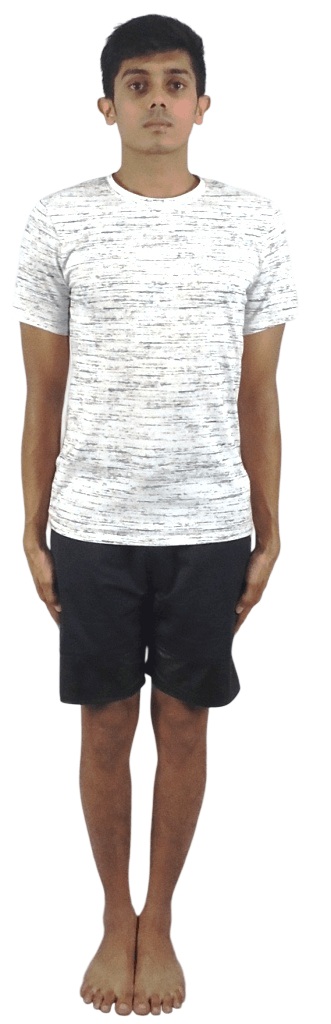
Even though Samasthiti appears simple, it requires refined neuromuscular coordination, balance, somatic awareness, and postural integrity. In essence, it is the blueprint for all standing positions.
2. Definition
Samasthiti is a balanced, neutral standing posture with feet grounded, spine aligned in its natural curves, pelvis neutral, chest open, shoulders relaxed, and awareness steady.
It is:
- A symmetrical posture with no rotation, flexion, or side bending
- A neutral, anatomical alignment of the musculoskeletal system
- A preparatory position used before and after asanas
- A stabilizing and centering pose
- A mindfulness training posture, cultivating presence and quietude
It may be performed:
- With feet together (traditional Ashtanga/Tadasana variation)
- With feet hip-width apart (therapeutic or beginner variation)
Though visually similar to Tadasana, Samasthiti emphasizes stillness, neutrality, and readiness—a poised, alert, meditative stance.
3. Method of Practice – Step-by-Step Technique
Step 1: Establishing the Base
- Stand upright with feet together or hip-width apart.
- Ground the feet evenly through:
- Base of big toe
- Base of little toe
- Inner and outer heels
- Spread the toes to activate intrinsic foot muscles.
- Distribute weight equally between:
- Right and left foot
- Front (ball) and back (heel)
- Inner and outer edges
Step 2: Organizing the Legs
- Engage the arches slightly, lifting them naturally.
- Draw kneecaps up gently without locking the knees.
- Activate quadriceps lightly; keep hamstrings receptive.
- Maintain micro-bend or neutral knee extension.
Step 3: Aligning the Pelvis
- Balance the pelvis in a neutral position:
- Not tilting forward (anterior tilt)
- Not tucking excessively (posterior tilt)
- Engage lower abdominals (TVA) to stabilize lumbar spine.
Step 4: Spinal Organization
- Lengthen the spine while retaining natural curves.
- Lift through the sternum without flaring ribs.
- Widen collarbones; soften lower ribs inward.
- Reduce excessive lumbar arch.
Step 5: Shoulders and Arms
- Roll shoulders up, back, and down; allow them to relax.
- Arms hang naturally along the sides.
- Palms face thighs or slightly forward (anatomical position).
- Fingers relaxed, not rigid.
Step 6: Head, Neck & Gaze
- Balance the head over the spine—ears over shoulders.
- Lengthen back of neck slightly.
- Chin parallel to the floor.
- Gaze soft, straight ahead or slightly downward.
Step 7: Breath & Awareness
- Breathe naturally through the nose.
- Observe body alignment and sensations.
- Cultivate quiet, steady awareness—stillness in movement and breath.
4. Alignment Cues
Feet & Ankles
- “Press evenly through all four corners of the feet.”
- “Lift the arches without gripping.”
- “Spread your toes like they are waking up.”
Knees & Legs
- “Draw kneecaps up softly, avoid locking.”
- “Keep weight evenly distributed.”
Pelvis & Core
- “Neutral pelvis—imagine your pelvis as a bowl of water not spilling.”
- “Gently engage lower abs toward the spine.”
- “Lift from the pelvic floor.”
Spine
- “Grow tall from feet to crown.”
- “Lengthen through the sides of the waist.”
- “Soften lower ribs inward.”
Shoulders & Chest
- “Broaden the collarbones.”
- “Allow the shoulders to melt down the back.”
- “Heart open without leaning back.”
Head & Neck
- “Crown of head rising upward.”
- “Chin parallel to floor.”
- “Gaze soft, stable, and present.”
Awareness
- “Feel equal energy rising and grounding.”
- “Stand still but alive.”
- “Presence in every cell.”
5. Benefits of Samasthiti
Physical Benefits
- Improves overall posture and spinal alignment
- Strengthens feet, ankles, and legs
- Enhances weight distribution and balance
- Reduces muscular imbalances
- Improves proprioception and neuromuscular coordination
- Strengthens core stabilizers
- Aligns major joints (ankle-knee-hip-shoulder)
- Reduces strain on lower back
- Enhances breathing efficiency
- Corrects faulty posture patterns (kyphosis, lordosis, scoliosis tendencies)
Physiological Benefits
- Improves circulation
- Reduces sympathetic nervous system dominance
- Enhances parasympathetic activation
- Improves lung expansion
- Optimizes diaphragmatic function
- Enhances vestibular (inner ear) balance system
Mental & Emotional Benefits
- Improves concentration and mindfulness
- Encourages grounding and stability
- Reduces stress and anxiety
- Teaches presence and body awareness
- Promotes clarity of mind before practice
Energetic Benefits
- Balances pranic flow
- Grounding through Apana Vayu
- Uplifts energy through Udana Vayu
- Harmonizes Ida and Pingala nadi channels
6. Contraindications
Though Samasthiti is generally safe, caution in the following conditions:
Absolute Contraindications
- Severe foot injury
- Severe plantar fasciitis (without modification)
- Vertigo with risk of fall
- Severe balance disorders
Relative Contraindications
- Low blood pressure (risk of dizziness)
- Severe knee instability
- Acute ankle sprain
- Spinal injuries requiring special alignment
Beginners who cannot stand straight due to dizziness should rest or widen stance.
7. Counterposes
Samasthiti typically acts as a neutral base or midpoint; however, suitable counterposes include:
- Uttanasana (Forward Fold) – releases spine
- Tadasana – similar, but more active lift
- Shavasana standing / Mountain Pose
- Gentle side stretches
- Ankle mobility movements
Because Samasthiti is neutral, counterposes are mild and restorative.
8. Preparatory Practices
To prepare for Samasthiti:
Feet & Leg Conditioning
- Toe lifting exercises
- Ankle circles
- Foot grounding practice
- Calf raises
Core Activation
- Pelvic tilts
- TVA breathing
- Gentle standing abdominal engagement
Spinal Preparation
- Cat-cow
- Gentle thoracic extension
- Shoulder rolls
Balance Training
- Tree pose (Vrikshasana)
- Simple single-leg standing
- Weight shifting practice
9. Modifications & Variations
For Beginners
- Stand with feet hip-width apart
- Keep hands on hips to feel alignment
- Use a wall for support
For People with Balance Issues
- Stand near a wall or chair
- Slightly widen the base
For Foot Pain or Weak Arches
- Use a yoga mat or soft surface
- Engage feet gently
- Strengthening exercises recommended
Therapeutic Variation
- Hands on lower ribs to feel sternum lift
- Light core support
- Neutral spine focus
Advanced Variation
- Eyes closed to challenge proprioception
- Hands in Namaste to refine symmetry
- Deep internal awareness with subtle adjustments
10. Muscles Involved
Primary Muscles
- Quadriceps
- Hamstrings
- Gluteus medius and minimus
- Erector spinae
- Intrinsic foot muscles
- Tibialis anterior & posterior
- Gastrocnemius & soleus
- Transverse abdominis
- Multifidus
Secondary Muscles
- Obliques
- Rhomboids
- Middle and lower trapezius
- Serratus anterior
- Rectus abdominis
- Iliopsoas (postural)
Stabilizers
- Deep neck flexors
- Pelvic floor musculature
- Rotator cuff (postural stabilizers)
11. Kinesiology of Samasthiti
Kinesiologically, Samasthiti represents:
A Closed Kinetic Chain Activity
- Feet fixed on ground
- Movement rises upward through joints
- All muscle actions influence entire chain
Joint Kinematic Actions
- Ankle: Neutral dorsiflexion/plantarflexion
- Knee: Neutral extension
- Hip: Neutral rotation, no flexion/extension
- Spine: Neutral curves maintained
- Shoulder: Neutral
- Neck: Slight axial extension
Types of Muscle Contractions
- Isometric contractions in legs, core, and spine
- Eccentric control to prevent hyperextension or sway
- Co-contraction of agonist/antagonist pairs for stability
Movement Qualities
- Symmetrical
- Static
- Balanced
- Grounded yet uplifted
Kinesiology emphasizes stability, alignment, and vertical stacking.
12. Kinematics
Kinematics refers to the motion of joints without regard to forces.
In Samasthiti:
1. No Large Movements Occur
- Joints remain in anatomical neutral
- Minimal micro-adjustments maintain balance
2. Center of Gravity Alignment
- Stacked over base of support
- Increases efficiency of posture
- Reduces muscular overuse
3. Balanced Weight Distribution
- Prevents lateral or anterior deviations
- Avoids knee valgus/varus strain
4. Subtle Oscillatory Sway
- Natural micro-movements
- Controlled by neuromuscular coordination
- Important for maintaining posture
Kinematically, Samasthiti trains the body to find stillness through micro-motion.
13. Biomechanism / Biomechanics
1. Ground Reaction Force
- Feet press downward
- Body receives upward rebound force
- Creates vertical lift and elongation
2. Joint Stacking Efficiency
- Minimizes energy expenditure
- Distributes load evenly
- Reduces strain on single joints
3. Spine as Suspension System
- Balanced curves absorb shock
- Core muscles support spine
- Pelvic neutrality protects lumbar region
4. Balance & Proprioception
- Feet’s proprioceptors sense pressure
- Inner ear (vestibular) stabilizes head
- Visual system anchors the posture
5. Soft Tissue Mechanics
- Ligaments remain tension-free
- Fascia elongates smoothly
- Myofascial lines align (Superficial Back Line and Front Line)
Overall, Samasthiti is biomechanically efficient—using minimal energy to maintain vertical posture.
14. Functional Anatomy & Physiology
Foot & Ankle Function
- Foot arches lift and stabilize
- Subtalar joint maintains neutral pronation/supination
- Ankle dorsiflexors and plantarflexors co-contract
Knee Function
- Stabilized in neutral extension
- Quadriceps prevent collapse
- Hamstrings support back of knee
Hip & Pelvis Function
- Gluteus medius prevents side sway
- Hip rotators maintain neutral alignment
- Pelvic floor supports core
Spinal Function
- Erector spinae maintain extension
- TVA compresses abdominal cavity
- Multifidus stabilizes vertebrae
Shoulders & Upper Body
- Scapulae rest in neutral
- Thoracic spine lifts
- Neck aligns with gravity
Physiological Effects
- Reduces cortisol
- Balances autonomic nervous system
- Improves respiratory efficiency
- Increases blood flow to brain
- Enhances sensory integration
15. How to Correct and Adjust While Teaching
Verbal Cues
- “Spread your toes and root your feet.”
- “Lift through the crown of your head.”
- “Relax the shoulders.”
- “Draw the lower ribs gently inward.”
- “Balance your weight front-to-back.”
Visual Demonstration
- Demonstrate ideal posture
- Show common errors
- Provide mirror-based awareness (if available)
Physical Adjustments (Light & Safe)
- Feet:
- Pressing gently on outer heels to align arches
- Pelvis:
- Soft guidance to find neutral
- Shoulders:
- Gentle downward sweep to release tension
- Spine:
- Lifting sternum with fingertips
- Head/Neck:
- Light cue at occiput to elongate neck
Correction of Common Errors
- Hyperextended knees:
“Micro-bend your knees.” - Pelvic tilt (anterior):
“Engage lower belly.” - Rounded shoulders:
“Broaden collarbones.” - Uneven weight:
“Shift weight subtly until it feels equal.” - Head forward posture:
“Bring ears in line with shoulders.”
16. Common Mistakes and Their Solutions
Mistake 1: Locking the knees
- Causes hyperextension and strain
Solution: Micro-bend knees, activate quads lightly
Mistake 2: Pelvic tilt
- Excessive lordosis or flat back
Solution: Neutral pelvis cues
Mistake 3: Shoulders rising up
Solution: Roll shoulders down and back
Mistake 4: Collapsed arches
Solution: Lift inner arches, spread toes
Mistake 5: Rib flare
Solution: Draw ribs inward
Mistake 6: Forward chin/neck strain
Solution: Ears over shoulders; lengthen neck
17. Role of Samasthiti in Yoga Practice
- Acts as the starting and ending point for sequences
- Builds awareness of postural alignment
- Trains stillness and attention
- Develops somatic intelligence
- Enhances breath-body integration
- Provides a neutral reference for correcting other postures
In Ashtanga Vinyasa, Samasthiti is repeated throughout to maintain focus and reset alignment.
18. Energetic & Philosophical Insights
- Samasthiti symbolizes balance of opposites:
stability & fluidity, grounding & rising, strength & relaxation. - Represents Sthira Sukham Asanam (stable and comfortable posture).
- Trains equanimity (Samatvam) — mental balance.
- Teaches practitioner to become aware of habitual imbalances.
- Enhances presence, mindfulness, and meditative quality.
19. Conclusion
Samasthiti, though seemingly simple, is one of the most profound postures in yoga. It is the blueprint of all standing poses, a mirror of one’s habitual alignment, and a foundation for mindful embodiment. Through Samasthiti, practitioners learn to balance structural integrity with ease, grounding with elevation, and stillness with alertness.
The practice of Samasthiti cultivates:
- Anatomical alignment
- Energetic balance
- Breath connection
- Mental focus
- Spiritual grounding
It is a powerful reminder that stillness is not the absence of movement but the harmony of subtle internal forces. When practiced correctly and consciously, Samasthiti becomes a living experience of yoga—union of body, breath, and awareness.
QUESTION AND ANSWER
Section 1: Word Meaning & Definition
1. The Sanskrit term “Samasthitiḥ” primarily means:
a) Forward bend
b) Balanced standing
c) Deep relaxation
d) Side twist
Answer: b
2. “Sama” in Samasthiti translates to:
a) Strength
b) Equal or balanced
c) Expansion
d) Breath
Answer: b
3. Samasthiti is best described as:
a) A seated posture
b) A dynamic flow
c) A foundational neutral standing posture
d) A backbend
Answer: c
4. Samasthiti is considered the base alignment for:
a) Inversions
b) Surya Namaskar
c) Restorative poses
d) Pranayama only
Answer: b
5. Another common English name for Samasthiti is:
a) Mountain Pose
b) Equal Standing
c) Warrior Stance
d) Stillness Pose
Answer: b
Section 2: Method of Practice (Steps)
6. The first step in entering Samasthiti is usually:
a) Locking the knees
b) Bringing feet together or hip-width
c) Raising arms overhead
d) Closing the eyes tightly
Answer: b
7. In Samasthiti, the weight distribution should be on:
a) Heels only
b) Toes only
c) Outer edges of feet
d) All four corners of feet
Answer: d
8. Knees in Samasthiti should remain:
a) Hyperextended
b) Slightly soft, not locked
c) Deeply bent
d) Rotated inward
Answer: b
9. The pelvis in Samasthiti aligns best when:
a) Excessively tucked
b) Excessively tilted forward
c) In neutral position
d) Firmly rotated
Answer: c
10. The chin should be positioned:
a) Upward
b) Downward
c) Neutral, parallel to floor
d) Turned sideways
Answer: c
Section 3: Alignment Cues
11. A commonly used cue for grounding in Samasthiti is:
a) Spread your toes and root evenly
b) Point toes inward strongly
c) Lift heels off the ground
d) Relax feet completely
Answer: a
12. Shoulder position in Samasthiti:
a) Elevated toward ears
b) Completely rounded
c) Neutral and relaxed
d) Pulled aggressively backward
Answer: c
13. The rib cage in Samasthiti should be:
a) Flared outward
b) Compressed downward
c) Aligned over the pelvis
d) Rotated to the side
Answer: c
14. A teacher may cue the student to imagine:
a) A rope pulling the head upward
b) Leaning forward
c) Tightening the jaw
d) Collapsing the chest
Answer: a
15. The palms are usually placed:
a) Behind the back
b) On hips
c) Alongside the body
d) Over the head
Answer: c
Section 4: Benefits
16. One physical benefit of Samasthiti is:
a) Increased lumbar compression
b) Improved postural awareness
c) Reduced balance
d) Increased knee strain
Answer: b
17. A key mental benefit of Samasthiti is:
a) Stimulation of stress response
b) Improved focus and grounding
c) Increased mental agitation
d) Distractibility
Answer: b
18. Samasthiti supports:
a) Spinal misalignment
b) Muscular imbalance
c) Healthy neuromuscular coordination
d) Fatigue
Answer: c
19. The pose helps regulate:
a) Fight-or-flight activation
b) Parasympathetic stability
c) Sleep cycles only
d) Appetite
Answer: b
20. Samasthiti can improve breathing by:
a) Restricting chest movement
b) Encouraging upright posture
c) Forcing hyperventilation
d) Decreasing lung capacity
Answer: b
Section 5: Contraindications & Precautions
21. A relative precaution for Samasthiti is:
a) Mild ankle instability
b) Healthy joints
c) Normal blood pressure
d) Good balance
Answer: a
22. Students with severe vertigo should:
a) Perform with wall support
b) Avoid breathing deeply
c) Close eyes tightly
d) Lean forward
Answer: a
23. Hyperextension of knees is a concern especially in:
a) Men
b) Children
c) People with ligament laxity
d) Athletes only
Answer: c
24. If a student feels low blood pressure symptoms:
a) Close eyes
b) Continue without pause
c) Take support or sit down
d) Lean backward
Answer: c
25. People with recent foot fractures:
a) Should practice fully
b) Can stand on one leg
c) Should avoid unsupported standing
d) Should jump into the pose
Answer: c
Section 6: Counterposes
26. A simple counter movement for Samasthiti is:
a) Deep backbend
b) Gentle ankle rotation
c) Headstand
d) Strong twist
Answer: b
27. Another basic counterpose is:
a) Tadasana variations
b) Kakasana
c) Dhanurasana
d) Matsyasana
Answer: a
28. To release tension after Samasthiti, a student may do:
a) Forward fold
b) Wheel pose
c) Shoulderstand
d) Scorpion pose
Answer: a
Section 7: Preparatory Practices
29. A good preparatory practice is:
a) Arm balancing
b) Awareness of the feet
c) Deep inversions
d) Sudden strength training
Answer: b
30. Before Samasthiti, students may practice:
a) Shaking legs and loosening joints
b) Intense twists
c) Backbends
d) Fast running
Answer: a
Section 8: Modifications
31. Students with balance issues can practice:
a) On an unstable surface
b) With a wall
c) On one leg
d) On tiptoes
Answer: b
32. To reduce knee hyperextension, teachers may cue:
a) Lock the knees
b) Soften the knees slightly
c) Rotate knees outward aggressively
d) Shift weight forward
Answer: b
33. For shoulder tension, a modification is:
a) Shrug shoulders
b) Roll shoulders back and down
c) Keep arms rigid
d) Lift arms overhead
Answer: b
34. In case of dizziness, the student should:
a) Close eyes
b) Open eyes and fix gaze
c) Lean backward
d) Tighten jaw
Answer: b
35. Foot separation modification:
a) Feet must touch
b) Hip-width stance is acceptable
c) Step feet very wide
d) One foot forward
Answer: b
Section 9: Anatomy, Biomechanics, Kinesiology
36. Samasthiti mainly strengthens:
a) Hip flexors
b) Postural stabilizers
c) Wrist extensors
d) Shoulder rotators
Answer: b
37. Which kinetic chain is most engaged?
a) Anterior chain only
b) Posterior chain only
c) Entire axial kinetic chain
d) Upper limb chain
Answer: c
38. The primary joint action at the ankle is:
a) Plantar flexion
b) Dorsiflexion to neutral
c) Supination
d) Pronation
Answer: b
39. The core engagement in Samasthiti focuses on:
a) Rectus abdominis only
b) Deep stabilizers—transversus abdominis and multifidus
c) Obliques only
d) No engagement
Answer: b
40. The spinal alignment target is:
a) Excessive lumbar arch
b) Rigid flattening
c) Natural physiological curves
d) Thoracic collapse
Answer: c