
1. Introduction
Tadasana—commonly known as Mountain Pose—is the foundational standing position in yoga. Although it appears extremely simple to the untrained eye, it is considered one of the most important asanas in all of Hatha Yoga. Every standing posture evolves from Tadasana; therefore, understanding Tadasana deeply is a prerequisite for good alignment, safe practice, and the development of mindful body awareness.
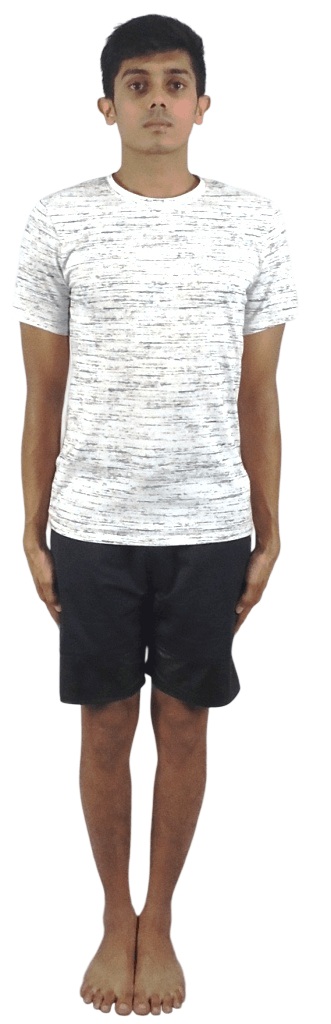
Tadasana teaches postural integrity, neuromuscular balance, and conscious patterning of movement. It introduces practitioners to the organization of gravity through the skeletal system, the distribution of muscular tone, the activation of the feet, and the functional lengthening of the spine.
Tadasana is not just “standing straight.” It is the practice of rooting and rising simultaneously—rooting down through the feet into the earth and rising upward through the spine toward the sky. In this meeting of stability and uplift, the body finds its structural equilibrium and the mind finds clarity.
2. Word Meaning and Etymology
The Sanskrit word Tadasana is made from two words:
- Tada — Mountain
- Asana — Pose, seat, or posture
Thus, Tadasana translates literally to:
“The Mountain Posture”
A mountain is the archetype of stability, groundedness, stillness, strength, and vertical elevation. Practicing Tadasana cultivates these same qualities—firmness, steadiness, presence, and inner alignment.
3. Definition of Tadasana
Tadasana is defined as a standing posture in which the practitioner stands upright with feet grounded, spine elongated, shoulders open, and breath steady, creating a balanced alignment of body and mind.
Classical texts describe it not in terms of muscular effort, but in terms of postural harmony and quiet strength.
In modern yoga anatomy, Tadasana is a neutral standing blueprint posture that teaches:
- How to distribute weight
- How to organize joint stacking
- How to engage stabilizing muscles
- How to create axial extension
Tadasana is a preparatory, transitional, and meditative pose that influences posture, gait, and functional movement patterns.
4. Method of Practice: Step-by-Step Technique
Step 1: Establish the Base
- Stand with feet either:
- Hip-width apart (functional version), or
- Feet together with big toes touching and heels slightly apart (classical version)
- Spread the toes and ground evenly through:
- Base of big toe
- Base of little toe
- Center of heel
Step 2: Align the Ankles and Knees
- Press shins gently inward to activate arches.
- Micro-bend knees to avoid hyperextension.
- Then straighten legs with soft engagement.
Step 3: Engage the Thighs and Hips
- Engage quadriceps.
- Lift kneecaps slightly.
- Align hips over ankles.
- Neutralize pelvis:
- Avoid tucking excessively
- Avoid overarching lumbar spine
Step 4: Lengthen the Spine
- Lift the crown of the head upward.
- Elongate the sides of the waist.
- Create space between vertebrae.
Step 5: Align the Shoulders
- Roll shoulders up, back, and down.
- Maintain shoulder blades gently retracted and depressed.
- Open the chest without thrusting ribs forward.
Step 6: Position the Arms
- Arms hang naturally at the sides.
- Palms facing inward or forward.
- Fingers soft and extended.
Step 7: Align the Head and Neck
- Chin parallel to the floor.
- Ears aligned over shoulders.
- Face relaxed.
Step 8: Establish Breath and Awareness
- Breathe naturally.
- Observe grounding in feet and uplift along the spine.
- Maintain steady stillness like a mountain.
5. Alignment Cues (Teaching Cues)
Feet & Legs
- “Spread your toes like a fan.”
- “Press evenly through all four corners of your feet.”
- “Lift the arches by engaging the inner legs.”
- “Lift the kneecaps—engage your quadriceps softly.”
Pelvis & Core
- “Find neutral pelvis—avoid tucking or collapsing.”
- “Draw the lower belly gently inward and upward.”
- “Lengthen the tailbone toward the heels.”
Spine
- “Grow tall through the crown of your head.”
- “Imagine the spine lengthening like a string pulling upward.”
Shoulders & Chest
- “Roll shoulders up, back, and down.”
- “Widen across your collarbones.”
- “Let the shoulder blades glide down the back.”
Head & Neck
- “Keep the chin parallel to the floor.”
- “Draw the skull back slightly to align ears with shoulders.”
Breath & Awareness
- “Let the breath move from belly to ribs to chest.”
- “Stand steady and still, like a mountain.”
6. Benefits of Tadasana
Physical Benefits
- Improves natural standing posture
- Enhances balance, stability, and proprioception
- Strengthens legs, feet, and hip stabilizers
- Improves spinal alignment
- Enhances neuromuscular coordination
- Reduces muscular imbalances
- Improves gait pattern
- Strengthens arches of the feet
- Enhances breathing capacity
Physiological Benefits
- Enhances blood circulation
- Improves lymphatic flow
- Encourages diaphragmatic breathing
- Optimizes joint stacking and reduces load on spine
- Reduces fatigue caused by poor posture
Therapeutic Benefits
- Helpful for postural disorders
- Beneficial for flat feet
- Helps in recovery from scoliosis (mild)
- Reduces lower back strain
- Provides grounding for anxiety
- Helps correct forward-head posture
Psychological / Energetic Benefits
- Improves grounding and stability
- Increases mental clarity
- Enhances presence and mindfulness
- Activates Muladhara Chakra
- Develops confidence and calmness
- Encourages centered awareness
7. Contraindications and Precautions
Although Tadasana is safe for most people, consider the following:
Avoid or modify in:
- Severe low-back pain
- Hyperlordosis
- Recent leg, ankle, or foot injury
- Severe vertigo or balance disorders
Precautions
- Do not lock knees—risk of fainting or hyperextension
- Avoid thrusting ribs forward—prevents lumbar compression
- Ensure neutral pelvis—protects spine
- Avoid excessive shoulder tension—may restrict breathing
Pregnant practitioners should stand with wider feet for stability.
8. Counterposes
Although Tadasana is neutral, recommended counterposes include:
- Uttanasana (Standing Forward Fold)
- Balasana (Child’s Pose)
- Adho Mukha Svanasana (Downward Dog)
- Supta Baddha Konasana (Reclining Bound Angle Pose)
These counterposes rebalance the spine and relax the body.
9. Preparatory Practices
Before practicing Tadasana, these postures help awaken awareness:
- Foot activation drills
- Ankle circles
- Samasthiti
- Shoulder rolls
- Cat-Cow for spinal awareness
- Hip mobility exercises
- Simple balance work (Tree Pose preparation)
These help connect the brain to the muscles needed for alignment.
10. Modifications and Variations
1. Wall-Supported Tadasana
- Stand with back against a wall
- Helps alignment of spine, pelvis, and shoulders
2. Block Between Thighs
- Encourages inner leg engagement
- Prevents knees from turning out
3. Strap Around Arms
- Helps maintain shoulder width
- Creates awareness of scapular alignment
4. Feet Hip-Width Apart
- Best for beginners and those with balance issues
5. Raised Arms Variation (Urdhva Hastasana)
- Enhances spinal elongation
- Mobilizes shoulders
11. Muscles Involved in Tadasana
Tadasana appears passive but is actually highly active.
Prime Movers (Stabilizers)
- Quadriceps
- Hamstrings (isometric)
- Gluteus medius and minimus
- Tibialis anterior and posterior
- Intrinsic foot muscles
Spinal Support Muscles
- Erector spinae
- Multifidus
- Transverse abdominis
- Obliques (for stabilization)
Shoulder and Chest Muscles
- Trapezius (lower fibers)
- Serratus anterior
- Rhomboids
- Rotator cuff stabilizers
Neck
- Longus colli
- Sternocleidomastoid (neutral)
Tadasana activates nearly the entire body in a balanced way.
12. Kinesiology of Tadasana
Kinesiology studies human movement patterns. In Tadasana:
Joint Actions
- Ankles: Neutral dorsiflexion
- Knees: Neutral extension
- Hips: Neutral with slight external rotation control
- Pelvis: Neutral (no tilt)
- Spine: Axial extension
- Shoulders: Neutral or slight external rotation
- Neck: Neutral alignment
Neuromuscular Patterns
- Co-contraction of anterior and posterior muscle groups
- Active arch lifting
- Balanced weight distribution
- Enhanced proprioception
Force Transmission
- Ground reaction force travels up from feet to spine
- Proper alignment reduces muscular load and overuse
Kinesiologically, Tadasana trains efficiency, balance, and optimal movement patterns.
13. Kinematics of Tadasana
Kinematics concerns the geometry of motion.
Key Kinematic Components
- Vertical axial elongation
- Upward kinetic chain force transfer
- Symmetrical joint stacking
- Midline organization
- Balanced left–right weight distribution
- Reduced sway through better proprioception
Tadasana reduces compensatory patterns such as:
- Forward head
- Pelvic tilt
- Knee hyperextension
- Pronation/supination of feet
The pose reorganizes the body’s architecture.
14. Biomechanics of Tadasana
Biomechanics explores how forces act on the body.
1. Ground Reaction Forces
Tadasana teaches the body to transmit force upward efficiently. The bones carry load, reducing stress on muscles.
2. Joint Stacking
Proper stacking reduces compressive forces on:
- Hips
- Knees
- Ankles
- Spine
3. Foot Biomechanics
Creates the “Tripod Foot”:
- Big toe base
- Little toe base
- Center of heel
This structure stabilizes the arches of the foot.
4. Pelvic Position
Neutral pelvis maintains natural lumbar curvature and spinal shock absorption.
5. Spinal Biomechanics
Tadasana distributes load across spinal curves, reducing disc stress.
6. Shoulder Mechanics
Expect gentle external rotation to avoid impingement.
15. Functional Anatomy & Physiology
Functional Anatomy
Tadasana involves:
- Dynamic isometric contractions
- Postural muscles firing in balance
- Foot stabilizers lifting arches
- Pelvic stabilizers maintaining neutral
- Scapular stabilizers preventing collapse
- Respiratory muscles enabling diaphragmatic breathing
Functional Physiology
- Improved respiratory efficiency
- Nervous system resets through stillness
- Better circulation through upright posture
- Improved lymphatic drainage
- Hormonal balance via stress reduction
The pose is a grounding practice affecting both body and mind.
16. How to Correct and Adjust While Teaching
Verbal Adjustments (Primary Method)
- “Shift weight evenly into both feet.”
- “Press down through the heels.”
- “Soften the ribs in.”
- “Lengthen the spine upward.”
- “Relax the shoulders.”
Hands-On Adjustments
(Only when appropriate and consent obtained)
Feet and Legs
- Press down lightly on thighs to encourage grounding.
- Place hand near outer shins to avoid collapse.
Pelvis
- One hand at sacrum, one at lower belly—guide into neutral.
- Avoid pushing aggressively.
Shoulders and Chest
- Gently roll shoulders back and down with hands.
- Lift occiput slightly to lengthen back of neck.
Spine
- Place one hand on sternum and one on upper back to guide alignment.
Common Mistakes and Corrections
| Mistake | Correction |
| Knees locked | “Micro-bend, then re-engage thighs gently.” |
| Pelvis tilting forward | “Draw navel in and lengthen tailbone.” |
| Ribs thrusting | “Soften ribs down.” |
| Shoulders lifted | “Relax shoulders; widen collarbones.” |
| Feet collapsing | “Press through base of big toe; spread toes.” |
Teaching Tips
- Start every standing sequence with Tadasana.
- Use it to cultivate mindful awareness.
- Encourage beginners to use a mirror or wall.
17. Conclusion
Tadasana is the simplest and yet most profound posture in yoga. It creates the blueprint for all other standing poses and teaches practitioners how to align themselves with gravity, breath, and awareness. Beyond physical alignment, Tadasana cultivates psychological grounding and energetic stability.
A mountain rises from the earth with unwavering presence; in Tadasana, the practitioner becomes that mountain—calm, tall, rooted, balanced, still, and powerful.
QUESTION AND ANSWER
SECTION 1 — Meaning, Name, Definition
1. The Sanskrit word “Tada” in Tadasana means:
A. Tree
B. Mountain
C. Thunder
D. Sky
Answer: B
2. Tadasana is classified as a:
A. Backbend
B. Standing foundational pose
C. Forward bend
D. Restorative pose
Answer: B
3. The primary intention of Tadasana is to cultivate:
A. Flexibility
B. Stillness and alignment
C. Heat and sweating
D. Relaxation only
Answer: B
4. Tadasana is considered the blueprint for:
A. All seated postures
B. All balancing postures
C. All standing asanas
D. All twists
Answer: C
5. The energetic quality associated with Tadasana is:
A. Groundedness
B. Agitation
C. Lethargy
D. Instability
Answer: A
SECTION 2 — Method of Practice (Steps)
6. In classical Tadasana, the feet are placed:
A. Very wide apart
B. Hip-width apart
C. Together with heels slightly apart
D. One foot ahead of the other
Answer: C
7. Correct weight distribution in Tadasana requires grounding through:
A. Only the heels
B. Only the toes
C. All four corners of the feet
D. Inside edges of feet
Answer: C
8. The pelvis in Tadasana should be:
A. Tucked forward strongly
B. Tucked backward strongly
C. Neutral
D. Locked in one position
Answer: C
9. The crown of the head should be:
A. Tilted back
B. Tilted forward
C. Lifting upward
D. Dropping downward
Answer: C
10. The breath in Tadasana is ideally:
A. Held
B. Forced
C. Natural and steady
D. Shallow
Answer: C
SECTION 3 — Alignment Cues
11. The knees should be:
A. Locked tightly
B. Hyperextended
C. Soft and neutral
D. Bent deeply
Answer: C
12. The shoulders in Tadasana should be:
A. Elevated
B. Rolled forward
C. Rolled up, back, and down
D. Stiff and tense
Answer: C
13. The ribs should be:
A. Protruding outward
B. Softened in without collapsing
C. Completely compressed
D. Completely expanded
Answer: B
14. The gaze (drishti) is usually:
A. Upward
B. To the side
C. Down at the feet
D. Forward, at eye level
Answer: D
15. The feet should be:
A. Collapsed inward
B. Strongly gripping ground
C. Parallel with toes spread
D. Turned outward
Answer: C
SECTION 4 — Muscles Involved
16. The primary stabilizer in Tadasana is:
A. Biceps
B. Quadriceps
C. Triceps
D. Deltoids
Answer: B
17. Which muscle supports spinal extension in Tadasana?
A. Erector spinae
B. Rectus abdominis
C. Pectoralis major
D. Gastrocnemius
Answer: A
18. The intrinsic muscles of the feet help maintain:
A. Knee flexion
B. Arch support
C. Neck mobility
D. Shoulder rotation
Answer: B
19. The muscle stabilizing the pelvis in Tadasana is:
A. Gluteus medius
B. Biceps femoris
C. Sartorius
D. Latissimus dorsi
Answer: A
20. Scapular stabilization in Tadasana primarily uses:
A. Sternocleidomastoid
B. Rhomboids and lower trapezius
C. Deltoids
D. Psoas
Answer: B
SECTION 5 — Kinesiology, Kinematics, Biomechanics
21. The ankle position in Tadasana is:
A. Plantarflexion
B. Dorsiflexion
C. Neutral
D. Everted
Answer: C
22. The primary spinal movement in Tadasana is:
A. Flexion
B. Rotation
C. Axial extension
D. Lateral flexion
Answer: C
23. Proper joint stacking reduces:
A. Ground reaction force
B. Muscular efficiency
C. Spinal compression
D. Proprioception
Answer: C
24. Weight distribution ideally aligns the body’s center of gravity:
A. Behind the heels
B. Over the toes
C. Slightly forward and back in balance
D. Completely to one side
Answer: C
25. The foot’s “tripod structure” refers to:
A. Heel, ankle, knee
B. Big toe base, little toe base, heel
C. Arch, shin, thigh
D. Hip, knee, ankle
Answer: B
SECTION 6 — Functional Anatomy & Physiology
26. Tadasana promotes healthy breathing by encouraging:
A. Upper chest breathing
B. Constricted inhalation
C. Diaphragmatic breathing
D. Rapid shallow breathing
Answer: C
27. The pose supports which physiological system the most?
A. Lymphatic system
B. Olfactory system
C. Renal system
D. Reproductive system
Answer: A
28. Practicing Tadasana reduces strain on which area?
A. Fingers
B. Neck and shoulders
C. Eyebrows
D. Teeth
Answer: B
29. Tadasana improves posture by correcting:
A. Forward head posture
B. Knee tracking only
C. Wrist pain
D. Toe cramps
Answer: A
30. Which chakra is primarily activated in Tadasana?
A. Heart chakra
B. Solar plexus chakra
C. Root chakra
D. Third eye chakra
Answer: C
SECTION 7 — Benefits
31. Tadasana is especially beneficial for people with:
A. Excessive fatigue from sitting
B. Severe arthritis
C. Major fractures
D. Respiratory infection
Answer: A
32. One major psychological benefit is:
A. Anxiety increase
B. Reduced concentration
C. Grounding and mental clarity
D. Emotional numbness
Answer: C
33. Tadasana helps improve which movement pattern?
A. Sleeping posture
B. Running and walking gait
C. Jumping height
D. Vocal projection
Answer: B
34. Long-term practice promotes:
A. Muscular imbalance
B. Poor balance
C. Neuromuscular efficiency
D. Tension in the core
Answer: C
35. Tadasana helps manage:
A. Hypertension during crisis
B. Spinal and postural issues
C. Active injury bleeding
D. Severe anemia
Answer: B
SECTION 8 — Contraindications
36. Tadasana should be practiced with caution in:
A. Flat feet
B. Shoulder tightness
C. Severe vertigo or balance disorders
D. Mild backache
Answer: C
37. People with knee hyperextension should:
A. Lock their knees fully
B. Practice barefoot on uneven ground
C. Slightly micro-bend their knees
D. Bend deeply
Answer: C
38. Tadasana is not advisable for:
A. Moderate stress
B. Recently broken ankle
C. Tight calves
D. Poor posture
Answer: B
39. If the lower back hurts in Tadasana, the likely cause is:
A. Neutral pelvis
B. Soft shoulders
C. Ribs thrusting forward
D. Straight spine
Answer: C
40. Pregnant practitioners should:
A. Bring feet closer
B. Stand with wider stance
C. Hold breath
D. Tense abdomen
Answer: B
SECTION 9 — Modifications & Props
41. Standing with back against a wall helps correct:
A. Toe pain
B. Spinal alignment
C. Elbow hypermobility
D. Facial tension
Answer: B
42. A block between thighs helps engage:
A. Biceps
B. Inner thighs and pelvic floor
C. Chest muscles
D. Neck muscles
Answer: B
43. A strap around arms encourages:
A. Wrist pain
B. Shoulder protraction
C. Scapular stability
D. Knee locking
Answer: C
44. Feet hip-width apart is recommended for:
A. Advanced students only
B. Those with balance issues
C. High-level athletes only
D. Children only
Answer: B
45. Urdhva Hastasana is a variation that adds:
A. Forward bend
B. Side twist
C. Overhead arm stretch
D. Hip rotation
Answer: C
SECTION 10 — Teaching, Adjustments, Methodology
46. The most important verbal cue for beginners:
A. “Lock your knees.”
B. “Spread your toes and ground evenly.”
C. “Lift your shoulders.”
D. “Push ribs out.”
Answer: B
47. Hands-on adjustment at shoulders focuses on:
A. Pushing shoulders forward
B. Lifting shoulders up
C. Rolling shoulders back and down
D. Pressing ribs inward
Answer: C
48. A safe adjustment for the pelvis is to:
A. Forcefully tuck the tailbone
B. Push the hips backward
C. Gently guide pelvis to neutral
D. Twist pelvis hard
Answer: C
49. The best correction for collapsing arches:
A. Ask student to grip floor
B. Cue “press base of big toe”
C. Tell them to jump
D. Ask them to turn feet outward
Answer: B
50. The first principle a teacher should emphasize in Tadasana is:
A. Aesthetic beauty
B. Perfect stillness
C. Grounding and weight distribution
D. Shoulder strength
Answer: C