
1. Introduction
Yoga, the ancient Indian science, harmonizes the body, mind, and spirit through postures (asanas), breathing techniques, and meditation. Among its standing balancing postures, Utthita Hasta Padangusthasana, commonly known as the Extended Hand-to-Big-Toe Pose, is notable for combining balance, strength, flexibility, and focus.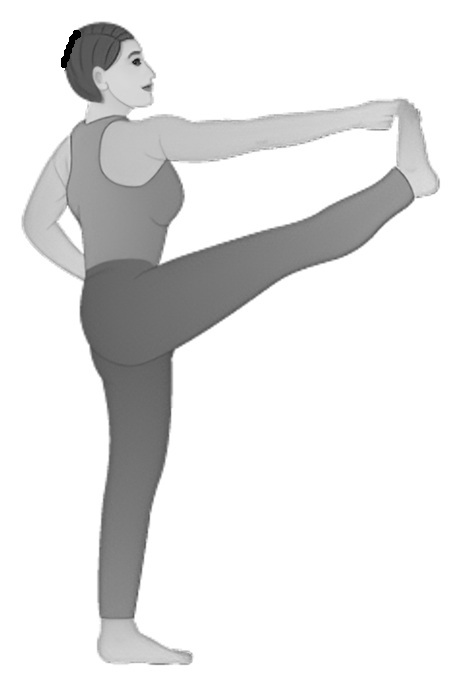
This pose requires single-leg balance, hamstring flexibility, hip stabilization, and core engagement, making it a sophisticated asana that challenges both beginners and advanced practitioners. Beyond the physical benefits, Utthita Hasta Padangusthasana cultivates mental concentration, body awareness, and inner calm, symbolizing the harmony between strength and grace.
2. Word Meaning and Etymology
The Sanskrit term Utthita Hasta Padangusthasana is composed of:
- Utthita – Extended
- Hasta – Hand
- Pada – Foot
- Angustha – Big toe
- Asana – Posture
Thus, Utthita Hasta Padangusthasana translates to “Extended Hand-to-Big-Toe Pose”, highlighting the action of the hand grasping the big toe while the leg is extended forward or to the side. Symbolically, the pose represents steadiness, control, and focused awareness, as the practitioner balances the body while extending the limbs.
3. Definition of Utthita Hasta Padangusthasana
Utthita Hasta Padangusthasana is a standing balance asana in which one leg is lifted and extended while the hand grasps the big toe. The pose emphasizes:
- Single-leg stability
- Hip mobility and hamstring flexibility
- Core activation for balance
- Postural alignment and mental focus
Classical Definition:
Utthita Hasta Padangusthasana is a yoga posture that combines balance, flexibility, and strength, training the legs, core, and shoulders while improving focus and concentration.
4. Method of Practice: Step by Step
Step 1: Starting Position
- Begin in Tadasana (Mountain Pose), with feet together and arms by the sides.
- Ground through the feet evenly, engaging the quadriceps and lifting the kneecaps.
Step 2: Engage and Lift
- Shift weight onto the left leg.
- Inhale, lift the right leg bending the knee toward the chest.
Step 3: Grasp the Big Toe
- Reach the right hand to hold the right big toe (using a yoga strap if necessary).
- Keep the left arm extended sideways for balance.
Step 4: Extend the Leg
- Exhale, straighten the lifted leg in front (utthita) or to the side for variation.
- Ensure the standing leg is stable, and the core is engaged.
Step 5: Align the Body
- Square hips forward.
- Lengthen the spine and keep shoulders relaxed.
- Maintain a focused gaze (drishti) to improve balance.
Step 6: Hold the Pose
- Maintain for 20–60 seconds, breathing steadily.
- Avoid collapsing the chest or locking the standing knee.
Step 7: Release
- Gently bend the lifted leg, release the toe, and return to Tadasana.
- Repeat on the opposite side.
5. Alignment Cues
- Feet: Standing foot grounded, lifted foot active.
- Knees: Micro-bend in standing leg if needed; lifted leg fully extended.
- Hips: Square forward; avoid tilting.
- Spine: Lengthened; avoid rounding the back.
- Shoulders & Arms: Relaxed; opposite arm extended for balance.
- Head & Neck: Neutral, aligned with spine; gaze fixed forward.
6. Benefits of Utthita Hasta Padangusthasana
Physical Benefits:
- Improves balance and coordination.
- Strengthens legs, ankles, core, and shoulders.
- Stretches hamstrings, calves, groin, and spine.
- Enhances hip mobility and postural alignment.
Mental Benefits:
- Develops concentration and focus.
- Reduces stress and anxiety through mindful balance practice.
- Cultivates body awareness and confidence.
Energetic Benefits:
- Stimulates Muladhara and Manipura chakras, enhancing grounding and core strength.
- Promotes stability and equilibrium of the mind and body.
7. Contraindications
- Hamstring or knee injuries: Avoid full extension or modify.
- Hip or ankle instability: Use support or skip pose.
- Lower back pain or disc issues: Practice cautiously, maintain neutral spine.
- Vertigo or balance disorders: Perform near a wall for support.
- Pregnancy: Avoid extreme extension of lifted leg.
8. Counterpose
After Utthita Hasta Padangusthasana, recommended counterposes:
- Tadasana (Mountain Pose) – restores balance.
- Adho Mukha Svanasana (Downward Dog) – stretches posterior chain.
- Setu Bandhasana (Bridge Pose) – mild spinal extension to release hamstrings.
9. Preparatory Practice
To prepare for Utthita Hasta Padangusthasana, practice:
- Tadasana (Mountain Pose): Foundation for balance.
- Vrksasana (Tree Pose): Single-leg stability.
- Paschimottanasana (Seated Forward Bend): Hamstring flexibility.
- Supta Padangusthasana (Supine Hand-to-Big-Toe Pose): Prepares hamstrings and hips.
- Baddha Konasana (Bound Angle Pose): Hip opening and groin flexibility.
10. Modifications
- Beginner: Use a yoga strap around the lifted foot.
- Intermediate: Lift leg fully without support, focus on core engagement.
- Advanced: Lift leg to the side (Utthita Hasta Padangusthasana B) or fold torso toward leg.
- Pregnancy or tight hamstrings: Keep knee bent, hinge from hips lightly.
11. Muscles Involved
Primary Muscles Stretched:
- Hamstrings (Biceps Femoris, Semitendinosus, Semimembranosus)
- Calves (Gastrocnemius, Soleus)
- Adductors and hip flexors of lifted leg
- Erector spinae (spinal extensors)
Primary Muscles Engaged:
- Quadriceps (standing leg for stabilization)
- Gluteus medius and maximus (hip stabilization)
- Core muscles (Rectus Abdominis, Obliques, Transverse Abdominis)
- Deltoids and Trapezius (arm support)
Secondary Muscles:
- Foot intrinsic muscles (balance)
- Tibialis anterior (stability)
- Shoulder stabilizers
12. Kinesiology
- Hip joint: Extension (standing leg), flexion/extension (lifted leg)
- Knee joint: Extension (lifted leg), slight micro-bend (standing leg)
- Ankle joint: Plantarflexion (standing leg for balance)
- Spine: Neutral, slight elongation
- Shoulder joint: Flexion/abduction to hold lifted foot
13. Kinematics
- Weight distribution: Single-leg weight-bearing; micro-adjustments at ankle, knee, and hip.
- Range of motion (ROM):
- Hip flexion: 70–90° (front)
- Hip abduction: 30–45° (side variation)
- Knee extension: 0°
- Spinal elongation: 10–20°
- Center of Mass: Shifts over standing leg; requires fine motor control and proprioception.
14. Biomechanism
- Lever mechanics: Standing leg acts as a support lever; lifted leg as resistance lever.
- Torque generation: Quadriceps and glute muscles stabilize standing leg.
- Balance mechanics: Core muscles and vestibular system maintain equilibrium.
- Stretch-tension relationship: Eccentric stretch in hamstrings, adductors, and calf muscles.
15. Functional Anatomy & Physiology
- Musculoskeletal function: Strengthens lower limb stabilizers, improves hamstring flexibility.
- Neuromuscular coordination: Enhances proprioception, balance, and fine motor control.
- Circulatory effect: Mild inversion increases venous return.
- Respiratory effect: Chest opens, promoting deep diaphragmatic breathing.
- Neurological engagement: Activates parasympathetic system, promoting calm and concentration.
16. How to Correct and Adjust While Teaching
Common Errors & Corrections:
- Collapsed chest: Cue to lift sternum, engage shoulders back.
- Rotated hips: Adjust pelvis to square forward.
- Locked standing knee: Micro-bend to protect joint.
- Leaning torso: Encourage core engagement, lengthen spine.
- Foot slipping: Use strap or wall support for balance.
Hands-on Adjustments:
- Stabilize pelvis to prevent lateral tilt.
- Guide lifted leg with hand or strap to maintain alignment.
- Encourage weight evenly on standing foot.
Verbal Cues:
- “Engage your core, lift the chest, and lengthen your spine.”
- “Square your hips forward, reach through your lifted leg.”
- “Find a steady gaze to enhance balance.”
17. Conclusion
Utthita Hasta Padangusthasana is a complex standing balance posture integrating strength, flexibility, and concentration. It challenges lower limb stability, core engagement, and hamstring flexibility while enhancing mental focus.
Understanding the muscles involved, biomechanics, alignment cues, and modifications enables safe practice and effective teaching. Regular practice cultivates strength, grace, balance, and mindful awareness, embodying the holistic principles of yoga.
QUESTION AND ANSWER
1. Basic Knowledge
- The Sanskrit meaning of Utthita Hasta Padangusthasana is:
A) Extended Hand-to-Big-Toe Pose ✅
B) Tree Pose
C) Wide-Legged Forward Bend
D) Lord of the Dance Pose - Utthita Hasta Padangusthasana primarily involves:
A) Seated twist
B) Standing balance ✅
C) Forward bend only
D) Backbend - The lifted leg is grasped by:
A) Both hands
B) Opposite hand
C) Same-side hand ✅
D) No hand - The standing leg must be:
A) Relaxed
B) Micro-bent or straight, engaged ✅
C) Locked fully
D) Crossed
2. Alignment & Technique
- The torso should be:
A) Leaning forward
B) Neutral and elongated ✅
C) Twisted
D) Rounded - Common alignment cue for the lifted leg:
A) Rotate outward
B) Keep extended, toes pointing forward ✅
C) Bend the knee
D) Press foot down - The arms should be:
A) Both overhead
B) One holding the toe, opposite arm extended for balance ✅
C) Crossed
D) Behind back - Gaze (drishti) in the pose should be:
A) Down
B) Forward or fixed point ✅
C) Closed
D) Rotated left
3. Muscles Involved
- Primary muscles stretched in Utthita Hasta Padangusthasana:
A) Hamstrings and calves ✅
B) Quadriceps
C) Deltoids
D) Biceps - Primary muscles engaged for stabilization:
A) Quadriceps, gluteus medius, core ✅
B) Forearm flexors
C) Pectorals
D) Neck flexors - Core muscles engaged include:
A) Rectus abdominis, obliques ✅
B) Gastrocnemius
C) Soleus only
D) Deltoids - Shoulder stabilizers involved:
A) Deltoids and trapezius ✅
B) Biceps only
C) Hamstrings
D) Quadriceps
4. Kinesiology & Biomechanics
- Utthita Hasta Padangusthasana involves which primary joint action?
A) Hip flexion and abduction ✅
B) Knee flexion
C) Ankle dorsiflexion only
D) Elbow flexion - This pose is primarily a:
A) Open kinetic chain exercise
B) Single-leg closed kinetic chain with lifted limb as lever ✅
C) Plyometric exercise
D) Passive stretch - The center of mass shifts:
A) Over standing leg ✅
B) Forward
C) Backward
D) Remains unchanged - Spinal action in the pose:
A) Neutral/elongated ✅
B) Fully flexed
C) Extended
D) Laterally bent
5. Benefits
- Physical benefits include:
A) Improves balance, leg strength, hamstring flexibility ✅
B) Arm hypertrophy only
C) Vision improvement
D) Weight loss - Mental benefits include:
A) Improves focus and concentration ✅
B) Stimulates hunger
C) Increases anxiety
D) Reduces attention - Energetic/chakra benefits:
A) Stimulates Muladhara and Manipura ✅
B) Crown chakra only
C) Heart chakra only
D) Throat chakra only - Therapeutic benefits:
A) Mild relief for back tension ✅
B) Causes knee strain
C) Weakens ankles
D) Reduces hip mobility
6. Contraindications
- Utthita Hasta Padangusthasana should be avoided in:
A) Hamstring injuries ✅
B) Normal flexibility
C) Healthy knees
D) Good balance - Individuals with ankle or hip instability should:
A) Use support, practice near wall ✅
B) Attempt full extension
C) Hold for long duration
D) Skip standing leg - Individuals with vertigo or balance issues should:
A) Avoid or use wall support ✅
B) Close eyes while balancing
C) Jump into the pose
D) Twist torso forcibly
7. Preparatory & Counter Poses
- Preparatory poses for hamstring flexibility:
A) Supta Padangusthasana, Paschimottanasana ✅
B) Bhujangasana
C) Utkatasana
D) Ardha Matsyendrasana - Preparatory poses for balance:
A) Tadasana, Vrksasana ✅
B) Adho Mukha Svanasana
C) Dandasana
D) Setu Bandhasana - Counterposes:
A) Tadasana or Adho Mukha Svanasana ✅
B) Another forward bend
C) Standing jump
D) Shoulderstand
8. Modifications
- Beginner modification:
A) Use yoga strap around lifted foot ✅
B) Lift leg fully without support
C) Side extension
D) Rotate torso - Advanced variation:
A) Lift leg to side (Utthita Hasta Padangusthasana B) ✅
B) Bend standing knee
C) Keep torso forward
D) Hold both feet - Pregnancy or tight hamstrings:
A) Keep knee bent, hinge lightly ✅
B) Full extension
C) Side lift only
D) Hands overhead
9. Teaching & Adjustments
- Common error: leaning torso backward. Correction:
A) Engage core, square hips ✅
B) Force leg forward
C) Rotate shoulders
D) Lock standing knee - If standing foot slips:
A) Place foot on firm surface or mat ✅
B) Jump into pose
C) Lean torso forward
D) Close eyes - Hips rotated outward:
A) Cue to square pelvis forward ✅
B) Twist torso further
C) Bend knee
D) Lift arms - Shoulder collapse correction:
A) Roll shoulders back, lift chest ✅
B) Shrug
C) Lower torso
D) Pull elbow
10. Functional Anatomy & Physiology
- Primary muscles stretched:
A) Hamstrings, adductors, gastrocnemius ✅
B) Quadriceps
C) Deltoids
D) Pectorals - Core muscles activated:
A) Rectus abdominis, obliques, transverse abdominis ✅
B) Forearms only
C) Neck flexors
D) Quadriceps only - Neurological effect:
A) Enhances proprioception and balance ✅
B) Reduces vision
C) Stimulates hearing
D) None - Respiratory benefit:
A) Deep diaphragmatic breathing ✅
B) Shallow breathing
C) Suppresses lung function
D) No effect - Joint stabilization occurs primarily at:
A) Ankle, knee, hip of standing leg ✅
B) Elbows only
C) Wrist only
D) Neck only