
1. WORD MEANING
- Ardha = “Half”
- Chakra = “Wheel”
- Asana = “Posture” or “Seat”
Thus, Ardha Chakrasana means Half Wheel Posture. While Chakrasana refers to the full backbend, Ardha Chakrasana refers to a gentler, upright version performed from standing.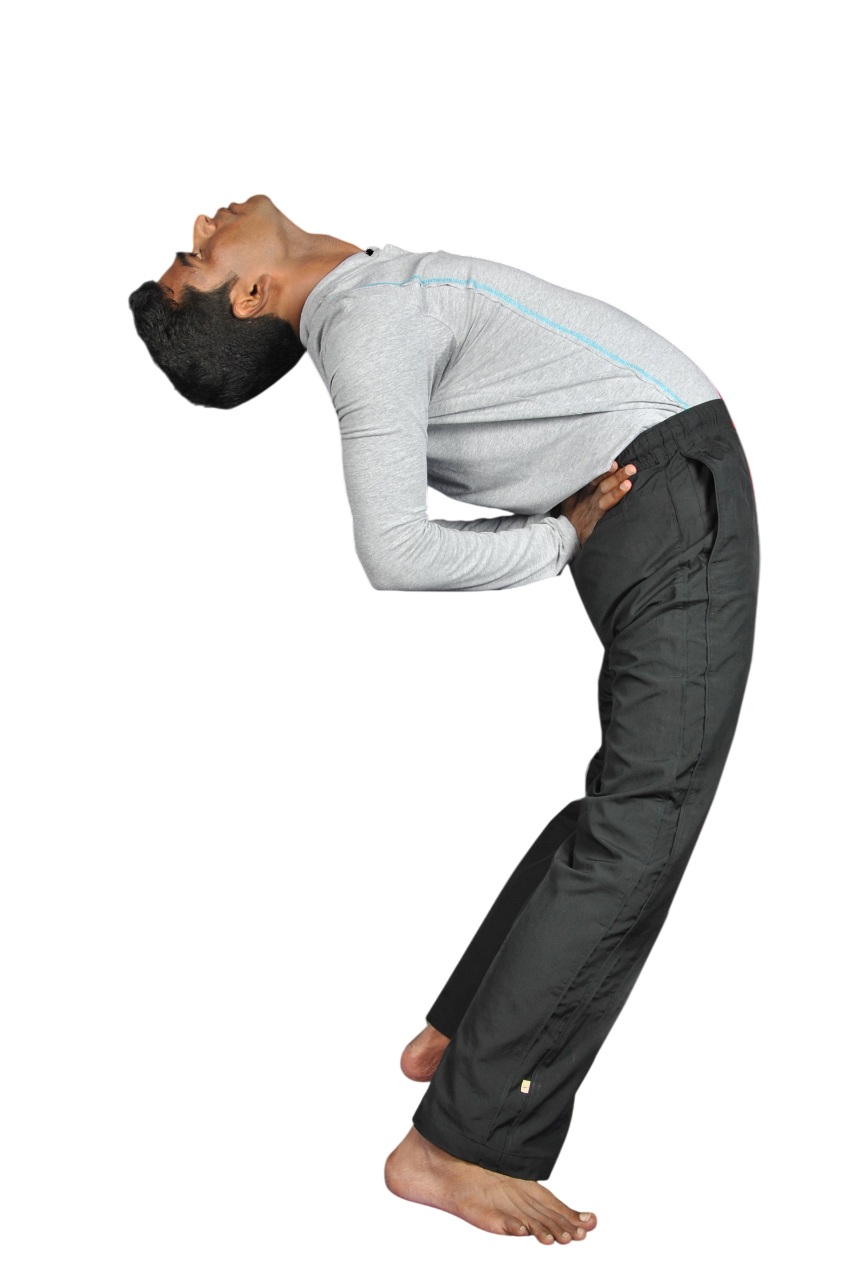
Symbolically, the “wheel” represents mobility, continuity, circulation, and energy flow. Bending backward resembles the upper half of a wheel arc, creating an energetic opening through the front body.
2. DEFINITION
Ardha Chakrasana is a standing backbend that involves extension of the spine, elevation of the chest, elongation of the anterior kinetic chain, and controlled engagement of the posterior musculature.
It is commonly included in:
- Classical Hatha Yoga
- Sivananda warm-up series
- Sun Salutation variations
- Therapy-focused spine extension routines
- Modern Vinyasa as a transitional backbend
The pose is accessible even for beginners while still holding significant value for intermediate and advanced practitioners due to its spinal conditioning, respiratory expansion, and postural correction benefits.
3. METHOD OF PRACTICE – STEP-BY-STEP
Starting Position:
Stand in Samasthiti/Tadasana with feet hip-width apart, body grounded, spine neutral.
Step 1 – Align the Base
- Stand with equal weight on both feet.
- Activate arches by gently lifting toes and placing them down.
- Engage thighs while keeping knees soft (not locked).
- Tailbone drops naturally; pelvis stays neutral.
Step 2 – Prepare the Upper Body
- Inhale and stretch both arms forward then upward overhead.
- Alternatively in classical Hatha:
- Place hands on lower back/Sacrum with fingers pointing downward.
- Elbows drawn slightly toward each other.
- Shoulders broaden.
Step 3 – Initiate the Backbend
- On inhalation, lift the sternum upward.
- Lengthen the lumbar spine before bending.
- Begin bending from the upper thoracic spine, not only the lower back.
Avoid collapsing the lower spine.
Step 4 – Perform the Backbend
- Lean back slowly.
- Push hips slightly forward.
- Keep the pelvis integrated—avoid excessive anterior tilt.
- Gaze gently upward or backward depending on comfort and neck mobility.
- Breathe steadily.
Step 5 – Hold
- Stay for 3–10 breaths.
- Keep the glutes lightly engaged (not squeezed tightly).
- Activate quadriceps for stability.
Step 6 – Exit Safely
- Inhale and return upright, lifting from the chest.
- Keep legs active.
- Exhale and release arms or hands.
4. ALIGNMENT CUES (TTC-LEVEL)
Feet & Legs
- Keep feet parallel; avoid turning toes outward.
- Distribute weight evenly on all four corners of the feet.
- Engage quadriceps to protect the knees.
- Avoid hyperextension of the knees.
Pelvis & Spine
- Lift the chest before bending the spine.
- Keep lumbar spine long, not compressed.
- Navel gently drawn in toward spine for support.
- Hips move slightly forward to counterbalance.
Shoulders & Arms
If arms are overhead:
- Keep biceps aligned with ears.
- Avoid shrugging shoulders.
- External rotation of arms for space in the neck.
If hands are on the back:
- Press elbows inward.
- Broaden collarbones.
- Slide shoulder blades down and inward.
Head & Neck
- Avoid dropping head too far back if cervical spine is weak.
- Keep the neck long.
- Gaze upward without collapsing the throat.
Breath
- Inhale during the lift.
- Maintain smooth breathing during the backbend.
- Avoid holding breath.
5. BENEFITS
Physical Benefits
Spinal Health
- Improves spinal extension.
- Mobilizes thoracic spine.
- Reduces forward-head posture and kyphosis.
Respiratory System
- Expands rib cage.
- Improves lung capacity.
- Activates intercostal muscles.
Core & Back Strength
- Strengthens erector spinae, glutes, hamstrings, and core stabilizers.
Posture Correction
- Counteracts the effects of prolonged sitting/computer posture.
Digestive Health
- Stimulates abdominal organs.
- Enhances peristalsis.
Endocrine System
- Mild stimulation to thyroid and adrenal glands.
Cardiovascular Benefits
- Opens chest and improves circulation.
Mental & Energetic Benefits
- Opens Anahata Chakra (Heart Center).
- Elevates mood and reduces lethargy.
- Enhances emotional resilience and confidence.
- Creates an energizing, uplifting effect.
6. CONTRAINDICATIONS
Absolute Contraindications
- Severe lumbar disc herniation
- Advanced spondylolisthesis
- Post-surgery (abdominal or spinal)
- Uncontrolled hypertension
- Severe vertigo
- Glaucoma (avoid excessive intraocular pressure)
- Cervical instability
Relative Contraindications (Practice with Modifications)
- Mild back pain
- Pregnancy (only gentle variations recommended)
- Migraine
- Chronic dizziness
- Shoulder impingement
- Obesity (requires prop support)
7. COUNTERPOSES
Perform after Ardha Chakrasana to neutralize spine.
Immediate Counterposes
- Tadasana – neutral alignment
- Samasthiti – grounding the spine
- Ardha Uttanasana – elongates front body
- Pawanmuktasana (lying) – releases lower back
Deep Counterposes
- Paschimottanasana – full forward bend
- Child’s Pose (Balasana) – gentle flexion
- Marjaryasana (Cat Pose) – spinal recovery
8. PREPARATORY PRACTICES
Warm-up for Spine & Shoulders
- Shoulder rolls
- Cat–Cow
- Thoracic extension warm-ups
- Gentle standing backbends
- Arm extension and chest-opening stretches
Lower Body Warm-ups
- Quadriceps stretching
- Hip opening
- Hamstring mobilization
- Pelvic tilts
Breath Prep
- Diaphragmatic breathing
- Chest breathing
- Ujjayi (for awareness and stability)
9. MODIFICATIONS
For Beginners
- Hands on back of pelvis for support
- Bend slightly and maintain shorter range
- Keep feet wider for balance
- Use wall support behind the back
- Keep head neutral without dropping back
For Limited Back Mobility
- Place hands on lower ribs instead of hips
- Keep arms crossed over chest
- Practice supported standing backbend using a chair
For Pregnancy
- Gentle thoracic extension only
- Keep legs wide apart
- Do not push hips forward excessively
- Avoid leaning too far back
For Weak Knees
- Slightly bend knees
- Engage quadriceps
- Keep stance wider for stability
10. MUSCLES INVOLVED
Primary Muscles (Prime Movers)
Back Extensors
- Erector spinae
- Multifidus
- Quadratus lumborum
Hip Muscles
- Gluteus maximus
- Hamstrings (eccentric stability)
Shoulder & Chest Muscles
- Deltoids
- Pectoralis minor (stretch)
- Serratus anterior
- Trapezius
Secondary Muscles
- Rectus abdominis (stretched)
- Iliopsoas (elongated)
- Quadriceps (support)
- Intercostals (expansion)
11. KINESIOLOGY
Ardha Chakrasana primarily involves:
- Spinal extension
- Shoulder flexion (if arms overhead)
- Hip extension movement with anterior hip stretching
- Thoracic expansion
- Controlled lumbar extension
The movement uses:
- Concentric contraction of spinal extensors
- Eccentric lengthening of abdominal muscles
- Isometric stabilizing of lower limb muscles
- Coordinated breathing with thoracic expansion
12. KINEMATICS
Joints Involved
1. Vertebral Column
- Cervical: Extension
- Thoracic: Extension (limited but crucial)
- Lumbar: Extension (mobilized but controlled)
2. Shoulder Joint
- Flexion and upward rotation (arms overhead)
3. Hip Joint
- Slight extension
- Anterior structures stretched
4. Knee Joint
- Neutral or slight flexion for stability
5. Ankle Joint
- Stable dorsiflexion to maintain balance
Movement Sequence
- Upward vertical lift → backward arc formation
- Posterior chain engages to support arc
- Center of gravity shifts slightly backward
- Weight shifts to front of feet for stability
13. BIOMECHANISM
Spinal Biomechanics
- Lengthen spine first → then extend
- Thoracic extension prevents overloading lumbar spine
- Pelvis should stabilize from the sacroiliac joint
- Core stabilizers engage to protect lower back
Force Distribution
- Body weight distributed between ankles and knees
- Vector forces move upward through spine
- Compression minimized through proper alignment
Stabilization Components
- Transverse abdominis protects lumbar region
- Gluteal muscles prevent excessive lumbar lordosis
- Scapular stabilizers support open chest posture
14. FUNCTIONAL ANATOMY & PHYSIOLOGY
Functional Anatomy Highlights
- Lumbar vertebrae allow maximum extension → flexibility
- Thoracic vertebrae stiff; requires conscious mobilization
- Scapulothoracic rhythm plays key role
- Pelvic alignment determines spinal safety
Physiological Effects
Circulatory:
- Increased blood supply to spine
- Improved venous return
Respiratory:
- Rib cage expands
- Intercostals activated
- Enhanced lung capacity
Endocrine:
- Stimulates adrenal region
- Influences thyroid glands via neck extension
Nervous System:
- Mild sympathetic activation → energizing
- Improves proprioception
- Enhances balance mechanisms
15. HOW TO CORRECT & ADJUST WHILE TEACHING
A. Common Mistakes & Corrections
1. Lower Back Compression
Mistake: Students collapse into lumbar spine.
Correction:
- Instruct: “Lift chest first, then bend.”
- Encourage thoracic expansion.
- Engage core.
2. Overarching Neck
Mistake: Dropping the head excessively.
Correction:
- Ask student to gaze at 45° upward.
- Keep the back of neck long.
3. Knees Locked
Mistake: Hyperextension leading to instability.
Correction:
- Teach micro-bend.
- Activate thigh muscles.
4. Feet Turning Out
Mistake: Loss of balance.
Correction:
- Cue: “Press big toes down.”
- Align feet parallel.
5. Hips Not Moving Forward
Mistake: Leaning backward without hip counterbalance.
Correction:
- Guide pelvis forward gently.
- Use hand-on-sacrum adjustment if appropriate.
B. Safe Physical Adjustments (When Appropriate)
Front-Body Lift Adjustment
- Stand beside the student.
- Support upper back with one hand.
- Guide sternum upward.
Pelvic Support Adjustment
- Place hands gently on their iliac crest.
- Encourage pelvis to move slightly forward.
Shoulder Adjustment
- From the back, gently guide elbows inward if hands are on hips.
- Or assist arm alignment when overhead.
Safety Guidelines
- Never push student into deeper backbend.
- Avoid pressure on lower spine.
- Adjust with permission only.
C. Verbal Teaching Cues (TTC Quality)
- “Lengthen before you bend.”
- “Lift the heart up toward the sky.”
- “Engage your legs, soften your knees.”
- “Let your glutes support—not dominate—the movement.”
- “Expand the chest; breathe into your ribs.”
- “Move hips forward as chest rises.”
- “Keep your neck long—don’t collapse.”
- “Backbend comes from the entire spine, not only the lower back.”
QUESTION AND ANSWER
SECTION 1 — Sanskrit, Word Meaning & Definition
1. What is the Sanskrit meaning of “Ardha Chakrasana”?
A. Half Moon Pose
B. Half Wheel Pose
C. Half Bow Pose
D. Half Camel Pose
Answer: B
2. “Chakra” in Ardha Chakrasana refers to:
A. A circle or wheel
B. A triangle
C. A crescent
D. A square
Answer: A
3. Ardha Chakrasana is classified under which category of asanas?
A. Forward bends
B. Backbends
C. Twisting poses
D. Inversions
Answer: B
4. Ardha Chakrasana is also known as:
A. Half Wheel Pose
B. Gentle Camel
C. Half Bow Pose
D. Crescent Pose
Answer: A
SECTION 2 — Method of Practice (Steps)
5. In Ardha Chakrasana, the arms are typically:
A. Kept at the sides
B. Raised overhead or placed on the lower back
C. Folded in namaste
D. Held behind the body
Answer: B
6. What is the first step before entering Ardha Chakrasana?
A. Exhale and lift chest
B. Stand in Tadasana
C. Sit in Vajrasana
D. Lie in supine position
Answer: B
7. When entering Ardha Chakrasana, the spine is:
A. Rounded
B. Laterally flexed
C. Extended
D. Twisted
Answer: C
8. The knee position in Ardha Chakrasana should be:
A. Bent deeply
B. Slightly inward
C. Hip width and straight
D. Locked backward
Answer: C
SECTION 3 — Alignment & Teaching Cues
9. The pelvis in Ardha Chakrasana should:
A. Tilt forward excessively
B. Tilt backward excessively
C. Remain neutral
D. Rotate outward
Answer: C
10. Which area must stay long and lifted?
A. Lower ribs
B. Collar bones
C. Side waist
D. Both B and C
Answer: D
11. To prevent compression, the teacher should cue:
A. Squeeze buttocks hard
B. Engage core and lift chest
C. Push hips forward aggressively
D. Grip toes tightly
Answer: B
12. The safest breathing technique during the pose is:
A. Deep inhalation during extension
B. Holding the breath
C. Forced exhalation
D. Rapid breath
Answer: A
SECTION 4 — Benefits
13. Ardha Chakrasana primarily strengthens:
A. Quadriceps
B. Back extensor muscles
C. Deep core flexors
D. Forearm muscles
Answer: B
14. Which system benefits from chest expansion?
A. Circulatory system
B. Digestive system
C. Lymphatic system
D. Reproductive system
Answer: A
15. The pose is recommended for:
A. Improving posture and spinal mobility
B. Increasing knee flexibility
C. Strengthening arms only
D. Strengthening forearms
Answer: A
16. Which chakras are stimulated?
A. Root chakra
B. Heart and Throat chakras
C. Sacral chakra
D. Crown chakra
Answer: B
SECTION 5 — Contraindications & Precautions
17. Ardha Chakrasana should be avoided in:
A. Mild indigestion
B. Chronic back injuries
C. Normal fatigue
D. Mild headache
Answer: B
18. Those with vertigo should:
A. Avoid backbends entirely
B. Practice with wall support
C. Practice with head tilted back
D. Practice after heavy meal
Answer: B
19. The pose is contraindicated for individuals with:
A. Controlled asthma
B. High or low blood pressure (uncontrolled)
C. Healthy spine
D. Mild anxiety
Answer: B
20. A common mistake increasing injury risk is:
A. Lifting chest
B. Overarching lumbar spine
C. Engaging core
D. Using wall support
Answer: B
SECTION 6 — Counterposes
21. Which is the best counterpose after Ardha Chakrasana?
A. Tadasana
B. Paschimottanasana
C. Ardha Matsyendrasana
D. Uttanasana
Answer: D
22. A gentle counterpose for the spine is:
A. Cat–Cow
B. Chakrasana
C. Bow Pose
D. Ustrasana
Answer: A
SECTION 7 — Preparatory Practices
23. A good preparatory pose is:
A. Utkatasana
B. Bhujangasana
C. Padmasana
D. Uddiyana Bandha
Answer: B
24. To open shoulders before Ardha Chakrasana:
A. Gomukhasana arms
B. Shoulder shrugs
C. Kapalbhati
D. Savasana
Answer: A
SECTION 8 — Modifications & Props
25. Beginners may use:
A. A block behind the back
B. A wall for support
C. A belt around knees
D. All of the above
Answer: D
26. A pregnant woman may practice:
A. Deep backbend
B. A gentle, wall-assisted version
C. No chest lifting
D. Full Urdhva Dhanurasana
Answer: B
SECTION 9 — Anatomy & Muscles Involved
27. Primary muscles strengthened:
A. Hamstrings
B. Spinal extensors (erector spinae)
C. Latissimus dorsi
D. Hip flexors
Answer: B
28. Muscles stretched:
A. Chest, hip flexors, abdominal muscles
B. Hamstrings only
C. Shoulders only
D. Feet muscles
Answer: A
29. Stabilizers in Ardha Chakrasana include:
A. Obliques
B. Gluteus medius
C. Quadriceps
D. All of these
Answer: D
SECTION 10 — Kinesiology & Biomechanics
30. Main spinal movement in Ardha Chakrasana:
A. Flexion
B. Extension
C. Rotation
D. Lateral bending
Answer: B
31. Shoulder movement:
A. Internal rotation
B. Abduction and flexion
C. Horizontal adduction
D. Retraction only
Answer: B
32. The pose increases:
A. Anterior chain compression
B. Posterior chain activation
C. Permanent spinal curve
D. Knee rotation
Answer: B
33. To protect lumbar spine, the teacher must cue:
A. Rib knitting
B. Lengthening tailbone downward
C. Deep chest lift
D. Both A and B
Answer: D
SECTION 11 — Physiology
34. The pose stimulates:
A. Thyroid gland
B. Adrenal glands
C. Pancreas
D. None of these
Answer: B
35. Deep chest expansion improves:
A. Gas exchange
B. Sweating
C. Nervous irritation
D. Eye lubrication
Answer: A
SECTION 12 — Teaching Methodology & Adjustments
36. A safe adjustment technique is:
A. Pushing student’s lower back forward
B. Guiding chest upward with verbal cue + light support
C. Pulling arms backward forcefully
D. Pushing the pelvis aggressively
Answer: B
37. A verbal cue to prevent over-arching is:
A. “Drop the head fully backward.”
B. “Squeeze shoulder blades and widen chest.”
C. “Lift the chest, but keep the lower ribs in.”
D. “Lock your knees.”
Answer: C
38. In hands-on assistance, the teacher should stand:
A. Behind the student
B. In front of the student
C. To the side
D. Far away
Answer: A
39. To avoid strain in the neck, teacher cues:
A. Look up gently, not backward
B. Drop head down
C. Turn head side-to-side
D. Press chin to chest
Answer: A
40. Best cue to maintain balance:
A. Tighten throat
B. Engage core and ground feet evenly
C. Tilt pelvis forward
D. Bend knees deeply
Answer: B