
1. Introduction
Utkatāsana—popularly known as Chair Pose or Fierce Pose—is a foundational standing asana practiced across multiple yoga traditions, including Hatha Yoga, Ashtanga Vinyasa, Vinyasa Flow, Iyengar Yoga, and modern yoga schools worldwide. Though often underestimated because of its simple external appearance, Utkatāsana is one of the most powerful, strengthening, and neuro-muscularly intelligent postures in yoga. It integrates lower-body strength, pelvic alignment, spinal stability, breath coordination, proprioception, and mental discipline.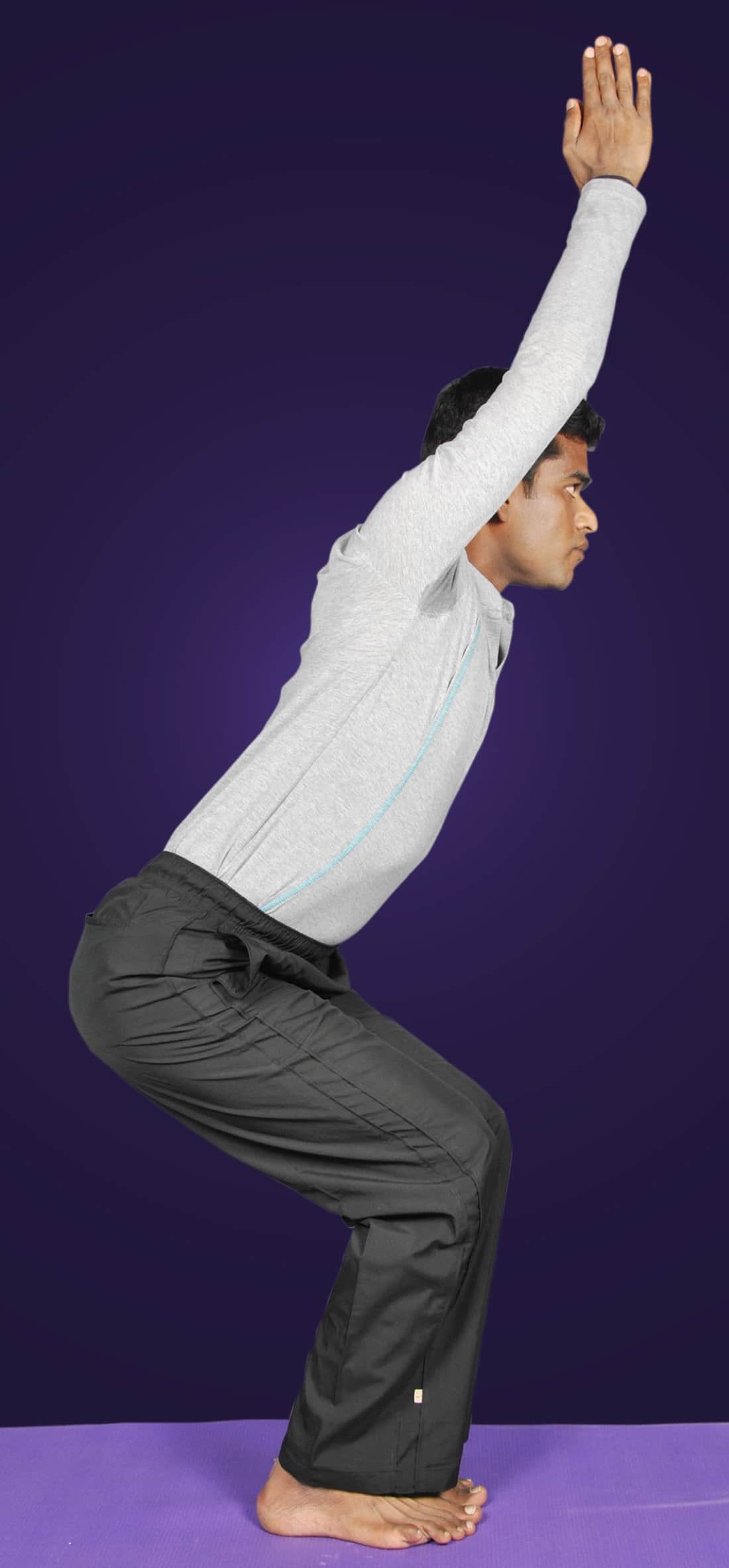
Utkatāsana teaches practitioners how to sit into the strength of their legs, rather than collapsing into the lower back, and how to activate the core to create stability in standing postures. It is also a gateway pose that introduces key principles used in more advanced asanas, such as Warrior III, Handstand, Eagle Pose, and transitions in Sun Salutation B.
This essay explores Utkatāsana in depth from every angle—classical meaning, method of practice, alignment, functional anatomy, biomechanical principles, therapeutic application, teaching corrections, and more.
2. Word Meaning of Utkatāsana
The Sanskrit term Utkatāsana is composed of:
- “Utkata” = intense, fierce, mighty, powerful, high, elevated
- “Āsana” = posture or seat
Thus, Utkatāsana means “the fierce posture,” “the intense pose,” or “the powerful seat.”
Although commonly referred to as Chair Pose, historically there were no chairs in yogic tradition; instead, the word “utkata” refers to a strong, powerful stance, similar to squatting or lowering oneself toward an invisible seat.
3. Definition
Modern Definition:
Utkatāsana is a semi-squat posture performed while standing, with the hips descending as if sitting (without actually sitting), the spine lengthening upward, and the arms extended overhead or forward. It builds strength in the legs, core, hips, and back, promotes balance, and improves posture.
Traditional Yogic Definition:
A strong “seat” of stability and effort that cultivates tapas (discipline) and sthira sukham (steadiness and ease).
It is a symbolic posture that teaches inner strength, endurance, and the ability to stay calm under intensity.
4. Method of Practice (Step-by-Step Guide)
Step 1: Starting Position (Tāḍāsana – Mountain Pose)
- Stand with feet together or hip-width apart.
- Ground through all four corners of the feet.
- Lengthen the spine, lift the chest, and relax the shoulders.
Step 2: Inhale – Lift the Arms
- Raise the arms overhead, palms facing each other.
- Keep elbows straight but not rigid.
- Draw the shoulder blades down away from the ears.
Step 3: Exhale – Bend the Knees
- Send the hips back as if sitting on an invisible chair.
- Keep knees tracking over the toes.
- Weight should shift slightly into the heels.
Step 4: Position the Torso
- Maintain a neutral spine.
- Avoid overarching the lower back.
- The rib cage should soften down.
Step 5: Engage the Body
- Draw the navel inward and upward.
- Activate quadriceps, glutes, and hamstrings.
- Lift the chest without flaring ribs.
Step 6: Deepening the Pose
- Bend the knees to a comfortable depth: ideally thighs approach parallel to ground.
- Keep breathing steady and smooth.
- Hold for 5–10 breaths.
Step 7: Exiting the Pose
- Inhale, press through the feet, and rise back to Tāḍāsana.
- Exhale, lower arms alongside the body.
5. Alignment Cues (Teaching-Level Precision)
Feet & Ankles
- Keep feet parallel, toes spread.
- Ground evenly through heels, big toe mound, little toe mound.
- Knees track over second toe.
Knees
- Do not allow knees to collapse inward.
- Keep them slightly behind or in line with toes.
- Avoid locking or hyperextension.
Hips
- Sink hips backward, not downward.
- Imagine sitting into a chair placed far behind you.
- Maintain neutral pelvis; avoid excessive anterior tilt (butt sticking out).
Spine
- Lengthen through crown of head.
- Maintain natural curve of lumbar spine without exaggeration.
- Avoid rounding of upper back.
Rib Cage & Core
- Draw ribs in and down.
- Engage transverse abdominis to support spine.
Shoulders & Arms
- Shoulders away from ears.
- Arms straight in line with ears if possible.
- If shoulders fatigue, bring hands to heart center.
Breath
- Keep inhalation expansive.
- Avoid holding breath.
- Use ujjayi breath (optional).
6. Benefits of Utkatāsana
Physical Benefits
- Strengthens quadriceps, glutes, hamstrings.
- Builds ankle and knee stability.
- Strengthens core muscles and improves abdominal tone.
- Enhances spinal stability.
- Improves balance and body awareness.
- Opens chest and shoulders.
- Stimulates circulation in legs.
- Improves posture.
Physiological Benefits
- Activates cardiovascular system mildly.
- Enhances respiratory capacity.
- Improves lymphatic drainage in lower limbs.
- Stimulates digestive organs through abdominal compression.
Therapeutic Benefits
- Helps correct flat feet by strengthening arch muscles.
- Supports rehabilitation of weak knees (with care).
- Helps relieve lower-back stiffness.
- Builds endurance in athletes, dancers, runners.
- Improves neuromuscular coordination.
Psychological Benefits
- Builds willpower and mental resilience.
- Develops concentration and clarity.
- Encourages grounding and inner stability.
7. Contraindications
Do NOT practice (absolute contraindications):
- Acute knee injury or ligament tears.
- Recent hip surgery.
- Severe lower-back disorders.
- Uncontrolled blood pressure (arms overhead may increase BP).
Practice with caution (relative contraindications):
- Weak ankles or flat feet.
- Shoulder impingement (modify arms).
- Pregnancy (late stages — widen stance).
- Mild herniated discs (keep spine neutral).
8. Counterposes
To relieve the intensity:
- Tāḍāsana (Mountain Pose)
- Uttānāsana (Standing Forward Bend)
- Ardha Uttānāsana (Half Standing Forward Fold)
- Prasārita Pādottānāsana (Wide-Leg Forward Fold)
- Supta Baddha Koṇāsana (Reclining Bound Angle Pose)
9. Preparatory Practices
These poses help warm up relevant muscles:
- Tāḍāsana
- Adho Mukha Svanāsana (Downward Dog)
- Setu Bandhasana (Bridge Pose)
- Anjaneyasana (Low Lunge)
- Chair Pose against the wall
- Squats
- Warrior I & II
10. Modifications & Variations
For beginners:
- Practice with back against wall.
- Keep arms parallel to floor instead of overhead.
- Feet hip-width apart for more balance.
For limited shoulder mobility:
- Hands on hips.
- Hands in namaste.
- Arms forward instead of overhead.
For knee sensitivity:
- Reduce depth of squat.
- Place block between thighs for alignment.
- Use chair for support.
Advanced Variations:
- Utkatāsana Twist (Parivritta Utkatāsana)
- Utkatāsana with heels lifted
- Utkatāsana transition to Crow Pose
- One-leg Utkatāsana
11. Muscles Involved
Primary Muscle Activation
- Quadriceps
- Gluteus maximus
- Hamstrings (eccentric control)
- Erector spinae
- Transverse abdominis
- Rectus abdominis
- Iliopsoas
- Deltoids
- Serratus anterior
Secondary Muscles
- Gastrocnemius & soleus
- Tibialis anterior
- Adductors
- Obliques
- Latissimus dorsi (arm elevation control)
12. Kinesiology of Utkatāsana
Joint Movements
- Hips: flexion
- Knees: flexion
- Ankles: dorsiflexion
- Shoulders: flexion
- Spine: elongation with slight extension
- Scapula: upward rotation, elevation minimally
Muscle Dynamics
- Quadriceps concentrically control knee bending.
- Glutes stabilize pelvis and hip flexion.
- Hamstrings work eccentrically.
- Core stabilizes trunk.
13. Kinematics: Movement Analysis
Sagittal Plane
- Entire movement primarily occurs in sagittal plane.
- Forward hip hinge + downward pelvis shift.
Frontal Plane
- Ideally minimal movement—knees should not collapse inward.
Horizontal Plane
- Slight external rotation in hips for stability.
14. Biomechanism & Load Analysis
Key Biomechanical Principles
- Center of gravity shifts backward, requiring hip and knee stability.
- Joint stacking of knees over ankles prevents strain.
- Neutral pelvis prevents lumbar compression.
- Scapular upward rotation stabilizes arm elevation.
- Abdominal engagement reduces shear force on lumbar spine.
Potential Incorrect Load
- Knees going past toes → strain on knee joints.
- Overarching lower back → facet joint compression.
- Collapsed arches → pronation stress.
- Shoulders elevated excessively → neck tension.
15. Functional Anatomy & Physiology
Lower Body Function
- Strengthens quadriceps for stability.
- Activates glute max to protect lumbar spine.
- Enhances ankle mobility for balance.
Core Function
- Improves spinal stability.
- Deep abdominal contraction enhances digestion.
Shoulder & Upper Body Function
- Strengthens upper back.
- Opens thoracic region for better breathing.
Physiological Mechanisms
- Increases heart rate slightly.
- Improves oxygen uptake efficiency.
- Enhances proprioceptive feedback in lower limbs.
16. Common Mistakes and How to Correct Them
1. Knees collapsing inward
Correction:
- Place a block between thighs.
- Cue “press knees outward gently.”
2. Lower back overarched
Correction:
- Cue “tailbone lengthens down.”
- Engage core and ribs.
3. Weight in toes
Correction:
- Shift weight into heels.
- Lift toes to activate arches.
4. Shoulders lifting toward ears
Correction:
- Relax upper traps.
- Move arms slightly wider.
5. Chest collapsing
Correction:
- Lift sternum gently.
- Strengthen erector spinae.
17. How to Adjust & Assist While Teaching
Hands-On Adjustments
- Hip Adjustment:
Place hands on outer hips and gently guide hips back. - Knee Stabilization:
Light touch on outer knees to prevent collapse. - Spinal Alignment:
Hand on back ribs to encourage rib containment. - Arm Assistance:
Light upward lift from elbows to elongate spine.
Verbal Cues
- “Sit back, not down.”
- “Draw your lower belly in.”
- “Relax the shoulders.”
- “Keep breathing steadily.”
Prop-Assisted Adjustments
- Wall support for beginners.
- Chair behind as safety for elderly students.
- Block between thighs for knee tracking.
Conclusion
Utkatāsana is a transformative posture blending strength, stability, alignment, breathwork, and focus. Its simplicity conceals profound depth—making it one of the most valuable asanas for yoga practitioners, TTC students, and teachers. It integrates the principles of functional movement, biomechanics, core stability, joint integrity, and mindful awareness.
Mastering Utkatāsana enhances almost every other asana and builds the foundation for safe, intelligent practice.
QUESTION AND ANSWER
SECTION A — Meaning, Definition & Basics
1. What is the literal Sanskrit meaning of the word “Utkatasana”?
A. Easy pose
B. Fierce or powerful pose
C. Thunder pose
D. Raised hands pose
Answer: B
2. Utkatasana is commonly known in English as:
A. Mountain Pose
B. Chair Pose
C. Tree Pose
D. Eagle Pose
Answer: B
3. Which of the following best defines Utkatasana?
A. A gentle forward bend
B. A balancing pose on one leg
C. A strong standing squat-like posture
D. A reclining hip opener
Answer: C
4. Utkatasana primarily works which movement pattern?
A. Hip extension
B. Hip and knee flexion
C. Shoulder adduction
D. Spinal rotation
Answer: B
5. In traditional texts, Utkatasana symbolizes:
A. Surrender
B. Power, heat, and determination
C. Balance and calm
D. Stillness
Answer: B
6. Utkatasana is often practiced at which point in Surya Namaskar (variations)?
A. Beginning and end
B. Mid-sequence
C. Only at the end
D. Not part of Sun Salutation
Answer: A
7. Which plane of movement does Utkatasana primarily involve?
A. Transverse plane
B. Frontal plane
C. Sagittal plane
D. Oblique plane
Answer: C
8. The spine in Utkatasana should ideally be:
A. Completely rounded
B. Over-arched
C. Neutral or slightly extended
D. Flexed strongly
Answer: C
9. The traditional drishti recommended in Utkatasana is:
A. Nasagra (nose tip)
B. Hastagra (hands)
C. Bhrumadhya (third eye)
D. Urdhva (upward gaze)
Answer: D
10. Utkatasana is considered primarily a:
A. Restorative pose
B. Backbend
C. Strength-building standing pose
D. Supine pose
Answer: C
SECTION B — Method of Practice
11. What is the first step of entering Utkatasana from Tadasana?
A. Bend the elbows
B. Sit back as if into a chair
C. Raise the arms overhead
D. Lower the torso to the floor
Answer: C
12. When lowering into Utkatasana, the knees should:
A. Move far beyond the toes
B. Stay directly behind or above the toes
C. Lock tightly
D. Lean inward significantly
Answer: B
13. The weight distribution in Utkatasana should be:
A. Only in the toes
B. Only in the heels
C. Balanced: heels rooted, toes light
D. Only on the outer edges of feet
Answer: C
14. When sitting back into the pose, which cue is correct?
A. Drop the chest to the knees
B. Sit back with the hips as if sitting into a chair
C. Pull the knees wide apart
D. Tighten the neck
Answer: B
15. Arms in Utkatasana should be:
A. Hanging by the sides
B. Parallel to the floor
C. Extended upward in line with the ears
D. Held behind the back
Answer: C
16. Exiting Utkatasana is typically done by:
A. Jumping back
B. Straightening the legs and lowering the arms
C. Sitting fully on the floor
D. Folding forward
Answer: B
17. Which breath technique suits the posture?
A. Fast and shallow
B. Holding the breath
C. Steady, slow inhalation lifting the chest
D. Reverse breathing
Answer: C
18. Which cue prevents lumbar over-arching?
A. Relaxing the core
B. Tucking the pelvis extremely
C. Drawing the navel gently toward the spine
D. Opening the knees wide
Answer: C
SECTION C — Alignment & Teaching Cues
19. In correct alignment, the knees should:
A. Touch each other
B. Collapse inward
C. Point in the direction of the second toe
D. Rotate outward strongly
Answer: C
20. The most common alignment mistake in Utkatasana is:
A. Elbows bent
B. Chest too lifted
C. Knees going too far forward
D. Arms too low
Answer: C
21. To avoid strain in the neck, the student should:
A. Look straight up at the ceiling
B. Drop the head back
C. Keep the gaze slightly upward without compressing neck
D. Tuck the chin excessively
Answer: C
22. What alignment cue ensures knee safety?
A. Knees stacked behind or over ankles
B. Knees pushed far ahead
C. Knees bending inward
D. Knees locked
Answer: A
23. What is an effective cue for engaging glutes?
A. Collapse the chest
B. Squeeze thighs and sit deeper
C. Lift heels high
D. Drop pelvis forward
Answer: B
24. Arms should be:
A. Internally rotated strongly
B. Externally rotated slightly
C. Folded behind the back
D. Kept shoulder-width behind the torso
Answer: B
25. To relieve lower back compression:
A. Widen the stance dramatically
B. Strengthen core activation
C. Lean backward
D. Raise the heels
Answer: B
26. Proper hip alignment requires:
A. Pushing pelvis forward
B. Neutral pelvis, hips back
C. Twisting pelvis laterally
D. Dropping hips to the side
Answer:
SECTION D — Benefits
27. Which body part is most strengthened in Utkatasana?
A. Quadriceps
B. Jaw muscles
C. Wrists
D. Neck flexors
Answer: A
28. A physiological benefit of Utkatasana is:
A. Reduced metabolism
B. Improved cardiovascular endurance
C. Decreased circulation
D. Reduced lung capacity
Answer: B
29. Utkatasana helps improve:
A. Lateral spinal rotation
B. Core strength and stability
C. Neck mobility
D. Supine relaxation
Answer: B
30. Energetically, Utkatasana stimulates:
A. Ajna chakra
B. Muladhara and Manipura chakras
C. Vishuddhi chakra
D. Sahasrara chakra
Answer: B
SECTION E — Contraindications & Safety
31. Utkatasana should be avoided or modified in:
A. Mild muscle soreness
B. Severe knee injuries
C. Cold weather
D. After meals
Answer: B
32. Students with low back pain should:
A. Deepen the lumbar curve
B. Not engage the core
C. Keep a neutral spine and activate the abdomen
D. Drop torso forward
Answer: C
33. People with uncontrolled hypertension should avoid:
A. Slow breathing
B. Keeping arms overhead for long durations
C. Standing upright
D. Engaging the thighs
Answer: B
34. In pregnancy (2nd–3rd trimester), modification includes:
A. Twisting deeply
B. Feet together
C. Widening stance for balance
D. Holding breath
Answer: C
SECTION F — Anatomy, Kinesiology & Biomechanics
35. Primary action at the hip in Utkatasana:
A. Hyperextension
B. Flexion
C. Adduction
D. Rotation
Answer: B
36. Which muscles are MOST active?
A. Hamstrings, deltoids, quadriceps
B. Trapezius only
C. Biceps and triceps
D. Calves only
Answer: A
37. Which bone bears increased load?
A. Clavicle
B. Femur
C. Radius
D. Fibula
Answer: B
38. The ankle joint is positioned in:
A. Dorsiflexion
B. Plantar flexion
C. Rotation
D. Hyperextension
Answer: A
39. Spinal movement in Utkatasana is:
A. Strong flexion
B. Strong extension
C. Neutral with axial extension
D. Lateral bending
Answer: C
40. Center of gravity in Utkatasana shifts:
A. Forward and upward
B. Backward and downward
C. Strongly to the left
D. Toward the crown of the head
Answer: B