
Word Meaning, Definition, Method, Alignment, Benefits, Contraindications, Modifications, Anatomy, Physiology, Biomechanics, Kinesiology, Kinematics, Teaching & Adjustments
1. Word Meaning
Virabhadrasana comes from three Sanskrit roots:
- Vira – hero, warrior
- Bhadra – auspicious, blessed, noble
- Asana – posture, seat

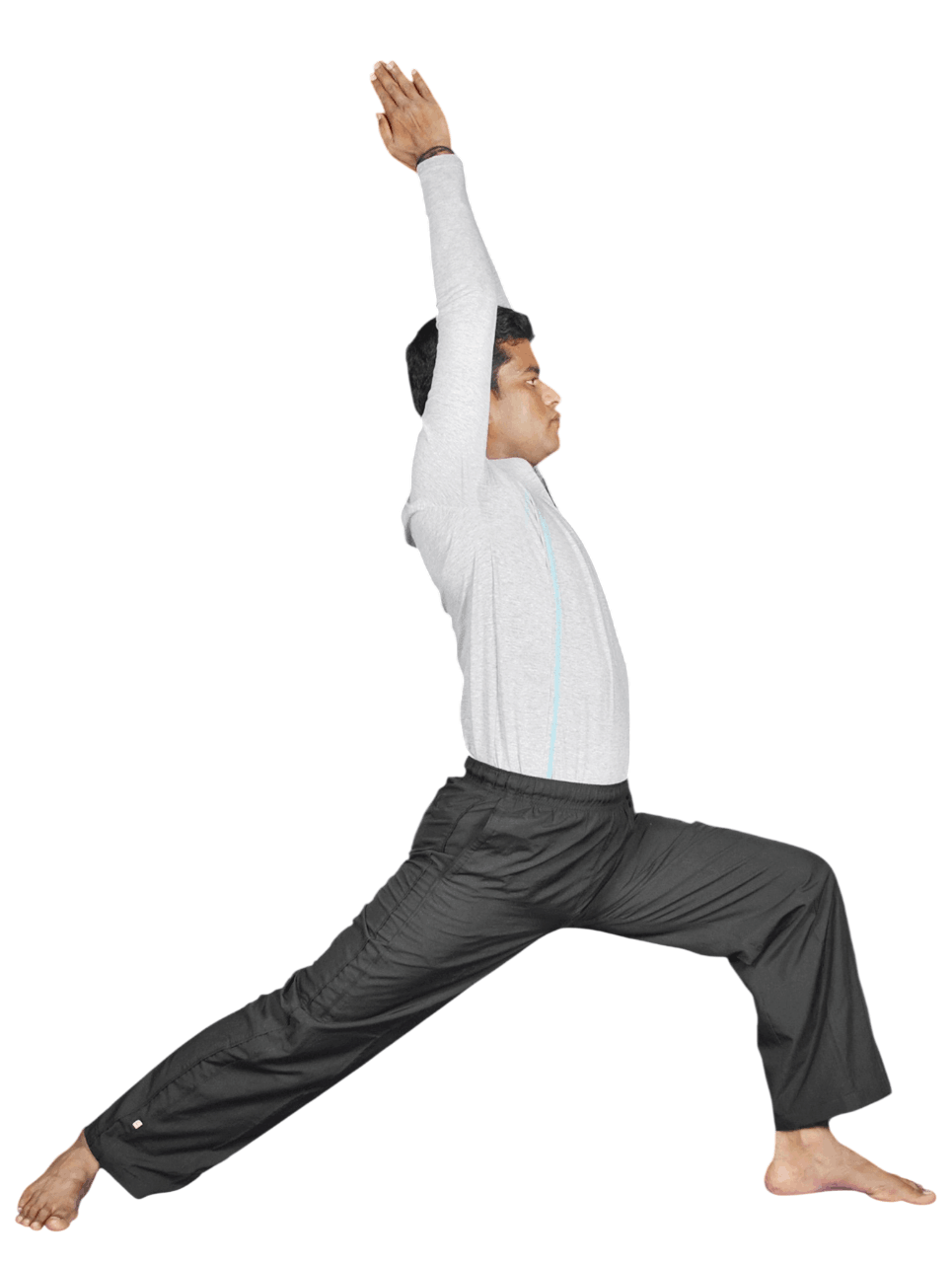
Virabhadra is the fierce warrior created by Lord Shiva from a lock of his hair to restore dharma. Thus Virabhadrasana I represents courage, stability, strength, and purposeful action.
The pose symbolizes standing firm in adversity, cultivating both warrior energy and spiritual humility.
2. Definition
Virabhadrasana I is a foundational standing posture combining:
- deep hip opening
- lumbo-pelvic stability
- thoracic extension
- full-body muscular engagement
- balanced weight distribution
- focus and steady gaze (drishti)
It is categorized under:
- Classical standing asanas
- Hip-flexor and chest-opening postures
- Lower-body strengthening asanas
- Dynamic or static hold postures in Hatha, Ashtanga and Vinyasa yoga sequences
The hallmark of Warrior I is front-leg lunge + back-leg extension + square hips + raised arms.
3. Method of Practice (Step-by-Step)
Step 1: Starting Position
- Stand in Tadasana.
- Ground all four corners of both feet.
- Align pelvis, spine and head in neutral.
Step 2: Step the Legs Apart
- Step the right leg backward 3½ to 4 feet depending on height and mobility.
- Turn the back foot out 30–45°.
- Keep the front foot pointing directly forward.
Step 3: Square the Pelvis
- Rotate the pelvis to face forward.
- Draw the right hip forward and left hip back.
- This is often the hardest portion for beginners.
Step 4: Deepen the Front Knee Bend
- Bend the front knee until the thigh approaches parallel to the floor.
- Ensure the knee tracks over the ankle and not collapsing inward.
- Press the outer back foot firmly into the ground.
Step 5: Stabilize the Lower Body
- Root the tailbone downward.
- Engage the core.
- Expand the ribcage while stabilizing the lumbar spine.
Step 6: Raise the Arms
- Inhale and sweep arms overhead.
- Palms can be together or shoulder-distance apart.
- Keep shoulders relaxed and away from ears.
- Broaden the collarbones.
Step 7: Lift the Chest, Maintain Grounding
- Lift sternum upward
- Draw shoulder blades down the back
- Keep weight evenly distributed on both feet
Step 8: Gaze
- Look toward the thumbs or straight ahead.
- Keep the neck in neutral if cervical discomfort exists.
Step 9: Holding the Pose
- Breathe deeply with steady Ujjayi or normal breath.
- Hold for 5–10 breaths.
Step 10: Release
- Exhale, lower arms, straighten front leg.
- Step back to Tadasana.
- Repeat on the opposite side.
4. Alignment Cues
Feet & Legs
- Front foot faces 12 o’clock.
- Back foot angled 30–45°, heel heavy.
- Press the outer back heel, activate arches.
- Front knee above ankle, not collapsing inward.
- Avoid lifting the back heel.
Pelvis
- Hips face forward.
- Draw front hip back, back hip forward.
- Avoid over-tilting pelvis (anterior pelvic tilt).
- Light coccyx lengthening.
Spine
- Lift from the base of the spine upward.
- Avoid lumbar compression.
- Maintain neutral spine with subtle thoracic extension.
Arms & Shoulders
- Arms straight but not rigid.
- Outer arms rotate inward slightly to broaden the upper back.
- Shoulders down and wide.
Ribs
- Avoid flaring the ribs forward.
- Lower front ribs slightly inward.
Drishti
- Thumbs or forward horizon depending on neck comfort.
5. Benefits of Virabhadrasana I
Physical Benefits
- Strengthens quadriceps, hamstrings, glutes
- Opens hip flexors (psoas, rectus femoris)
- Improves ankle and foot stability
- Expands chest and lungs
- Builds spinal strength
- Strengthens shoulders and arms
- Improves balance and posture
- Enhances core stability
- Improves circulation and lymph flow
- Enhances endurance and stamina
Physiological Benefits
- Stimulates adrenal glands
- Enhances lung capacity
- Improves cardiovascular efficiency
- Activates deep stabilizing muscles
- Stimulates digestive fire (agni)
Mental & Emotional Benefits
- Builds courage, determination, grounded confidence
- Enhances willpower
- Improves focus and concentration
- Reduces anxiety through grounding action
- Improves mental resilience
Energetic Benefits (Pranic)
- Opens Manipura Chakra (solar plexus)
- Activates Anahata Chakra
- Promotes circulation of prana through Sushumna
- Stabilizes Apana Vayu and stimulates Prana Vayu
6. Contraindications & Precautions
Major
- Recent hip, knee, or ankle injuries
- Severe shoulder injury
- Severe lumbar lordosis
- Uncontrolled hypertension
- Recent cardiac event
- Vertigo or balance disorders
- Herniated lumbar discs
Minor / Practice With Caution
- Pregnancy (2nd & 3rd trimester: widen stance)
- Weak knees (use support or shorten stance)
- Limited shoulder mobility (keep arms apart or at hips)
- Neck tension (gaze forward, not up)
7. Counterposes
After Warrior I, it is recommended to practice:
- Prasarita Padottanasana
- Adho Mukha Svanasana
- Tadasana
- Uttanasana
- Supta Padangusthasana
- Ardha Uttanasana
- Balasana
These poses neutralize spine and hips and lengthen quadriceps.
8. Preparatory Practices
Warm-up Asanas
- Sukshma Vyayama (ankle, hip, shoulder rotations)
- Tadasana for grounding
- Uttanasana for hamstring stretch
- Adho Mukha Svanasana for shoulder & spine prep
- Low Lunge (Anjaneyasana) for hip flexors
- Trikonasana for lateral hip stability
Preparatory Strength Work
- Wall squats
- Glute bridges
- Core activation (Uddiyana Bandha prep)
Preparatory Stretches
- Psoas stretch
- Quadriceps stretch
- Calf stretch
9. Modifications & Variations
Modifications
- Hands on hips
- For shoulder injury
- Shorten stance
- For balance issues or tight hip flexors
- Back heel lifted
- For hip alignment difficulty
- Use a chair
- Sit lightly on the edge for seniors
- Use blocks under hands
- During transition phases
Variations
- Crescent Warrior (High Lunge)
- Humble Warrior
- Warrior I with Eagle arms (Garudasana arms)
- Wall-supported Warrior I
10. Muscles Involved
Primary Muscles (Agonists)
- Quadriceps (front leg)
- Gluteus maximus
- Hamstrings (back leg stabilizing)
- Psoas & Hip flexors (front leg)
- Gastrocnemius & Soleus (back heel grounding)
- Abdominals
- Erector spinae
- Deltoids (arms overhead)
Secondary Muscles (Synergists)
- Gluteus medius
- Tensor fascia lata
- Adductors
- Trapezius
- Serratus anterior
- Rhomboids
- Latissimus dorsi (shoulder stability)
Stabilizers
- Transverse abdominis
- Pelvic floor muscles
- Tibialis posterior (foot arch stability)
11. Kinesiology of Virabhadrasana I
Movements Involved
- Front hip: flexion
- Back hip: extension + internal rotation
- Knees: front knee flexion, back knee extension
- Ankles: dorsiflexion front, plantarflexion back
- Spine: axial extension + mild thoracic extension
- Shoulders: flexion, slight external rotation
Joint Actions
- Hip joint under dual action (complex rotational stability)
- Knee joint stabilizing in closed-chain movement
- Scapulohumeral rhythm engages as arms lift
- Ankle joints maintain subtalar stability
12. Kinematics (Movement Analysis)
Linear and Angular Components
- Forward lunge creates linear anterior motion
- Back leg rotation creates angular adjustments in pelvis
- Upward arm motion produces scapular upward rotation
Movement Speed
- Typically slow to maintain alignment
- Controlled eccentric load in quadriceps
Planes of Motion
- Sagittal plane: predominant
- Transverse plane: pelvic adjustment
- Frontal plane: knee stabilization
13. Biomechanism / Biomechanics
Ground Reaction Force
- Back heel pressing activates kinetic chain upward
- Front leg pushes downward to stabilize trunk
Center of Gravity Shift
- Moves slightly forward
- Requires enhanced core engagement
Kinetic Chain Involvement
- Foot → knee → hip → spine → shoulder alignment must remain integrated
Lumbar Spine Management
- Risk of hyperlordosis if ribs flare
- Must use core and glute engagement
Knee Tracking
- Prevent valgus collapse (internal knee drop)
14. Functional Anatomy & Physiology
Functional Role
- Enhances lower limb functional strength
- Improves gait pattern
- Develops lumbopelvic rhythm
- Enhances shoulder stability
- Trains balanced weight distribution
Physiological Responses
- Increased heart rate (mild cardiovascular conditioning)
- Enhanced respiratory depth
- Increased blood flow to lower extremities
- Activation of stabilizing neuromuscular pathways
- Proprioception enhancement
15. How to Correct & Adjust While Teaching
Common Mistakes & Corrections
- Knee collapsing inward
➤ Cue: “Press the outer heel, track knee over second toe.” - Back heel lifting
➤ Cue: “Root your back heel; press down and back.” - Pelvis not squared
➤ Cue: “Draw your right hip forward, left hip back.” - Rib flare / lower back compression
➤ Cue: “Soften your ribs; engage your lower belly.” - Shoulders lifting toward ears
➤ Cue: “Relax shoulders, widen collarbones.”
Hands-On Adjustments (TTC Standard)
Pelvis Correction
- Stand behind the student.
- Gently guide hips into square position.
Front Knee Tracking
- Touch lightly on the outer knee and guide alignment.
Back Heel Grounding
- Press downward on student’s back heel
OR - Use a block under heel.
Arm & Shoulder Adjustment
- Assist upward lift without rib flare.
- Encourage scapular rotation and shoulder relaxation.
Safety Rules
- Avoid pressing on joints directly.
- Avoid pushing into pain.
- Adjust with awareness of student’s injuries.
QUESTION AND ANSWER
SECTION 1 — Sanskrit & Theory
1. What is the Sanskrit name for Warrior I Pose?
a) Virabhadrasana I
b) Virabhadrasana II
c) Virasana
d) Vrikshasana
Answer: a
2. The name “Virabhadra” refers to:
a) A mountain sage
b) A legendary warrior created by Shiva
c) The Sun God
d) A king of ancient India
Answer: b
3. “Asana” in Virabhadrasana means:
a) Breath
b) Posture
c) Balance
d) Movement
Answer: b
4. Virabhadrasana I primarily symbolizes:
a) Compassion
b) Heroic readiness & courage
c) Stillness
d) Nonviolence
Answer: b
SECTION 2 — Method of Practice
5. In Virabhadrasana I, the back foot is usually rotated:
a) 90°
b) 30–45° inward
c) 10° outward
d) Straight forward
Answer: b
6. The hips in Virabhadrasana I ideally face:
a) Side
b) Slightly outward
c) Diagonally
d) Forward towards the front leg
Answer: d
7. The front knee should align directly above:
a) Hip
b) Ankle
c) Toes
d) Outer edge of foot
Answer: b
8. The arms in Warrior I should be:
a) Parallel or palms together overhead
b) Beside the body
c) On the hips
d) Crossed in front
Answer: a
9. In the classical version, the back heel is:
a) Lifted
b) Lifted and rotated
c) Grounded firmly
d) Rotated outward
Answer: c
SECTION 3 — Alignment Principles
10. To avoid compressing the lower back, the teacher cues:
a) Arch the back deeply
b) Widen the feet further
c) Draw ribs in and lengthen spine
d) Drop the arms
Answer: c
11. Common alignment error in Virabhadrasana I:
a) Back leg too straight
b) Front knee collapsing inward
c) Shoulders relaxed
d) Back heel grounded
Answer: b
12. To maintain knee safety, the teacher should emphasize:
a) Knee moves beyond toes
b) Knee tracks over second toe
c) Knee rotates inward
d) Knee stays locked
Answer: b
13. Proper stance stability is achieved by:
a) Narrowing the feet
b) Widening the feet hip-width apart
c) Crossing the feet
d) Standing on toes
Answer: b
SECTION 4 — Benefits
14. Virabhadrasana I primarily strengthens:
a) Arms only
b) Hips, legs, core, shoulders
c) Neck and wrists
d) Fingers
Answer: b
15. Virabhadrasana I enhances:
a) Forward bending flexibility
b) Lower back compression
c) Spinal lengthening and chest expansion
d) Only foot stability
Answer: c
16. Therapeutically, Warrior I helps improve:
a) Cardiovascular strength
b) Cervical mobility
c) Eye health
d) Wrist issues
Answer: a
17. Emotional benefit associated with the pose:
a) Withdrawal
b) Grounding, courage, stability
c) Anxiety
d) Lethargy
Answer: b
SECTION 5 — Contraindications
18. Strong caution is needed for students with:
a) High blood pressure
b) Tight hamstrings
c) Mild cold
d) Low body weight
Answer: a
19. Students with knee injury should:
a) Deepen the bend
b) Keep knee straight or reduce angle
c) Jump into the pose
d) Avoid grounding the heel
Answer: b
20. For lower back pain, teachers should cue:
a) Deep backbend
b) Shorten stance & stabilize pelvis
c) Widen the arms
d) Bend backward more
Answer: b
SECTION 6 — Muscles Involved
21. Main agonist muscle for front-knee flexion:
a) Quadriceps
b) Hamstrings
c) Hip abductors
d) Calves
Answer: a
22. Major stabilizer of the back leg:
a) Adductors
b) Gluteus medius
c) Psoas
d) Biceps femoris
Answer: b
23. Which muscle primarily lengthens in the back leg?
a) Gastrocnemius
b) Adductor magnus
c) Soleus and hip flexors
d) Latissimus dorsi
Answer: c
24. Arms overhead activate:
a) Rhomboids
b) Deltoids and serratus anterior
c) Scalenes
d) Wrist flexors
Answer: b
SECTION 7 — Kinesiology & Biomechanics
25. The front hip joint performs:
a) Extension
b) Flexion
c) Rotation only
d) Abduction
Answer: b
26. The back hip joint is in:
a) Internal rotation and extension
b) Flexion and internal rotation
c) Flexion and adduction
d) External rotation
Answer: a
27. The lumbar spine in safe alignment is in:
a) Extension + rib flare
b) Neutral with core engagement
c) Hyperextension
d) Side bending
Answer: b
28. Weight distribution should be:
a) Only front leg
b) Only back leg
c) Even between both legs
d) More on arms
Answer: c
SECTION 8 — Preparatory & Counterposes
29. Best preparation pose for Warrior I:
a) Balasana
b) Low lunge (Anjaneyasana)
c) Padmasana
d) Paschimottanasana
Answer: b
30. Effective counterpose:
a) Ustrasana
b) Uttanasana
c) Matsyasana
d) Sarvangasana
Answer: b
31. For tight calves, preparation may include:
a) Savasana
b) Adho Mukha Svanasana
c) Headstand
d) Fish pose
Answer: b
SECTION 9 — Modifications & Props
32. For balance issues, modify by:
a) Narrowing stance
b) Widening stance
c) Closing eyes
d) Lifting both heels
Answer: b
33. For shoulder pain, arms can be:
a) Forced overhead
b) Kept behind the body
c) Placed on hips
d) Crossed in front
Answer: c
34. For high BP, arms should be:
a) Overhead
b) Extended to sides
c) Hands on hips or heart center
d) Raised repeatedly
Answer: c
SECTION 10 — Teaching, Corrections & Adjustments
35. Safe cue for alignment:
a) Push hips aggressively forward
b) Lengthen tailbone downward
c) Arch back deeply
d) Lock knees
Answer: b
36. To stabilize front knee, teacher can cue:
a) Press outer heel
b) Hug thighs inward
c) Turn shoulders
d) Lift ribs
Answer: b
37. To avoid rib flaring, cue:
a) Draw ribs toward hips
b) Lift chest excessively
c) Drop arms
d) Hold breath
Answer: a
38. Hands-on assist for hips:
a) Pull hips apart
b) Rotate hips gently to face forward
c) Push pelvis backward
d) Press ribs downward forcibly
Answer: b
39. A common student mistake is:
a) Back leg is active
b) Knee falls inward
c) Spine stays long
d) Arms aligned with ears
Answer: b
40. A verbal cue for beginners:
a) “Lean forward to go deeper.”
b) “Keep back heel grounded and spine tall.”
c) “Twist the spine.”
d) “Drop the chest.”
Answer: b