
1. Word Meaning and Etymology
The Sanskrit term Trikoṇāsana is composed of three words:
- Tri – three
- Koṇa – angle or corner
- Āsana – posture, seat, or stable position
Thus, Trikoṇāsana literally means “the Three-Angle Pose” or “Triangle Posture.”
The pose derives its name from the shape the body forms: a triangle created by the legs and another triangle formed between the front leg, torso, and floor.
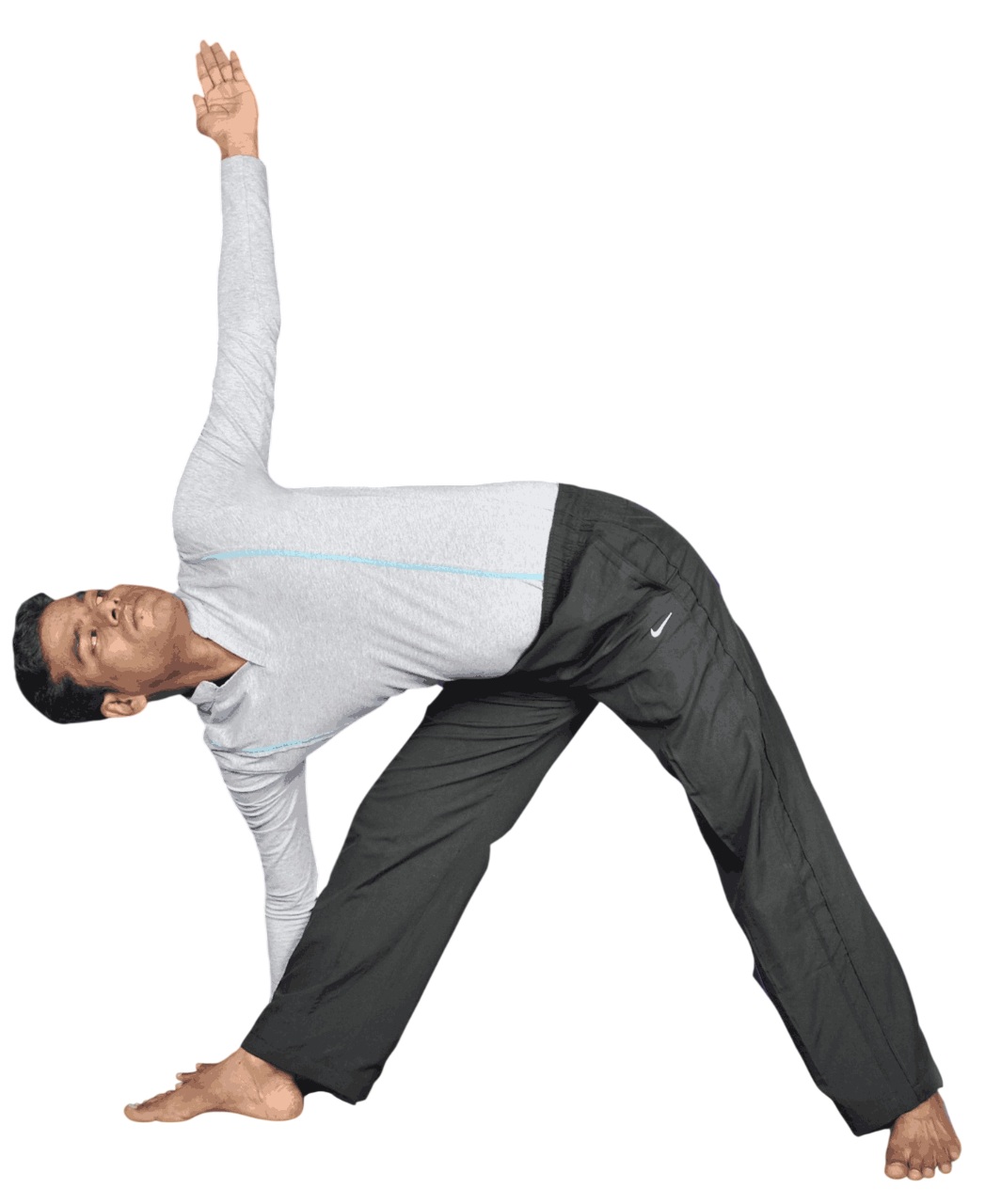
In yogic symbolism, the triangle represents:
- Balance of the three guṇas (sattva, rajas, tamas)
- Integration of body, mind, and breath
- Stability with expansiveness
2. Definition of Trikoṇāsana
Trikoṇāsana is a standing lateral-flexion posture involving:
- A wide stance
- External rotation of the legs
- Lateral extension of the spine
- Opening of the thoracic cage
- Lengthening of the hamstring and adductor chain
- Strong activation of the core and back muscles
It is a foundational standing pose in Hatha Yoga and part of:
- Sivananda series
- Iyengar foundational sequence
- Vinyasa warm-up series
- Ashtanga Standing Series
This asana emphasizes:
- Alignment
- Stability
- Core engagement
- Breath awareness
It is both therapeutic and strengthening, beneficial for beginners and advanced practitioners.
3. Method of Practice — Step-by-Step Instructions
Step 1: Starting Position (Tāḍāsana)
- Stand with feet together, arms by the side.
- Engage the thighs, lift the kneecaps.
- Ensure even weight distribution on both feet.
Step 2: Take a Wide Stance
- Step or hop the feet 3.5–4.5 feet apart (depending on height).
- Align heels in one line (traditional Hatha) or heel-to-arch alignment (Iyengar).
Step 3: Foot Positioning
- Turn the right foot outward to 90°.
- Slightly turn the left foot inward 10°–15°.
- Ensure both hip bones face the side wall.
Step 4: Raise the Arms
- Inhale and lift both arms parallel to the ground.
- Palms face downward.
- Lengthen from fingertips to fingertips.
Step 5: Hinge at the Hip Joint
- Exhale and shift the pelvis toward the left side.
- Lean the torso to the right without collapsing the waist.
- Maintain long lateral extension.
Step 6: Right Hand Down, Left Arm Up
- Rest the right hand on:
- Shin
- Ankle
- Block
- Floor (if flexibility allows)
- Extend the left arm vertically above the shoulder.
- Chest rotates upward.
Step 7: Head and Gaze Alignment
- Gaze toward the left thumb without straining the neck.
- Option: look straight ahead or down for neck issues.
Step 8: Breath and Stability
- Maintain the pose for 5–10 deep breaths.
- Engage thighs, draw belly in, keep spine long.
Step 9: Return to Starting Position
- Inhale, rise slowly.
- Rotate feet to center.
- Repeat on the other side.
4. Alignment Cues
Feet and Legs
- Press firmly through outer edge of back foot.
- Front foot pointing straight ahead.
- Heel-to-arch alignment for knee safety.
Pelvis and Hips
- Neutral pelvis; avoid pelvic tilt.
- Imagine lengthening both waist lines evenly.
- Avoid collapsing the underside waist.
Torso
- Lengthen through both sides of the body.
- Avoid rounding forward; rotate chest open.
- Keep ribs integrated (avoid flaring).
Shoulders and Arms
- Stack top shoulder above bottom shoulder.
- Extend arms actively in opposite directions.
- Keep shoulder blades gliding down the back.
Neck and Head
- Neutral, long neck.
- Avoid compressing cervical spine.
- Turn gaze with breath ease.
Breath
- Inhale: lengthen
- Exhale: rotate and deepen
5. Benefits of Trikoṇāsana
Physical Benefits
- Strengthens legs – quadriceps, hamstrings, calves.
- Stretches hip adductors.
- Improves lateral spinal flexibility.
- Strengthens obliques and core muscles.
- Opens chest and shoulders.
- Improves digestion by compression and release in abdominal region.
- Stimulates the kidneys.
- Enhances postural alignment.
- Improves hamstring length.
- Increases balance and stability.
Therapeutic Benefits
- Relieves lower-back stiffness (when performed with correct alignment).
- Useful for sciatica (modified versions).
- Improves lymphatic flow.
- Helps reduce anxiety through slow controlled breathing.
Energetic Benefits
- Activates Maṇipūra (solar plexus) chakra.
- Balances Ida and Piṅgalā nāḍi.
- Enhances prāṇa flow along the side body.
Mental Benefits
- Improves groundedness, clarity, and focus.
- Enhances sense of expansion and centeredness.
6. Contraindications
Absolute Contraindications
- Acute low back injury
- Recent hip or spinal surgery
- Severe balance issues
- Cervical spondylosis (avoid neck turning)
Relative Contraindications
- High or low blood pressure
- (Avoid raising the arm too long; avoid looking up)
- Vertigo
- Herniated disc (practice modified, no deep lateral flexion)
- Hamstring tear or strain
- Migraine (avoid head tilting)
Pregnancy
- Safe in early pregnancy with support
- Avoid deep lateral bending in 2nd/3rd trimester
7. Counterposes
After Trikoṇāsana, perform poses that neutralize spine:
- Tāḍāsana
- Utthita Pārśvakoṇāsana
- Prasārita Padottanāsana
- Pārśvottanāsana
- Gentle spinal twists
8. Preparatory Practices
Before entering Trikoṇāsana, warm up with:
Standing Preparations
- Tāḍāsana
- Utthita Hasta Pādāsana (wide leg stance)
- Pārśva stretching
- Hip opening exercises
Hamstring Preparation
- Ardha Uttānāsana
- Uttānāsana
- Supta Pādānguṣṭhāsana
Spinal Mobilization
- Cat–Cow
- Side bends
- Thoracic rotation drills
9. Modifications and Variations
Beginner Modifications
- Use block under the lower hand.
- Keep top hand on waist instead of overhead.
- Look straight ahead rather than up.
Therapeutic Modifications
- Practice against the wall to maintain alignment.
- Shorten stance to reduce hamstring strain.
- Bend the knee of front leg if needed.
Advanced Variations
- Bound Trikoṇāsana (Baddha Trikoṇāsana)
- Revolved Triangle (Parivṛtta Trikoṇāsana)
- Extended Reach Triangle
- Floating triangle (balancing variation)
10. Muscles Involved (Muscular Anatomy)
Primary Muscles Working
- Quadriceps
- Hamstrings
- Gluteus medius and minimus
- Adductor group
- Obliques
- Transverse abdominis
- Erector spinae
- Latissimus dorsi
- Intercostals
Secondary Muscles
- Gastrocnemius and soleus
- Tibialis anterior
- Serratus anterior
- Rotator cuff muscles
- Rhomboids and trapezius
11. Kinesiology (Movement Science)
Major Movements in Trikoṇāsana
- Hip Abduction (front leg)
- Hip External Rotation (front leg)
- Hip Internal Rotation (back leg)
- Spinal Lateral Flexion
- Thoracic Rotation
- Shoulder Abduction
- Ankle Stabilization
Planes of Movement
- Frontal plane – dominant
- Transverse plane – for chest opening
- Sagittal plane – neutral stability
Joint Actions
- Knee extension
- Hip hinge
- Scapular stabilization
- Neck rotation (optional)
12. Kinematics (Displacement, Motion Analysis)
Lower Body Kinematics
- Stance width determines load distribution.
- Front-leg hip abducts; back leg internally rotates.
- Ground reaction force stabilizes the lower kinetic chain.
Spinal Kinematics
- Long axis lateral flexion with rotation.
- Shoulders stack; ribs expand.
Upper Body Kinematics
- Arms create counter-balance.
- Top arm alignment affects thoracic rotation.
13. Biomechanics of Trikoṇāsana
Key Biomechanical Principles
- Length–Tension Relationship
Hamstrings and adductors lengthen optimally when knees remain extended. - Force Couples
- Obliques + spinal extensors maintain torso’s side bending.
- Gluteus medius + tensor fascia lata stabilize pelvis.
- Ground Reaction Force
- Back foot distributes force upward through leg and pelvis.
- Stacking of Joints
- Shoulder alignment prevents collapse.
- Hip alignment preserves SI joint stability.
- Spinal Neutrality
- Preventing flexion protects lumbar discs.
14. Functional Anatomy & Physiology
Musculoskeletal Function
- Strengthens lower kinetic chain
- Enhances flexibility of hip and thigh muscles
- Improves lateral spinal mobility
Respiratory Function
- Expands thoracic cage
- Improves intercostal muscle flexibility
- Increases lung capacity
Cardiovascular Response
- Mild activation; stimulates blood flow
- Enhances venous return
Digestive System Function
- Abdominal compression stimulates peristalsis
- Supports liver and kidney function
Nervous System
- Enhances proprioception
- Improves neuromuscular coordination
- Encourages parasympathetic activation
15. How to Correct and Adjust While Teaching
Common Misalignments & Corrections
1. Collapsed Bottom Waist
- Teacher cue: “Lengthen both sides of the torso evenly.”
2. Torso leaning forward
- Cue: “Open your chest; rotate your top ribs toward the ceiling.”
3. Hyperextended front knee
- Cue: “Micro-bend the knee; activate quadriceps.”
4. Top arm falling backward or forward
- Cue: “Stack the shoulder directly above the bottom shoulder.”
5. Back foot turning outward
- Cue: “Press outer edge of the foot firmly into the mat.”
Manual Adjustments (Hands-On)
(For trained TTC-level teachers only)
- Pelvis Stabilization
- Place one hand on sacrum, one on front hip.
- Guide pelvis into neutral alignment.
- Torso Extension
- Support ribs gently and encourage upward length.
- Chest Rotation
- Lightly rotate upper shoulder backward.
- Leg Stability
- Press downward on front thigh to ground femur.
- Arm Alignment
- Guide top arm into vertical line.
Golden Rule:
Adjust with breath awareness, consent, and safety.
16. Teaching Methodology Tips
- Demonstrate pose from side view for clarity.
- Use blocks for beginners.
- Encourage breathing patterns (inhale lengthening, exhale rotation).
- Observe from multiple angles (front, side, diagonal).
- Offer verbal + visual + tactile cues.
17. Conclusion
Trikoṇāsana is an essential posture in classical Hatha Yoga that integrates:
- Alignment
- Lateral spinal movement
- Balance
- Stability
- Strength
- Flexibility
Its anatomical, biomechanical, and energetic dimensions make it invaluable for yoga teachers and TTC students. Practiced mindfully, it brings harmony between the physical body, breath, and mental focus.
QUESTION AND ANSWER
1. The word “Trikoṇāsana” means:
a) Three angles pose
b) Three-legged pose
c) Twisting pose
d) Square pose
Answer: a
2. Trikoṇāsana primarily works in which plane?
a) Sagittal
b) Transverse
c) Frontal
d) Oblique
Answer: c
3. Main spinal movement in Trikoṇāsana is:
a) Flexion
b) Extension
c) Rotation
d) Lateral flexion
Answer: d
4. Which muscle group is lengthened most?
a) Quadriceps
b) Hamstrings + Adductors
c) Calves
d) Psoas
Answer: b
5. Which shoulder should stack directly above the other?
a) Bottom shoulder above top
b) Top shoulder above bottom
c) Shoulders relaxed
d) No shoulder alignment needed
Answer: b
6. The recommended alignment for the feet is:
a) Heel-to-toe
b) Heel-to-arch
c) Parallel
d) Crossed
Answer: b
7. Contraindication for looking upward:
a) Anxiety
b) Neck pain
c) Asthma
d) Flat feet
Answer: b
8. Best modification for beginners:
a) Shorter stance
b) Close eyes
c) Lift back heel
d) Deep bend forward
Answer: a
9. Which chakra is activated?
a) Muladhara
b) Anahata
c) Manipura
d) Sahasrara
Answer: c
10. Primary joint action of front hip:
a) Internal rotation
b) External rotation
c) Flexion
d) Hyperextension
Answer: b
11. Trikoṇāsana strengthens the:
a) Obliques
b) Biceps
c) Neck flexors
d) Wrist extensors
Answer: a
12. Therapeutic use of Trikoṇāsana:
a) Vertigo
b) Sciatica (modified)
c) Fracture healing
d) Migraine
Answer: b
13. A common mistake is:
a) Chest rotating downward
b) Chest rotating upward
c) Looking forward
d) Using blocks
Answer: a
14. Counterpose:
a) Chakrasana
b) Tadasana
c) Matsyasana
d) Vajrasana
Answer: b
15. Which area stabilizes the pose?
a) Biceps
b) Core
c) Pelvic floor
d) Occipital muscles
Answer: b
Section 1: Basics, Meaning & Definitions
1. The Sanskrit term “Trikonasana” literally means:
A. Three circles pose
B. Three angles pose
C. Three directions pose
D. Three lines pose
Answer: B
2. Trikonasana is primarily categorized as a:
A. Forward bend
B. Backbend
C. Lateral standing stretch
D. Prone twist
Answer: C
3. Which of the following is the closest translation of “Trikona”?
A. Square
B. Triangle
C. Star
D. Circle
Answer: B
4. Trikonasana is traditionally practiced in which family of poses?
A. Balance poses
B. Standing poses
C. Inversions
D. Arm balances
Answer: B
Section 2: Steps & Method of Practice
5. The correct starting position for Trikonasana is:
A. Vajrasana
B. Tadasana
C. Dandasana
D. Sukhasana
Answer: B
6. When entering Trikonasana, the front foot should face:
A. 30° inward
B. 45° outward
C. Straight forward (0°)
D. 90° outward
Answer: C
7. The back foot is usually turned approximately:
A. 5–10° inward
B. 45° outward
C. 90° outward
D. 0° straight
Answer: A
8. The main movement in descending toward the front leg is:
A. Forward bending
B. Back bending
C. Lateral flexion at the hip
D. Chest compression
Answer: C
Section 3: Alignment Principles
9. In correct alignment, the chest in Trikonasana should be:
A. Rotated downward
B. Rotated upward
C. Collapsed inward
D. Facing forward
Answer: B
10. The front knee should remain:
A. Bent
B. Hyperextended
C. Neutral with micro-bend
D. Completely locked
Answer: C
11. The top arm should ideally be:
A. Hanging loosely
B. Rotated forward
C. Stacked over the bottom arm
D. Kept behind the torso
Answer: C
12. What is the correct cue for the spine?
A. Rounding forward
B. Collapsing downward
C. Lengthen both sides of the waist
D. Compress the lower ribs
Answer: C
Section 4: Muscles Involved
13. Primary muscle lengthened in the front leg during Trikonasana:
A. Quadriceps
B. Hamstrings
C. Gastrocnemius
D. Tibialis anterior
Answer: B
14. The side-body stretch mainly activates the:
A. Multifidus
B. Obliques and quadratus lumborum
C. Gluteus medius
D. Psoas
Answer: B
15. Which muscle is strongly active to stabilize the pelvis?
A. Biceps brachii
B. Gluteus minimus
C. Gluteus medius
D. Deltoid
Answer: C
16. Which muscle externally rotates the front thigh?
A. Vastus intermedius
B. Piriformis
C. Pectineus
D. Soleus
Answer: B
Section 5: Kinematics, Kinesiology & Biomechanics
17. The major joint movement at the front hip is:
A. Flexion
B. Lateral flexion
C. Abduction
D. External rotation
Answer: A
18. The trunk movement is primarily:
A. Spinal extension
B. Axial rotation
C. Spinal lateral flexion
D. Forward folding
Answer: C
19. The lower hand placement should NOT create which of the following?
A. Lateral stability
B. Length in the spine
C. Compression in the lower ribs
D. Proper grounding
Answer: C
20. Center of gravity shifts in Trikonasana toward:
A. Back heel
B. Front heel
C. Midline
D. Toes
Answer: B
Section 6: Benefits
21. Which of the following is a key physical benefit?
A. Strengthens calves only
B. Improves lateral spinal flexibility
C. Reduces upper body strength
D. Increases blood pressure
Answer: B
22. Therapeutically, Trikonasana helps with:
A. Cervical hernia
B. Poor digestion
C. High fever
D. Severe heart failure
Answer: B
23. Which system benefits most from chest opening in Trikonasana?
A. Circulatory system
B. Nervous system
C. Respiratory system
D. Endocrine system
Answer: C
Section 7: Contraindications
24. Which condition requires modification or avoidance?
A. Mild fatigue
B. Migraine
C. Acute sciatica
D. Healthy spine
Answer: C
25. Students with high blood pressure should:
A. Raise the top arm straight up
B. Avoid raising the top arm
C. Deeply rotate the chest
D. Fold fully down
Answer: B
26. Avoid deep lateral flexion if there is:
A. Slight stiffness
B. Osteoarthritis of the hip (acute)
C. Tight hamstrings
D. Low stamina
Answer: B
Section 8: Modifications & Props
27. Beginners often require which prop under the lower hand?
A. Blanket
B. Strap
C. Block
D. Bolster
Answer: C
28. Students with tight hamstrings can modify by:
A. Widening the stance excessively
B. Shortening the stance
C. Twisting deeper
D. Locking the knee
Answer: B
29. For better balance, one can practice with:
A. Shoulder against a wall
B. Back against a wall
C. Feet on a cushion
D. Eyes closed
Answer: B
Section 9: Counterposes & Preparatory Poses
30. A suitable counterpose is:
A. Camel pose
B. Tadasana
C. Matsyasana
D. Chakrasana
Answer: B
31. Good preparation for hamstring mobility:
A. Bhujangasana
B. Uttanasana
C. Vajrasana
D. Shavasana
Answer: B
32. A warm-up pose enhancing external hip rotation:
A. Virasana
B. Baddha Konasana
C. Savasana
D. Setu Bandhasana
Answer: B
Section 10: Teaching Methodology & Adjustments
33. Best verbal cue for beginners:
A. Collapse into the bottom ribs
B. Reach the crown and tailbone away from each other
C. Drop the chest downward
D. Lock the knee
Answer: B
34. Hands-on adjustment for chest rotation is applied to:
A. Shoulders only
B. Upper arm and rib cage
C. Lower back
D. Hamstrings
Answer: B
35. Avoid adjusting students from which area?
A. Wrist
B. Torso
C. Knees
D. Upper back
Answer: C
36. A safe alignment cue for students with hypermobility:
A. Deepen lateral stretch
B. Micro-bend front knee
C. Straighten the knee strongly
D. Collapse toward the shin
Answer: B
37. Teachers should emphasize grounding of which point first?
A. Toes
B. Heels
C. Forefoot
D. Crown of head
Answer: B
38. For students losing balance, instructor should advise:
A. Bigger stance
B. Narrower stance
C. Twist deeper
D. Lower head
Answer: B
39. A correct tactile cue for spinal lengthening:
A. Push down on shoulders
B. Gently lift the side ribs upward
C. Press the chest downward
D. Push pelvis sideways aggressively
Answer: B
40. The safest teacher instruction is:
A. “Go as deep as possible.”
B. “Let your breath guide the movement.”
C. “Push until you feel pain.”
D. “Drop the body weight on the lower hand.”
Answer: B