
1. Word Meaning
Parivṛtta Pārśvakonāsana comes from Sanskrit:
- Parivṛtta = “revolved,” “twisted,” or “turned around”
- Pārśva = “side” or “flank”
- Kona = “angle”
- Āsana = “posture”
Thus, Parivṛtta Pārśvakonāsana means Revolved Side Angle Pose—a deep twisting lunge posture combining spinal rotation, hip stability, balance, and thoracic mobility.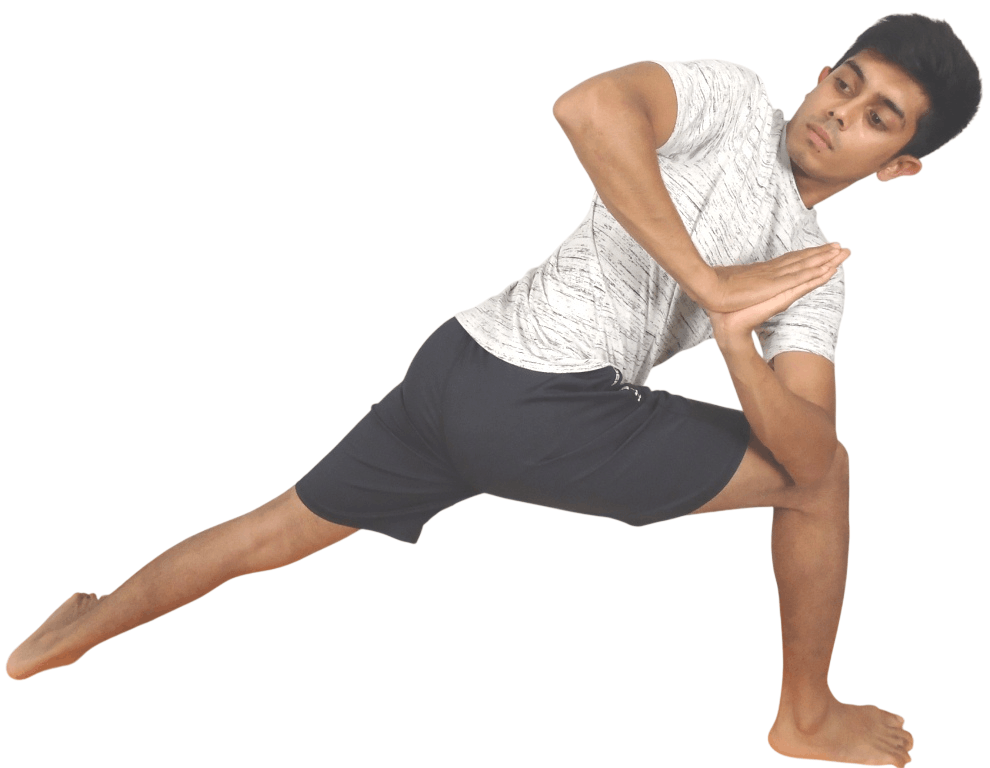
2. Definition
Parivṛtta Pārśvakonāsana is an advanced twisting standing posture that integrates:
- A deep lunge
- A full spinal rotation
- A bind or prayer twist
- Stabilization of the pelvis and core
- An elongated spine resisting collapse
- Integration of breath for detoxification
It is considered a detoxifying, strengthening, and internally cleansing posture in yoga traditions.
This asana appears in Ashtanga, Vinyasa, Hatha, and Power Yoga sequences.
3. Method of Practice (Step-by-Step)
Preparatory Setup
- Stand in Tadasana.
- Step your right leg back into a high lunge with the left knee at 90°.
- Hands at prayer (Anjali Mudra) at heart.
Step-by-Step Instructions
Step 1 — Establish the Lunge
- Left foot forward, right foot back.
- Front knee directly above ankle.
- Back leg straight and strong.
- Both hips facing forward.
Step 2 — Activate the Core
- Inhale deeply.
- Lengthen the spine upward.
- Lift through the chest and crown.
Step 3 — Initiate the Twist
- Exhale and rotate torso to the left (towards front leg).
- Bring your right elbow to the outside of the left knee.
- Maintain length before twisting deeper.
Step 4 — Set the Arms
Option A – Prayer Twist (most common)
- Press palms together.
- Use elbow-to-knee leverage to deepen the twist.
Option B – Open Arm Twist
- Lower hand to the outside of front foot, top arm to sky.
Option C – Bound Twist (advanced)
- Bottom arm wraps under the thigh.
- Top arm wraps behind back.
- Hands clasp if possible.
Step 5 — Integrate Lower Body
- Back heel actively presses.
- Front thigh parallel to floor.
- Pelvis remains level—not tipping.
Step 6 — Final Alignment
- Shoulder blades broaden.
- Chest rotates upward.
- Head neutral or gazing upward.
Step 7 — Breath
- Deep inhalation expands rib cage.
- Exhalation twists torso further.
- Maintain 5–10 breaths.
Step 8 — Exit
- Inhale, untwist gently.
- Return to lunge.
- Step into Tadasana.
- Repeat on other side.
4. Alignment Cues (Teacher Level)
Feet & Legs
- Front heel under knee; thigh abducts slightly to avoid collapsing inward.
- Back heel pushes back; toes face forward.
- Inner arches active.
- Knee tracks with toes.
Hips & Pelvis
- Keep hips square before twisting.
- Front hip draws back; back hip moves forward.
- Avoid collapsing pelvis downward or lifting unevenly.
Spine
- Spine lengthens upward before rotating.
- Maintain axial extension.
- Twist is thoracic dominant—not lumbar.
Shoulders & Chest
- Shoulders stack vertically.
- Open chest upward.
- Avoid rounding or collapsing inward.
Arms
- In prayer variation:
- Press palms firmly.
- Use elbow leverage to enhance rotation.
- In open arm variation:
- Top shoulder stacks above bottom shoulder.
- Bottom hand stable, not overreaching.
Head & Neck
- Neutral gaze if cervical sensitivity.
- Advanced option: look upward.
5. Benefits
Physical Benefits
- Improves spinal mobility
- Strengthens legs, glutes, core, obliques
- Enhances balance and proprioception
- Stimulates abdominal organs
- Opens the hips, shoulders, thoracic cage
- Enhances lung capacity and breathing coordination
Physiological Benefits
- Supports digestion and peristalsis
- Improves circulation
- Stimulates detoxification pathways
- Enhances endocrine system stimulation (adrenal, pancreatic tone)
Energetic Benefits
- Activates Manipura Chakra (solar plexus)
- Builds inner confidence and personal power
- Releases emotional stagnation stored in hips and ribs
Mental & Emotional Benefits
- Improves concentration
- Strengthens mental resilience
- Reduces stress and anxiety
- Encourages internal awareness and grounding
6. Contraindications
Absolute Contraindications
- Recent abdominal surgery
- Disc herniation with nerve compression
- Late pregnancy
- Post-spinal surgery
- Uncontrolled hypertension
- Severe vertigo
Relative Contraindications
- Early pregnancy (avoid deep compression)
- Knee injuries
- Hip labral tears
- Shoulder instability
- GERD (adjust twist height)
- Asthma (modify depth)
Beginner Safety Concerns
- Avoid collapsing into the elbow
- Avoid over-twisting lumbar spine
- Keep front knee stable (prevent valgus collapse)
7. Counterposes
After Parivritta Parsvakonasana, suitable counterposes include:
- Parsva Balasana (Thread the Needle)
- Vajrasana with gentle twist
- Ardha Uttanasana (Half Forward Fold)
- Adho Mukha Svanasana
- Paschimottanasana
- Supta Matsyendrasana
These poses relieve spinal tension and neutralize hips and pelvis.
8. Preparatory Practices
To warm spine and hips:
- Cat–Cow
- Low Lunge
- Lizard Pose
- Supine Twist
- Parivrtta Anjaneyasana
- Parivrtta Utkatasana
- Trikonasana
- Parivritta Trikonasana
Strengthening work:
- Plank
- Boat Pose
- Side Plank
9. Modifications
For beginners
- Keep back knee down
- Hands on blocks
- Reduce twist angle
- Widen stance for stability
For Intermediate Level
- Use open-arm twist
- Press bottom hand into block for elevation
- Keep back heel elevated
For Advanced Level
- Bind variation
- Full expression: back heel grounded + deep rotation
- Transition into Bird of Paradise pose
- Use deeper hip flexion and thoracic rotation
10. Muscles Involved (Functional Anatomy)
Prime Movers
- Obliques – drive spinal rotation
- Psoas and Iliacus – hip flexion
- Quadriceps – stabilize the front knee
- Gluteus medius/minimus – hip stabilization
- Erector Spinae – spinal extension
Synergists
- Hamstrings
- Adductors
- Rotator cuff muscles
- Serratus anterior
- Latissimus dorsi
- Internal intercostals
Antagonists
- Muscles resisting rotation
- Opposing obliques
- Posterior chain during flexion
11. Kinesiology
Joint Actions
- Spinal rotation (thoracic > lumbar)
- Hip flexion in front leg
- Hip extension in back leg
- Scapular rotation and stabilization
- Thoracic expansion
Planes of Movement
- Transverse plane (primary, twisting)
- Sagittal plane (lunge)
- Frontal plane (side angle opening)
Muscle Activation Patterns
- Activation of oblique sling system
- Stabilization from glutes + quadratus lumborum
- Psoas activation determines twist depth
- Hip external rotators stabilize knee alignment
12. Kinematics (Movement Analysis)
Phase 1 — Entry Movement
- Transition from neutral spine to extended spine
- Forward lunge
- Initial rotation from thoracic region
Phase 2 — Stabilization
- Ground reaction forces through feet
- Center of gravity shifts diagonally
- Pelvis counters rotation for balance
Phase 3 — Final Twist
- Closed chain rotation
- Rib cage lifts and rotates
- Deep fascial tension in spiral lines
Phase 4 — Exit
- Controlled derotation
- Re-stacking of pelvis over legs
- Safe re-positioning of torso
13. Biomechanics
Key Biomechanical Points
- Spinal rotation primarily originates from the thoracic spine, not lumbar.
- Pelvis should remain stable; excessive pelvic rotation reduces spinal benefits.
- Front knee valgus is the most common misalignment—avoid inward collapsing.
- Ground reaction force from back foot enables stability.
- Lever mechanics from elbow-to-knee contact deepen twist.
- Fascial slings (anterior + posterior oblique) activate to stabilize core.
14. Functional Anatomy & Physiology
Digestive System
- Compression improves organ motility
- Enhanced blood flow improves digestion
- Massages liver, pancreas, and intestines
Respiratory System
- Expands intercostal space
- Improves breath control
- Strengthens diaphragm coordination
Musculoskeletal System
- Strengthens core and lower body
- Improves rotational mobility
- Enhances balance and structural alignment
Neurological System
- Enhances proprioceptive feedback
- Improves mind-body coordination
- Stimulates parasympathetic nervous response after release
15. How to Correct & Adjust While Teaching
Verbal Cues
- “Lengthen first, twist second.”
- “Keep front knee aligned with toes.”
- “Lift your chest away from thigh.”
- “Engage your core before deepening twist.”
- “Press the back heel down to stabilize.”
Hands-On Adjustments (Safe TTC-Level Techniques)
Adjustment 1 — Spinal Lengthening
- Place one hand between shoulder blades.
- Gently guide upward for axial extension.
Adjustment 2 — Pelvic Stabilization
- One hand on back hip stabilizing forward rotation.
- Prevent collapsing or excessive external rotation.
Adjustment 3 — Thoracic Rotation
- One hand on upper arm guiding backward
- Other hand stabilizing opposite shoulder.
- Light pressure to encourage expansion, not force twist.
Adjustment 4 — Front Knee Alignment
- Use one hand to gently guide knee outward to avoid valgus.
Adjustments to Avoid
- Never force twist manually
- Avoid pushing lower back
- Avoid aggressive arm manipulation
- Do not compress abdomen excessively
QUESTION AND ANSWER
1. The Sanskrit term “Parivritta” means what?
A. Extended
B. Bound
C. Revolved or twisted
D. Lifted
Answer: C
2. Parivritta Pārśvakonasana belongs to which category of asanas?
A. Backbends
B. Twists
C. Forward bends
D. Inversions
Answer: B
3. Which of the following is the primary spinal movement in Parivritta Pārśvakonāsana?
A. Extension
B. Lateral flexion
C. Rotation
D. Compression
Answer: C
4. What is the ideal position of the front knee in the pose?
A. Hyperextended
B. Slightly bent
C. Directly above the ankle
D. Behind the ankle
Answer: C
5. The back heel in the classical version of the pose should be:
A. Lifted off the floor
B. Rooted into the floor
C. Turned inward
D. Parallel to the front heel
Answer: B
6. Which muscle group works hardest to maintain spinal rotation?
A. Erector spinae
B. Internal and external obliques
C. Psoas major
D. Gluteus maximus
Answer: B
7. Which joint is MOST challenged in balance during Parivritta Pārśvakonāsana?
A. Wrist
B. Knee
C. Ankle
D. Shoulder
Answer: C
8. Which of the following is a major benefit of Parivritta Pārśvakonāsana?
A. Reduces spinal mobility
B. Improves digestion
C. Weakens core muscles
D. Reduces blood flow to abdominal organs
Answer: B
9. Which chakra is primarily stimulated in Parivritta Pārśvakonāsana?
A. Muladhara
B. Manipura
C. Visuddhi
D. Ajna
Answer: B
10. Which of the following is a contraindication?
A. Low blood pressure
B. Mild anxiety
C. Migraine
D. Spinal twisting injuries
Answer: D
11. Which muscle is primarily stretched in the back leg?
A. Gastrocnemius
B. Hamstrings
C. Quadriceps
D. Hip flexors
Answer: D
12. Which modification helps beginners balance?
A. Lift the front heel
B. Shorten the stance and place hand on a block
C. Bend the back knee deeply
D. Twist only the pelvis
Answer: B
13. Proper alignment of the spine requires:
A. Rounding the back
B. Overarching the lumbar region
C. Lengthening before twisting
D. Twisting first, then stabilizing
Answer: C
14. Which arm position is used in the full pose?
A. Hands at heart center
B. Bottom elbow outside the front knee, top arm overhead
C. Both arms behind the back
D. Both hands on the ground
Answer: B
15. What is the biomechanical function of twisting in this pose?
A. Decreases intervertebral space
B. Enhances fascial elasticity and organ compression
C. Reduces blood flow
D. Immobilizes the pelvis
Answer: B
16. Which breathing pattern supports deeper rotation?
A. Inhale during twisting
B. Exhale during rotation
C. Hold breath in
D. Hold breath out
Answer: B
17. In teaching, the first adjustment cue should focus on:
A. Forcing deeper twist
B. Stabilizing the pelvis and foundation
C. Locking the knee joint
D. Heavy weighting of the front wrist
Answer: B
18. Which muscle stabilizes the front-leg knee?
A. Gluteus minimus
B. Vastus medialis
C. Piriformis
D. Tibialis anterior
Answer: B
19. Which variation is safer for people with lower back pain?
A. Bind twist
B. Short stance with hand on block
C. Heel lifted
D. Deep rotation of lumbar spine
Answer: B
20. What is the primary function of the back foot in stability?
A. To rotate the pelvis
B. To distribute weight evenly
C. To provide strong grounding for the twist
D. To lift the body upward
Answer: C
21. Which shoulder action is essential in the final expression of the pose?
A. Protraction of both scapulae
B. Retraction and depression of top scapula
C. Elevation of bottom shoulder
D. Internal rotation of top arm
Answer: B
22. Which anatomical plane does the twist occur in?
A. Sagittal plane
B. Frontal plane
C. Transverse plane
D. Oblique plane
Answer: C
23. Which cue helps prevent rounding of the spine?
A. Drop the chest
B. Collapse the front ribs
C. Lengthen crown of head forward
D. Lock the pelvis
Answer: C
24. In beginners, the most common misalignment is:
A. Over-bending the front knee
B. Back heel lifting and pelvis collapsing
C. Too much thoracic extension
D. Over-relaxing the shoulders
Answer: B
25. Which muscle initiates rotation of the thoracic spine?
A. Latissimus dorsi
B. Rhomboids
C. Internal oblique
D. Quadratus lumborum
Answer: C
26. Which of the following is a correct counterpose?
A. Cobra
B. Forward fold
C. Seated gentle twist
D. Camel
Answer: C
27. What is the safest way to deepen the pose while teaching?
A. Push shoulders manually
B. Twist from the pelvis
C. Encourage lengthening the spine before deeper rotation
D. Encourage locking of knees
Answer: C
28. In biomechanical terms, the front hip primarily undergoes:
A. Extension
B. Flexion
C. Abduction
D. Adduction
Answer: B
29. Which internal organ benefits most from the twist?
A. Lungs
B. Liver and digestive organs
C. Kidneys
D. Heart
Answer: B
30. Which cue best supports both alignment and stability?
A. “Twist from the neck first.”
B. “Sink into the back heel and lengthen through the spine.”
C. “Collapse the ribs for deeper rotation.”
D. “Lift the front foot slightly.”
Answer: B