
Garudasana(Eagle Pose)
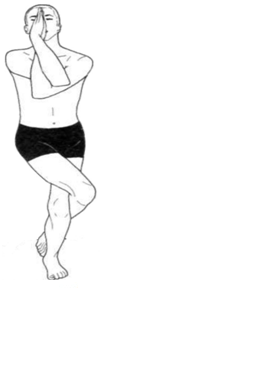
From Tadasana bend the knee, bring the other knee over and rest the back of this thigh over the thigh of the inside leg. Move the outer foot behind the calf so the outer foot shin touches the inner calf. Balance on the inner leg. Bend the elbow and raise the arms to the chest level. Rest the right elbow on the front of the left upper arm near the elbow, then move the right hand back to the right and the left hand back to the left and join the palms.
Ardha Chakrasana(Half Wheel Pose)
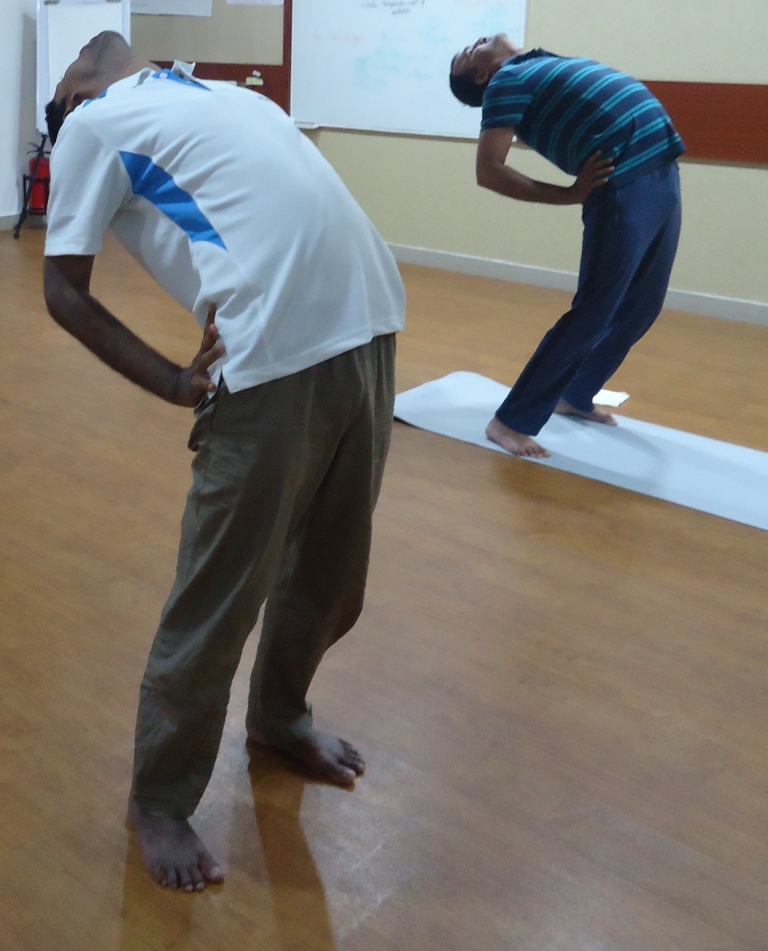
Tadasana, support both palms on the back of the hips, push the hip forward and bend backwards from the sacral region, widen chest, head backwards.
Pada Hastasana(Hand to Foot Pose)
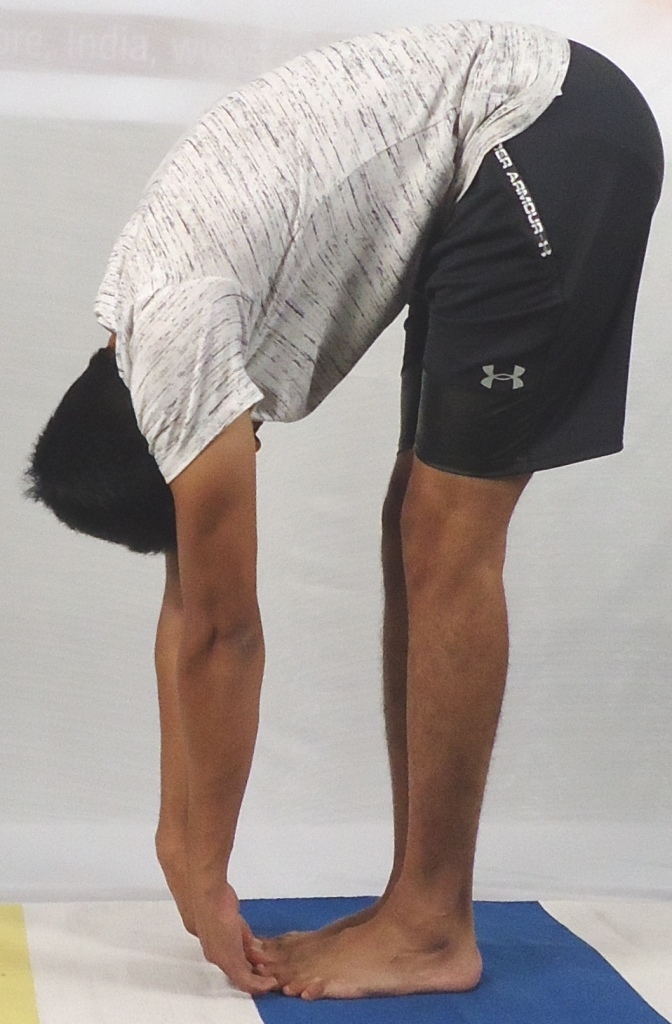
From Tadasana, inhale and raise arms above head, exhale bend forward from the hips, spine straight and knees straight. Lengthen neck towards feet, keep the chest open and rest palms besides feet, with feet firm. Hip to ankle should be in a straight line. Lengthen from lower back and stretch from upper back, abdomen sucked in.
Ardha Uttanasana(Standing Half Forward Bend Pose)
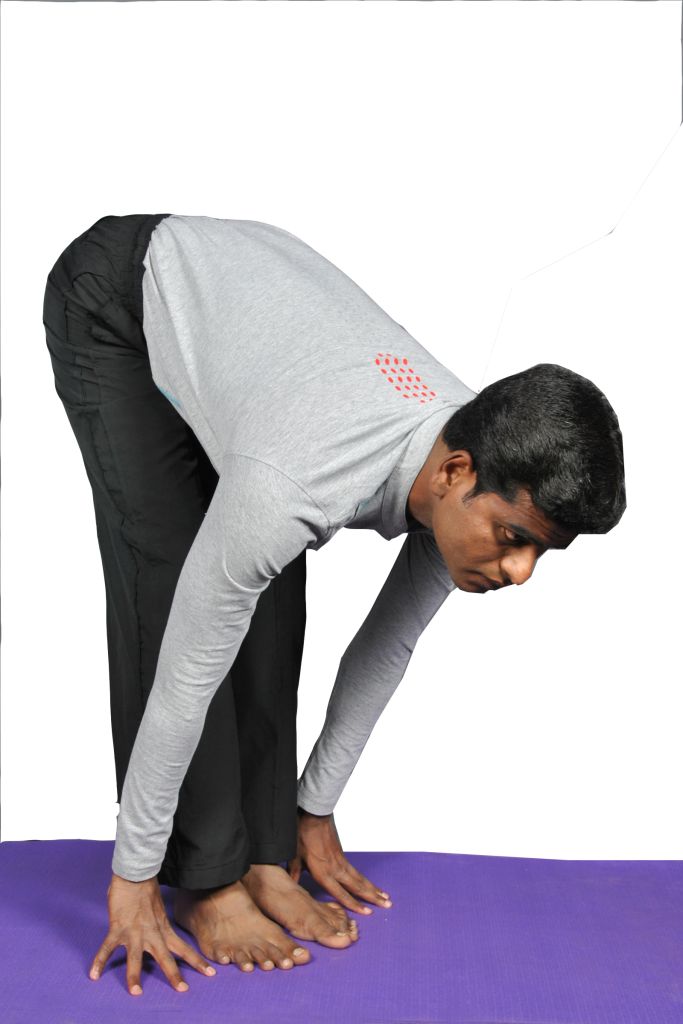
From standing forward bend, press palms or fingertips into the floor, inhale lift torso away from thighs, lengthening between pubic bone and navel. Try to keep knees straight, if it’s difficult, bend them.
Vrksasana(Tree Pose)
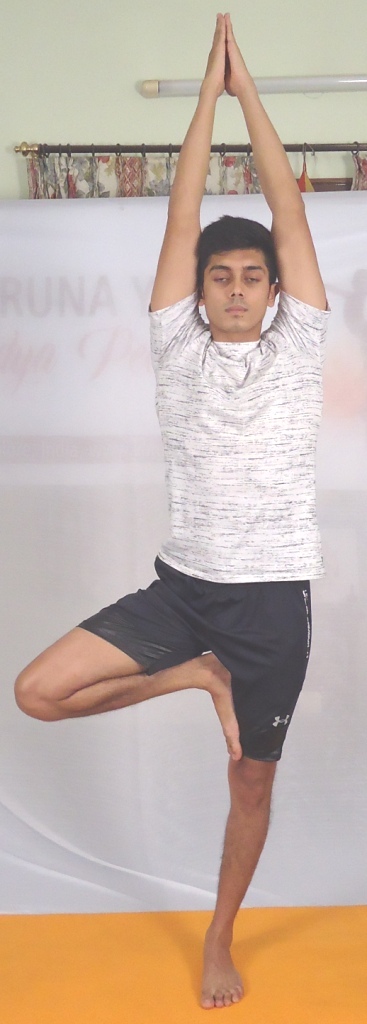
From Tadasana, shift weight to the foot that is straight on the floor and distribute weight evenly across the foot. Bend other leg and rest it on the inner thigh, right foot pointing straight downwards. Raise both arms sideways and adopt namaskara mudra. Foot, spine and arms straight, elbows locked beside ears. Lengthen tailbone and pelvis straight.
Tadasana(Mountain Pose)
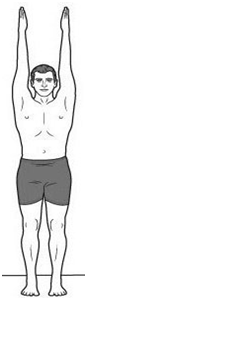
Feet together, heels and toes touching, tighten the knees and knee caps pulled up, contract the hips, pull up the muscles of the backs of the thighs, stomach pulled in, chest forward, and spine and neck straight, distribute weight across heels and soles of foot. Lift hops, stomach in, rib cage up, chest up, neck and head straight. Arms stretched over the head, elbows locked and fingers reaching straight out.
Samasthiti (Equal Standing Pose)
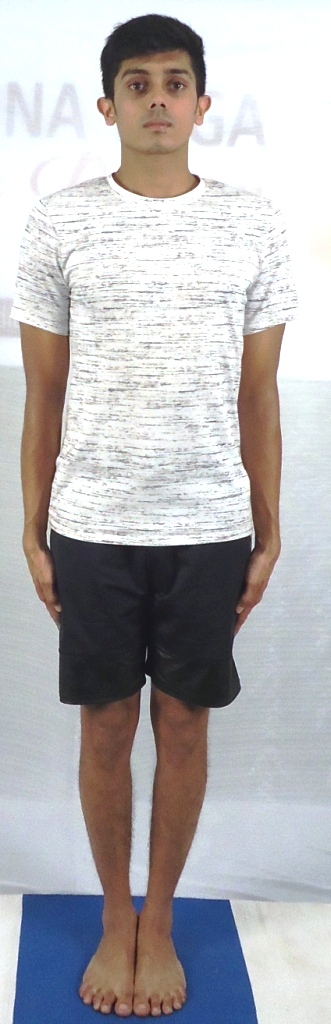
Feet together, heels and toes touching, tighten the knees and knee caps pulled up, contract the hips, pull up the muscles of the backs of the thighs, stomach pulled in, chest forward, and spine and neck straight, distribute weight across heels and soles of foot. Arms by thighs, elbows locked and fingers reaching straight out.
Concept of Asana According To Patanjali
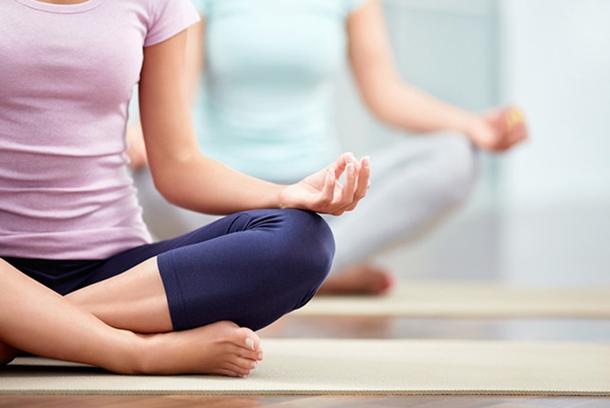
Patanjali talks about asanas in only 3 sutras: 46. A sitting posture should be steady and comfortable, 47. This is achieved through the relaxation of exertion, and making contact with the unlimited; 48. Then there is no further affliction from the dualities of existence. Patanjali does not refer to specific postures or sequences of movements as we practice nowadays, he just speaks about a comfortable posture one should be able to maintain effortless for a prolonged time while undergoing meditation and concentration of the mind.
Querying new yoga student
0) We should introduce our self with smiling face and positive attitude ask questions. 1) Have you ever practiced yoga? If answer is no. Assure them no problem but if the answer is yes 2) What style of yoga has been practised? 3) How long period yoga has been practised? 4) Do you have any injuries or anything else going on with your body that i should be aware of? 5) Have you ever had any surgeries? If yes collect details 6) How are your ankles, knees, hips, back, shoulders, neck , wrists ? Try to follow up the relevant questions with their answers. We should use our knowledge but also prepare to acknowledge that we do not know about the injury or issue and encourage the student to take care of him or herself. 7) are you pregnant or have you recently had a baby? Ask this of any women if we think she is pregnant or who recently gave birth, share with her basic trimester cautions. 8) What is your profession, work or daily life like? 9) What do you do for exercise? According to the answers to the above questions we should give the student some initial guidance on how he / she might modify his / her practice.
Hatha Yoga
The larger part of yoga being rehearsed in the globe is hatha yoga, including asanas (yoga stances), pranayama (breathing practices), kriyas (inside purging strategies), bandhas (strong locks and contractions), and mudras (hand gestures and seals), to more prominent or lesser degrees relying upon the arrangement of yoga. The 200-hour Hatha Yoga practice by Karuna Yoga Maha Vidya Peetham, teacher training center in, Bangalore, India is one of the best institutions today to learn Hatha Yoga. Yoga Anatomy of Hatha Yoga Despite the fact that a physical practice, hatha yoga is more than a workout schedule. Hatha yoga is an exceptionally refined arrangement of all-encompassing wellbeing and prosperity, tending to all layers of the self, which are not isolated but rather interrelated, influencing each other. On the off chance that the body is debilitated, the psyche, heart, and soul are altogether decreased, and the other way around; if the heart is discouraged, the brain, soul, and body are lazy; etcetera. Considered a science with refined procedures and practices, hatha yoga viably balances and fortifies each arrangement of the body — the musculoskeletal, respiratory, circulatory, stomach related, anxious, and endocrine frameworks — permitting professionals to discharge pressure, increment dissemination, dispense with poisons, and reestablish common wellbeing and essentials. Meaning of Hatha Yoga In spite of the fact that the Sanskrit expression hatha signifies “mighty” or “extreme,” when broken into its syllables, ha for “sun” and that for “the moon,” it infers a joining of contrary energies. Manly qualities, for example, quality, animation, animosity, hardness, and warmth are related with the sun, and feminine qualities, for example, delicate quality, lack of involvement, tenderness, nurturance, and cool-ness are related with the moon. The yoga of the sun and moon, hatha yoga, looks to adjust the restricting strengths: manly and female, hard and delicate, right and left, inward and external, doing and being, yin and yang. Physically hatha yoga requires adjusted activity. Through the practice, we build up a harmony amongst quality and adaptability while figuring out how to explore the unobtrusive move amongst exertion and surrender. The flawless thing is that a few stances, for example, forward folds, cool the body and quiet the sensory system, while others, for example, backbends, warm and empower the body. At that point, there are turns, which are alluded to as either “shrewd” represents that will cool or warmth the body, whichever is important to take the body back to impartial. Spine & Hatha Yoga The asanas collectively work to reestablish and keep up an adaptable and conditioned spine. For creatures, it is vital to move the spine in all directions with a specific end goal to keep the spinal segment supple and portable. They move, extend, twist, and twist their spines in each course.) The spinal segment is comprised of various vertebrae and supple, sinewy circles that fill in as spacers in the middle. It houses the spinal string, which associates with the cerebrum and, together with it, creates the focal sensory system. Nerves then branch out from the spinal string through the spaces between the vertebrae, associating particular body parts — organs, organs, et cetera — to the mind. After some time, with gravity, the spine starts to pack, losing space between the vertebrae and bargaining the vertebral circles. The outcome is regularly an encroached nerve, removing the stream of vitality and nerve driving forces through the body, bringing on debilitated organs and loss of muscle capacity, also torment. In this way, the significance of a supple yet conditioned spine can’t be focused on enough. The wide range of yoga postures flex, contort, bend, protract, and open the distinctive districts of the spine, keeping up the wellbeing of the whole spinal segment and reinforcing the sensory system. Prana & Hatha Yoga On the subtle, or active, level, the full yogic breath brings more prana into the body while likewise managing the life-constrain vitality. Prana is the body’s unobtrusive vitality. It is the enlivening power behind every atom, cell, organ, and arrangement of the body, organizing each real movement from the pumping of the heart to the disposal of waste. Prana likewise enormously impacts the mind’s state. Unsteady pranic vitality causes the brain to wind up distinctly upset and the body’s different frameworks to be unpredictable, producing disease in the psyche and body. The breath is an augmentation of prana. The more profound you inhale with cognizant mindfulness, the more prana you get. By being a part of Karuna Yoga Maha Vidya Peetham, Yoga TTC program Bangalore, you can even direct the stream of prana into particular regions of the body just by sending the breath there. Moreover, when inward breaths and exhalations are balanced, prana gets to be distinctly steadier and the mind calmer, and all the body’s living frameworks work all the more ideally. Join Karuna Yoga Maha Vidya Peetham, Yoga TTC program for a better understanding of Hatha Yoga. Hatha yoga has evolved over the previous century to wind up distinctly more inclusive and keeps on advancing as new logical revelations are made in the fields of kinesiology, brain science, neurology, and comprehensive wellbeing. Whichever style you follow, yoga can bring balance physically, rationally, and inwardly, to all parts of your life. It is the rare 90 minutes when students don’t need to consider their occupations and other world affairs. However your own, so give yourself the authorization to remain totally exhibit for the length of the class, leave every bit of your stresses and duties with your shoes at the entryway, and be with yourself in your body on your mat.