
Total lung air Volume & Residual volume
Total lung air Volume: The total lung air volume is about 4-6 litres. Residual volume: The amount of air that remains in the lungs at all times, even during a deep exhalation, is called residual volume. This is usually about a litre of air.
Role of External intercostals muscles during inhalation & exhalation
Role of External intercostals muscles during inhalation. The contraction of the external intercostals and diaphragm is required for inhalation. Role of External intercostals muscles during exhalation. Relaxation of external intercostals and diaphragm is required for exhalation.
Conscious and Unconscious control of breathing
Unconscious control of breathing Unconscious control of breathing is maintained by the respiratory centre of the brainstem, which monitors the concentration of gases in the blood and adjusts the rate and depth of breathing as need Conscious control of breathing Conscious control of breathing is maintained by the cerebral cortex of brain. The cerebral cortex may override the respiratory centre during the practice of pranayama.
Why we have to do deep breathing, during hatha yoga practices
A slow breathing rate keeps the heart stronger and better nourished, as it exerts a positive effect on the cardiac functions and coronary supply – improving oxygenation of blood and circulation. This also helps preserve life expectancy. Furthermore, deep breathing increases the absorption of energy by pranayama kosha, enhancing dynamism, vitality and general well being.
Yogic practices to overcome Shallow breathing
A few yogic practices to overcome shallow breathing are as follows: Kapalbhati Pranayama Bhastrika Pranayama Nadi Shodana Pranayama Ujjayi Pranayama
Yoga Teacher Training Student Assignment
Define Anatomy Anatomy is the study of the structure of the body. It is the science that deals with the structures of the human body and its relationship of various parts to each other. It includes Histology (the study of tissues), Osteology (study of bones), Mycology (study of muscles), Arthrology (study of joints), Splanchnology (study of organs) and Neurology (study of nervous system). Why yoga student should know about “anatomy” The knowledge of anatomy will help a student of yoga to enhance their practice, break through blockages and avoid injuries. Moreover, since yoga is a practice that involves our bodily structure and function, a basic understanding of anatomy will help us to better understand how the practice affects our body and mind. Such a scientific background will also help the individual to remove confusion or misconception if any. Why yoga student should know about “Physiology” Physiology and its understanding allow the student to better understand the physiological changes brought about by the yogic practices. It also provides a better grasp of the probable mechanisms involved in various yogic practices on the scientific background. Therefore, this knowledge will help them apply the technique systematically for themselves or for other students. How many ‘planes’ are there in human body and mention its optimum movements? There are three planes of movement, namely Coronal, Sagittal and Transverse. – Coronal plane: Divides the body from front to back. Movements along this place are called adduction (extremity towards the midline) and abduction (extremity away from midline). – Sagittal plane: Divides the body into right and left. Movements are called flexion (extremity forward, except at the knee – moves backward) and extension (extremity backward). Write five kosha. The five kosha are as follows: – Annamaya Kosha – Pranamaya Kosha – Manomaya Kosha – Vignanamaya Kosha – Anandamaya Kosha What practices will you prescribe for Annamaya Kosha? Since Annamaya Kosha is concerned with the physical body, the practices of yoga poses – Asana – can be recommended. What practices will you prescribe for Pranamaya Kosha? Since Pranamaya Kosha is concerned with the life force, the practice of breathing – Pranayama – can be recommended. What practices will you prescribe for Manomaya Kosha? Since Manomaya Kosha is concerned with the mind, the practice of meditation – Dhyana – can be recommended. What practices will you prescribe for Vignanamaya Kosha? Since Vignanamaya Kosha is concerned with wisdom and intellect, the practice of meditation and breathing – Dhyana and Pranayama – can be recommended. What practices will you prescribe for Anandamaya Kosha? Since Anandamaya Kosha is concerned with bliss, the practice of service, worship or meditation – seva, Bhakti yoga and dhyana.
Relevance of Yoga in today’s world.
As people of the 21st century, we hear a lot about the modern lifestyle we live and its undesirable effects on our health and society. Diseases brought by such a lifestyle, such as diabetes and chronic respiratory diseases, have broken out like an epidemic due to systemic yet necessary evils that afford us the conveniences of life in the modern age. Humanity often finds itself progressing onward to new eras of prosperity because of the knowledge and learnings of our forefathers. In other words: sometimes we have to go backwards to go forwards. Thus, Yoga is (without a shadow of a doubt) indeed of relevance – an ancient practice that offers lasting remedies to the maladies of people living in this day and age. From alleviating medical conditions such as diabetes and hypertension to improving the quality of life for those struggling with obesity – Yoga offers a solution to almost all problems, provided one is dedicated and consistent in their practice. Since prevention is better than cure, Yoga is not only a solution to problems but also a deterrent to physical ailments – thanks to its immunity-boosting properties. It prevents a dependency on medicines that do more harm than good in the long run and aids the removal of toxins from one’s system. Another aspect of Yoga is its emphasis on retrieving an internal equilibrium long lost in the modern lifestyle. Amidst the stresses of modern life, physical ailments are not the only cause of concern. Mental health is the need of the hour, affecting one in four people worldwide – that amounts to over 800 million people across the globe. As we mentioned earlier, Yoga has many benefits for one’s physical health. A healthy mind resides in a healthy body – an often-forgotten cornerstone of alleviating the symptoms of several mental health disorders such as depression, anxiety, mood swing disorders, etc. Yoga is also vital to one’s interaction with society and phenomenological experience of it. Accumulated stresses find release through the practice of Yoga and change the way we comprehend both our environment and the events that unfold before us in our immediate surroundings. Without this, one may suffer from what is colloquially termed as ‘mental fog’ – difficulty putting thoughts together, concentrating or remembering what you were doing. Yoga also improves one’s accessibility to the flow state, enhancing creativity and removing negative mental blocks to improve innovative thought and creation. Lastly, Yoga is of utmost relevance because it offers health benefits to all – young and old, men and women alike! It helps children manage their anxiety, improve their emotional regulation, boost their self-esteem, increase body awareness and mindfulness, enhance concentration and memory, develop strength and flexibility, teach discipline, and reduce impulsivity. It helps the elderly obtain better sleep habits, improve strength and protect joints, control diabetes, reduce hypertension, improve mood and anxiety, help with chronic pain, relieve breathing and lung issues, enhance bone strength, sharpen the mind, and maintain bodily flexibility. It helps women during pregnancy and labour, reduces the symptoms of premenstrual syndrome, improves symptoms of menopause, helps those coping with gestational diabetes, improves heart health, delays the onset of Alzheimer’s disease, improves back pain and helps with symptoms of anxiety. In men, it promotes flexibility and mobility, all-over body strength and conditioning, focus and full-body awareness, aids in correcting body imbalance and injuries, reduces stress, improves digestion, boosts brain function, and better sleep. For these reasons, Yoga is of utmost relevance in today’s world. Its broad umbrella of applications and remarkable effects are features that only bolster the integrity of such a claim.
Yoga and Kinesiology
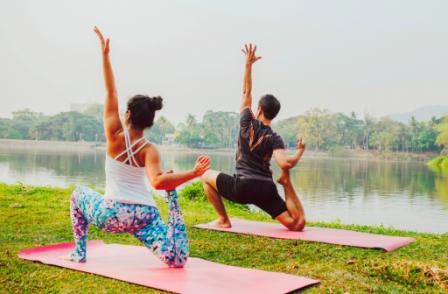
1. Flexion and Extension are movements that take place along the sagittal plane and involve anterior or posterior movements of the body. Flexion is an anterior-directed movement; eg. Bending the forearm at the elbow. The extension is a posteriorly directed movement; eg. Straightening of the bent forearm. 2. Abduction is the movement of a limb away from the midline of the body. Adduction is the movement of a limb towards the midline of the body. 3. Lateral rotation and medial rotation; rotations are movements when a bone moves around or within another bone. The lateral rotation occurs towards the lateral direction. The medial rotation occurs towards the medial direction. 4. Supination and Pronation are movements of the forearm. the upper limb is held next to the body with the palm facing forward. This is the supinated position of the forearm. In this position, the radius and ulna are parallel to each other. When the palm of the hand faces backward, the forearm is in the pronated position, and the radius and ulna form an X-shape. 5. Circumduction is the movement of a body region in a circular manner, in which one end of the body mode stays relatively stationary and the other end describes a circle. It involves the sequential combination of flexion, adduction, extension, and abduction at a joint. Eg. Arm rotations. 6. Protraction and Retraction are anterior-posterior movements of the scapula or mandible. Protraction moves the scapula forward (anteriorly) and toward the side of the body (laterally). Retraction is the opposite movement; shoulder blades move back and medially. 7. Inversion and Eversion. Eversion: Tilting of the foot so the sole faces away from the midline. Inversion: Tilting of the foot so the sole faces into the midline. 8. Elevation and Depression The terms elevation and depression refer to movement above and below the horizontal. Elevation refers to movement in a superior direction. Depression refers to movement in an inferior direction. 9.Dorsiflexion and Plantar flexion Dorsiflexion and plantar flexion refer to the extension or flexion of the foot at the ankle. Dorsiflexion is where the toes are brought closer to the shin. This decreases the angle between the dorsum of the foot and the leg. Plantar flexion or plantarflexion is the movement that decreases the angle between the sole of the foot and the back of the leg.
obstacle in each chakra
Mooladhara chakra (Root chakra) Lock in Brahma granthi Swadhisthana chakra (Sacral chakra) Karmic block, Desire for food and sex Manipura (Solar plexus chakra) Habits, mindsets, and traumatic experiences in life Anahata (Heart chakra) Lock in Vishnu granthi Vishuddhi (Throat chakra) Self-destructive behavior and challenges around communication Ajna (Third eye chakra) Lock in Rudra granthi Bindu Fire of Manipura Sahasrara (Crown chakra) Blockage in all other chakras
Visuddhi chakra
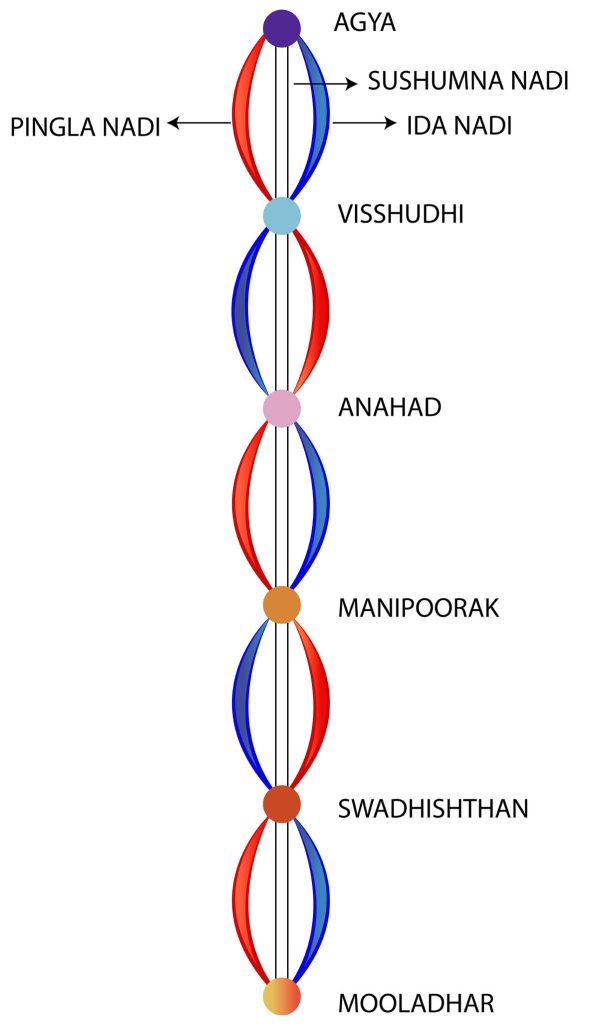
Visuddhi Chakra is violet in color, round, and has 16 petals. Vishudhi is the purification center and is known as the fountain of youth. Nectar of life falls from Bindu into this chakra, generating health, vitality, and longevity. Vishuddhi is associated with vijnanamaya kosha, when vishuddhi is purified, the sense of hearing becomes very sharp not only through the ears but through the mind too. Vishuddhi is located behind the throat pit in the spine and is associated with the thyroid gland. By meditating on vishudhhi, the mind becomes free of thought, pure and empty like space. Asanas that press the muscles in the neck and throat help in balancing the energy of the throat chakra.