
Pranayama three types, rechaka, pooraka, and kumbhaka

Pranayama three types, rechaka, pooraka, and kumbhaka. Pranayamas tridha prokto rechapurakakumbhakaih / Sahitah kevalascheti kumbhako dvividho matah// (Chapter -2, Verse 71). Pranayama is said to be of three types: exhalation (rechaka), inhalation (pooraka), and retention (kumbhaka). Kumbhaka is again of two types: connected sahita and unconnected kevala. (Chapter -2, Verse 71). Yavat kevalasiddhih syat sahitam tavad abhyaset/ Rechakam purakam muktva sukham yadvayudharanam//(Chapter -2, Verse 72). Till attain perfection in kevala kumbhaka, sahita kumbhaka has to be practiced. When you are freed of inhalation/exhalation then the breath/prana is ceased spontaneously. (Chapter -2, Verse 72). Pranayamoa yam ityuktah sa vai kevalakumbhakah/ Kumbhake kevale siddhe rechapurakavarjite//(Chapter -2, Verse 73). Perfection of isolated holding is freedom from inhalation and exhalation process. This pranayama spoken of is verily kevala kumbhaka. (Chapter -2, Verse 73). Na tasya durlabham kimchittrishu lokeshu vidyate/ Saktah kevalakumbhena yatheshtam vayudharanat//(Chapter -2, Verse 74). Nothing in the three worlds of existence is unobtainable by him who has mastery over kevala kumbhaka and can hold the breath as desired time. (Chapter -2, Verse 74).
Nadis and Chakras for retention of Prana
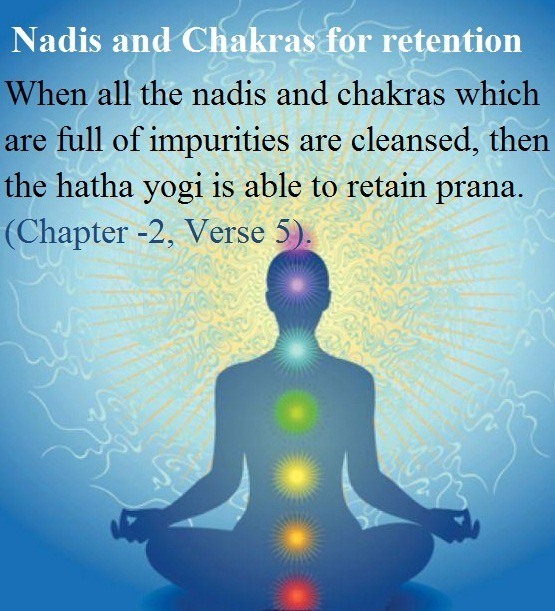
Cleansing of the Nadis and Chakras for retention of Prana Suddhameti yada sarvam nadichakram malakulam / Tadaiva jayate yogi pranasamghrahane kshamah//(Chapter -2, Verse 5). When all the nadis and chakras which are full of impurities are cleansed, then the hatha yogi is able to retain prana. (Chapter -2, Verse 5).
Mind and Prana

Interconnection of Mind and Prana Interconnection of Mind and Prana and their controlling through Pranayama Chale vate chalam chittam nischale nischalam bhavet / Yogi sthanutvamapnoti tato vayum nirodhayet//(Chapter -2, Verse 2). When Prana moves, chitta the mental force too moves. When prana is still, Chitta also still without any movement. By this steadiness of prana the Hatha Yogi reaches stableness and should thus control the Vayu air. (Chapter -2, Verse 2).
Diet and Pranayama – Milk and Ghee is recommended
Diet and Pranayama – Milk and Ghee is recommended. At the beginning period of pranayama practice, food, consisting of milk and ghee is recommended very much. Upon being established in the practice such conditions are not necessary at all. (Chapter -2, Verse 14).
Veerasana (Hero’s Pose)
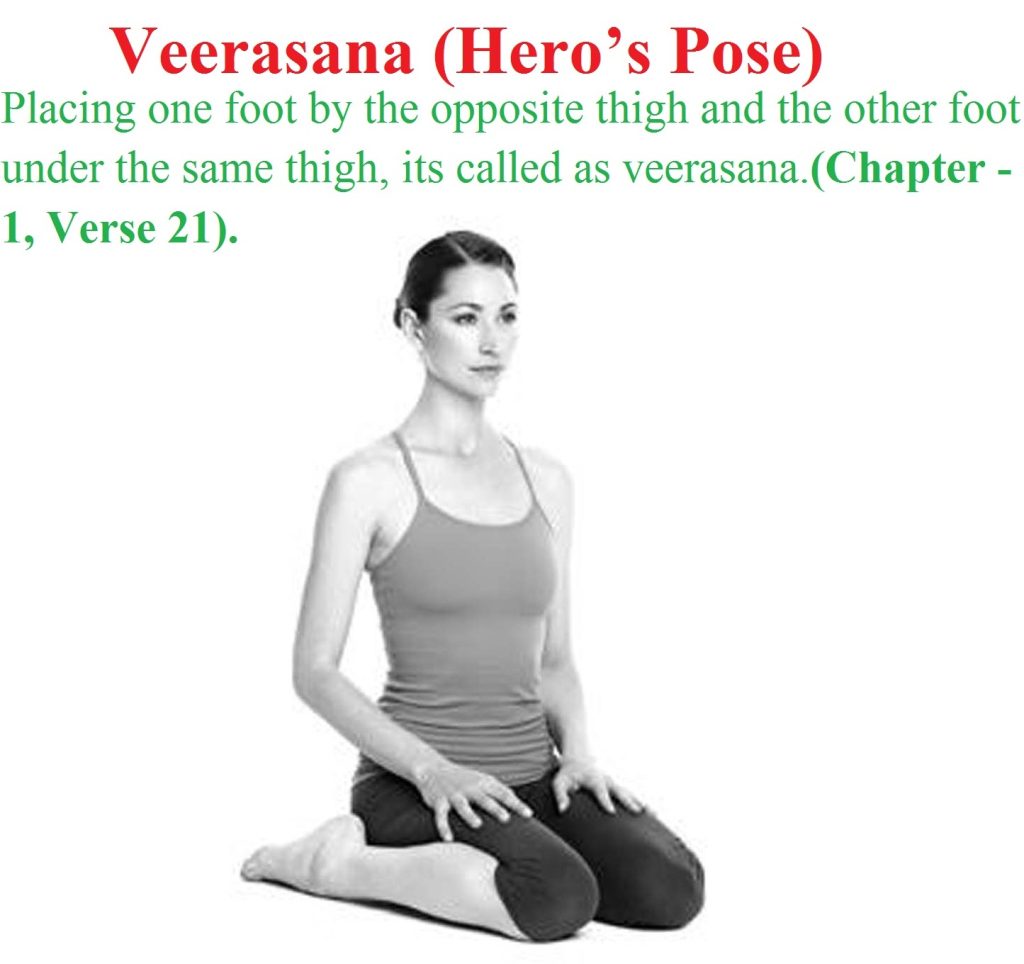
Veerasana (Hero’s Pose) Ekam padam tathaikasmin vinyased uruni sthiram / Itarasmims tatha chorum virasanam itiritam//(Chapter -1, Verse 21). Placing one foot by the opposite thigh and the other foot under the same thigh, its called as veerasana. (Chapter -1, Verse 21).
Swastikasana (auspicious pose)
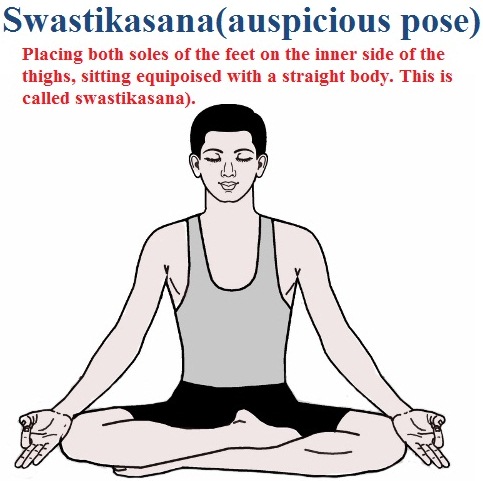
Swastikasana (auspicious pose) Janurvor antare samyak krtva padatale ubhe / Rjukayah samasinah svastikam tat prachakshate//(Chapter -1, Verse 19). Placing both soles of the feet on the inner side of the thighs, sitting equipoised with a straight body. This is called swastikasana). (Chapter -1, Verse 19).
Simhasana (lion’s pose)
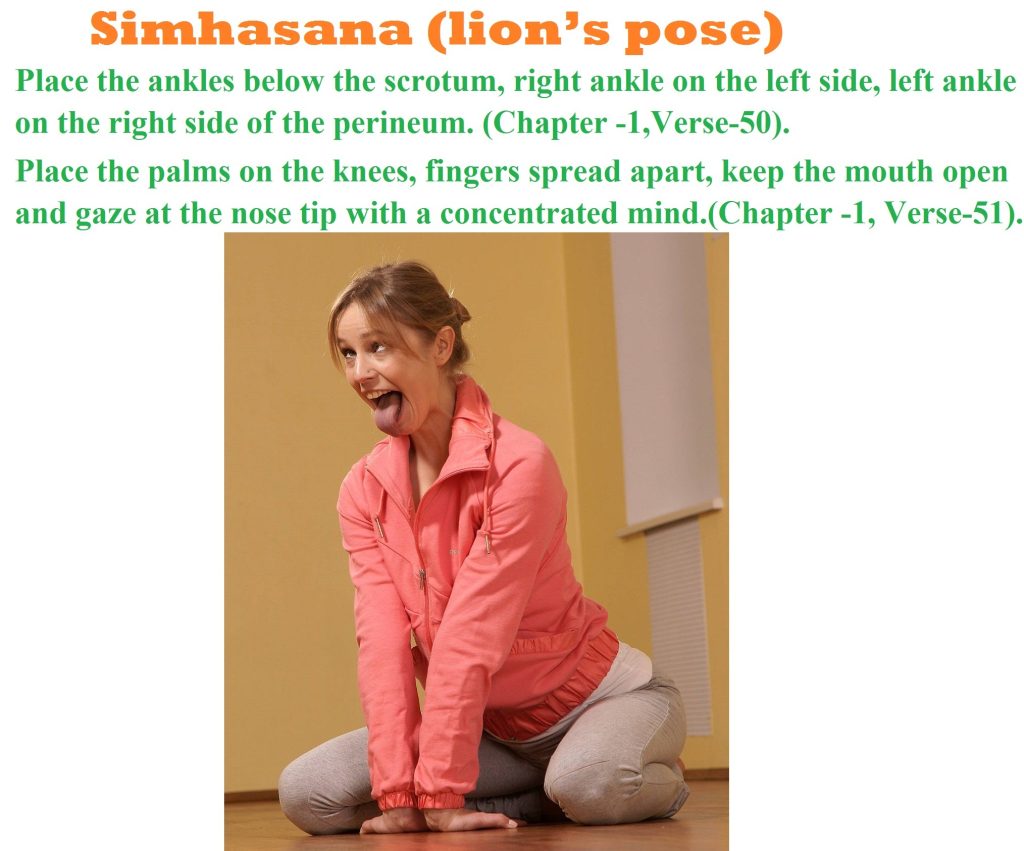
Simhasana (lion’s pose) Ghulphau cha vrshanasyadhah Sivantyah parsvayoh kshipet/ Dakshine savyaghulpham tu Dakshaghulpham tu savyake//(Chapter -1, Verse-50). Place the ankles below the scrotum, right ankle on the left side, left ankle on the right side of the perineum. (Chapter -1,Verse-50). Hastau tu janvoh samsthapya Svangghulih samprasarya cha / Vyattavaktro niriksheta nasaghram susamahitah// (Chapter -1, Verse-51). Place the palms on the knees, fingers spread apart, keep the mouth open and gaze at the nose tip with a concentrated mind.(Chapter -1, Verse-51). Simhasanam bhavedetatpujitam yoghipungghavaih / Bandhatritayasandhanam kurute chasanottamam//(Chapter -1, Verse-52). This is simhasana, held in great esteem by the highest yogis. This most excellent asana facilitates the three bandhas. (Chapter -1, Verse-52).
Siddhasana (Adept’s Pose)
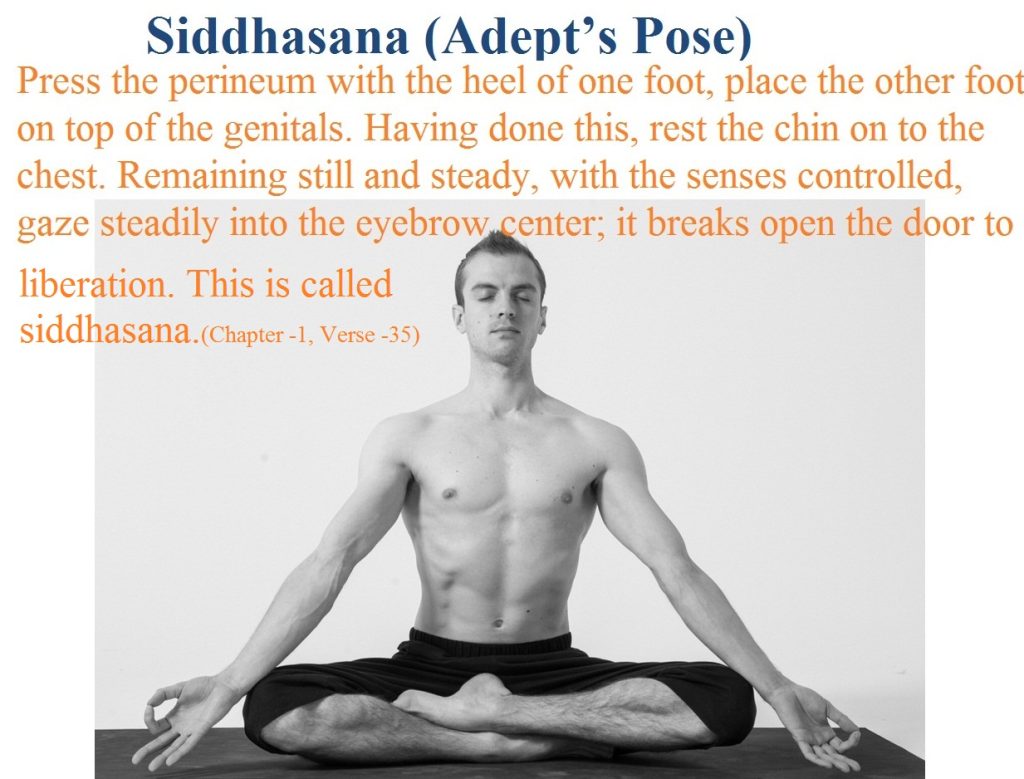
Siddhasana (Adept’s Pose) Yonisthanakam angghrimulaghatitam Krtva drdham vinyaset / Mendhre padam athaikameva hrdaye Krtva hanum susthiram // Sthanuh samyamitendriyoa chaladrsa pasyed bhruvor antaram/ Hyetan mokshakapatabhedajanakam Siddhasanam prochyate//(Chapter -1, Verse -35) Press the perineum with the heel of one foot, place the other foot on top of the genitals. Having done this, rest the chin on to the chest. Remaining still and steady, with the senses controlled, gaze steadily into the eyebrow center; it breaks open the door to liberation. This is called siddhasana. (Chapter -1, Verse -35)
Shavasana (Corpse Pose)
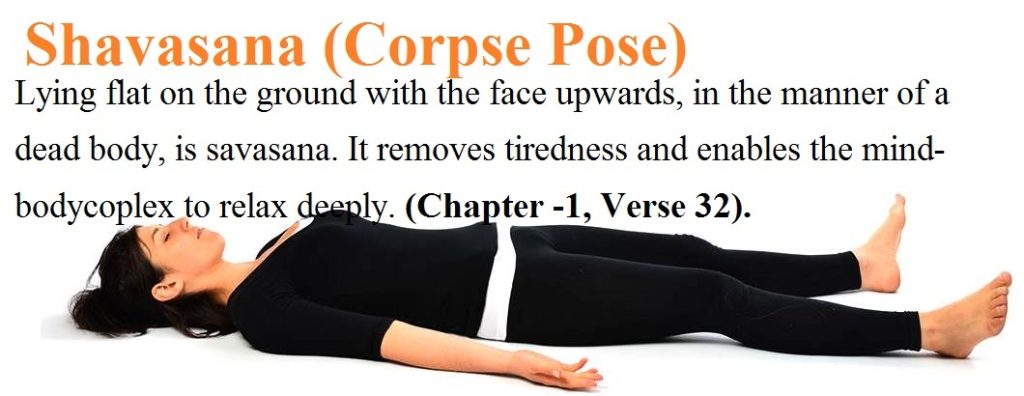
Shavasana (Corpse Pose) Uttanam sabavad bhumau sayanam tat savasanam/ Savasanam srantiharam chittavisrantikarakam//(Chapter -1, Verse 32). Lying flat on the ground with the face upwards, in the manner of a dead body, is savasana. It removes tiredness and enables the mind-body complex to relax deeply. (Chapter -1, Verse 32).
Paschimottanasana (Back Stretching Pose)
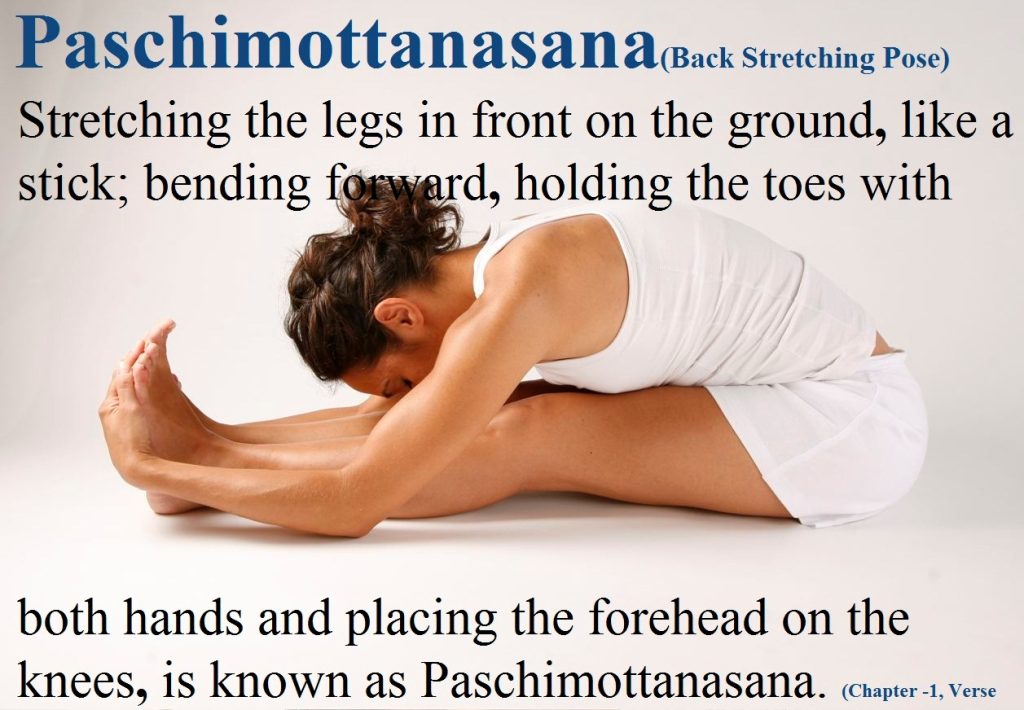
Paschimottanasana (Back Stretching Pose) Prasarya padau bhuvi dandarupau Dorbhyam padaghradvitayam ghrhitva/ Januparinyastalalatadeso Vasedidam paschimatanamahuh.// (Chapter -1, Verse 28). Stretching the legs in front on the ground, like a stick; bending forward, holding the toes with both hands and placing the forehead on the knees, is known as Paschimottanasana. (Chapter -1, Verse 28). Paschimottanasana Iti paschimatanamasanaghryam Pavanam paschimavahinam karoti/ Udayam jatharanalasya kuryad Udare karsyamaroghatam cha pumsam//(Chapter -1, Verse 29). Paschimottanasana is the best among asanas. By this asana the pranic currents rise through sushumna, the digestive fire stimulates, the abdomen becomes flat, and the practitioner becomes free from all kind of diseases. (Chapter -1, Verse 29).