
Chitta: Vasana and Prana
Chitta has two qualities: vasana and prana Hetudvayam tu chittasya vasana cha samiranah / Tayorvinashta ekasmintau dvavapi vinasyatah// Chitta has two qualities, vasana and prana. When one of the two is eliminated or deactivated the other also will become inertia. (Chapter -4, Verse 22).
Hatha Yogi-Arambha Avastha (beginning stage)
Arambha Avastha (beginning stage) Arambha avastha (beginning stage) – When the Hatha Yogi experiences arambha in the void of the heart, his body becomes lustrous and brilliant with a divine smell and disease less. Brahmaghranther bhaved bhedad anandah sunyasambhavah/ Vichitrah kvanako dehe anahatah sruyate dhvanih// The Brahma granthi being pierced, the feeling of bliss arises from the nothingness; wondrous, tinkling sounds and the spontaneous sound anahata are heard within the body. (Chapter -4, Verse 70). Divyadehas cha tejasvi divyaghandhas tvaroghavan/ Sampurnahrdayah sunya arambhe yogavan bhavet// When the Hatha Yogi feels arambha in the void of the heart, his body becomes lustrous and brilliant with a divine smell and diseaseless. (Chapter -4, Verse 71).
Disorders of Heart
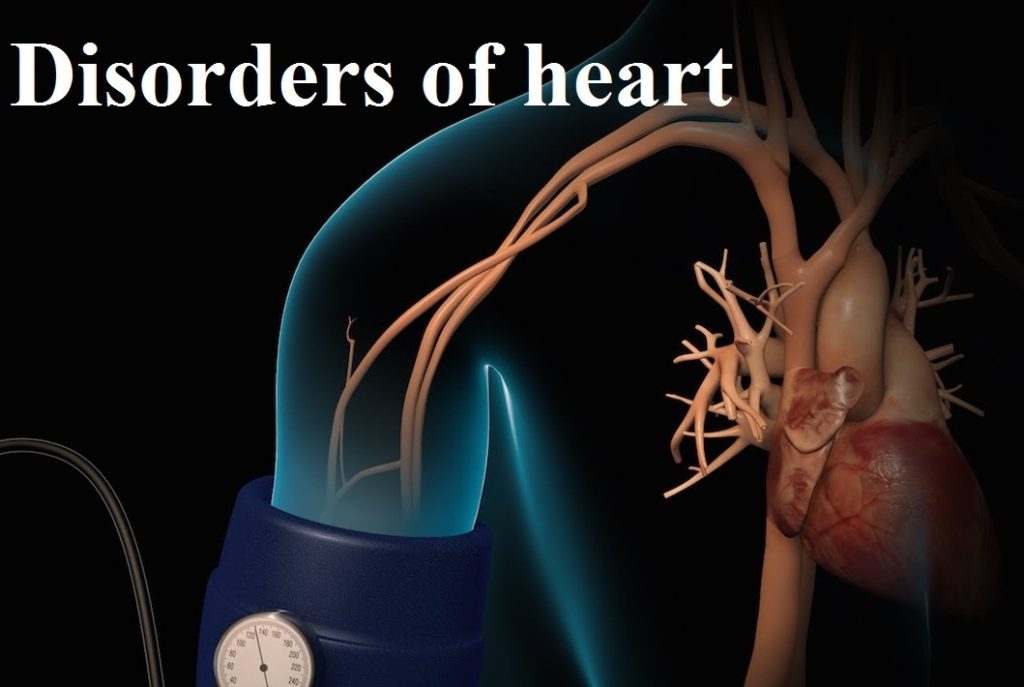
Disorders of Heart Cardiac failure: It’s a condition in which the myocardium of ventricle is unable to maintain sufficient circulation of blood to meet the needs of the body. Depending on onset it may be classified into: 1- Acute failure: when it’s sudden. 2- Chronic failure: when it’s gradual. Stenosis of valves: it’s the narrowing of the valves of the heart. In this condition, the edges of the cusps of the valves become rough. So they stick together and narrow the valvular opening. The incompetence of valves: it’s a functional defect caused by the failure of the valve to close completely. This allows blood to flow back into the ventricle when it relaxes. Angina pectoris: it’s a pain occurring due to myocardial ischemia. It occurs due to narrowing of coronary arteries. Due to this, physical effort causes severe ischemic pain. Myocardial infarction: it’s the death of an area of cardiac tissue due to lack of coronary blood supply to the segment of the myocardium. It occurs due to occlusion of the coronary artery. Cardiac arrhythmia: it’s a disorder in cardiac rate and rhythm. It occurs due to defective impulses formation and defective impulse conduction in the heart.
Vipareeta Karani Mudra (reversing attitude)
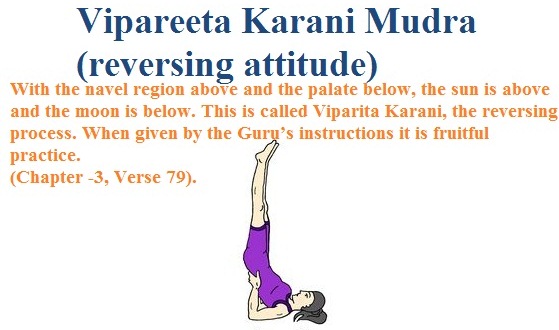
Vipareeta Karani Mudra (reversing attitude) Urdhvanabheradhastalorurdhvam bhanuradhah sasi / Karani viparitakha ghuruvakyena labhyate// With the navel region above and the palate below, the sun is above and the moon is below. This is called Viparita Karani, the reversing process. When given by the Guru’s instructions it is fruitful practice. (Chapter -3, Verse 79). Valitam palitam chaiva shanmasordhvam na drsyate / Yamamatram tu yo nityamabhyasetsa tu kalajit// The practice should be done daily, gradually increasing the duration. After six months of practice, grey hairs and wrinkles become vanished. One who practices it for yama three hours masters or conquers death.(Chapter -3, Verse 82).
Uddiyana Bandha (Abdominal Retraction Lock)
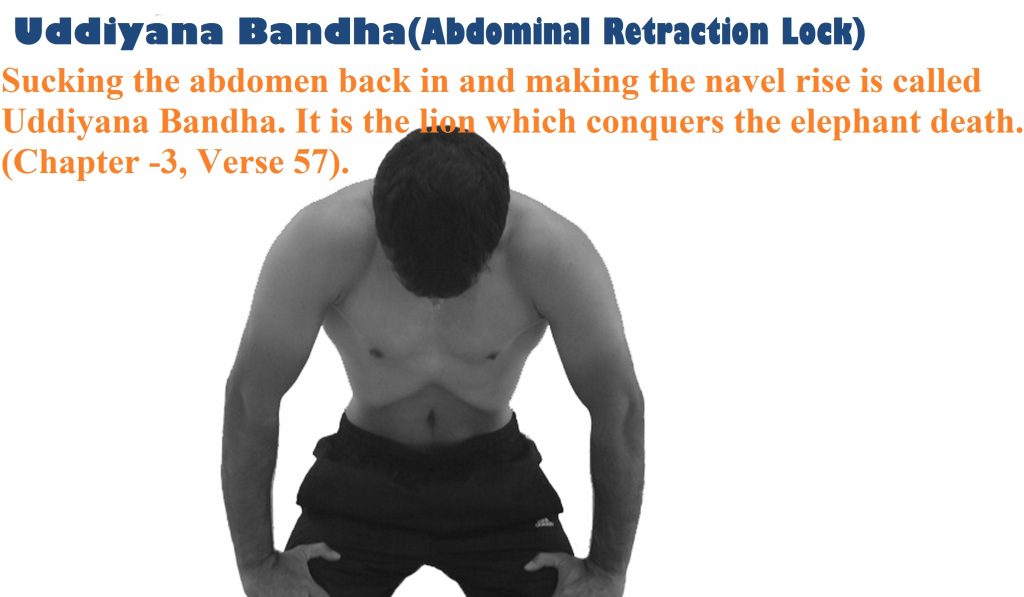
Uddiyana Bandha (Abdominal Retraction Lock) Atha uddiyanabandhah Baddho yena sushumnayam pranastuddiyate yatah/ Tasmad uddiyanakhyoa yam yoghibhih samudahrtah/ Uddiyana bandha is so-called by the yogis because through its practice the prana (is concentrated at one point and) rises through sushumna. (Chapter -3, Verse 55). Uddinam kurute yasmadavisrantam mahakhaghah/ Uddiyanam tadeva syattatra bandho abhidhiyate// The bandha explained is called the rising or flying bandha, because through its practice, the great bird Shakti flies upward with ease and comfortably. (Chapter -3, Verse 56). Udare paschimam tanam nabherurdhvam cha karayet / Uddiyano hyasau bandho mrtyumatangghakesari// Sucking the abdomen back in and making the navel rise is called Uddiyana Bandha. It is the lion which conquers the elephant death. (Chapter -3, Verse 57).
Moola Bandha(perineum/cervix retraction lock)
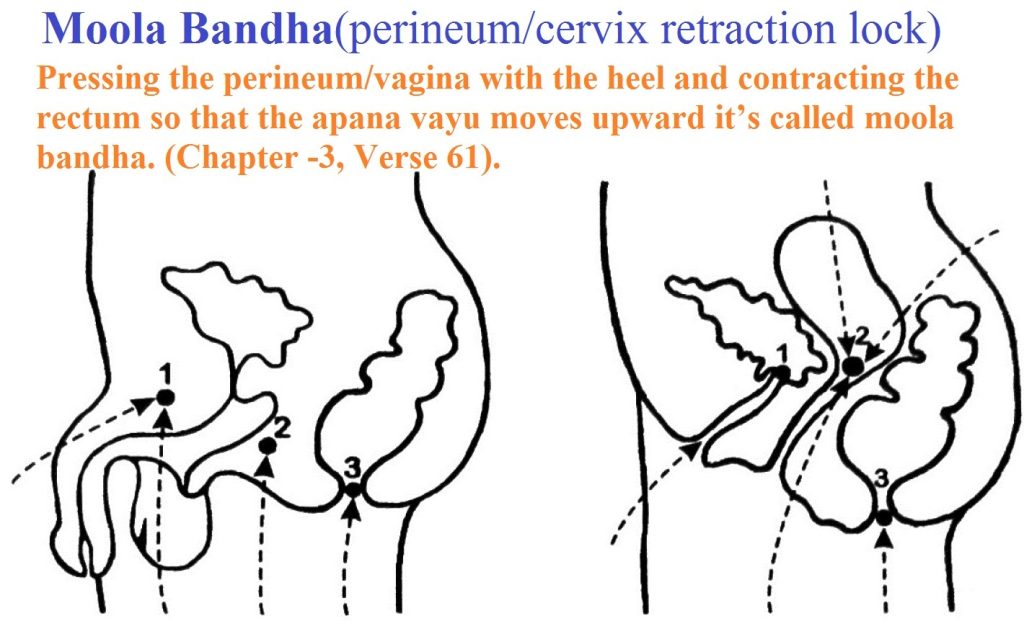
Moola Bandha(perineum/cervix retraction lock) Atha mulabandhah Parshnibhaghena sampidya yonim akunchayed ghudam/ Apanam urdhvam akrshya mulabandho abhidhiyate// Pressing the perineum/vagina with the heel and contracting the rectum so that the apana vayu moves upward it’s called moola bandha. (Chapter -3, Verse 61). Adhogatim apanam va urdhvagam kurute balat/ Akunchanena tam prahur mulabandham hi yoginah// By contracting the perineum the downward moving apana vayu is forced to go upward. Hatha Yogis called it as Moola Bandha. (Chapter -3, Verse 62). Gudam parshnya tu sampidya vayumakunchayed balat/ Varam varam yatha chordhvam samayati samiranah// Press the heel strongly against the rectum and contract forcefully and repeatedly, so that the prana energy rises. (Chapter -3, Verse 63). Pranapanau nadabindu mulabandhena chaikatam/ Gatva yogasya samsiddhim yachchato natra samsayah// There is no doubt that by practicing moola bandha, prana/apana and nada/bindu are joined, and total perfection gained.64
Maha Vedha Mudra (Great Piercing Attitude)
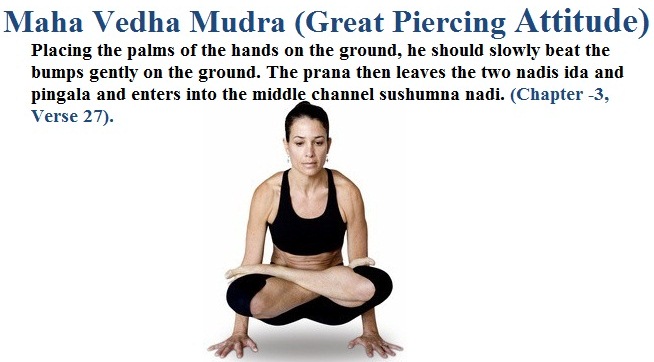
Maha Vedha Mudra (Great Piercing Attitude) Atha mahavedhah Mahabandhasthito yogi krtva purakam ekadhih/ Vayunam ghatimavrtya nibhrtam kanthamudraya// The Hatha Yogi, in the position of Maha Bandha, should breath in, make the mind steady and hold the movement of prana by doing the throat lock. (Chapter -3, Verse 26). Samahastayugho bhumau sphichau sanadayechchanaih/ Putadvayam atikramya vayuh sphurati madhyaghah// Placing the palms of the hands on the ground, he should slowly beat the bumps gently on the ground. The prana then leaves the two nadis ida and pingala and enters into the middle channel sushumna nadi. (Chapter -3, Verse 27). Mahavedhoa yam abhyasan mahasiddhipradayakah/ Valipalitavepaghnah sevyate sadhakottamaih// This is maha vedha, and by practicing its benefited great perfections. Wrinkles, grey hair and the trembling of old age are avoidable, thus the best of practitioners devote themselves to it. (Chapter -3, Verse 29). Khecharya mudritam yena vivaram lambikordhvatah/ Na tasya ksharate binduh kaminyasleshitasya cha// Even when there is movement of the bindu and it enters the genitals, it is catched by closing the perineum and is taken upward direction. (Chapter -3, Verse 43). Sushiram jnanajanakam panchasrotah samanvitam/ Tishthate khechari mudra tasminsunye niranjane// Five nadis unite in this cavity and it is the root source of knowledge. Khechari should be established in that void, untainted by ignorance. (Chapter -3, Verse 53).
Maha Mudra (The Great Attitude)
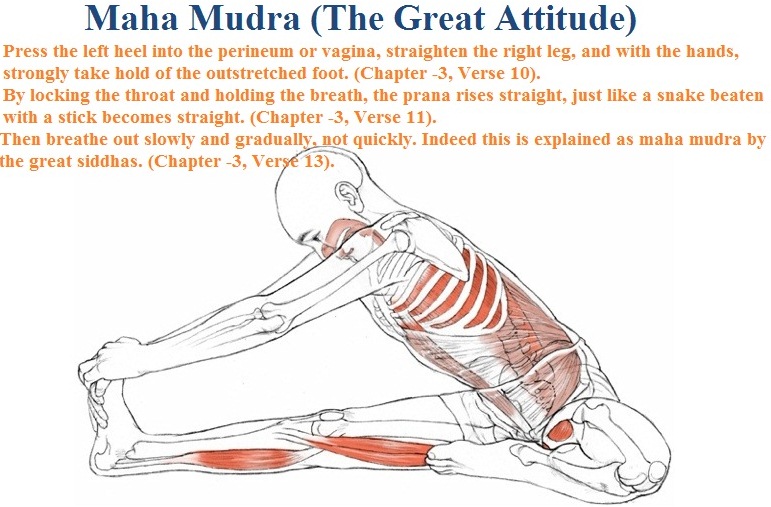
Maha Mudra (The Great Attitude) Padamulena vamena yonim sampidya dakshinam/ Prasaritam padam krtva karabhyam dharayeddrdham//(Chapter -3, Verse 10). Press the left heel into the perineum or vagina, straighten the right leg, and with the hands, strongly take hold of the outstretched foot. (Chapter -3, Verse 10). Kanthe bandham samaropya dharayed vayum urdhvatah / Yatha dandahatah sarpo dandakarah prajayate//(Chapter -3, Verse 11). By locking the throat and holding the breath, the prana rises straight, just like a snake beaten with a stick becomes straight. (Chapter -3, Verse 11). Rjvibhuta tatha saktih kundali sahasa bhavet/ Tada sa maranavastha jayate dviputasraya//(Chapter -3, Verse 12). So the kundalini sakti becomes very straight at once. Then the ida and pingala nadi become lifeless as the sakti enters into the sushumna nadi. (Chapter -3, Verse 12). Tatah sanaih sanaireva rechayennaiva veghatah/ Mahamudram cha tenaiva vadanti vibudhottamāh//(Chapter -3, Verse 13). Then breathe out slowly and gradually, not quickly. Indeed this is explained as maha mudra by the great siddhas. (Chapter -3, Verse 13).
Maha Bandha (Great Lock)
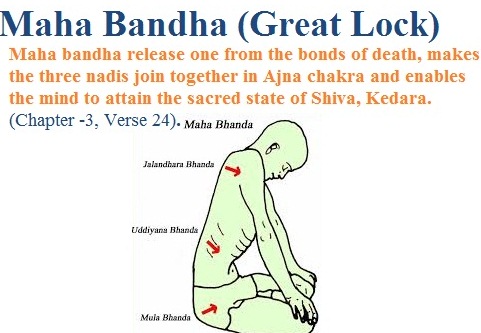
Maha Bandha (Great Lock) Parshnim vamasya padasya yonisthane niyojayet/ Vamorupari samsthapya dakshinam charanam tatha// Press the heel of the left foot in the perineum or vagina and place the right foot on the left thigh. (Chapter -3, Verse 19). Purayitva tato vayum hrdaye chubukam drdham/ Nishpidya yonimakunchya manomadhye niyojayet// Thus breathing in, bring the chin to the chest strenum bone, Jalandhara Bandha, constrict the perineal or cervical region as moola bandha and focus on the eyebrow center known as shambhavi mudra). (Chapter -3, Verse 20). Dharayitva yathasakti rechayedanilam sanaih / Savyangghe tu samabhyasya dakshangghe punarabhyaset// Having holding the breath as long as feeling comfortable, then breathe out slowly. Once completing the practice on the left side, practice again on the right side too.(Chapter -3, Verse 21). Matamatra tu keshamchitkanthabandham vivarjayet/ Rajadantasthajihvaya bandhah sasto bhavediti// Some of them think that the throat lock Jalandhara Bandha is unnecessary and it is sufficient to keep the tongue against the front teeth. (Chapter -3, Verse 22). Kalapasamahabandhavimochanavichakshanah/ Trivenisangghamam dhatte kedaram prapayenmanah// Maha bandha release one from the bonds of death, makes the three nadis join together in Ajna chakra and enables the mind to attain the sacred state of Shiva, Kedara. (Chapter -3, Verse 24).
Jalandhara Bandha (throat lock)
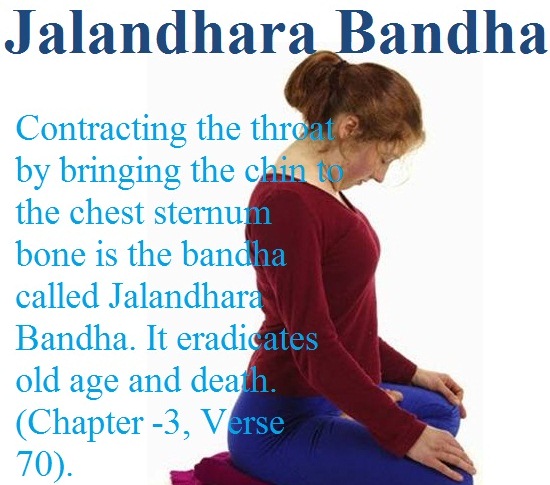
Jalandhara Bandha (throat lock) Atha jalandharabandhah Kanthamakunchya hrdaye sthapayechchibukam drdham/ Bandho jalandharakhyoayam jaramrtyuvinasakah// Contracting the throat by bringing the chin to the chest sternum bone is the bandha called Jalandhara Bandha. It eradicates old age and death. (Chapter -3, Verse 70). Badhnati hi sirajalamadhoghami nabhojalam/ Tato jalandharo bandhah kanthaduhkhaughanasanah// That is jalandhara bandha which holds the flow of nectar in the throat. It eliminates all throat ailments. (Chapter -3, Verse 71). Jalandhare krte bandhe kanthasamkochalakshane/ Na piyusham patatyaghnau na cha vayuh prakupyati// Having performed Jalandhara Bandha by contracting the throat, the nectar does not fall into the gastric fire and the prana is not disturbed. (Chapter -3, Verse 72). Kanthasamkochanenaiva dve nadyau stambhayed drdham/ Madhyachakramidam jneyam shodasadharabandhanam// By firmly contracting the throat, the two nadis, ida and pingala are paralyzed and the sixteen adharas of the manipura chakra are locked. (Chapter -3, Verse 73).