
Posture: Stand upright with your feet together.
Exercise: Lift one foot forward with a quick motion of the knee, then swing it backward, and repeat the movement while keeping your upper body straight and steady. After completing the exercise with one leg, switch to the other. When moving your leg backward, ensure the heel touches your buttock. Begin with ten repetitions. This exercise is beneficial for improving blood circulation in the knee area, making it helpful for managing rheumatic conditions. It is especially effective for football players.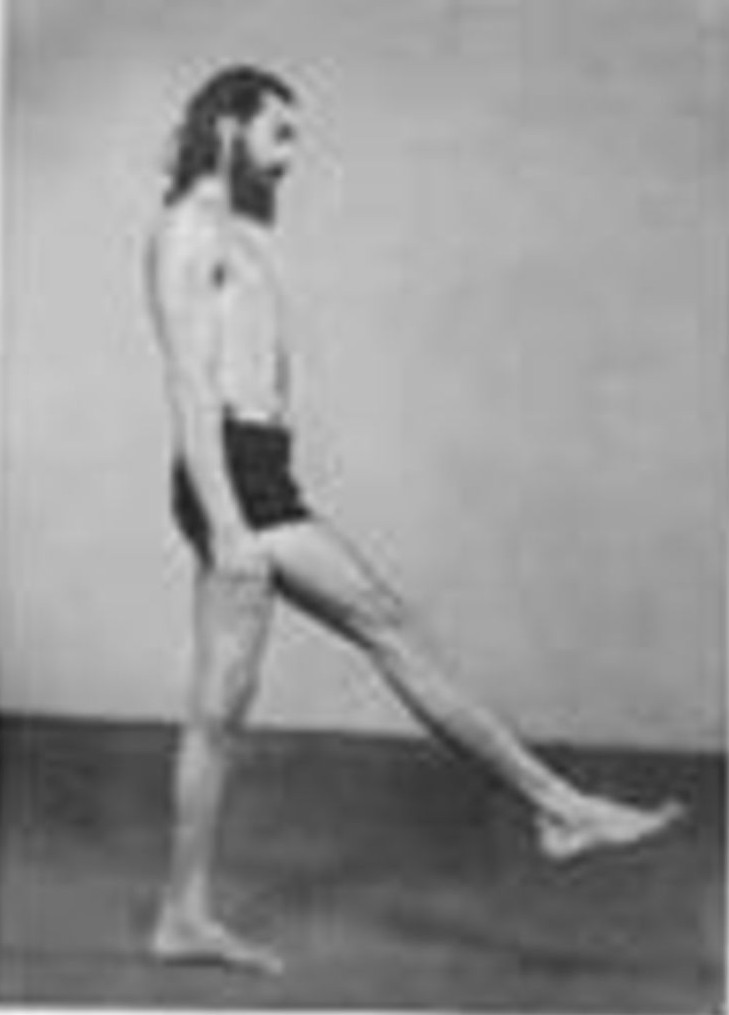
Introduction
Yoga is a complete science of health and well-being that promotes the harmonious development of the body, mind, and consciousness. While practices such as asanas, pranayama, and meditation are widely recognized, the preparatory practices known as Sukshma Vyayama (subtle yogic exercises) form the foundation of yogic training. These practices gently activate joints, muscles, and internal systems, improving circulation, flexibility, and neuromuscular coordination.
In modern lifestyles, characterized by prolonged sitting, lack of exercise, obesity, and poor posture, the knee joint (Janu) is particularly vulnerable. Knee pain, stiffness, reduced mobility, and degenerative changes are increasingly common across all age groups.
Janu-Shakti-Vikasaka is a specialized Sukshma Vyayama practice aimed at strengthening and improving the flexibility and functional efficiency of the knee joint. It involves controlled movements of the knee, coordinated with breath awareness and mindful attention.
This practice is essential for maintaining joint health, enhancing mobility, preventing injuries, and supporting overall physical activity.
Janu-Shakti-Vikasaka is an essential Sukshma Vyayama practice that enhances the strength, flexibility, and functional efficiency of the knee joint. Through controlled movements and breath awareness, it improves joint mobility, circulation, and neuromuscular coordination.
In modern lifestyles, where knee problems are increasingly common, this practice provides a simple and effective solution for maintaining joint health. Regular practice leads to improved mobility, reduced stiffness, and enhanced overall physical performance.
Ultimately, it contributes to the broader goal of yoga—achieving balance, stability, and optimal functioning of the body and mind.