
https://www.scribd.com/document/1096740538/Gayatri-Mudra-Study-Manual-pdf
Gayatri Mudra
Throughout history, mantras and mudras have been employed to promote health. The Gayatri mantra has consistently held a distinguished and revered position among all mantras since ancient times. This mantra ignites the inner strength and has the capability to fend off severe ailments such as cancer. Mudra science, asserts that performing 32 specific mudras alongside the Gayatri mantra can aid in the prevention and treatment of cancer.
He explains that the continuous practice of all Gayatri Mudras facilitates the circulation of life-affirming energy throughout the body, thereby preventing the union of negative and positive cells .The spine comprises 32 vertebrae, which are positively impacted by these 32 mudras .Numerous nerves and arteries traverse these vertebrae, extending to different parts of the body .The mudras and the chanting of the Gayatri mantra help to cleanse these nerves and arteries .As a result, the negative and positive cells affected by the disease undergo revitalization and transformation, allowing the pure essence of life to flourish within the body .Consequently, the once incurable illness gradually begins to diminish.
32 Gayatri Mudra with Gayatri Mantra
The Gayatri mantra is regarded as the most potent mantra found within the Vedas.
The naming of the Gayatri mantra is inspired by the Hindu goddess “Gayatri,” who embodies the unwavering pursuit of knowledge. In Vedic texts, Gayatri is represented as the feminine aspect of the sun’s brilliance.
Therefore, the Gayatri mantra serves as a wellspring of solar energy, and chanting it stimulates the solar energy or Pingala Nadi present in the body. It is recommended to chant it while facing east during the morning and afternoon, and towards the west in the evening.
What Are Gayatri Mudras?
To amplify the potency of the Gayatri mantra, a collection of 32 mudras are practiced before and after reciting this mantra, known collectively as Gayatri Mudras. Engaging in these Gayatri Mudras repeatedly infuses the body with vital energy, preventing the mixture of positive and negative cells.
The 32 Gayatri mudras symbolize the 32 vertebral segments of the spine. The spine serves as the central point for the 72000 Nadis, which further extend throughout the entire body .Additionally, the 7 chakras are situated within the spinal column of our subtle body (Sukshama Sharira) .
As blood flows through these pathways, it strengthens the body, eliminates harmful cells, clears blockages, and enhances our immunity .
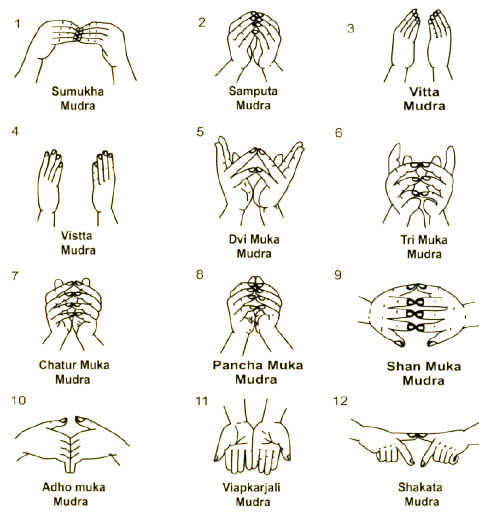
After performing all these mudras, one should recite the Gayatri mantra a minimum of 10 times while holding the hands in the Gyan mudra .
- Muktim Dravayam Teeti Mudraaha (Means Emancipation/Moksha can be achieved by Mudra).
- Mudam Kurvanti Devaanam Manaamsi Draavayanticha Tsmaan Mudraaha (“Mudras bring joy to the minds of the gods and melt or soften their hearts; therefore, they are called Mudras.”)
These 32 Gayatri mudras are categorized into two groups: poorva mudra and uttara mudra .Let us explore these in greater detail.
Poorva Mudras
The initial 24 mudras from a total of 32 mudras, referred to as Poorva Mudras, are executed prior to reciting the Gayatri mantra. These gestures should be practiced in the presence of a sacred emblem or a figure of Gayatri.
Among the 24 mudras, the first 17 emphasize the Pancha bhutas, or five elements of the physical body. They purify, energize, and harmonize the pancha tattva, or five elements, which in turn energizes the Nadis and chakras.
1. Sumukham Mudra(Gayatri) The Sanskrit word Sumukham can be understood as “beautiful face,” “auspicious appearance,” or “pleasant expression.” Symbolically, this mudra represents the beginning of creation, the formation of life, and the emergence of the universe from its unmanifest state. In the philosophical interpretation provided, Sumukham Mudra represents Iccha Shakti, the energy of desire or will. Iccha Shakti is understood as the initial impulse that inspires creation and gives rise to the possibility of manifestation. Before the visible world appears, existence is symbolically described as Ekam, meaning “one” or the state of primordial unity. In this state, everything exists in an undifferentiated potential. Sumukham Mudra therefore symbolizes the transition from unity to diversity, from potential to manifestation, and from the unexpressed to the expressed. It reminds the practitioner that every creation begins with an intention or inner impulse. During Gayatri Mantra meditation, contemplating this mudra can encourage awareness of one’s intentions, thoughts, and creative potential. It may serve as a symbolic reminder to cultivate pure intentions, clarity of mind, and a positive outlook. Steps to perform
|
2. Samputam Mudra(Gayatri) Samputam Mudra is one of the 24 Gayatri Mudras traditionally associated with the chanting and meditation of the Gayatri Mantra. The Sanskrit word Samputa generally refers to a closed container, enclosure, or something held securely within. Symbolically, this mudra represents a bud that contains the potential to blossom into a beautiful flower. The bud signifies the hidden potential of knowledge, wisdom, and spiritual awareness within the human soul. Just as a bud gradually develops and opens into a flower, spiritual knowledge unfolds progressively through self-reflection, meditation, discipline, and sincere learning. Samputam Mudra represents the inner space in which divine knowledge is preserved and nurtured. It reminds practitioners that the deepest wisdom is not always gained from external sources alone; it can also emerge through inner observation, contemplation, and the purification of thoughts. In the context of Gayatri Mantra meditation, this mudra symbolizes the awakening of higher intelligence and the gradual realization of truth. It encourages the practitioner to remain receptive, patient, humble, and devoted to the pursuit of wisdom. The bud also represents the beginning of spiritual transformation. Although knowledge may initially remain hidden, consistent practice can help it develop into clarity, understanding, and discernment. Steps to perform
|
3. Vitatam Mudra(Gayatri) Symbolically, this mudra represents the blossoming stage of a bud, when its hidden potential begins to unfold into a flower. It signifies growth, expansion, manifestation, and the expression of inner possibilities. In yogic philosophy, Iccha Shakti refers to the energy of desire, will, or intention, while Kriya Shakti represents the energy of action and purposeful activity. Vitatam Mudra symbolizes the transformation of Iccha Shakti into Kriya Shakti. It teaches that an intention becomes meaningful when it is supported by effort, discipline, and appropriate action. Just as a flower bud gradually opens under favourable conditions, human potential develops through learning, practice, patience, and perseverance. A sincere intention is the beginning of a journey, but consistent action helps that intention become a reality. During Gayatri Mantra meditation, practitioners may contemplate Vitatam Mudra as a reminder to transform positive thoughts into constructive actions. It encourages individuals to overcome hesitation, develop determination, and use their abilities wisely. Steps to perform Keeping the same formation of the fingers as in samputam, separate the hands slightly till there is a small gap between the palms. None of your fingers or the palm should be touching each other. |
4. Vistrutam Mudra(Gayatri) The Sanskrit term Vistrutam is associated with the idea of spreading, extending, or expanding. In the symbolic interpretation of this mudra, the blossoming bud represents the transformation of hidden potential into complete expression. Just as a flower gradually opens its petals to reveal its beauty, consciousness is understood to expand from a limited state of awareness toward a broader understanding of existence. Vistrutam Mudra also symbolizes the expansion of the universe or cosmos. It reminds practitioners that creation is not merely a process of beginning but also one of continuous growth, development, and manifestation. The universe expresses diversity while remaining interconnected through the underlying principle of existence.
During Gayatri Mantra meditation, practitioners may contemplate this mudra as a symbol of expanding awareness, openness, and spiritual growth. It encourages a willingness to learn, recognize interconnectedness, and move beyond narrow perspectives. Steps to perform Straighten your fingers while widening the gap between the palms. Your fingers should now slant away from each other. |
5. Dvimukham Mudra(Gayatri) The Sanskrit word Dvi means “two,” while Mukham means “face.” Therefore, Dvimukham can be interpreted as “two-faced” or “having two aspects.” Symbolically, this mudra represents the dual aspects of existence, particularly Prakriti and Purusha.
In Indian philosophical traditions, Prakriti refers to nature, the material world, and the dynamic forces responsible for manifestation. It encompasses the physical body, mind, senses, and the changing phenomena of the universe. Purusha, particularly in Samkhya philosophy, refers to pure consciousness, the witnessing principle that observes experiences without itself undergoing change.
Dvimukham Mudra reminds practitioners to contemplate the relationship between these two fundamental principles. Prakriti represents the changing aspects of existence, whereas Purusha represents the conscious witness. Their distinction is central to understanding human experience and spiritual liberation in Samkhya philosophy.
During Gayatri Mantra meditation, practitioners may reflect on the difference between the body and the awareness that observes it, or between changing thoughts and the witnessing consciousness. Steps to perform Spread your fingers and join the tips of the ring and little fingers. The rest of the fingers and thumbs are away from each other. |
6. Trimukham Mudra(Gayatri) Tri means “three,” and Mukham means “face” or “aspect.” Symbolically, this mudra represents the integration of three fundamental energies: Iccha Shakti, Jnana Shakti, and Kriya Shakti. Iccha Shakti is the energy of desire, will, and intention. Jnana Shakti represents the energy of knowledge, wisdom, and understanding. Kriya Shakti signifies the energy of action, effort, and manifestation. Together, these three energies illustrate how an intention, guided by knowledge, can be transformed into meaningful action. Trimukham Mudra is also symbolically associated with the Hindu divine trinity of Brahma, Vishnu, and Mahesh (Shiva). Brahma represents creation, Vishnu represents preservation, and Shiva represents transformation or dissolution. These three divine aspects express the continuous processes through which the universe manifests, sustains itself, and transforms.
During Gayatri Mantra meditation, practitioners may contemplate these three energies and their importance in daily life. The mudra serves as a reminder to develop clear intentions, acquire sound knowledge, and act responsibly. Steps to perform While making the dvimukham, join the tips of the middle finger as well. |
7. Chaturmukham Mudra (Gayatri Mudra) Chaturmukham Mudra is a sacred hand gesture associated with Gayatri, symbolising fourfold knowledge, wisdom, and the completeness of human life. The Sanskrit word Chatur means four, while Mukham means face or aspect. Therefore, Chaturmukham represents four faces or four dimensions of knowledge and awareness.
This mudra symbolically represents the four Vedas: Rigveda, Yajurveda, Samaveda, and Atharvaveda, which are the foundations of ancient Indian spiritual knowledge. It also signifies the four Purusharthas, or the four principal aims of human life: 1. Dharma: Righteousness, moral values, duties, and living a life of truth and responsibility. 2. Artha: Material prosperity, financial stability, and the responsible pursuit of wealth. 3. Kama: Fulfilment of healthy desires, pleasure, love, and enjoyment of life. 4. Moksha: Spiritual liberation, self-realisation, and freedom from ignorance and attachment. In Gayatri meditation, Chaturmukham Mudra can be practised as a symbolic reminder of integrating knowledge, discipline, prosperity, and spiritual growth. It encourages practitioners to reflect on balancing material responsibilities with inner development.
During meditation, maintain the mudra comfortably, keep the spine upright, relax the shoulders, and focus on the breath while mentally chanting the Gayatri Mantra. Practise with a calm and devotional attitude, allowing the gesture to support concentration, awareness, and spiritual contemplation.
Steps to perform In continuation with the above mudra, join the tips of index fingers as well. |
8. Panchamukham Mudra (Gayatri Mudra) Panchamukham Mudra is a sacred hand gesture associated with Gayatri and symbolises the five fundamental elements of nature, known as the Pancha Mahabhutas or Pancha Tattvas. The Sanskrit word Pancha means five, while Mukham means face or aspect. This mudra represents the five essential elements that form the universe and constitute every living being.
According to yogic philosophy, the five fundamental elements are: 1. Akasha (Space or Ether): Represents space, openness, expansion, and the medium through which sound travels. 2. Vayu (Air): Symbolises movement, circulation, breathing, and all forms of motion within the body. 3. Agni (Fire): Represents heat, transformation, digestion, metabolism, and energy. 4. Jala (Water): Symbolises fluidity, nourishment, adaptability, and the various fluids present in the body. 5. Prithvi (Earth): Represents stability, strength, structure, and the physical foundation of the body. In yogic understanding, these five elements work together to maintain the structure and functioning of the human body. Panchamukham Mudra serves as a symbolic reminder of the relationship between the individual and the natural universe.
During Gayatri meditation, practitioners may hold this mudra comfortably while maintaining an upright posture and relaxed breathing. Mentally contemplate the five elements and their presence within the body and nature. Practising with awareness and devotion encourages concentration, self-reflection, and a deeper appreciation of the connection between the body, mind, and universe.
Steps to perform Join the tips of the thumb such that all the fingertips of both hands are touching each other. |
9. Shanmukham Mudra (Gayatri Mudra) Shanmukham Mudra is a sacred hand gesture associated with Lord Shanmukha, also known as Lord Kartikeya, Subramanya, or Murugan. In Sanskrit, Shan refers to six, and Mukham means faces. Lord Shanmukha is traditionally depicted with six faces, symbolising divine wisdom, courage, strength, and spiritual awareness. He is the son of Lord Shiva and Goddess Parvati and is regarded as the commander of the divine forces. According to Hindu mythology, Lord Shiva and Goddess Parvati performed intense tapas (spiritual austerities) and divine practices associated with the manifestation of Lord Kartikeya. Therefore, Shanmukham Mudra symbolically reminds practitioners of the importance of Tapas, which means discipline, dedication, self-control, and sustained effort in spiritual life.
The six faces of Lord Shanmukha can also be understood as representing the development of awareness through the senses and the cultivation of higher consciousness. This mudra encourages practitioners to develop inner strength, determination, purity, and control over the mind.
In Gayatri meditation, Shanmukham Mudra may be practised with a calm and devotional attitude. Sit comfortably with the spine upright, relax the body, and maintain gentle, natural breathing. Mentally contemplate the sixfold symbolism of Lord Shanmukha and the importance of discipline in daily life. Regular contemplative practice can serve as a reminder to cultivate patience, courage, youthful energy, and spiritual determination.
Steps to perform Keeping the above mudra intact, only separate the tips of both little fingers. |
10. Adhomukham Mudra (Gayatri Mudra) Adhomukham Mudra is one of the symbolic hand gestures practised in Gayatri Mudra sequences. The Sanskrit word Adho means downward, and Mukham means face or direction. Thus, Adhomukham represents a downward-facing orientation, symbolising the movement of nature from its subtle state towards the physical and manifest world. In yogic philosophy, this mudra provides an opportunity to contemplate the relationship between the Jnanendriyas (five organs of perception) and the Karmendriyas (five organs of action). The Jnanendriyas allow us to receive information from the external environment through seeing, hearing, smelling, tasting, and touching. The Karmendriyas enable us to respond to the world through speech, grasping, movement, reproduction, and elimination.
These ten faculties are essential aspects of human existence. They connect the mind and body with the surrounding environment and influence our everyday experiences, thoughts, and actions.
Adhomukham Mudra symbolically represents the outward and downward expression of consciousness through sensory perception and physical activity. During Gayatri meditation, practitioners can use this mudra to reflect on how the senses influence the mind and how actions shape daily life.
Practise with a relaxed body, steady posture, and natural breathing. Observe the senses without reacting to every external stimulus. This contemplation encourages self-awareness, sensory discipline, and a balanced relationship between inner awareness and the outer world.
Steps to perform Bend your fingers such that they are pointed towards you and keep the thumb extended upwards. Bring your hands together so that the back of the fingers are touching each other. |
11. Vyaapakaanjali Mudra (Gayatri Mudra) Vyaapakaanjali Mudra is a sacred hand gesture associated with Gayatri meditation, symbolising expansion, openness, and the all-pervading nature of the universe. The Sanskrit word Vyaapaka means widespread, extensive, or all-pervading, while Anjali refers to an offering made with joined palms. Together, Vyaapakaanjali represents an offering of oneself to the universal divine consciousness.
This mudra encourages practitioners to contemplate the vastness of nature and the interconnectedness of all living beings. Just as the five elements – space, air, fire, water, and earth – exist throughout the universe and support all forms of life, divine consciousness is traditionally understood in yogic philosophy as present everywhere.
Vyaapakaanjali Mudra also represents devotion, surrender, gratitude, and openness towards higher knowledge. It reminds us that spiritual awareness should not remain limited to individual experience but should gradually expand towards universal understanding, compassion, and harmony.
During Gayatri meditation, practitioners can practise this mudra with a calm mind and devotional attitude. Sit comfortably with the spine upright and bring awareness to the hands and natural breathing. While mentally chanting the Gayatri Mantra, contemplate the infinite expansion of nature and the universal presence of divine energy.
This practice serves as a reminder to develop humility, gratitude, selflessness, and a sense of unity with all existence.
Steps to perform From the above mudra, roll your hands to the front so that your hands are laid flat next to each other, fingers are pointing straight, and palms are facing upwards. Keep them together by placing the sides of the little fingers together. |
12. Sakatam Mudra (Gayatri Mudra) Sakatam Mudra is a symbolic hand gesture included in the Gayatri Mudra sequence. It represents the relationship between the body’s energy centres (chakras) and the movement of energy throughout the physical and subtle body. In yogic philosophy, the human body is understood not only as a physical structure but also as a system of subtle energy pathways (Nadis) and energy centres (Chakras). The seven principal chakras are traditionally described as Muladhara, Svadhisthana, Manipura, Anahata, Vishuddha, Ajna, and Sahasrara. Each chakra is associated with different aspects of human experience, including stability, creativity, confidence, compassion, communication, intuition, and spiritual awareness. Sakatam Mudra symbolically encourages practitioners to understand the connection between these energy centres and the movements of the body. Physical movements, breathing patterns, posture, and mental concentration are considered important aspects of yogic practice that influence one’s awareness of the body and its subtle dimensions.
During Gayatri meditation, practitioners may hold Sakatam Mudra comfortably while maintaining an upright and relaxed posture. Bring attention to the natural flow of breathing and gradually develop awareness of the different regions of the body, from the base of the spine to the crown of the head. Contemplating this mudra can serve as a reminder of the importance of maintaining harmony between physical movement, breath, mental awareness, and spiritual development. It encourages a deeper understanding of the interconnected nature of the body and mind.
Steps to perform Curl the fingers of both hands into a fist except for the index finger and thumb. Join the tips of both thumbs while keeping the index fingers straight and pointing to the front. The formation should look like “I_I” with palms facing down. |
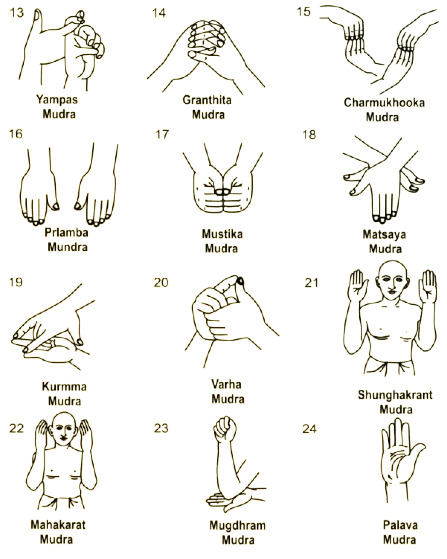
13. Yamaapasam Mudra (Gayatri Mudra) The Sanskrit term Yama is associated with the deity of death and the principle of restraint, while Pasha means a rope, noose, or binding. Together, Yamaapasam symbolically represents the concepts of death, limitation, control, and the inevitable cycle of life and death. In yogic philosophy, this mudra encourages practitioners to reflect on the temporary nature of physical existence and the importance of understanding life’s deeper purpose. It reminds us that birth, growth, ageing, and death are natural stages of existence. Through this contemplation, practitioners are encouraged to develop detachment, acceptance, self-discipline, and awareness of the present moment.
Yamaapasam Mudra is also traditionally associated with balancing the two major energy channels, Ida Nadi and Pingala Nadi. Ida represents the lunar, cooling, and receptive aspects of energy, while Pingala represents the solar, warming, and active aspects. Their harmonious relationship is considered important in traditional Hatha Yoga for preparing the mind for meditation.
During Gayatri meditation, practise this mudra comfortably with an upright spine and relaxed breathing. Contemplate the changing nature of life and the importance of balancing opposing energies within oneself.
The symbolic message of Yamaapasam Mudra is to overcome fear, attachment, and ignorance through awareness, discipline, and spiritual understanding.
Steps to perform Curl your fingers, except the index fingers, and slightly rest your thumb on the top of curled fingers. Interlock the index fingers to form a chain or link that is pulling at each other. |
14. Granthitam Mudra (Gayatri Mudra) Granthitam Mudra is a symbolic hand gesture associated with Gayatri meditation, representing unity, integration, and the coming together of the five fundamental elements of nature, known as Pancha Tattvas or Pancha Mahabhutas. The Sanskrit word Granthitam refers to something tied, joined, or connected. It symbolises the integration of different aspects of existence into a unified whole. According to yogic philosophy, the five elements – Akasha (space), Vayu (air), Agni (fire), Jala (water), and Prithvi (earth) – form the foundation of the physical universe and the human body. Although each element has its own characteristics, they function together to support life and maintain the natural order.
Granthitam Mudra symbolically represents the harmonious integration of these five elements within the individual. At a deeper spiritual level, it reflects the journey from individual consciousness towards universal consciousness. It reminds practitioners that the apparent differences between the body, mind, nature, and divine existence can be understood as interconnected expressions of one universal reality.
During Gayatri meditation, practise this mudra with a comfortable posture, relaxed shoulders, and natural breathing. Mentally contemplate the five elements coming together in harmony and gradually expand your awareness towards the divine.
The spiritual significance of Granthitam Mudra is the dissolution of separation, encouraging unity, devotion, inner harmony, and the experience of oneness with the Supreme Consciousness.
Steps to perform Place your palms together facing each other (namaste formation). Bend each finger through the gaps to interlock your fingers. |
15. Sanmukhonmukham Mudra (Gayatri Mudra) Sanmukhonmukham Mudra is a symbolic hand gesture associated with Gayatri meditation, representing the spiritual journey of the individual soul towards union with the Supreme Consciousness. In yogic and Vedantic philosophy, Jeevatma refers to the individual soul or individual consciousness, while Paramatma refers to the Supreme Soul or universal consciousness. This mudra symbolises the gradual transformation of individual awareness into a state of higher spiritual understanding. It reminds practitioners that although human beings experience themselves as separate individuals, their deeper spiritual nature is traditionally understood as connected with the universal divine reality.
The gesture represents the movement from limited identification with the physical body, senses, and mind towards inner awareness, self-realisation, and spiritual unity. It also encourages practitioners to move beyond ego, attachments, desires, and the sense of separation.
In Gayatri meditation, Sanmukhonmukham Mudra can be practised with devotion and concentration. Sit comfortably with the spine upright, relax the body, and maintain gentle, natural breathing. While mentally chanting the Gayatri Mantra, contemplate the relationship between Jeevatma and Paramatma.
The deeper significance of this mudra is the recognition of the divine presence within oneself and all living beings. It symbolically represents surrender, devotion, self-knowledge, and the ultimate aspiration of yoga: the realisation of unity between individual and universal consciousness. Steps to perform This mudra finger formation will be the same as sumukham. You will then turn your hands in a way that the right hand comes on top of the left hand. The palm of the left hand should face upwards. |
16. Pralambam Mudra (Gayatri Mudra) The Sanskrit word Pralamba conveys the meaning of something extended, prolonged, or hanging, symbolically reflecting the length and continuity of the spiritual path. According to Hindu philosophical traditions, the individual soul passes through numerous births and deaths in the cycle of Samsara. This continuous cycle is influenced by karma, desires, attachments, and ignorance. The journey towards liberation requires patience, self-discipline, spiritual knowledge, and sincere dedication. Pralambam Mudra reminds practitioners that spiritual development is not an immediate achievement but a gradual process of inner transformation. Through practices such as meditation, mantra chanting, self-inquiry, devotion, and ethical living, an individual gradually develops greater awareness and understanding of the true nature of existence. In Gayatri meditation, this mudra symbolically represents the many stages, experiences, and challenges encountered on the path towards spiritual freedom. It encourages practitioners not to become discouraged by difficulties but to continue their spiritual efforts with faith and determination. Practise this mudra comfortably while maintaining an upright posture and natural breathing. Reflect on the temporary nature of worldly experiences and the importance of spiritual progress. The deeper message of Pralambam Mudra is that liberation requires perseverance, detachment, wisdom, and unwavering commitment to self-realisation.
Steps to perform Both the palms of the hand should be facing down. The fingers should be kept straight and pointed to the front. The hands should be placed next to each other. The formation is similar to the gesture when a Hindu priest or an adult gives aashirwad (blessing) to the one touching their feet. |
17. Mushtikam Mudra (Gayatri Mudra) The Sanskrit word Mushti means fist or closed hand. Symbolically, the closed fist represents the gathering of inner strength and the determination required to overcome negative tendencies and limitations of the mind.
In yogic philosophy, ignorance is known as Avidya, which is considered one of the major obstacles to spiritual development. Avidya refers to the inability to recognise the true nature of the Self, resulting in attachment, ego, fear, desires, and mistaken identification with the physical body and mind. Mushtikam Mudra symbolically reminds practitioners to develop the inner strength necessary to overcome Avidya and move towards knowledge and wisdom. It represents the determination to control negative thoughts, overcome mental distractions, and develop clarity in everyday life.
During Gayatri meditation, practise this mudra with a comfortable posture and relaxed breathing. While mentally chanting the Gayatri Mantra, contemplate the removal of ignorance through the light of knowledge and divine wisdom. Observe your thoughts without becoming attached to them.
The deeper significance of Mushtikam Mudra is the transformation of inner weakness into spiritual strength. It encourages courage, discipline, confidence, and determination on the path of self-realisation. Through continuous self-reflection and spiritual practice, one can gradually move from darkness towards knowledge and awareness.
Steps to perform Curl your fingers to form a fist with the thumbs placed on the side of the curled index finger. Join the hand at the middle phalanges with the thumbs joined at the sides. |
18. Matsyam Mudra (Gayatri Mudra) The Sanskrit word Matsya means fish. In Hindu mythology, Matsya is the first incarnation (Avatara) of Lord Vishnu, who appeared in the form of a fish to protect life and preserve sacred knowledge during a great cosmic flood.
The fish symbolises adaptability, survival, protection, and the ability to move through the changing conditions of life. Just as a fish moves freely through water, Matsyam Mudra reminds practitioners to develop flexibility and stability while facing different situations in life.
In yogic contemplation, this mudra is associated with mental steadiness, awareness, and the preservation of knowledge. It symbolically encourages practitioners to overcome mental confusion, distraction, and forgetfulness by cultivating concentration and mindfulness. The Matsya Avatar also represents the protection of wisdom and the preservation of spiritual knowledge during difficult circumstances.
During Gayatri meditation, practise Matsyam Mudra comfortably while sitting in a stable meditative posture. Keep the spine upright, relax the shoulders, and maintain natural breathing. Bring your attention to the mind and observe thoughts without unnecessary reactions. Mentally contemplate the symbolism of Lord Vishnu’s Matsya Avatar and the importance of protecting wisdom.
The deeper message of Matsyam Mudra is to remain mentally balanced, adaptable, and connected with spiritual knowledge. It reminds practitioners to develop clarity, perseverance, and awareness while moving through the changing experiences of life.
Steps to perform Place the right hand on top of the left hand, both palms facing down. The fingers are kept straight while the thumb is extended sideways. This hand formation looks like a fish. |
19. Koormam Mudra (Gayatri Mudra) The Sanskrit word Koorma means tortoise or turtle. In Hindu mythology, Koorma is also the second incarnation (Avatara) of Lord Vishnu, who took the form of a giant tortoise to support Mount Mandara during the churning of the cosmic ocean (Samudra Manthana).
The tortoise is known for its ability to withdraw its limbs and head into its shell whenever it senses danger. This natural behaviour symbolises protection, withdrawal of the senses, inner stability, and self-preservation. Similarly, Koormam Mudra reminds practitioners of the importance of turning their attention inward rather than constantly responding to external distractions.
In yogic philosophy, this concept is closely associated with Pratyahara, the withdrawal of the senses from external objects. Through this practice, individuals gradually develop self-awareness, mental stability, and control over sensory experiences.
Koormam Mudra also symbolises patience, endurance, courage, and the ability to face difficult situations with a calm mind. It teaches us that temporarily withdrawing from external disturbances can help restore inner strength and improve clarity in decision-making.
During Gayatri meditation, practise this mudra in a comfortable seated position with relaxed breathing. Turn your awareness inward and observe your thoughts and emotions without judgment.
The deeper message of Koormam Mudra is to develop inner security, emotional balance, patience, and the courage to fulfil life’s responsibilities with wisdom and confidence.
Steps to perform Curl the middle and ring finger of the right hand while keeping the other fingers straight. Place this hand on the left palm such that the thumb is placed on the middle of the left wrist. The index finger of the right hand should be placed on top of the left thumb and the tip of the right hand’s little finger should touch the tip of the left hand’s index finger. The remaining fingers of the left hand should be wrapped around the edge of the right hand. |
20. Varaahakam Mudra (Gayatri Mudra) The Sanskrit word Varaaha means boar and refers to the third incarnation (Avatara) of Lord Vishnu, known as Varaha Avatar.
According to Hindu mythology, Lord Vishnu took the form of a mighty boar to rescue Goddess Bhudevi (Mother Earth) from the cosmic ocean, where she had been submerged by the demon Hiranyaksha. Lord Varaha lifted the Earth with his powerful tusks and restored balance to the universe. This story symbolises the victory of righteousness over ignorance and the restoration of harmony from chaos. Varaahakam Mudra represents the inner strength required to face challenging circumstances and overcome obstacles. It reminds practitioners that even when life appears confusing, uncertain, or difficult, determination, wisdom, and faith can help reveal a positive direction.
In Gayatri meditation, this mudra can be contemplated as a symbol of protection and divine guidance. Practise it comfortably with an upright spine, relaxed shoulders, and natural breathing. Mentally reflect on the qualities of Lord Varaha, particularly courage, perseverance, and the willingness to protect righteousness.
The deeper significance of Varaahakam Mudra is to develop confidence, resilience, and mental clarity. It encourages practitioners to approach seemingly impossible tasks with patience, faith, and determination rather than fear or hesitation.
Steps to perform Place your hands in the matsyam mudra. Slightly bend the index, middle, and ring fingers of both hands down. The little finger and thumbs should be extended straight and spread sideways. |
21. Simha Krantam Mudra (Gayatri Mudra) The Sanskrit word Simha means lion, which is traditionally regarded as a symbol of bravery, authority, confidence, and leadership. The word Kranta is associated with movement, progression, or overcoming limitations.
In spiritual traditions, the lion represents divine strength and protection. Goddess Durga is traditionally depicted riding a lion, symbolising the victory of divine power over negative forces. The lion also represents the ability to face challenges without fear and to maintain confidence even during difficult circumstances.
Simha Krantam Mudra symbolically reminds practitioners to develop inner courage and overcome fear, self-doubt, hesitation, and negative mental tendencies. It encourages individuals to express their true potential, stand firmly for righteousness, and face life’s challenges with determination and wisdom.
During Gayatri meditation, practise this mudra comfortably while maintaining an upright spine and relaxed shoulders. Allow the breath to flow naturally and bring awareness to the qualities of courage, confidence, and inner strength. Mentally reflect on the importance of overcoming personal limitations and developing a fearless attitude.
The deeper significance of Simha Krantam Mudra is the transformation of weakness into strength and fear into confidence. It inspires practitioners to cultivate self-discipline, leadership, determination, and spiritual courage on the path towards self-realisation.
Steps to perform Bring your hand near your ears and face the palms to the front. Keep your fingers straight and pointed upwards. The forearms should be parallel to each other with elbows pointed down. |
22. Mahakrantam Mudra (Gayatri Mudra) The Sanskrit word Maha means great or immense, while Kranta suggests movement, progression, or advancement. Together, Mahakrantam symbolically represents a significant transformation in one’s journey towards higher consciousness. In yogic philosophy, ignorance is known as Avidya, which prevents individuals from understanding their true nature. It creates attachment, ego, confusion, and the mistaken identification of the Self with the physical body and mind. Through spiritual practices, self-inquiry, meditation, and the study of sacred knowledge, practitioners gradually overcome these limitations and develop Jnana (spiritual wisdom).
Mahakrantam Mudra symbolises this transformation from darkness to light, from confusion to clarity, and from limited understanding to expanded awareness. It reminds practitioners that true knowledge is not merely the accumulation of information but the direct understanding of the deeper nature of existence.
During Gayatri meditation, practise this mudra with a steady posture and natural breathing. Mentally contemplate the removal of ignorance and the awakening of inner wisdom while chanting the Gayatri Mantra.
The deeper significance of Mahakrantam Mudra is the continuous expansion of consciousness through knowledge, discrimination, and spiritual discipline. It inspires practitioners to move towards self-realisation, clarity, and liberation through the light of divine wisdom.
Steps to perform From the above mudra, turn your hands so that the palms are facing the back. |
23. Mudgaram Mudra (Gayatri Mudra) Sanskrit word Mudgara means hammer or mace, traditionally understood as a powerful weapon used to destroy harmful forces and restore balance. In Hindu spiritual symbolism, divine weapons represent the power of righteousness to overcome ignorance, negativity, and destructive tendencies.
At a deeper philosophical level, Mudgaram Mudra symbolises the destruction of inner obstacles such as ego, greed, attachment, fear, and ignorance. It reminds practitioners that spiritual progress requires the courage to eliminate negative habits and transform unhealthy patterns of thought and behaviour.
In the context of yogic contemplation, this mudra may also be associated with physical discipline and awareness of metabolic health. Some traditional interpretations connect it with diabetes and related health concerns. However, there is insufficient scientific evidence to establish that this mudra reduces blood glucose levels or treats diabetes. It should not replace medical treatment, prescribed medication, appropriate nutrition, or regular physical activity.
During Gayatri meditation, practise this mudra comfortably with an upright spine and relaxed breathing. Contemplate the symbolic destruction of ignorance and the development of positive qualities.
The deeper message of Mudgaram Mudra is transformation through discipline, strength, and wisdom. It encourages practitioners to remove negative influences and cultivate physical awareness, mental clarity, and spiritual determination.
Steps to perform Form a fist in your right hand and bring the hand at eye level in front of you. Place the right elbow on top of the left palm. The right forearm should be straight and the right palm should be facing forward.
|
24. Pallavam Mudra (Gayatri Mudra) Sanskrit word Abhaya means fearlessness, while Pallava refers to a tender leaf, sprout, or new growth. Symbolically, this mudra represents the development of courage, confidence, and positive energy.
Abhaya Mudra is commonly depicted in images of Hindu and Buddhist deities, with the palm facing outward as a gesture of reassurance and protection. It communicates the message, “Do not fear; you are protected.” In spiritual contemplation, this gesture represents freedom from fear, insecurity, anxiety, and negative thoughts.
Pallavam Mudra reminds practitioners that courage is not the absence of difficulties but the ability to face challenging situations with a calm and balanced mind. It encourages the development of faith, emotional stability, self-confidence, and trust in the divine.
During Gayatri meditation, practise this mudra with a relaxed body and steady posture. Maintain natural breathing and mentally contemplate the qualities of protection, peace, and fearlessness while chanting the Gayatri Mantra.
The deeper significance of Pallavam Mudra is to overcome inner fears and cultivate a positive outlook towards life. It inspires practitioners to face uncertainty with courage, patience, compassion, and spiritual confidence.
Steps to perform Hold the right hand at shoulder height with palms facing forward and ring and little fingers slightly bent. |
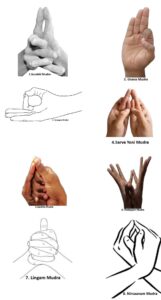
Uttara Mudra
These 8 mudras, according to rigveda and yajurveda, are performed after sandhya upasana (spiritual practice done during the evening) and after the poorna mudras. These mudras activate nerves and give peace of mind.
Once you have completed performing these mudras, take some water in your right hand and let them seep through the gaps between the fingers while chanting tatsat brahmaarpana matsu.
Gayatri Mantra
oṃ bhūr bhuvaḥ svaḥ
tat savitur vareṇyaṃ
bhargo devasya dhīmahi
dhiyo yo naḥ pracodayāt
Om Śāntiḥ Śāntiḥ Śāntiḥ
We meditate on the glory of sacred light illuminating the three worlds. May that divine light inspire our thoughts, Om Peace, Peace, Peace
1. Surabhi Mudra (Gayatri Mudra) Sanskrit word Surabhi refers to a divine and auspicious cow associated with Kamadhenu, the celestial wish-fulfilling cow in Hindu mythology. Surabhi is traditionally regarded as the daughter of the divine cow Kamadhenu and symbolises generosity, purity, nourishment, and the abundance of nature.
In this mudra, the fingers are arranged in a specific interlocking position, symbolically resembling the udders of a cow. This association represents the nourishing and life-supporting qualities of the divine mother. Surabhi Mudra is also known as the Wish-Fulfilling Mudra because it is traditionally believed to support the fulfilment of sincere wishes and positive aspirations.
From a yogic perspective, Surabhi Mudra encourages practitioners to develop mental clarity, balance, patience, and a positive attitude. It serves as a reminder that true abundance includes not only material prosperity but also physical well-being, emotional harmony, spiritual growth, and contentment.
During Gayatri meditation, practise this mudra comfortably while maintaining an upright posture. Keep the shoulders relaxed and breathe naturally. Focus on the Gayatri Mantra and cultivate feelings of gratitude, generosity, and devotion.
The deeper significance of Surabhi Mudra is to develop an attitude of abundance, selflessness, nourishment, and harmony with nature and the divine.
Steps to perform
|
2. Gnanam Mudra (Gayatri Mudra) Sanskrit word Gyana or Jnana means knowledge, wisdom, or spiritual understanding. This mudra symbolises the union of individual consciousness with universal knowledge and represents the awakening of inner wisdom.
In this gesture, the tip of the index finger gently touches the tip of the thumb, while the remaining three fingers are extended comfortably. The thumb represents universal consciousness or divine wisdom, while the index finger represents individual consciousness. Their connection symbolises the relationship between the individual self and the Supreme Consciousness.
Gnanam Mudra is traditionally associated with improving concentration, developing mental clarity, and supporting meditation. It encourages practitioners to cultivate awareness, patience, mindfulness, and a calm state of mind. It is also commonly practised to support relaxation and reduce mental restlessness.
During Gayatri meditation, sit comfortably in Sukhasana, Padmasana, or any stable seated posture. Place the hands on the knees with palms facing upward and practise Gnanam Mudra. Keep the spine upright, relax the shoulders, and breathe naturally while mentally chanting the Gayatri Mantra.
The deeper significance of Gnanam Mudra is the removal of ignorance through knowledge and the development of intuitive understanding, concentration, and spiritual awareness.
Steps to perform Join the tips of the index finger and thumb. With this formation, place your right hand, palms facing inwards, at the center of the chest. The left hand will be kept on the left knee, with palms facing up. |
3. Vairagya Mudra (Gayatri Mudra) Sanskrit word Vairagya means non-attachment or freedom from excessive desires and worldly attractions. It does not mean abandoning responsibilities or withdrawing completely from society; rather, it refers to maintaining mental balance while performing one’s duties without becoming excessively attached to results.
This mudra encourages practitioners to develop a balanced relationship with material possessions, personal desires, emotions, and external experiences. It symbolises the ability to remain calm and centred even when facing pleasure, pain, success, or failure.
In yogic philosophy, Vairagya is an important principle of spiritual development. Patanjali explains Vairagya as freedom from attachment to sensory experiences and worldly desires. When combined with regular meditation and self-discipline, it helps cultivate mental clarity, emotional stability, and inner peace.
Vairagya Mudra also symbolically represents coming out of deep absorption or a trance-like state and returning to conscious awareness with clarity and steadiness.
During Gayatri meditation, practise this mudra comfortably with an upright spine and relaxed breathing. Reflect on the temporary nature of worldly experiences and the importance of developing inner freedom.
The deeper significance of Vairagya Mudra is to live in the world with awareness, fulfil responsibilities sincerely, and gradually develop freedom from attachment, ego, and excessive desires.
Steps to perform The hand formation is similar to the gnanam mudra with the difference of placing the hands on the thighs instead of the thighs. |
4. Yoni Mudra (Gayatri Mudra) Sanskrit word Yoni means womb, origin, or source. In yogic philosophy, it represents the creative power of nature (Prakriti) and the potential for spiritual transformation and inner awakening.
Yoni Mudra symbolises returning to the source of one’s existence by withdrawing attention from external distractions and turning awareness inward. It encourages introspection, silence, emotional balance, and a deeper connection with the inner self. The gesture is also associated with the divine feminine energy, traditionally known as Shakti, which represents creation, nourishment, transformation, and life force.
In meditation, Yoni Mudra is often used to develop Pratyahara, the withdrawal of the senses from external objects. By reducing sensory distractions, practitioners can gradually experience greater mental stillness and inner awareness.
During Gayatri meditation, practise Yoni Mudra in a comfortable seated posture. Bring the hands together in the traditional Yoni Mudra formation, keep the shoulders relaxed, and maintain a natural breathing rhythm. Focus your attention on the breath and mentally chant the Gayatri Mantra.
The deeper significance of Yoni Mudra is the journey towards the inner source of consciousness. It reminds practitioners to cultivate silence, self-awareness, balance, and spiritual understanding while recognising the creative energy present throughout nature and existence. |
5. Sankha Mudra (Gayatri Mudra) Sanskrit word Sankha means conch. The conch is traditionally blown during religious ceremonies, temple rituals, and auspicious occasions to announce the beginning of worship and invite divine blessings. Its sacred sound is believed to create an atmosphere of purity, devotion, and spiritual awareness.
The conch is associated with Lord Vishnu, who holds the divine Panchajanya Shankha. It symbolises the cosmic sound, the power of creation, and the victory of positive forces over negativity. Similarly, Sankha Mudra represents the purification of the body, mind, and inner consciousness.
This mudra is traditionally associated with the removal of negative thoughts, the development of inner peace, and the awakening of spiritual awareness. The conch’s sound also symbolises the vibration of Om, reminding practitioners of the universal energy present throughout creation.
During Gayatri meditation, practise Sankha Mudra comfortably with an upright spine and relaxed shoulders. Maintain natural breathing and mentally chant the Gayatri Mantra. Visualise the inner consciousness becoming illuminated with divine light, just as a temple is opened for morning worship.
The deeper significance of Sankha Mudra is inner purification, devotion, positive transformation, and awakening to divine wisdom.
Steps to perform
|
6. Pankajam Mudra (Gayatri Mudra) Sanskrit word Pankajam means lotus. The lotus is an important symbol in Indian spiritual traditions because it grows in muddy water while remaining beautiful, pure, and untouched by its surroundings.
In yogic philosophy, the lotus is closely associated with the Sahasrara Chakra, also known as the crown chakra. It is traditionally represented as a thousand-petalled lotus situated at the crown of the head. Sahasrara symbolises the highest state of spiritual awareness, divine wisdom, self-realisation, and the union of individual consciousness with universal consciousness.
Pankajam Mudra symbolically represents the unfolding of spiritual knowledge, just as a lotus gradually opens its petals towards sunlight. Some traditional spiritual interpretations also associate higher states of consciousness with awareness of past-life impressions and karmic experiences. However, such experiences are matters of spiritual belief rather than scientifically established outcomes. During Gayatri meditation, practise this mudra comfortably with an upright spine and relaxed breathing. Bring your awareness towards the crown of the head and mentally visualise a thousand-petalled lotus opening with divine light.
The deeper significance of Pankajam Mudra is the purification of consciousness, the awakening of inner wisdom, and the gradual movement towards spiritual enlightenment.
Steps to perform Bring your palms in namaste formation. Keeping the base of the palms joined along with the sides of the thumb and little finger, spread the remaining fingers away from each other. The hand formation should look like a blossoming flower. |
7. Lingam Mudra (Gayatri Mudra) Sanskrit word Linga refers to a sign, symbol, or mark. In Hindu traditions, the Shiva Lingam represents Lord Shiva as the formless Supreme Consciousness and the creative principle of the universe. Although it is sometimes associated with masculine symbolism, its deeper spiritual meaning extends beyond physical gender.
Lingam Mudra represents the powerful transformative energy of Lord Shiva, who is traditionally regarded as the destroyer of ignorance and the source of spiritual renewal. It symbolises the awakening of inner strength, determination, vitality, and the ability to overcome limitations.
This mudra is also associated with the complementary relationship between Shiva and Shakti, representing consciousness and creative energy. When considered alongside Yoni Mudra, it symbolically expresses the union of masculine and feminine principles, which together represent the harmony of creation.
In yogic contemplation, this union is associated with the awakening of Kundalini Shakti, traditionally described as rising from the Muladhara Chakra towards the Sahasrara Chakra.
During Gayatri meditation, practise Lingam Mudra comfortably while maintaining an upright posture and natural breathing. Focus on inner strength, transformation, and the movement from ignorance towards wisdom.
The deeper significance of Lingam Mudra is the integration of Shiva consciousness and Shakti energy, encouraging spiritual growth, vitality, balance, and self-realization.
Steps to perform Interlock your fingers with palms together but keep the right thumb extended upwards. |
8. Nirvaanam Mudra (Gayatri Mudra) Sanskrit word Nirvana or Nirvana refers to liberation, freedom from suffering, and the dissolution of ignorance and ego. This mudra symbolises the journey towards a state of deep inner tranquillity and spiritual understanding.
In yogic and spiritual philosophy, liberation is achieved through the gradual release of attachments, desires, negative tendencies, and identification with the ego. The ego, known as Ahamkara, creates the feeling of individual separation and influences thoughts, emotions, and behaviour. Through meditation, self-inquiry, devotion, and awareness, practitioners gradually learn to observe the ego without becoming controlled by it.
Nirvaanam Mudra symbolically represents surrendering unnecessary mental burdens and allowing the mind to settle into a peaceful state. It reminds practitioners that true freedom does not depend on external circumstances but arises through inner understanding, acceptance, and non-attachment.
During Gayatri meditation, practise this mudra comfortably with an upright spine and relaxed shoulders. Maintain natural breathing and gently observe your thoughts without judgment. While mentally chanting the Gayatri Mantra, contemplate letting go of pride, fear, expectations, and unnecessary attachments.
The deeper significance of Nirvaanam Mudra is the movement from ego-consciousness towards universal awareness. It encourages humility, acceptance, emotional freedom, inner silence, and the gradual realisation of spiritual liberation.
Steps to perform Bring your palms to face each other keeping a slight distance between them. Now cross your hands so that the right hand is on the left side and the left hand is on the right side. Turn your hands inwards and join the palms. |