
Posture: Stand with your feet together and your body upright. Extend your arms straight in front of you, parallel to the ground at shoulder height. Keep your palms open, with fingers held close together.
Exercise A: Vigorously move your wrists up and down while simultaneously lifting and lowering your fists, aiming to touch your forearms. Maintain your arms as rigid and straight as possible throughout the exercise.
Exercise B: Lift your arms to the sides, bending them at the elbows to form a right angle at shoulder level. Move your wrists up and down while keeping your arms bent, palms open, and fingers pressed together.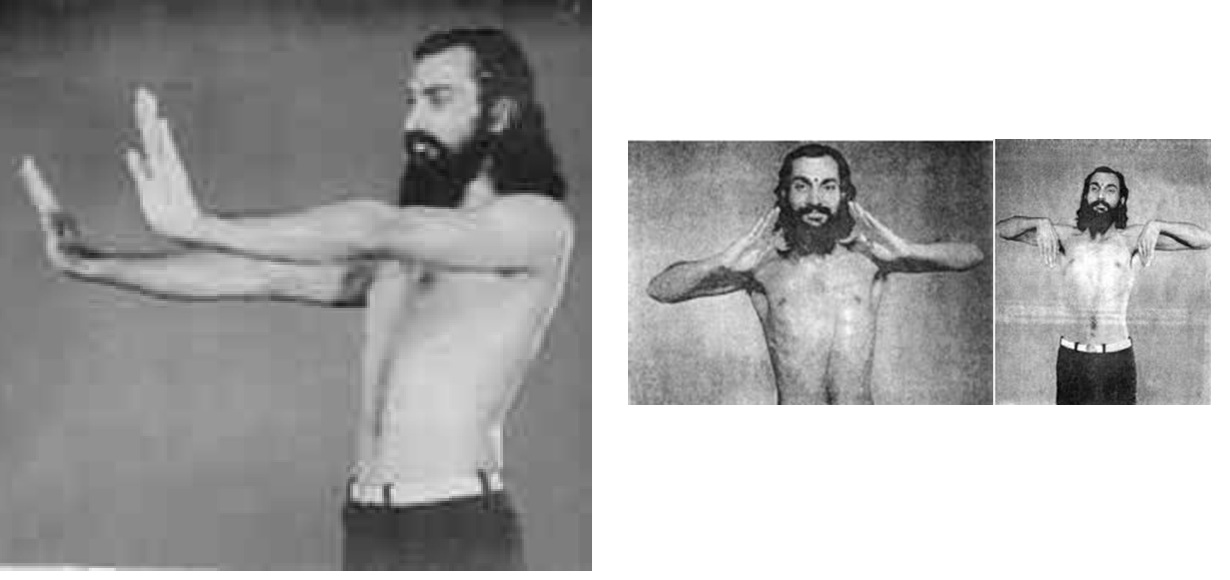
Introduction
Yoga is a holistic science that aims at the harmonious development of the body, mind, and spirit. Along with well-known practices such as asanas and pranayama, Sukshma Vyayama (subtle yogic exercises) plays a foundational role in preparing the body by activating different joints and muscle groups. These exercises are gentle, accessible, and highly effective in improving circulation, flexibility, and neuromuscular coordination.
In the modern era, the hands are constantly engaged in repetitive tasks such as typing, writing, gripping tools, and using digital devices. This continuous usage often leads to fatigue, stiffness, reduced flexibility, and weakness in the palm region (Kara-Tala). The palm is crucial for grip strength, dexterity, and sensory perception.
Kara-Tala-Shakti-Vikasaka is a specialized Sukshma Vyayama practice aimed at strengthening and enhancing the flexibility of the palm and associated structures. It involves systematic movements of the fingers, palm, and wrist, coordinated with breath and awareness.
This practice improves functional efficiency of the hands, enhances coordination, and helps prevent strain-related disorders, making it highly beneficial in daily life.
Kara-Tala-Shakti-Vikasaka is an important Sukshma Vyayama practice that enhances the strength and flexibility of the palm. Through systematic movements and awareness, it improves joint mobility, circulation, and neuromuscular coordination.
In modern lifestyles, where hand strain is common, this practice offers a simple yet effective solution for maintaining hand health and functionality. Regular practice leads to improved grip strength, reduced fatigue, and enhanced performance in daily tasks.
Ultimately, it contributes to the holistic goal of yoga—achieving balance, coordination, and optimal functioning of the body and mind.