
Posture: Stand with your feet together and your body relaxed. Lift your arms straight forward to shoulder level, keeping them parallel to the ground. Allow your hands to remain relaxed, with the fingers naturally drooping beyond the wrists.
Exercise A: Tense the entire arm while keeping the hand itself completely relaxed. Start by maintaining this position for five minutes.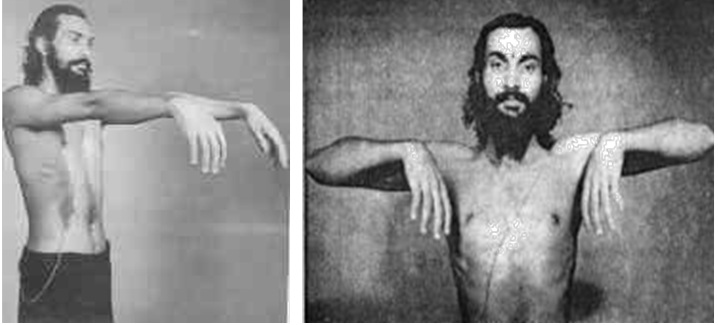
Exercise B: Follow the same steps as in Exercise A, but with your arms bent at the elbows. Begin by holding this position for two minutes.
Introduction
Yoga is a holistic discipline that integrates physical, mental, and spiritual aspects of human life. While practices such as asanas and pranayama are widely recognized, the preparatory techniques known as Sukshma Vyayama (subtle yogic exercises) are equally important. These exercises focus on activating specific joints and muscle groups through gentle, controlled movements, thereby improving circulation, flexibility, and neuromuscular coordination.
In modern lifestyles, the hands are continuously engaged in fine motor activities such as typing, writing, and handling devices. This repetitive usage often leads to strain and weakness, particularly at the base of the fingers (Angula-Mula), where the fingers connect to the palm. This region is crucial for grip strength, dexterity, and precise movements.
Angula-Mula-Shakti-Vikasaka is a specialized Sukshma Vyayama practice designed to strengthen and improve the flexibility of the finger bases. It involves coordinated movements of the fingers and palm, combined with breath awareness and mindful attention.
This practice enhances hand function, improves coordination, and prevents strain-related disorders, making it highly beneficial for individuals of all age groups.
Angula-Mula-Shakti-Vikasaka is an essential Sukshma Vyayama practice that enhances the strength and flexibility of the base of the fingers. Through systematic movements and awareness, it improves joint mobility, circulation, and neuromuscular coordination.
In modern lifestyles, where repetitive hand usage is common, this practice offers a simple and effective method for maintaining hand health and functional efficiency. Regular practice leads to improved grip strength, reduced fatigue, and enhanced performance in daily activities.
Ultimately, it contributes to the holistic goal of yoga—achieving balance, coordination, and optimal functioning of the body and mind.