
Posture: Stand with your feet positioned close together and maintain a straight posture. Extend your arms forward, ensuring your fingers are fully spread. Keep your arms parallel to the ground at shoulder height.
Exercise A: Using your wrists, move your hands vigorously up and down. As your palms move, aim to bring the fingers as close as possible to touching your arms.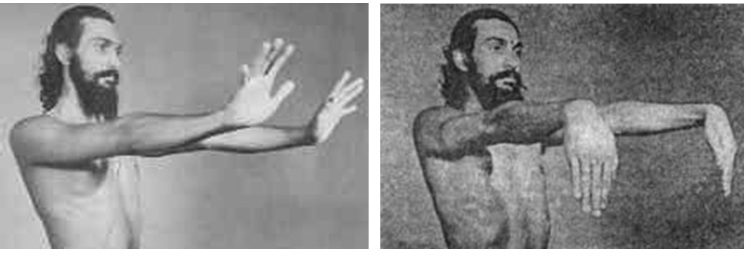
Exercise B: Maintain the same posture. Raise your arms to the sides, bending them at the elbows. Keep the fingers spread wide apart and move your hands up and down as if your fingers were attempting to touch your arms.
Introduction
Yoga is a complete science of life that aims at achieving harmony between body, mind, and spirit. While the practice of asanas and pranayama forms the visible aspect of yoga, the preparatory practices such as Sukshma Vyayama (subtle yogic exercises) are equally essential. These practices gently stimulate specific parts of the body, improve circulation, enhance neuromuscular coordination, and prepare the practitioner for more intensive yogic practices.
In the modern world, the hands are constantly engaged in repetitive activities such as typing, writing, lifting, and operating digital devices. This continuous use often leads to fatigue, stiffness, and weakness, especially in the back of the hand (Kara-Prstha) region. This area includes extensor muscles, tendons, and connective tissues that play a vital role in hand function.
Kara-Prstha-Shakti-Vikasaka is a specialized Sukshma Vyayama practice aimed at strengthening and improving the flexibility of the dorsal (back) aspect of the hand. It involves coordinated movements of the fingers, wrists, and hands, along with awareness and breath control.
This practice is highly beneficial for maintaining hand health, improving dexterity, and enhancing functional efficiency in daily activities.
Kara-Prstha-Shakti-Vikasaka is an important Sukshma Vyayama practice that enhances the strength and flexibility of the dorsal aspect of the hand. Through controlled movements and awareness, it improves joint mobility, circulation, and neuromuscular coordination.
In modern lifestyles, where repetitive hand usage is common, this practice provides an effective solution for maintaining hand health and functionality. Regular practice leads to improved dexterity, reduced fatigue, and enhanced performance in daily tasks.
Ultimately, it contributes to the holistic goal of yoga—achieving balance, coordination, and optimal functioning of the body and mind.