Malasana(garland pose)
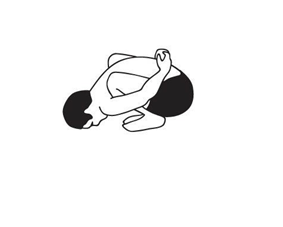
Malasana(garland pose) This is the garland pose. It is a low squat. Step your feet slightly apart so there is about enough place for your body to fit in between them. Then lower down into a squat, while keeping your feet flat on the ground. Fold your hands in Anjali mudra or prayer pose and press your elbows against your inner thighs. Stay here, breathing easily for thirty seconds. Then come out of the pose and relax. Precaution: Knee concern Benefits: Abdominal organs are exercised and gain strength. Pain in the back during the menstrual period, will get relief.
Mudras(Yoga Gesture)
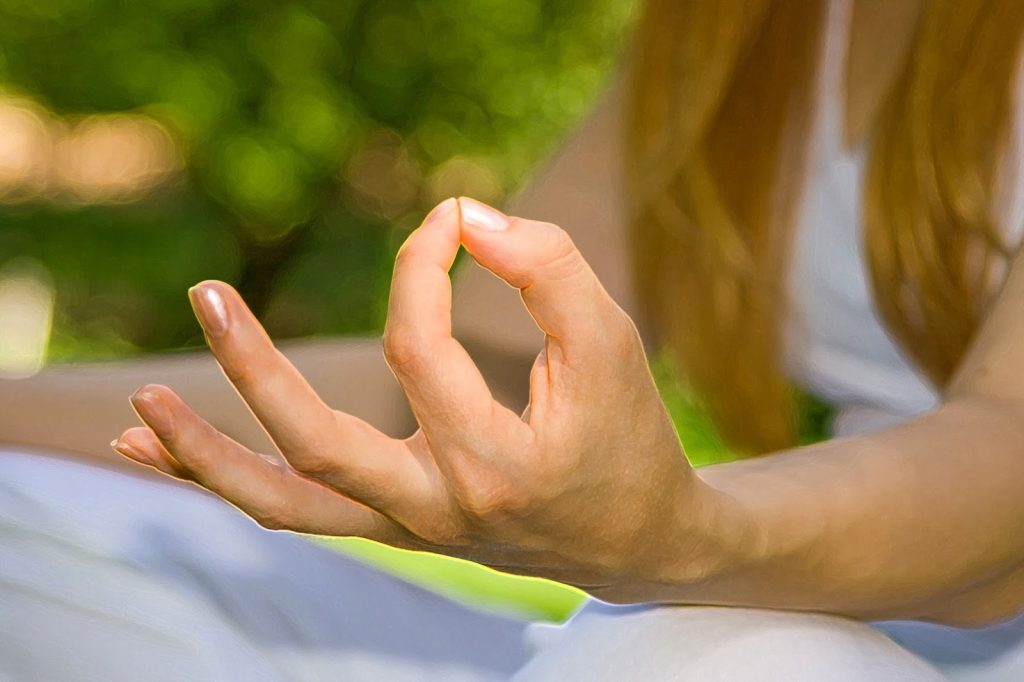
Karuna Yoga Maha Vidya Peetham, Yoga TTC program in Bangalore India, will make you proficient in various “Mudras”. Our experts in this field will help you learn these techniques. The Sanskrit word mudra means ‘gesture’ or ‘attitude’. Mudras can be described as psychic, emotional, devotional and aesthetic gestures or attitudes. Yogis have encountered mudras as attitudes of energy flow, intended to link individual Pranic force with universal or cosmic force. The Kularnava Tantra traces the word mudra to the root mud, meaning ‘delight’ or ‘pleasure’, and dravay, which means ‘to draw forth’. Mudra is also defined as a ‘seal’, ‘short-cut’ or ‘circuit by means of pass’ After being a part of the Karuna Yoga Maha Vidya Peetham, Yoga TTC program, you will realize that mudras are a combination of subtle physical movements, which adjust mood, attitude and belief. In addition, it deepens consciousness and focus. A mudra may also involve the complete body in a collection of asana, pranayama, bandha and visualization techniques, or it is able to be a simple hand function. The Hatha Yoga Pradipika and other yogic writings view mudra to be a Yoganga, an independent department of yoga, requiring an extremely diffused awareness. Mudras are presented after some capability has been achieved in Asana, Pranayama and Bandha, and net blockages have been eliminated. Mudras have been depicted in different writings from ancient times to the present day so as to safeguard them for the future generations. However, such references have been by no means specified or genuinely itemized or as these systems were not designed to be gained from a book. Practical training from a guru was constantly thought to be a vital imperative before endeavoring them. Mudras are higher practices which prompt to awakening of the pranas, chakras and kundalini, and which can give major siddhis, psychic powers, on the advanced practitioner. A scientific look at mudras In scientific terms, mudras offer a means to provide a means to get admission to and influence the unconscious reflexes and primal, instinctive addiction styles that originate in the primitive areas of the brain across the brain stem. They establish a subtle, non-intellectual reference to those areas. The 200-hour Hatha Yoga course at Karuna Yoga Maha Vidya Peetham, teacher training center in, India focuses on the essence of the centuries-old tradition of mudras. Furthermore, each mudra sets up a unique link and has a correspondingly special impact on the body, mind and Prana. The purpose is to create constant, repetitive postures and gestures that may snap the practitioner out of instinctive habit styles and set up a more refined consciousness.
Shambhavi Mudra (eyebrow center gazing)

Shambhavi Mudra (eyebrow center gazing) Shambhavi mudra (eyebrow center gazing) internalizes pranic flow and mind – If the Hatha Yogi remains with the chitta and prana absorbed in the internal object and gaze motionless, though seeing, he is not seeing, this is called shambhavi mudra, realm of Shiva consciousness). Antarlakshyam bahirdrshtir nimeshonmeshavarjita / Esha sa sambhavi mudra vedasastreshu ghopita// With internalised one-pointed awareness and external gaze unblinking, that truly is shambhavi mudra, preserved in the Vedas. (Chapter -4, Verse 36). Antarlakshyavilinachittapavano Yogi Yada vartate / Drshtya nischalataraya bahir adhah pasyannapasyannapi / Mudreyam khalu sambhavi bhavati sa labdha prasadad ghuroh/ Śunyasunyavilakshanam sphurati tattattvam Padam sambhavam// If the Hatha Yogi remains with the chitta and prana absorbed in the internal object and gaze motionless, though seeing, he is not seeing, this is called shambhavi mudra. When it is bestowed by the guru’s blessing, the state of shoonyashoonya obtained. That is the real state of Shiva consciousness. (Chapter -4, Verse 37)
Prana and Mind
Prana and mind are controlled through each other Pavano badhyate yena manastenaiva badhyate / Manascha badhyate yena pavanastena badhyate// Through controlling the prana, thought is contolled and through control of thought, prana or air is controlled. (Chapter -4, Verse 21).
Vipareeta Karani Mudra (reversing attitude)
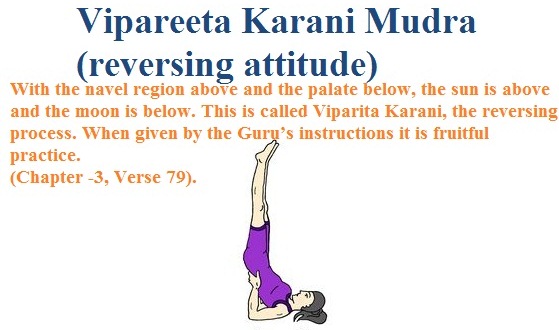
Vipareeta Karani Mudra (reversing attitude) Urdhvanabheradhastalorurdhvam bhanuradhah sasi / Karani viparitakha ghuruvakyena labhyate// With the navel region above and the palate below, the sun is above and the moon is below. This is called Viparita Karani, the reversing process. When given by the Guru’s instructions it is fruitful practice. (Chapter -3, Verse 79). Valitam palitam chaiva shanmasordhvam na drsyate / Yamamatram tu yo nityamabhyasetsa tu kalajit// The practice should be done daily, gradually increasing the duration. After six months of practice, grey hairs and wrinkles become vanished. One who practices it for yama three hours masters or conquers death.(Chapter -3, Verse 82).
Maha Vedha Mudra (Great Piercing Attitude)
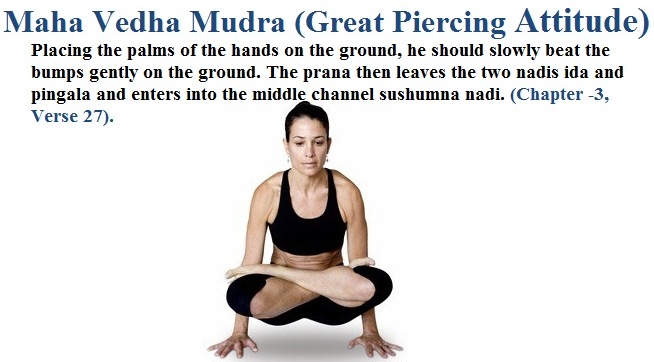
Maha Vedha Mudra (Great Piercing Attitude) Atha mahavedhah Mahabandhasthito yogi krtva purakam ekadhih/ Vayunam ghatimavrtya nibhrtam kanthamudraya// The Hatha Yogi, in the position of Maha Bandha, should breath in, make the mind steady and hold the movement of prana by doing the throat lock. (Chapter -3, Verse 26). Samahastayugho bhumau sphichau sanadayechchanaih/ Putadvayam atikramya vayuh sphurati madhyaghah// Placing the palms of the hands on the ground, he should slowly beat the bumps gently on the ground. The prana then leaves the two nadis ida and pingala and enters into the middle channel sushumna nadi. (Chapter -3, Verse 27). Mahavedhoa yam abhyasan mahasiddhipradayakah/ Valipalitavepaghnah sevyate sadhakottamaih// This is maha vedha, and by practicing its benefited great perfections. Wrinkles, grey hair and the trembling of old age are avoidable, thus the best of practitioners devote themselves to it. (Chapter -3, Verse 29). Khecharya mudritam yena vivaram lambikordhvatah/ Na tasya ksharate binduh kaminyasleshitasya cha// Even when there is movement of the bindu and it enters the genitals, it is catched by closing the perineum and is taken upward direction. (Chapter -3, Verse 43). Sushiram jnanajanakam panchasrotah samanvitam/ Tishthate khechari mudra tasminsunye niranjane// Five nadis unite in this cavity and it is the root source of knowledge. Khechari should be established in that void, untainted by ignorance. (Chapter -3, Verse 53).
Maha Mudra (The Great Attitude)
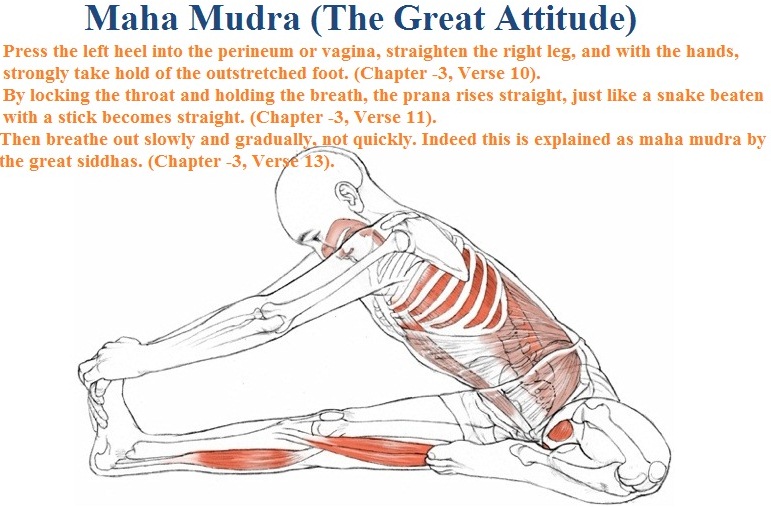
Maha Mudra (The Great Attitude) Padamulena vamena yonim sampidya dakshinam/ Prasaritam padam krtva karabhyam dharayeddrdham//(Chapter -3, Verse 10). Press the left heel into the perineum or vagina, straighten the right leg, and with the hands, strongly take hold of the outstretched foot. (Chapter -3, Verse 10). Kanthe bandham samaropya dharayed vayum urdhvatah / Yatha dandahatah sarpo dandakarah prajayate//(Chapter -3, Verse 11). By locking the throat and holding the breath, the prana rises straight, just like a snake beaten with a stick becomes straight. (Chapter -3, Verse 11). Rjvibhuta tatha saktih kundali sahasa bhavet/ Tada sa maranavastha jayate dviputasraya//(Chapter -3, Verse 12). So the kundalini sakti becomes very straight at once. Then the ida and pingala nadi become lifeless as the sakti enters into the sushumna nadi. (Chapter -3, Verse 12). Tatah sanaih sanaireva rechayennaiva veghatah/ Mahamudram cha tenaiva vadanti vibudhottamāh//(Chapter -3, Verse 13). Then breathe out slowly and gradually, not quickly. Indeed this is explained as maha mudra by the great siddhas. (Chapter -3, Verse 13).